Myth as Symbolic Language in Ancient Egyptian Mythology
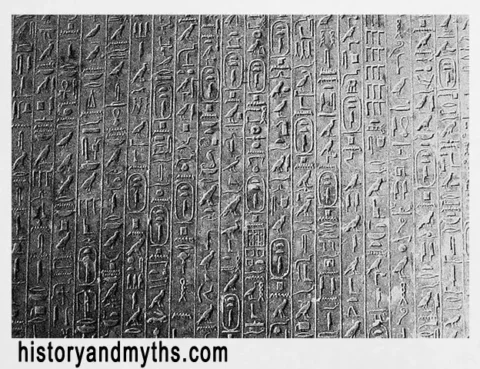
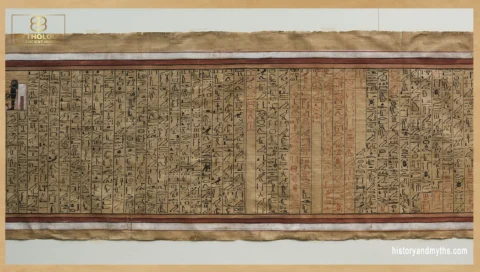
Ancient Egyptian myths were never meant to be read like stories. They were meant to be decoded. To the modern reader, these myths often appear fragmented, repetitive, or strangely symbolic—but to the ancient Egyptian mind, that symbolism was the message. Myth was not entertainment, and it was not metaphor in the modern sense. It was a language—a visual, ritual, and conceptual system designed to explain time, existence, death, and renewal when ordinary words were not enough.
This is why Egyptian myths speak through serpents, composite gods, boats traveling through darkness, and hours born and consumed by time itself. These images were not poetic flourishes. They were precise symbolic statements. When Egyptians described time as a serpent, or darkness as a god, they were not personifying ideas for drama—they were translating abstract realities into forms that could be understood, remembered, and ritually engaged with. Myth functioned as a bridge between human perception and cosmic order.
This article explores how symbolic language works inside ancient Egyptian mythology—how images replaced definitions, how repetition created meaning, and why myths were constructed as visual and ritual codes rather than linear narratives. By understanding this symbolic system, the reader can finally move beyond asking “What does this myth say?” and begin asking the more meaningful question the Egyptians themselves were answering:
“What reality is this myth trying to express?”
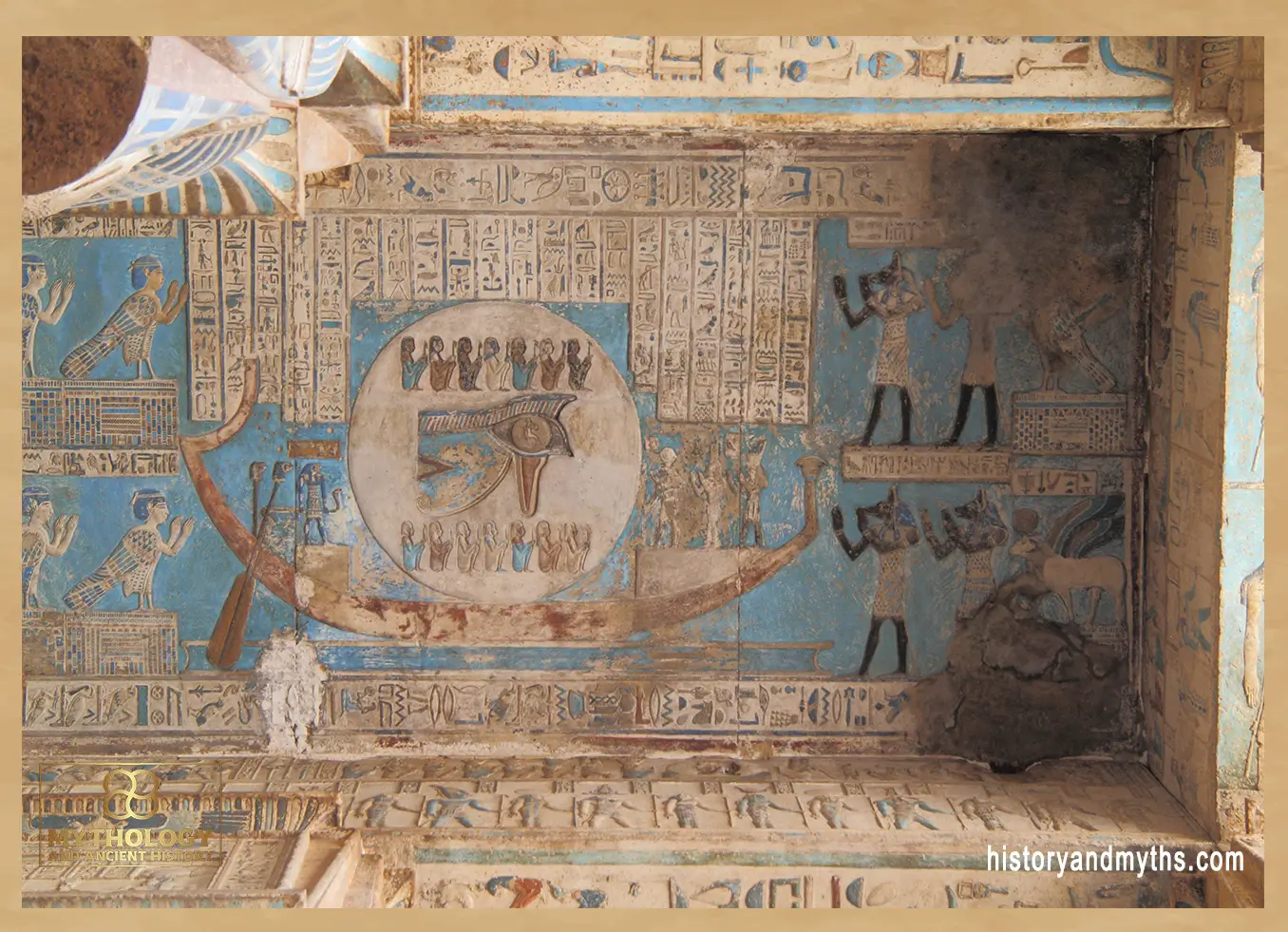
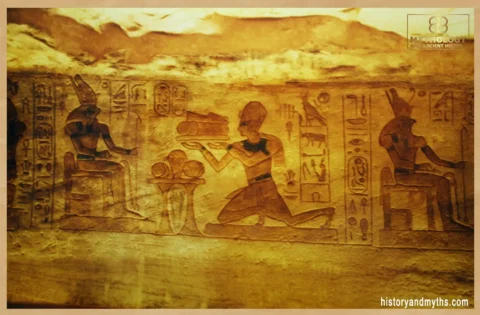
Description: Interior view showing carved reliefs and hieroglyphic inscriptions that illustrate the visual and symbolic language of ancient Egyptian mythology.
Date: 26 March 2016
Source: Wikimedia Commons
Author: Djehouty
License: Creative Commons Attribution–ShareAlike 4.0 International (CC BY-SA 4.0)
Myth as a Language, Not a Story
When modern readers approach ancient Egyptian myths, they often search for a familiar structure: a beginning, a conflict, a resolution. But Egyptian myth was never designed to work this way. It does not unfold like a novel, nor does it aim to entertain through plot. Instead, it operates as a language system—one that communicates meaning through symbols, repetition, and visual logic rather than narrative progression.
In this symbolic language, meaning is not carried by events but by forms. A serpent is never just an animal. A boat is never just a vehicle. Darkness is not simply the absence of light, and time is never counted—it is embodied. These images function the way grammar functions in spoken language: they structure thought, define relationships, and make abstract realities graspable. To read Egyptian myth literally is like reading a sentence while ignoring its grammar.
This explains why Egyptian myths often feel repetitive to modern readers. Gods are reborn again and again. The sun dies every night and rises every morning. Chaos is defeated endlessly but never destroyed. These are not storytelling flaws. They are linguistic features. Repetition in Egyptian myth reinforces meaning, just as repetition in ritual reinforces belief. Each recurrence restates a cosmic truth: order must be continually renewed, not permanently won.
Most importantly, this symbolic language allowed the Egyptians to express ideas that ordinary speech could not easily contain. Concepts like cyclical time, eternal renewal, divine presence in nature, and the continuity between life and death required more than explanation—they required visual thought. Myth became the medium through which philosophy, theology, and lived experience merged into a single expressive system.
Understanding Egyptian mythology, then, is not about memorizing stories or genealogies. It is about learning how to read a symbolic language—one in which images think, gods speak through form, and meaning emerges not from what happens, but from what is shown.
| Symbolic Element | Mythic Function | Symbolic Meaning | Why It Matters |
|---|---|---|---|
| Serpent | Embodiment of time and transformation | Cyclical time, renewal, continuity | Reveals time as a living force rather than a linear sequence |
| Solar Barque | Vehicle of cosmic transition | Passage between life, death, and rebirth | Expresses transformation as continuity, not finality |
| Composite Gods | Visual encoding of divine functions | Multiple powers unified in one form | Shows how symbolism replaced abstract definition |
| Repetition | Ritual reinforcement | Stability through renewal | Explains why myths repeat instead of progressing narratively |
| Temple Walls | Permanent mythic surface | Myth embedded in space | Shows myth as a continuous presence, not a one-time reading |
| Cosmic Imagery | Visualization of abstract forces | Order, chaos, and balance | Makes complex cosmology instantly legible through form |
Why Symbols Replaced Abstract Thought in Ancient Egypt
Ancient Egyptians did not lack the ability to think abstractly. What they lacked—by deliberate choice—was faith in abstraction as a reliable way to understand reality. For them, ideas that could not be seen, enacted, or ritually repeated were incomplete. Truth was not something to be defined; it was something to be experienced. Symbol became the tool that made this experience possible.
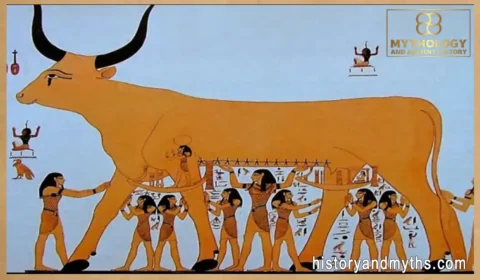
Abstract concepts such as time, eternity, chaos, order, and rebirth were not treated as mental categories. They were treated as forces—active, dangerous, and transformative. To describe such forces through pure definition would have stripped them of their power. Instead, Egyptians gave these ideas bodies, movements, and visual identities. Time became a serpent. Order became a goddess. Chaos became a living presence that had to be confronted again and again.
Symbolic thinking also allowed multiple meanings to coexist without contradiction. A god could be both creator and destroyer, both protector and threat. In abstract systems, such duality often demands resolution. In symbolic systems, it is expected. The image does not need to choose. It holds tension naturally. This is why Egyptian gods are frequently composite beings—human and animal, male and female, visible and hidden. The form itself communicates complexity without explanation.
Another crucial reason symbols replaced abstraction lies in ritual function. Egyptian myths were not meant only to be understood; they were meant to be used. Spoken words alone could not sustain ritual power. Images carved into stone, repeated in tombs, temples, and papyri, anchored meaning across time. A symbol could be reenacted, pointed to, worn, or inscribed. Abstraction could not.
For the ancient Egyptian, the universe was not governed by ideas but by patterns. Symbols were the visual shorthand of those patterns. They allowed knowledge to be preserved, transmitted, and activated without ever needing to be reduced to explanation. Meaning did not reside in definition—it resided in recognition.
This is why Egyptian mythology feels timeless rather than historical. Symbols do not age the way stories do. They remain legible across centuries because they do not depend on narrative context. They depend on perception. And perception, for the Egyptians, was the truest form of understanding.
Time, Cycles, and Mythic Meaning
In ancient Egyptian mythology, time was never a line moving forward. It had no clear beginning rushing toward an end. Instead, time was understood as a cycle, a force that continually folded back on itself. This belief shaped not only religious thought but the very structure of mythic language. Egyptian myths do not “progress”—they repeat, renew, and return.
This cyclical understanding of time explains why Egyptian myths resist linear storytelling. The sun does not triumph once and for all; it must be reborn every dawn. Chaos is not defeated permanently; it must be restrained continuously. Death is not an ending; it is a transformation within an ongoing process. Myth, therefore, does not narrate events—it maps patterns.
Symbolic images were the only effective way to express this kind of time. A cycle cannot be explained easily in words without contradiction, but it can be shown instantly through form. The serpent that gives birth to the hours and then consumes them again expresses an idea no timeline could convey: time is both creator and devourer. Past, present, and future are not separate—they exist within the same eternal motion.
This is why Egyptian myth is saturated with repetition. Ritual texts, funerary books, and temple scenes repeat the same images again and again. To modern readers, this may feel redundant. To the Egyptians, repetition was not weakness—it was activation. Each repetition reaffirmed the cosmic order and ensured its continuation. Myth functioned as a stabilizing force in a universe that was always at risk of collapse.
Cyclical time also removed the fear of finality. Since nothing truly ends, loss becomes transformation, and decay becomes renewal. This worldview gave myth its psychological power. It did not promise escape from death; it promised continuity. Symbolic language made this promise visible and believable.
Understanding Egyptian myth, then, requires abandoning the expectation of narrative development. Meaning does not lie in what happens next, but in what happens again. The myth speaks not by advancing forward, but by turning back upon itself—just as time itself was believed to do.
Gods as Symbols, Not Characters
In ancient Egyptian mythology, gods were not conceived as characters with personal stories, emotional arcs, or individual destinies. They were symbolic functions. Each god represented a specific force, principle, or mode of existence within the cosmic order. To treat them as fictional personalities is to misunderstand their purpose entirely.
This is why Egyptian gods rarely behave like humans. They do not evolve psychologically, they do not learn lessons, and they do not experience permanent change. Instead, they embody roles. Ra is not a hero on a journey; he is the manifestation of solar continuity. Osiris is not a tragic king; he is the principle of regeneration through death. Anubis is not a guide by choice; he is the function of transition itself.
Their visual forms reinforce this symbolic role. A god’s head was never chosen for decoration. Animal features were not metaphors—they were semantic markers. The falcon’s vision, the jackal’s association with liminal spaces, the ibis’s precision, the ram’s generative power: each element communicated meaning instantly. The image spoke faster and more accurately than words ever could.
This is also why gods could merge, split, or overlap without contradiction. Amun-Ra was not a new personality; it was a syntactic combination of powers. When two gods fused, their meanings interacted the way symbols combine in language. Egyptian theology was flexible because it was symbolic, not narrative. It did not need consistency of character—it needed coherence of meaning.
For the ancient Egyptian, worship was not directed toward a personality but toward a principle made visible. To stand before an image of a god was to confront an aspect of reality itself: time, fertility, protection, destruction, order. The god was the language through which that reality could be approached, named, and ritually engaged.
Understanding Egyptian gods as symbols rather than characters transforms how mythology is read. The question shifts from “What did this god do?” to “What force does this god express?” Once that shift is made, the entire mythological system becomes clearer. The myths stop behaving like stories—and start functioning like a cosmic grammar.
Visual Thinking: How Images Replaced Explanation
Ancient Egyptian mythology was built on a fundamentally visual way of thinking. Meaning was not primarily formed through abstract reasoning or verbal definition, but through images that could be seen, remembered, and ritually repeated. For the Egyptian mind, an image was not an illustration of an idea—it was the idea.
This visual logic explains why walls, coffins, temples, and papyri are saturated with scenes rather than explanations. A written definition could be misunderstood, forgotten, or argued against. An image, by contrast, imposed meaning immediately. It did not ask the viewer to analyze; it asked them to recognize. Recognition, not interpretation, was the core of understanding.
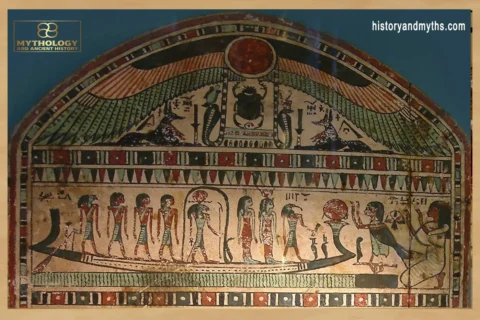
In this system, images functioned like complete sentences. A solar boat moving through darkness did not require commentary. It communicated transition, protection, danger, and renewal all at once. A god emerging from chaos did not narrate creation; it showed order asserting itself. Visual symbols compressed complex realities into forms that could be grasped instantly, even by those who could not read.
This is also why Egyptian myths resist abstraction. Abstract ideas separate thought from experience. Images do the opposite. They anchor meaning in the physical world. A symbol carved in stone existed continuously—it could be touched, revisited, and activated through ritual. Meaning was not locked in the mind; it was embedded in space.
Visual thinking also allowed myth to operate across time. An image carved centuries earlier could still function without explanation. It did not rely on changing language or cultural context. The symbol remained stable even as generations passed. This gave Egyptian mythology its extraordinary continuity. It was not preserved through texts alone, but through seeing.
For the ancient Egyptian, to see an image was to engage with reality itself. Myth was not something one read and understood later. It was something one stood before. In this way, visual language replaced explanation entirely. The image did not describe the world—it participated in it.
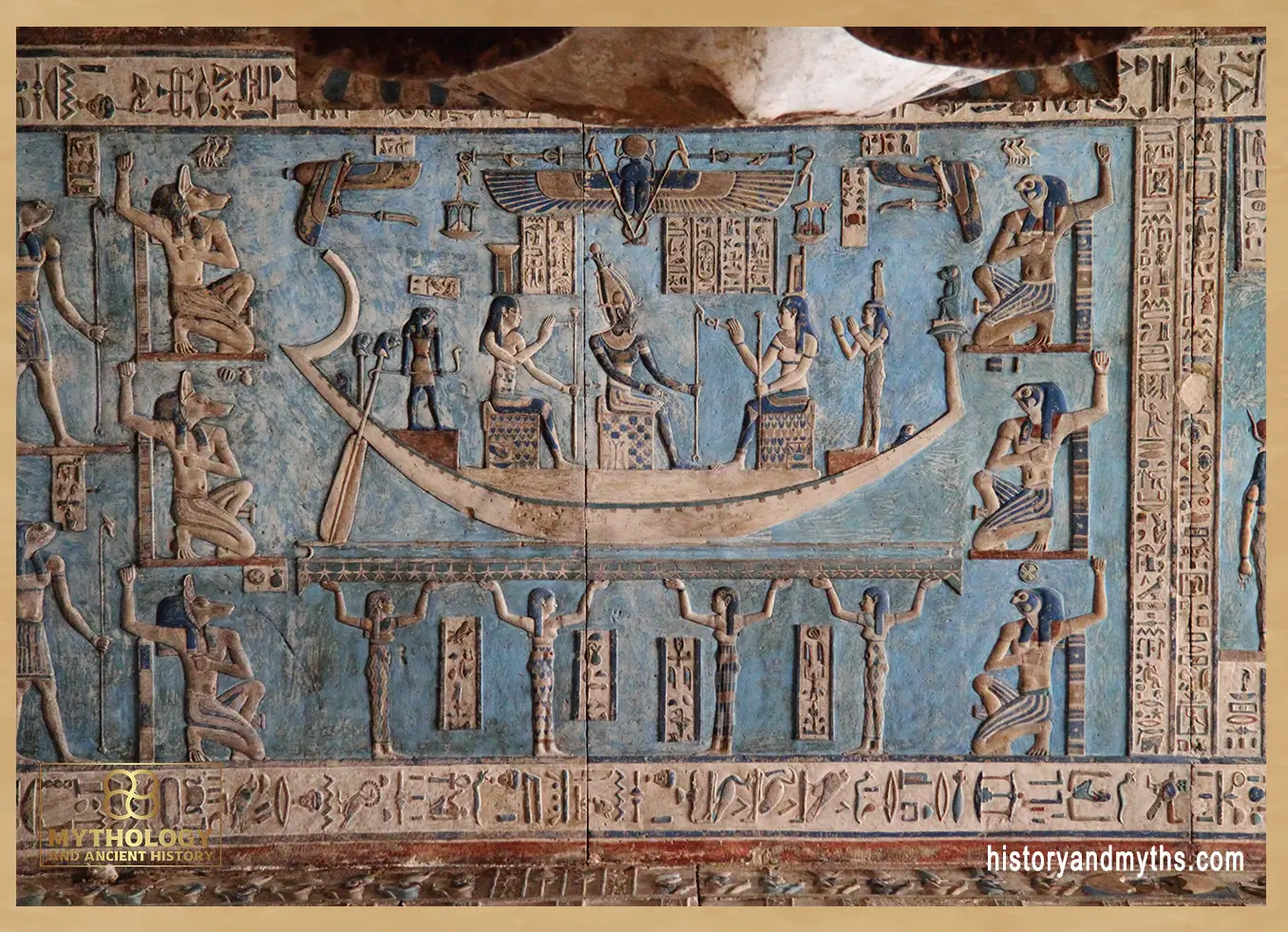
Description: Interior view highlighting carved reliefs and hieroglyphs that reflect the symbolic language of ancient Egyptian religion.
Date: 26 March 2016
Source: Wikimedia Commons
Author: Djehouty
License: Creative Commons Attribution–ShareAlike 4.0 International (CC BY-SA 4.0)
How Symbolic Language Works in Egyptian Myth
- Myth as Language: Egyptian myths communicate meaning through images and forms rather than linear storytelling.
- Symbols over Definitions: Abstract ideas like time, order, and chaos were expressed visually to preserve power and clarity.
- Repetition as Meaning: Cycles and repeated scenes reinforce cosmic stability instead of narrative progression.
- Gods as Functions: Deities represent forces and principles, not characters with personal arcs.
- Images as Active Tools: Reliefs, walls, and temples functioned as living texts meant to operate continuously.
How to Read Egyptian Myths Today
Most readers approach Egyptian mythology with the wrong tools. They read myths as if they were stories to follow, characters to track, or plots to summarize. When the myths fail to behave like stories, frustration follows. The key to understanding Egyptian mythology today is not learning more myths—it is learning how to read them correctly.
The first shift is to stop asking what a myth means in a literal sense and start asking what it is describing symbolically. Egyptian myths rarely explain ideas directly. Instead, they show relationships: between order and chaos, life and death, light and darkness, permanence and change. Every image is an answer to a question about reality, not a fictional event meant to entertain.
The second shift is to read symbols functionally, not emotionally. A serpent is not good or evil by default. Darkness is not negative. Death is not failure. Each symbol expresses a role within a larger system. When a myth depicts destruction, it is usually describing transformation. When it depicts conflict, it is often describing balance being restored. Modern moral readings flatten meanings that were never moral to begin with.
Context is also essential. Egyptian myths were not isolated texts; they were part of an environment of temples, rituals, calendars, and funerary practices. A scene carved in a tomb was not meant to be “read” once—it was meant to operate continuously. To understand a myth today, the reader must imagine it as something active, not descriptive. The myth does not tell you what happened; it maintains what must always happen.
Finally, reading Egyptian mythology requires patience with ambiguity. Symbols do not resolve neatly. Multiple meanings can exist at once without canceling each other. This is not confusion—it is intentional depth. Egyptian myth invites recognition, not conclusion. It rewards the reader who allows symbols to speak without forcing them into modern categories.
When approached this way, Egyptian mythology becomes remarkably coherent. The confusion fades, repetition gains purpose, and images reveal themselves as precise tools of thought. The myth stops being ancient—and starts becoming legible.
Key Takeaways
- Ancient Egyptian myth functioned as a symbolic language, not as narrative storytelling.
- Images and symbols replaced abstract definitions to express complex cosmic ideas.
- Time was understood as cyclical and alive, not linear or fixed.
- Gods represented forces and functions rather than personal characters.
- Repetition in myth reinforced order and continuity instead of advancing a plot.
- Temples and reliefs acted as living texts where myth operated continuously.
Frequently Asked Questions
What does symbolic language mean in ancient Egyptian mythology?
Symbolic language refers to the use of images, gods, animals, and cosmic scenes to express abstract ideas such as time, order, chaos, and rebirth instead of explaining them through direct definitions.
Why are Egyptian myths filled with repeated scenes and cycles?
Repetition reflects the Egyptian belief in cyclical time, where cosmic order must be constantly renewed rather than achieved once through a linear narrative.
Were Egyptian gods meant to be understood as characters or symbols?
Egyptian gods functioned primarily as symbols representing forces and principles, not as characters with personal stories or emotional development.
Why did ancient Egyptians prefer images over abstract explanations?
Images allowed complex ideas to be understood instantly, remembered easily, and activated through ritual, making them more powerful than abstract concepts.
How does visual symbolism help explain time in Egyptian mythology?
Time was often depicted as a living force, such as a serpent or cyclical journey, showing renewal and continuity rather than linear progression.
What role did temples play in conveying mythological meaning?
Temples acted as living texts where walls, ceilings, and reliefs continuously expressed mythological and cosmic order through symbolic imagery.
How should modern readers approach Egyptian myths?
Modern readers should focus on symbolic meaning rather than literal storytelling, reading myths as visual and conceptual systems rather than narratives.
Sources & Rights
- Assmann, Jan. The Mind of Egypt: History and Meaning in the Time of the Pharaohs. Harvard University Press, 2002.
- Hornung, Erik. Conceptions of God in Ancient Egypt: The One and the Many. Cornell University Press, 1982.
- Hornung, Erik. The Ancient Egyptian Books of the Afterlife. Cornell University Press, 1999.
- Allen, James P. Middle Egyptian: An Introduction to the Language and Culture of Hieroglyphs. Cambridge University Press, 2014.
- Wilkinson, Richard H. Symbol and Magic in Egyptian Art. Thames & Hudson, 1994.
- British Museum. Religion and Belief in Ancient Egypt. Department of Egypt and Sudan.
- Museo Egizio, Turin. Temple Reliefs and Symbolic Language in Ancient Egyptian Religion.
Written by H. Moses — All rights reserved © Mythology and History