Aaru (Iaru) — The Field of Reeds in Ancient Egyptian Afterlife
In ancient Egyptian belief, Aaru, the Field of Reeds, was not a distant, otherworldly heaven divorced from human life. It was Egypt itself—made eternal and perfected. The dead did not hope for escape from work, land, or responsibility; they hoped for continuity without decay. In Aaru, fields never failed, canals never dried, and social order endured without injustice. It was the reward for a life lived in balance, where chaos had finally been excluded.
What makes Aaru remarkable is how practical it was. Paradise was imagined not as rest, but as rightful participation in an ideal world governed by maat. After surviving the dangers of the Duat and passing judgment before Osiris, the justified dead did not vanish into light or silence—they returned to familiar rhythms: cultivating land, maintaining households, and living among others who had also proven worthy. Aaru was not an escape from Egypt; it was Egypt as it should have always been.
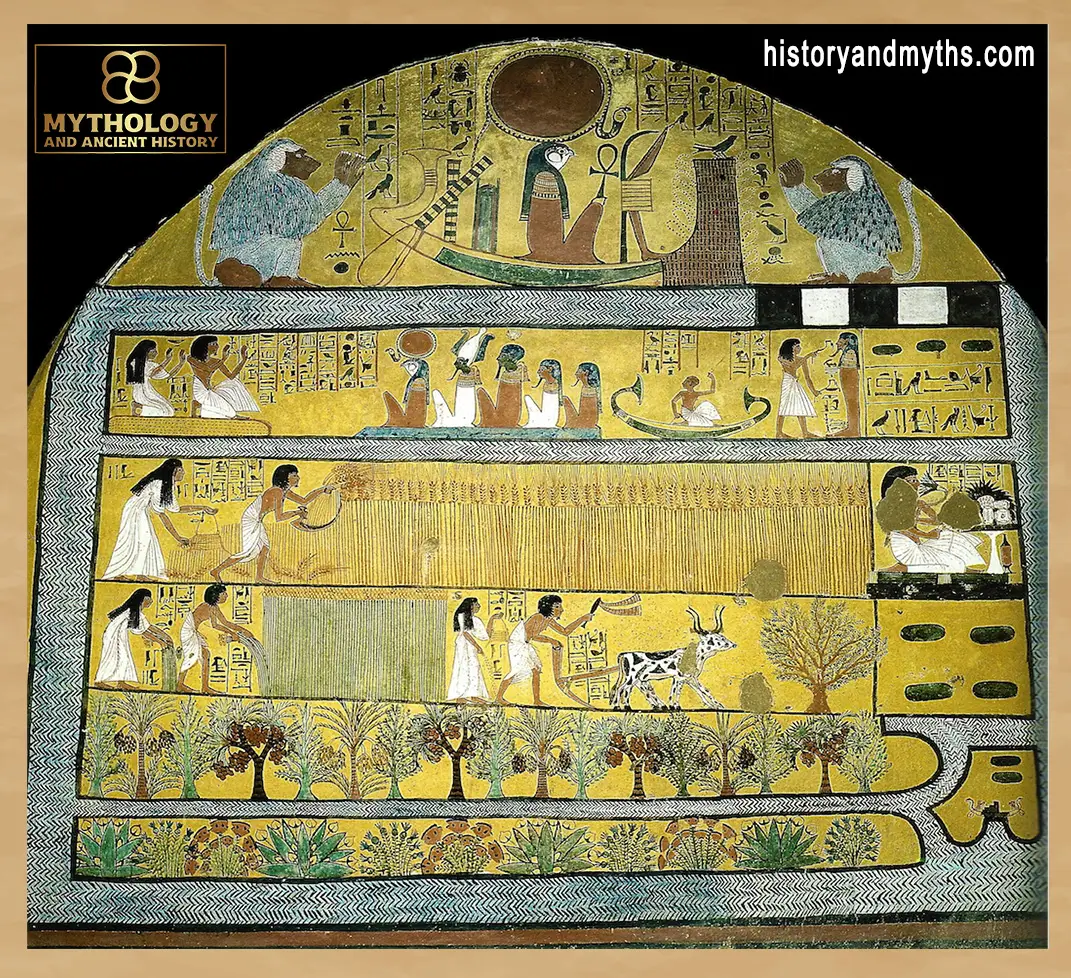
Description: Wall painting from the tomb of Sennedjem, Deir el-Medineh, Thebes-West, Egypt (ca. 1775 BC)
Source: Wikimedia Commons
Credit: After Abdel Ghaffar Shedid, The Tomb of Sennedjem
License: Public Domain
What Was Aaru in Ancient Egyptian Belief?
Aaru (also written Sekhet-Aaru, “Field of Reeds”) was the final destination of the blessed dead in ancient Egyptian belief—not a temporary realm, not a trial space, and not the Duat itself. It represented a perfected continuation of earthly existence, modeled explicitly on the Nile Valley. Egyptian texts describe fertile fields, orderly canals, abundant harvests, and stable communities governed eternally by maat (cosmic balance and justice).
Crucially, Aaru was not entered automatically. It lay beyond the perils of the Duat and could only be reached after successful judgment. The deceased who proved “true of voice” (maa-kheru) were admitted to Aaru, where they resumed a meaningful life free from hunger, disorder, and moral corruption. In this sense, Aaru functioned as the moral reward system of Egyptian religion, translating ethical behavior on earth into stability and prosperity after death.
Modern confusion often arises because many popular sources blur Aaru with vague ideas of “heaven.” Egyptian evidence does not support that abstraction. Aaru was geographic, agricultural, and social—a place where identity, labor, and community continued without decay. This interpretation is consistently supported by funerary texts such as the Book of the Dead (especially Spell 110), which lists named fields, canals, and tasks awaiting the justified dead, emphasizing continuity rather than transcendence.
| Aspect | Aaru (Field of Reeds) | Duat | Sekhet-Hetepet |
|---|---|---|---|
| Role | Final destination of the justified dead | Transitional realm and testing ground | Idealized region of the blessed afterlife |
| Nature | Ordered, fertile, eternal land | Dark, unstable, filled with dangers | Peaceful and perfected fields |
| Relation to Judgment | Entered only after successful judgment | Traversed before and during judgment | Accessible only to the justified |
| Daily Life | Agriculture, community, purposeful work | No permanent life; constant trials | Harmonious continuation of earthly life |
| Presence of Danger | None — chaos excluded | High — gates, demons, darkness | None |
| Governing Principle | Maat (eternal balance and justice) | Struggle between order and chaos | Maat |
| Who Could Enter | Any soul proven “true of voice” | All deceased must pass through | The morally justified |
Aaru vs. Duat: Destination vs. Journey
The most persistent confusion in modern explanations of Egyptian afterlife beliefs is the idea that Aaru and the Duat are the same place. Ancient Egyptian sources are clear: they serve entirely different functions. The Duat is the journey—a perilous transitional realm filled with gates, guardians, darkness, and tests. Aaru is the destination—a stable, luminous land where the justified dead finally live.
The Duat was not meant for residence. It was the night-world the sun god crossed each evening and the deceased had to traverse after death. Spells, passwords, and knowledge were essential to survive its dangers. Only after passing judgment before Osiris—and being declared maa-kheru (“true of voice”)—could the dead leave the Duat behind. At that point, the soul did not remain among shadows; it moved on.
Aaru, by contrast, was imagined as a land of daylight and order. Texts describe cultivated fields, canals with flowing water, and named regions that mirror Egypt itself. There are no monsters to defeat there, no gates to unlock, and no nightly battles against chaos. Aaru exists after judgment, not during it. Its role is not testing, but continuity—the continuation of life under perfect maat.
This distinction explains why Egyptian funerary texts treat the Duat with anxiety and preparation, while Aaru is described with longing and precision. The Duat demanded knowledge to survive; Aaru promised stability to those who had already proven themselves. Confusing the two flattens the entire Egyptian moral framework: trial leads to judgment, judgment leads to Aaru.
Life in the Field of Reeds: How the Dead Actually Lived
In Egyptian imagination, life in Aaru was neither abstract nor idle. The justified dead lived there much as they had hoped to live in Egypt—only without scarcity, injustice, or decay. Texts describe cultivated fields, irrigation canals, and measured plots of land, each carefully named and organized. The dead sowed grain, harvested crops, and moved through a landscape that mirrored the Nile Valley at its most generous. This was not symbolism alone; it was a literal blueprint for eternal life.
Homes and communities mattered. The deceased did not exist in isolation but among others who had also passed judgment. Social order continued under maat: disputes were absent, hierarchy was just, and cooperation replaced competition. Tools appear repeatedly in funerary texts and tomb scenes—hoes, sickles, baskets—because work was expected, meaningful, and productive. The goal was not endless labor but endless sufficiency: work without exhaustion, harvest without failure.
This is where the role of shabti figures becomes clear. These small funerary statuettes were intended to assist the deceased when agricultural tasks were assigned in Aaru. Their presence confirms that Egyptians expected real duties there—and planned for them. By delegating labor when needed, the blessed dead ensured participation in the cosmic order without suffering. Aaru promised agency, not passivity.
What sets Aaru apart from later notions of paradise is its moral realism. The Egyptians did not imagine happiness as escape from responsibility. Instead, fulfillment came from doing one’s role correctly in a world finally free of chaos. To live in Aaru was to belong—to land, to community, and to a moral system that no longer failed. This vision explains why Aaru was so carefully described: it was not a dream of rest, but a dream of life perfected.
Why Paradise Meant Work, Not Rest
To modern readers, the idea of working in paradise sounds contradictory. In ancient Egyptian thought, however, work was not a punishment—it was proof that the universe was functioning correctly. Aaru was governed eternally by maat, the principle of balance, truth, and rightful order. In such a world, meaningful labor was not exhausting or unjust; it was the natural expression of harmony.
Egyptian society was built on agriculture, and agriculture itself was understood as a sacred act. Cultivating the land mirrored the gods’ ongoing struggle to maintain order against chaos. If the blessed dead were to live eternally, they could not be idle—idleness belonged to disorder. To stop acting was to risk stagnation, and stagnation was dangerously close to nonexistence. Eternal life meant eternal participation in the cosmic system.
This explains why funerary texts repeatedly emphasize fields, tools, and assigned tasks in Aaru. These descriptions are not metaphors for suffering; they are assurances that the dead would continue to matter. Even the inclusion of shabti figures reflects this worldview: assistance was provided not to eliminate work, but to prevent imbalance or strain. Labor in Aaru was measured, fair, and purposeful, unlike the hardships of earthly life.
Philosophically, Aaru rejects the idea of paradise as passive reward. Instead, it presents salvation as continuity without corruption. The dead did not seek escape from their identity as farmers, householders, or community members—they sought a realm where those roles could finally be fulfilled without fear, injustice, or loss. In this sense, Aaru was not a place of rest, but a place where restlessness no longer existed.
Judgment, Osiris, and Entry into Aaru
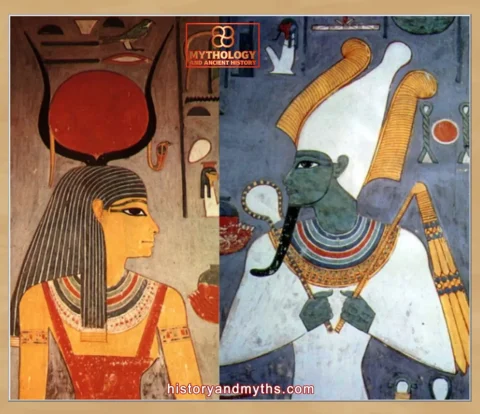
No one reached Aaru by chance. Entry depended on judgment, a moral process that tied earthly behavior directly to eternal destiny. After death, the individual faced a formal reckoning presided over by Osiris, ruler of the afterlife and guarantor of justice. This judgment was not symbolic theater—it was the decisive boundary between annihilation, continued testing, or admission into the Field of Reeds.
At the center of this process stood the Weighing of the Heart. The heart (ib), believed to contain memory, intention, and moral character, was weighed against the feather of maat. A heart made heavy by wrongdoing failed the test and faced destruction; a heart in balance was declared maa-kheru (“true of voice”). Only then could the deceased leave the trials behind and enter Aaru. Moral integrity, not status or wealth, was the qualifying standard.
What matters for understanding Aaru is what judgment enabled, not just what it prevented. Passing judgment did not grant abstract bliss; it granted belonging—to land, community, and purpose. Osiris’s role was therefore constructive as well as judicial. By confirming the deceased’s alignment with maat, he restored them to a world where order was permanent and life could continue without corruption. Aaru was the reward because it was earned continuity, not indulgence.
This system explains the practical tone of funerary texts. Spells, declarations of innocence, and ethical affirmations were tools to secure a future that looked familiar and meaningful. Judgment was the gateway that transformed moral conduct into a lived environment. In Egyptian belief, how you lived determined where—and how—you would live forever.
Aaru at a Glance
- Meaning: “Field of Reeds” — the perfected continuation of life after death
- Role: Final destination of the morally justified dead
- Relation to Duat: Reached only after surviving its trials and judgment
- Ruler: Osiris, guarantor of justice and moral order
- Governing Principle: Maat (eternal balance and rightful order)
- Daily Life: Agriculture, community life, purposeful work without suffering
- Who Entered: Any soul proven “true of voice” (maa-kheru)
© historyandmyths.com — Educational use
Who Was Allowed into Aaru?
Contrary to a common misconception, Aaru was not reserved for kings or elites alone. While early Egyptian texts emphasize royal afterlife privileges, evidence from the Middle Kingdom onward shows a clear shift: moral worth, not social rank, determined access. What mattered was living in accordance with maat—truthfulness, restraint, and responsibility—rather than wealth, power, or birth.
This development reflects a broader transformation in Egyptian religious thought. As funerary texts such as the Coffin Texts and later the Book of the Dead became accessible beyond royal circles, the promise of Aaru expanded. Farmers, artisans, and officials alike imagined themselves cultivating eternal fields, provided they could truthfully declare innocence before judgment. The afterlife became ethically democratic, even if earthly society was not.
Importantly, access to Aaru did not depend on perfection. Egyptian morality was pragmatic: humans were fallible, but redeemable. What judgment assessed was overall balance, not flawlessness. Those who acknowledged wrongdoing, respected divine order, and fulfilled their social roles could still be admitted. This explains the prominence of ethical “negative confessions” in funerary texts—statements not of divine purity, but of lived responsibility.
By the New Kingdom, Aaru functioned as a universal aspiration. It was no longer the private estate of the king but the shared horizon of a moral society. In this sense, Aaru was not only a vision of the afterlife—it was a mirror held up to life itself, reinforcing the idea that justice and balance on earth shaped eternity.
Key Takeaways
- Aaru was not an abstract heaven but a perfected version of Egypt itself.
- The Duat was a dangerous journey; Aaru was the stable destination beyond it.
- Paradise in Egyptian thought meant meaningful participation, not passive rest.
- Entry into Aaru depended on moral balance, not social status or wealth.
- Aaru reflects how Egyptians understood justice, identity, and eternal life.
Frequently Asked Questions About Aaru (Field of Reeds)
What was Aaru in ancient Egyptian belief?
Aaru, the Field of Reeds, was the final destination of the justified dead. It was imagined as a perfected version of Egypt where life continued eternally under maat, free from chaos and decay.
Is Aaru the same as the Duat?
No. The Duat was a dangerous transitional realm that the dead had to pass through, while Aaru was the stable destination reached only after judgment.
Was Aaru considered the Egyptian heaven?
Aaru can be compared to heaven, but it was not an abstract paradise. It was a real, agricultural land where the dead lived, worked, and belonged to an ordered community.
What did the dead do in the Field of Reeds?
The dead cultivated fields, maintained canals, and lived within harmonious communities. Work in Aaru was meaningful and balanced, not exhausting or punitive.
Why did paradise involve work in Egyptian belief?
In Egyptian thought, work was a sign of cosmic order. Eternal life meant ongoing participation in maat rather than passive rest or idleness.
Who was allowed to enter Aaru?
Anyone who passed judgment and was declared “true of voice” could enter Aaru. Moral balance mattered more than wealth, power, or social rank.
How was entry into Aaru decided?
Entry depended on the Weighing of the Heart, where the moral character of the deceased was judged against maat.
Is Aaru mentioned in the Book of the Dead?
Yes. Spell 110 of the Book of the Dead describes the Field of Reeds in detail, including its fields, canals, and the life awaiting the justified dead.
Sources & Rights
- Assmann, Jan. Death and Salvation in Ancient Egypt. Ithaca, NY: Cornell University Press, 2005.
- Taylor, John H. Death and the Afterlife in Ancient Egypt. London: British Museum Press, 2001.
- Faulkner, Raymond O. The Ancient Egyptian Book of the Dead. Austin: University of Texas Press, 1990.
- Allen, James P. Middle Egyptian: An Introduction to the Language and Culture of Hieroglyphs. Cambridge: Cambridge University Press, 2014.
- UCLA Encyclopedia of Egyptology. Entries on the Egyptian Afterlife, the Duat, and Moral Judgment.
Written by H. Moses — All rights reserved © Mythology and History