Collapse of Central Authority in Ancient Egypt: Why the State Failed
The collapse of central authority in Ancient Egypt wasn’t a single dramatic event—it was a slow breakdown of state control. When the pharaoh’s government could no longer enforce taxation, coordinate food distribution, control local elites, or project power across provinces, Egypt stopped functioning as one system. The result was fragmentation, rival centers, and unstable rule.
What “Collapse of Central Authority” Actually Means
A state does not collapse the moment a king becomes weak. Central authority collapses when the government stops working as a national machine. The pharaoh may still exist, royal titles may still be used, and temples may still operate, but the core functions that make Egypt one coordinated system begin to fail.
In practical terms, central authority means the ability to collect resources, enforce decisions, and move power across distance. When that ability shrinks, the center becomes symbolic while the provinces become real. Orders are no longer automatically obeyed. Officials start serving local power networks instead of the royal court. Regional leaders gain the freedom to tax, recruit, and build without needing approval.
This is why collapse looks like fragmentation rather than sudden destruction. The country does not “disappear.” It becomes politically divided. Multiple local authorities begin acting like independent governments, even if they still use traditional language of loyalty to the crown.
The key point is that collapse is not just social chaos. It is administrative failure. Once the state cannot coordinate food supply, labor, security, and taxation on a large scale, the center loses its monopoly on power—and Egypt becomes a map of competing local systems instead of one unified state.
| System Area | What a Strong Center Can Do | What Failure Looks Like | Why It Matters |
|---|---|---|---|
| Taxation and resources | Collect grain and wealth consistently | Irregular extraction, local retention | The court loses its financial engine |
| Provincial control | Appoint and replace local officials | Hereditary local power networks rise | Provinces become political competitors |
| Security and enforcement | Project authority across long distances | Uneven protection, local militias dominate | Order becomes regional, not national |
| Administration | Unified rules and consistent governance | Local solutions replace central coordination | Egypt stops functioning as one system |
| Legitimacy | Clear succession and accepted authority | Rival centers compete for “rightful rule” | Unity becomes negotiable |
| Recovery | Rebuild national capacity step by step | Fragmentation persists until one center dominates | Reunification is logistical, not just symbolic |
The Early Warning Signs: How a Strong Center Starts to Fail
Central authority rarely collapses without leaving signals first. The earliest signs are not always dramatic, but they are structural. The state begins to lose its ability to reach the provinces with the same force and consistency as before.
One major warning sign is the weakening of resource flow toward the center. If taxes, labor, and grain are harder to collect or arrive irregularly, the royal court loses the material base that funds administration, building projects, and military presence. A government that cannot reliably extract resources cannot reliably command loyalty.
Another sign is the rising independence of local elites. When provincial officials begin acting as long-term regional rulers rather than temporary royal appointees, power shifts quietly away from the capital. Over time, local leaders develop their own networks, their own control of land and storage, and their own ability to reward supporters—meaning loyalty becomes local before it is national.
A third sign is the breakdown of national coordination. Large systems require consistent communication and enforcement. If the center cannot secure trade routes, organize labor across regions, or guarantee protection beyond the core zone, then local authorities fill the gaps. The provinces start solving problems on their own, and once that becomes normal, the central state is no longer essential.
Collapse begins when “central authority” stops being the default solution. The moment Egypt can function locally without the capital, unity becomes optional—and fragmentation becomes possible.
Why It Happened: The Main Drivers Behind the Breakdown
The collapse of central authority in Ancient Egypt was not caused by one single factor. It was the result of multiple pressures hitting the state at the same time—political, economic, and administrative—until the center could no longer control the system it depended on.
One major driver was the long-term growth of provincial power. Over time, regional officials gained status, wealth, and local loyalty. When positions became effectively hereditary, the provinces stopped behaving like branches of the central government and started behaving like semi-independent states. The king’s authority did not vanish overnight, but it began to compete with local authority on the ground.
Another driver was succession instability. When the transition of power becomes unclear or contested, the state loses the one thing that holds everything together: a single uncontested source of legitimacy. Even small cracks in succession create openings for local leaders to act more independently, because the center is too busy stabilizing itself to enforce discipline elsewhere.
Economic stress also matters, not because hardship automatically causes collapse, but because it reduces the government’s ability to function. A state that struggles to predict harvests, secure storage, or stabilize supply chains loses the resources needed to enforce order. Once the center cannot guarantee basic stability, loyalty becomes transactional and local solutions become more attractive than national obedience.
These pressures created the same outcome: the royal government could no longer project power evenly across Egypt. Authority became uneven, enforcement became selective, and the country shifted from one centralized system into a landscape of competing regional powers.
The Nomarch Problem: When Provinces Become Political Competitors
In a strong centralized state, provincial governors exist to represent the king. In a weakened state, the same governors can become the king’s biggest rival—not by declaring independence immediately, but by quietly turning regional authority into something permanent.
Nomarchs gained power because they controlled what mattered locally: land, storage, labor, and security. When the center was strong, those resources fed the national system. When the center weakened, those resources stayed in the province and began supporting local political networks instead.
The shift becomes dangerous when provincial office stops being temporary. Once local positions become hereditary, authority is no longer tied to royal appointment. It is tied to family, territory, and local loyalty. At that point, the king is no longer the only figure who can distribute rewards or enforce consequences. The nomarch becomes a ruler in practice, even if he still uses the language of loyalty.
This changes how Egypt functions. Taxation becomes negotiable. Labor can be withheld or redirected. Military manpower becomes local rather than national. The provinces can fund their own projects, form their own alliances, and protect their own interests. The center does not necessarily lose all power, but it loses exclusivity—and that is what breaks a unified state.
By the time nomarch authority becomes normal, the collapse has already happened in operational terms. Egypt is still one country on paper, but politically it is a collection of local regimes with a weakened center trying to keep them aligned.
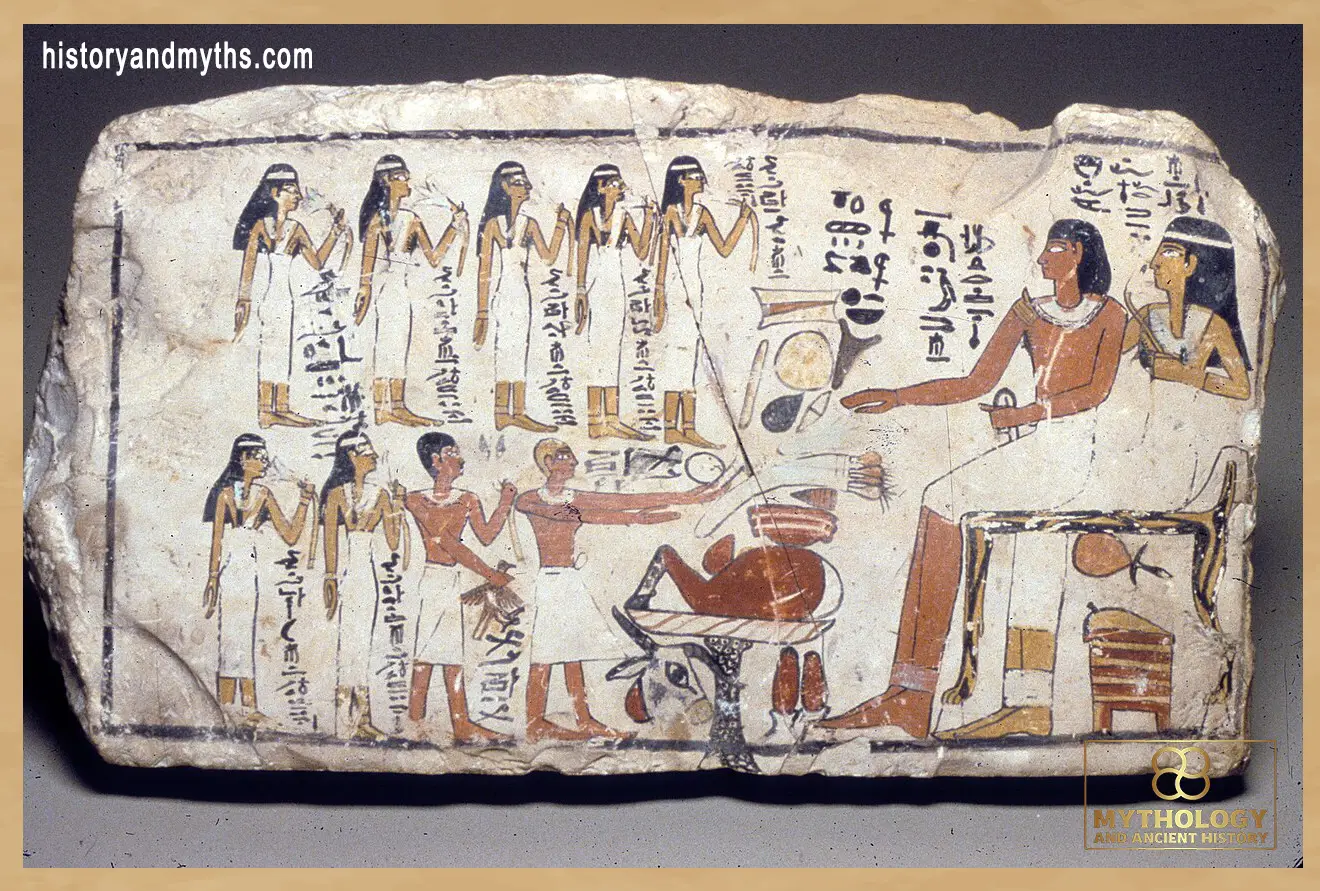
Stela of Tetu and Nefertjentet (c. 2124–1981 BCE), limestone with painted details, Dynasty 11 — Source: Wikimedia Commons (CC0 1.0)
What Collapse Looked Like on the Ground (Not Just in Royal Texts)
When central authority collapses, the biggest change is not the disappearance of kingship—it is the loss of uniform control. Egypt stops behaving like a single system and starts behaving like a patchwork of local systems. The same institution may exist in name everywhere, but it works differently depending on who holds power in each region.
On the ground, this produces uneven security and uneven administration. Some areas remain stable under strong local leadership, while others become more vulnerable to conflict, raiding, or disruption of trade routes. Instead of one national structure coordinating protection and justice, local power decides what order looks like.
Economic coordination also changes. Food storage, redistribution, and labor organization become provincial priorities. The center can no longer manage a national flow of resources with the same efficiency, which means that survival and prosperity depend more on local management than on state planning. The government’s ability to “solve crises at scale” shrinks.
Even culture starts to reflect the fragmentation. Local officials build more, commission their own monuments, and emphasize their status publicly. This is not just vanity—it is political signaling. It shows that legitimacy is no longer monopolized by the capital. Authority can be displayed and celebrated locally.
That is why collapse should not be imagined as one long disaster scene. It is a change in how power is distributed. Some people lose stability, others gain local influence, and the center becomes one competitor among many instead of the controller of all.
Was It Really “Chaos”? What Historians Debate About the First Intermediate Period
The First Intermediate Period is often described as a time of chaos, famine, and total breakdown. That picture exists partly because later royal traditions had political reasons to describe the period as failure. If a new dynasty presents itself as the “restorer of order,” it benefits from portraying the previous era as disorder.
But collapse does not automatically mean constant anarchy. In many regions, local administration continued and could even function effectively. Provincial leaders had incentives to keep stability, manage resources, and protect their territory. A fragmented state can still contain pockets of order—especially when local rulers become stronger than the weakened center.
This creates a more accurate framework: the period was unstable, but not uniformly desperate everywhere. The real transformation was political. Egypt was no longer coordinated by one central government, and that loss of national coordination produced vulnerability, competition, and uneven outcomes.
So the debate is not whether collapse happened—it did. The debate is how to measure its human impact and how much later narratives amplified the darkness of the period to justify later kingship. A serious reading avoids both extremes: it was not “nothing happened,” and it was not “the entire country collapsed into permanent chaos.”
How Egypt Reunified: The Return of Central Control
Reunification did not happen because Egyptians suddenly “wanted unity.” It happened because one power center managed to rebuild the practical tools of control: legitimacy, military reach, and administrative coordination. A central state is not restored by slogans. It is restored when one authority becomes capable of enforcing decisions across the country again.
Over time, rival regional centers competed for dominance, and the balance shifted toward those who could project power beyond their home region. That meant securing alliances, defeating competitors, and convincing officials that serving the rising center was safer than betting on local independence.
Reunification also required rebuilding the state’s economic and administrative wiring. The center needed predictable taxation, stable routes, and enough control over labor and storage to function as a national government. Without that, any victory would remain temporary, because regional rulers could simply re-emerge once pressure weakened.
The return of central authority was therefore a political and logistical achievement. It was the moment when Egypt became one system again, not because fragmentation ended culturally, but because one center regained the capacity to coordinate the entire country and make unity real in everyday governance.
The Real Lesson: Collapse Was a Failure of Capacity, Not a Single Disaster
The collapse of central authority in Ancient Egypt wasn’t simply “a bad king” or “a drought.” It was the failure of a system to keep operating at national scale. Once the center lost control over taxation, enforcement, provincial loyalty, and resource coordination, unity stopped being automatic and became negotiable.
That is why collapse looks gradual in practice. Power doesn’t vanish—it relocates. Regional leaders take over tasks the center can no longer perform, and Egypt shifts from one government to many competing authorities. Later dynasties may describe this as chaos, but the deeper reality is administrative: the state’s capacity broke, and the country’s political structure fractured with it.
Reunification, in the end, was the same story in reverse. Egypt became one system again only when one center rebuilt the tools of control and made national coordination real—not just symbolic.
- Central authority collapses when the state can no longer enforce taxation, security, and administration nationwide.
- The shift is usually gradual: power relocates from the capital to provinces rather than disappearing.
- Nomarchs become rivals when local offices turn permanent and loyalty becomes regional before national.
- The First Intermediate Period was fragmented and uneven, not a single uniform disaster everywhere.
- Reunification required rebuilding state capacity, not just claiming legitimacy.
Did Egypt “collapse” overnight?
No. The breakdown was gradual, as central enforcement weakened and provinces increasingly handled power locally.
Is the First Intermediate Period always described as total chaos?
Many later narratives portray it as darkness, but evidence suggests uneven conditions, with local stability in some regions.
What is the clearest sign that central authority has failed?
When taxation, security, and administration stop operating consistently across the whole country.
Were nomarchs rebels or official governors?
They began as officials, but in weakened conditions they could function as semi-independent rulers over their provinces.
Did drought alone cause the collapse?
Environmental stress may have contributed, but collapse typically requires political and administrative failure as well.
Why would later dynasties describe the period as worse than it was?
Presenting themselves as “restorers of order” becomes easier if the previous era is framed as disorder.
How did Egypt eventually reunify?
One power center rebuilt state capacity—military reach, taxation, and national coordination—until unity became enforceable again.
Sources & Rights
- Baines, John, and Jaromír Málek. Atlas of Ancient Egypt. Oxford: Phaidon, 2000.
- Bard, Kathryn A. “The Egyptian State: Collapse and Recovery.” In The Rise of the Egyptian State (selected studies on late 3rd millennium transformations). Academic reference material.
- Grajetzki, Wolfram. The Middle Kingdom of Ancient Egypt: History, Archaeology and Society. London: Duckworth, 2006.
- Kemp, Barry J. Ancient Egypt: Anatomy of a Civilization. 2nd ed. London: Routledge, 2006.
- Shaw, Ian, ed. The Oxford History of Ancient Egypt. Oxford: Oxford University Press, 2000.
- Van De Mieroop, Marc. A History of Ancient Egypt. Malden, MA: Wiley-Blackwell, 2011.
- Wenke, Robert J., ed. The Ancient Egyptian State: The Origins of Egyptian Culture (c. 8000–2000 BC). Cambridge: Cambridge University Press, 2009.
Written by H. Moses — All rights reserved © Mythology and History