Political Fragmentation in Ancient Egypt: How the State Split
Political fragmentation in Ancient Egypt means the country stopped functioning as one unified state and became a map of competing regional authorities. Power shifted away from the royal center into provinces, where local rulers controlled taxation, security, and legitimacy. The result wasn’t automatic chaos—it was uneven rule, rival “mini-states,” and constant pressure toward reunification.
What Political Fragmentation Really Means (Not Just “Division”)
Political fragmentation is not simply the idea that Egypt “split.” It is a specific political condition where the state no longer has a single center that can enforce decisions everywhere. Authority becomes regional. Multiple rulers, courts, and power networks operate at the same time, each controlling its own territory in practice even if they still use the language of national unity.
The key difference is enforcement. In a unified state, the king’s administration can collect taxes, recruit labor, secure routes, and punish disobedience across the whole country. In fragmentation, those functions become local. Provinces decide what they pay, who they obey, and how they protect themselves. The center may still exist, but it is no longer the default controller of the system.
Fragmentation also changes legitimacy. Instead of one uncontested government defining what is “rightful,” rival centers compete to claim that role. Political messaging becomes about proving authority, not just exercising it. That competition is what turns division into a lasting structure: once legitimacy becomes regional, unity becomes a contested project rather than a stable reality.
So, fragmentation is best understood as a shift from one national machine to several smaller machines—each capable of ruling locally, but none able to command the whole country permanently.
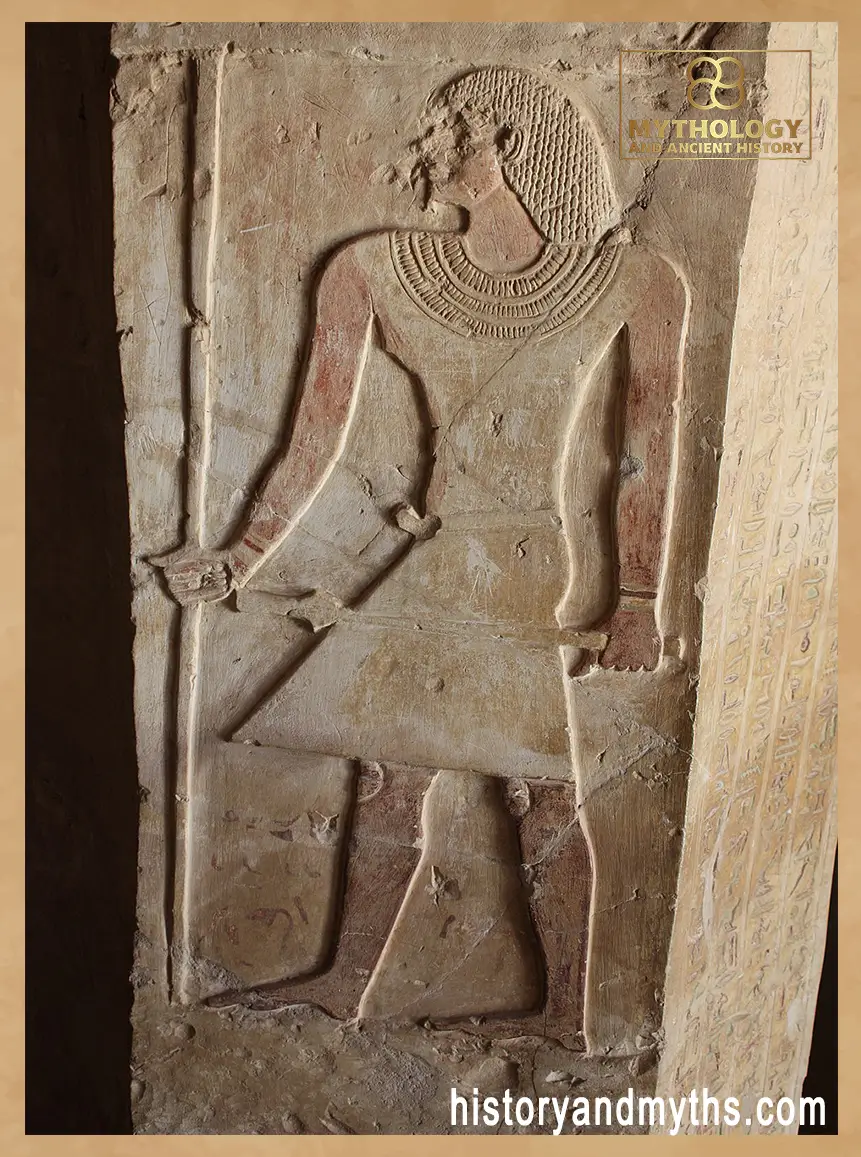
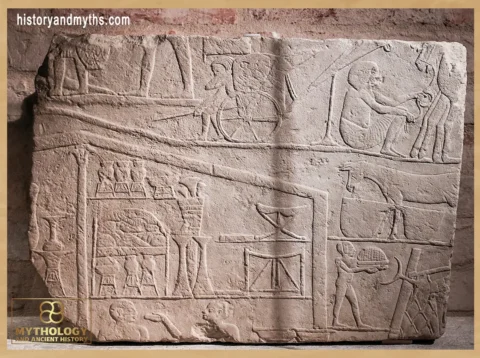
Tomb of Ankhtifi (First Intermediate Period wall art reproduction) — Source: Wikimedia Commons (Public Domain)
| Feature | Unified Egypt Looks Like | Fragmented Egypt Looks Like | What It Changes |
|---|---|---|---|
| Power center | One capital sets national policy | Multiple capitals act like governments | Rival authorities compete to rule |
| Taxation | Resources flow to the center reliably | Provinces keep and manage wealth locally | National capacity weakens |
| Security | Central enforcement across Egypt | Local protection depends on local rulers | Uneven order by region |
| Administration | One legal and bureaucratic system | Regional rule replaces national coordination | Egypt becomes several “mini-states” |
| Legitimacy | One accepted ruler defines authority | Competing claims of rightful rule | Politics becomes a struggle for recognition |
| Endgame | Stability through unified capacity | Reunification through dominance | One center absorbs rivals over time |
The Clear Signs Egypt Was Fragmented
Political fragmentation becomes real when national power stops behaving like a single system. You can see it through practical signs—things that change on the ground, not just in royal titles.
One major sign is local control of resources. When provinces can keep grain, labor, and wealth inside their own territory, the central government loses the engine that funds national administration. Taxes stop being automatic and become negotiable, delayed, or redirected.
Another sign is local enforcement replacing national enforcement. Security becomes uneven. Protection depends on who rules your region, not on a nationwide system. If a community’s safety relies on local forces and local decisions, central authority is already weak.
A third sign is regional legitimacy becoming visible. Local rulers start presenting themselves as permanent powers—commissioning monuments, promoting their status, and building loyal networks. They don’t have to declare independence to act independent. The more authority is celebrated locally, the less the national center controls identity and loyalty.
Finally, fragmentation shows up when Egypt has competing political “centers” at the same time. Instead of one court setting direction for the country, multiple courts and administrations behave like they have the right to rule. Once that becomes normal, Egypt is no longer unified in practice—even if official language still pretends it is.
How Regional “Mini-States” Worked (Taxes, Security, and Local Loyalty)
Once fragmentation starts, provinces don’t just drift away from the center. They begin operating like small states. A regional ruler can only survive if he controls three things: resources, protection, and loyalty. That is why fragmentation produces local systems that look stable inside their borders even while the country is unstable overall.
The first pillar is taxation and storage. If a province can collect grain, manage supplies, and keep enough resources to reward supporters, it no longer depends on the royal court. The local administration becomes the main economic authority, and the center becomes distant and negotiable.
The second pillar is security. Fragmented states require local protection. Whoever controls armed force locally controls order locally. That doesn’t mean constant war, but it means stability becomes private and regional. The ruler who can keep routes open and punish threats gains legitimacy simply through performance.
The third pillar is local loyalty networks. Officials and scribes still exist, but they begin serving the regional hierarchy rather than a national one. Positions become personal, long-term, and sometimes hereditary. Authority becomes rooted in family, territory, and local alliances instead of royal appointment.
This is the core reality of fragmentation: the center loses the monopoly on governing. Once provinces can fund themselves, protect themselves, and legitimize themselves, they stop being administrative units and become political competitors.
Rival Capitals: When More Than One Place Claims to Speak for “Egypt”
Fragmentation becomes more dangerous when regional power is no longer only local. It turns national when more than one political center starts acting like a capital. At that point, Egypt is not just divided into provinces—it is divided into competing governments, each claiming that its authority is the legitimate one.
This competition is not only about territory. It is about recognition. A rival capital needs officials to obey, temples to support, and surrounding regions to align. That creates a political map where loyalty is not determined by geography alone, but by networks of control and persuasion.
The existence of rival capitals also reshapes how power is displayed. Each center must act like a state: collecting taxes, maintaining order, issuing commands, and presenting itself as the guardian of stability. The more effectively it performs those functions, the more believable its claim becomes.
This is why political fragmentation can last. Once multiple capitals exist in practice, no single authority can restore unity without defeating or absorbing the others. Until that happens, Egypt remains a country with multiple “Egypts” inside it—each operating with its own political reality.
Fragmentation Was Not the Same as Total Chaos
A common mistake is to treat political fragmentation as if it automatically means daily life collapsed everywhere. In reality, fragmentation describes who controls power, not whether society stops functioning. Many regions could remain stable under strong local rule, because local leaders had every incentive to keep order, protect resources, and prevent disruption inside their territory.
The real damage of fragmentation appears at the national level. When there is no single authority coordinating the whole country, stability becomes uneven and fragile. Trade routes and travel can become less predictable. Conflicts between regions become more likely. National projects become impossible. And legitimacy becomes contested, because more than one ruler claims the right to govern.
Fragmentation also makes crisis management weaker. A unified state can move resources across regions during shortages, enforce consistent taxation, and respond to threats with coordinated force. A fragmented landscape cannot. Even if one region is well managed, another may suffer, and there is no reliable mechanism to balance the system nationally.
So fragmentation is best understood as a political structure with mixed outcomes: local order may survive, but national unity does not. The country becomes a collection of competing administrations, where stability depends on who rules your region rather than on a single state protecting everyone.
How Fragmentation Ends: Why Reunification Becomes Inevitable
Fragmentation can last for years, but it creates pressure toward reunification. Not because unity is sentimental, but because political competition has a natural endpoint: either one center becomes dominant, or the system remains permanently unstable.
A fragmented Egypt produces constant rivalry. Regional rulers compete for legitimacy, territory, and allies. Over time, the strongest center is usually the one that can do three things better than the rest: raise resources reliably, enforce security beyond its home region, and present itself as the only authority capable of restoring order nationally.
Reunification also becomes attractive to elites. Officials and administrators do not benefit from endless uncertainty. A single dominant center offers predictable hierarchy, stable rewards, and clearer rules. Once a power center starts winning consistently, loyalty shifts, and smaller rulers either align, submit, or are replaced.
In the end, fragmentation is not solved by speeches. It ends when one authority rebuilds national capacity—taxation, enforcement, coordination—and makes unity enforceable again. When that happens, political fragmentation stops being the normal condition and becomes a defeated phase in Egypt’s political cycle.
The Core Takeaway: Fragmentation Is a Power Map, Not a Mystery
Political fragmentation in Ancient Egypt is best understood as a shift in how power is distributed. The country stops operating under one government and becomes a landscape of competing authorities, each ruling locally with its own resources, security, and legitimacy.
This matters because fragmentation explains why Egypt can appear stable in some regions and unstable in others at the same time. It also explains why later reunification is not a sudden miracle—it is the result of one center rebuilding state capacity and absorbing rivals until Egypt becomes one system again.
So the real value of studying fragmentation is clarity. It shows that collapse does not erase politics—it multiplies it. Power doesn’t vanish; it breaks into pieces, and those pieces fight to become the whole again.
- Political fragmentation means multiple authorities govern at once, not just “division” in theory.
- The clearest sign is local control of resources, security, and administration replacing national coordination.
- Provinces become stable “mini-states” when they can tax, protect, and reward loyalty independently.
- Fragmentation is uneven: some regions function well locally while the national system weakens.
- Reunification happens when one center rebuilds capacity and absorbs rivals until unity is enforceable again.
Is political fragmentation the same as a civil war?
Not always. Fragmentation means power is split between competing authorities; open war can happen, but division can also persist through rivalry and negotiation.
Can Egypt be fragmented and still stable in daily life?
Yes. Some regions can remain orderly under strong local rule even while national unity breaks down.
What makes a province behave like a “mini-state”?
Local taxation, local security, and a loyal administrative network that operates without central control.
Why do rival capitals matter more than rival provinces?
Because rival capitals claim national legitimacy, not just regional influence, and compete to define who rules Egypt.
How do elites benefit during fragmentation?
Local rulers and officials often gain autonomy, resources, and status as power shifts away from the royal center.
Why does fragmentation usually end in reunification?
Competition creates pressure for one center to dominate, rebuild national capacity, and absorb rivals until unity becomes enforceable again.
What is the simplest way to define fragmentation?
Egypt stops being one political system and becomes multiple competing systems operating at the same time.
Sources & Rights
- Assmann, Jan. The Mind of Egypt: History and Meaning in the Time of the Pharaohs. Cambridge, MA: Harvard University Press, 2003.
- Grajetzki, Wolfram. The Middle Kingdom of Ancient Egypt: History, Archaeology and Society. London: Duckworth, 2006.
- Kemp, Barry J. Ancient Egypt: Anatomy of a Civilization. 2nd ed. London: Routledge, 2006.
- Shaw, Ian, ed. The Oxford History of Ancient Egypt. Oxford: Oxford University Press, 2000.
- Van De Mieroop, Marc. A History of Ancient Egypt. Malden, MA: Wiley-Blackwell, 2011.
- Wenke, Robert J., ed. The Ancient Egyptian State: The Origins of Egyptian Culture (c. 8000–2000 BC). Cambridge: Cambridge University Press, 2009.
Written by H. Moses — All rights reserved © Mythology and History