Sól and Máni: The Sun Goddess and Moon God in Norse Mythology
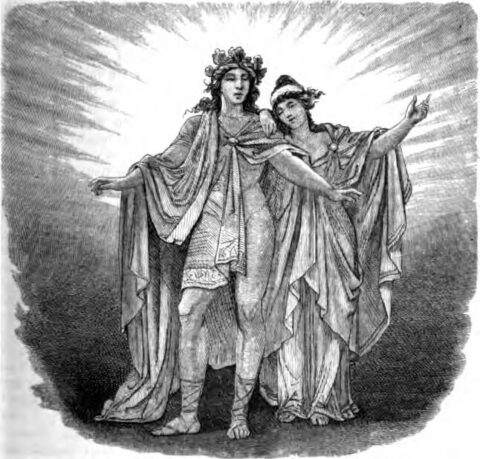
In Norse mythology, the sun is female and the moon is male. Their names are Sól and Máni, the children of Mundilfari. According to Snorri Sturluson’s Prose Edda, the gods placed them in the heavens, where Sól drives the sun’s chariot and Máni directs the moon and its changing phases.
Their journeys are threatened by pursuing wolves, although the surviving sources differ over which wolf chases each heavenly body. At Ragnarök, the sun is swallowed, but Sól leaves behind a daughter who will follow her mother’s path. These stories, preserved in the Poetic Edda and Prose Edda, also raise questions about how the two figures were understood and whether they were worshipped in pre-Christian Scandinavia.
Who Were Sól and Máni in Norse Mythology?
The names Sól and Máni are also the Old Norse words for “sun” and “moon.” Their portrayal as female and male reflects the grammatical genders of these nouns, reversing the more familiar Greek and Roman pattern of a male sun deity and a female moon goddess.
In Völuspá, stanza 5, the sun does not yet know where her halls are, while the moon remains unaware of his own power. These lines describe the early cosmos before its order is fully established. Vafþrúðnismál, stanzas 22–23, identifies Mundilfari as their father and links their journeys across the heavens to the measurement of years.
Snorri Sturluson’s Gylfaginning distinguishes the celestial bodies from the figures directing them. The sun itself was formed from sparks of Múspellheim, while Sól was assigned to guide its chariot. Snorri also includes her among the ásynjur, the goddesses associated with the Æsir, although Máni does not appear in his corresponding catalogue of gods.
Mundilfari: The Father of Sól and Máni
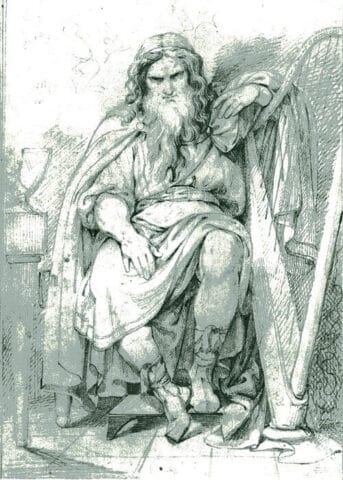
Vafþrúðnismál, stanza 23, names Mundilfari, also written Mundilfæri, as the father of Sól and Máni but offers no account of how his children came to travel across the heavens. That story appears in Snorri Sturluson’s Gylfaginning, chapter 11.
According to Snorri, Mundilfari had two children of exceptional beauty and named them after the sun and moon. He also arranged for Sól to marry a man named Glenr. Angered by his presumption, the gods took the siblings and placed them in the heavens, assigning them their celestial duties.
The narrative suggests that Mundilfari’s choice of names offended the gods, although it does not make clear whether Sól’s marriage also contributed to their anger. Neither Mundilfari’s origins nor Glenr’s role beyond the marriage is explained in the surviving accounts.
Sól’s Sun Chariot: Árvakr, Alsviðr, and Svalinn
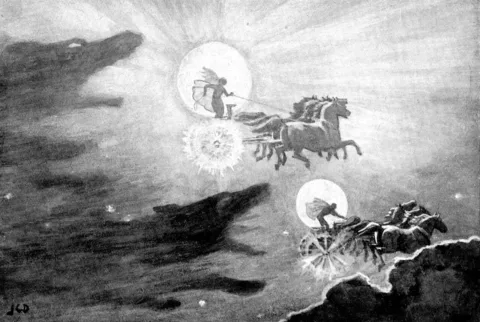
Sól’s chariot is drawn by two horses, Árvakr (“Early Awake”) and Alsviðr (“Very Swift”). In Grímnismál, stanza 37, they pull the sun across the sky, while the gods have placed something called ísarnkol, sometimes translated as “cold iron,” beneath their shoulders. The poem does not clearly explain what this object was or how it worked.
In Gylfaginning, chapter 11, Snorri Sturluson identifies ísarnkol with two bellows placed beneath the horses’ shoulders to protect them from the sun’s heat. This provides a practical explanation for an otherwise obscure detail, although the meaning of the original poetic term remains uncertain.
Grímnismál, stanza 38, describes another safeguard: Svalinn (“the Cooling One”), a shield standing before the sun. Without it, the poem warns, mountains and sea would burn. The shield protects the world from the sun’s destructive heat, but the text does not identify Sól as its bearer or explain who holds it in place.
Máni: The Moon’s Journey and Its Changing Phases
Unlike Sól, Máni has no named horses or chariot in the surviving accounts. In Gylfaginning, chapter 11, Snorri Sturluson describes him as guiding the moon across the sky and controlling its waxing and waning, without explaining how he produces these changes.
The moon’s role in measuring time also appears in Eddic poetry. Vafþrúðnismál, stanza 25, credits the gods with establishing the changing lunar phases so people could reckon the years. In Alvíssmál, stanza 14, the elves call the moon ártali, meaning “Year-Counter.” Neither poem describes Máni personally controlling the phases, a role attributed to him explicitly in Snorri’s account.
Bil and Hjúki: The Children Who Follow Máni
In Gylfaginning, chapter 11, Snorri Sturluson tells the story of Bil and Hjúki, two children of a man named Viðfinnr. As they returned from a well called Byrgir, they carried a water vessel named Sægr, suspended from a pole called Simul. Máni took the children from the earth and brought them into the heavens to accompany him.
Snorri states that the children can be seen from the earth but does not explain what they represent or why Máni took them. They are often interpreted as figures visible in the moon’s dark markings, although this identification is not made in the original text.
Bil appears again in Gylfaginning, chapter 35, where she is listed among the ásynjur, or goddesses. Hjúki receives no comparable status, and neither child’s later fate is recorded. No surviving Eddic poem provides a fuller account of their story.
Sköll and Hati: The Wolves That Chase the Sun and Moon
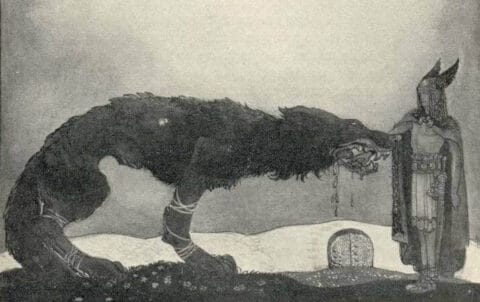
In Gylfaginning, chapter 12, Snorri Sturluson explains the sun’s rapid movement as an attempt to escape Sköll, a wolf destined to catch her. He also names Hati Hróðvitnisson, who runs ahead of the sun and seeks to capture the moon. This account forms the basis of the familiar association of Sköll with the sun and Hati with the moon.
Grímnismál, stanza 39, gives a less explicit account. Sköll pursues a shining deity, while Hati, identified as the son of Hróðvitnir, runs before the “shining bride of heaven.” Both descriptions may refer to the sun rather than separate celestial bodies. Hróðvitnir is generally identified with Fenrir, although the stanza does not name Fenrir directly.
The manuscript evidence adds another complication. Anthony Faulkes notes that the statement about Hati pursuing the moon appears in only two manuscripts of Gylfaginning and may be a later addition. The distinction between the wolves’ targets is therefore less secure than Snorri’s commonly reproduced narrative suggests.
Snorri traces the wolves to an ogress living in Járnviðr, the Ironwood forest east of Midgard, where she gives birth to giants in wolf form. Among their descendants is Mánagarmr, the “Moon-Hound,” who is said to swallow the moon and stain the heavens with blood. Whether Mánagarmr is another name for Hati or belongs to a separate tradition remains uncertain.
The wolves’ pursuit has also been interpreted as an explanation for eclipses, but neither Grímnismál nor Gylfaginning explicitly establishes such a connection.
What Happens to Sól and Máni at Ragnarök?
At Ragnarök, the wolves finally overtake the sun and moon. In Gylfaginning, chapter 51, Snorri Sturluson describes one wolf swallowing the sun and another seizing the moon, while the stars disappear from the sky. Although the moon is destroyed, Snorri does not separately describe Máni’s death.
The Eddic poems preserve different details. Vafþrúðnismál, stanzas 46–47, names Fenrir as the wolf that devours the sun. Völuspá, stanza 40, describes a monstrous descendant of Fenrir associated with the capture of a heavenly body, although interpretations differ over whether it refers to the sun or moon. In stanza 57, the sun turns black and the stars vanish as the earth sinks into the sea.
In Vafþrúðnismál, stanza 47, the sun is called Álfröðull, a poetic name meaning “Elf-Beam.” She bears a daughter before Fenrir catches her, and the daughter will follow her mother’s path after the gods have fallen.
Snorri repeats this prophecy in Gylfaginning, chapter 53, adding that the daughter will be no less beautiful than her mother. Her name is never given, and no comparable successor to Máni appears in the surviving accounts.
Read Also
Vafþrúðnismál: Odin’s Wisdom Contest in Norse Mythology
Were Sól and Máni Worshipped in Norse Religion?
Evidence for the historical worship of Sól and Máni is limited. No securely identified Viking Age temples, sacrifices, or religious ceremonies can be attributed specifically to either deity. Although Snorri includes Sól among the ásynjur, his classification does not establish that she had an organized cult.
A possible indication of the moon’s religious significance appears in Hávamál, stanza 137, which advises calling upon the moon against hostility. The passage suggests a protective use of lunar symbolism, but does not name Máni or describe a ceremony dedicated to him.
Earlier archaeological evidence reveals the importance of solar beliefs in Scandinavia. The Trundholm Sun Chariot, discovered in Denmark in 1902 and dated to around 1400 BCE, depicts a horse drawing a gilded solar disc. Other Nordic Bronze Age images associate the sun with horses and ships, suggesting that its imagined journey held religious significance long before the Viking Age.
These images predate the surviving Norse mythological accounts by more than two millennia. Their similarities to Sól’s chariot are noteworthy, but they cannot establish an unbroken religious tradition or prove that Bronze Age communities worshipped the sun as the goddess Sól.
Conclusion
Sól and Máni gave the sun and moon distinct identities in Norse mythology, but the surviving sources reveal far more about Sól. Her celestial journey is described in greater detail, and her unnamed daughter is destined to continue it after Ragnarök. No comparable future is recorded for Máni.
Their stories place the movement of the heavens within a world threatened by destruction but capable of renewal. Yet the differences between the Eddic poems and Snorri’s accounts, together with the limited evidence of historical worship, leave much about their place in pre-Christian Norse religion uncertain.
Sources & Primary Texts
- Pettit, Edward. (2023).
The Poetic Edda: A Dual-Language Edition.
Open Book Publishers.
Primary texts: Völuspá, Vafþrúðnismál, Grímnismál, and Alvíssmál.
Read source. - Sturluson, Snorri.
Edda: Prologue and Gylfaginning.
Edited by Anthony Faulkes, 2nd ed., Viking Society for Northern Research, 2005.
Chapters 11, 12, 35, 51, and 53.
Read source (PDF). - Mattioli, Vittorio. (2017).
Grímnismál: A Critical Edition.
PhD thesis, University of St Andrews.
Critical study of the poem, including the sun’s horses, Svalinn, and the pursuing wolves.
Read study. - Evans, D. A. H., ed. (1986).
Hávamál.
Viking Society for Northern Research.
Stanza 137, concerning an invocation of the moon.
View edition. - Kaul, Flemming. (2026).
“The Sun, the Ship, and the Horse in Nordic Bronze Age Iconography, in Petroglyphs and on Bronze Objects.”
L’Anthropologie, 130(1), article 103451.
Read study. - National Museum of Denmark.
The Sun Chariot.
Archaeological documentation of the Trundholm Sun Chariot, dated to approximately 1400 BCE.
View museum source.
Copyright & Editorial Notice
© 2026 History & Myths. All rights reserved. This article is an original editorial work based on historical sources and academic research. Interpretations of Norse mythology are presented with attention to differences between surviving texts and the limits of historical evidence. Reproduction of the article’s original text without permission is prohibited, except as permitted by applicable copyright law.