Iklaina: The Mycenaean City and the Rise of Pylos
Iklaina was a major Mycenaean settlement in Messenia, southwestern Greece, near the palace at Ano Englianos, the center of the Kingdom of Pylos. Excavations have uncovered monumental buildings, painted walls, drainage systems, and clay tablets inscribed in Linear B, the script used to write Mycenaean Greek. These finds point to an important regional center with its own administrative activity during the Late Bronze Age.
But Iklaina’s political position remains disputed. Did it once govern an independent territory before coming under Pylian authority, or was it already part of the kingdom at an earlier date? A second Linear B tablet fragment, discovered in 2025, adds evidence of local recordkeeping without settling that question. The site’s archaeological remains offer a way to trace how political authority developed in Mycenaean Greece before the collapse of its palatial kingdoms.
What Was Iklaina in Mycenaean Greece?
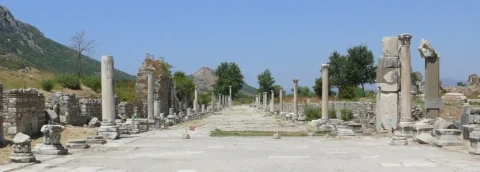
Iklaina stood on a plateau near the modern village of the same name, approximately 14 kilometers northeast of Pylos in Messenia, southwestern Greece. It belonged to the Mycenaean civilization of the Late Bronze Age, centuries before the emergence of the classical Greek city-states.
The settlement was occupied from around 1700–1600 BCE and flourished between approximately 1550 and 1250 BCE. At its height, Iklaina covered an estimated 12 hectares, making it one of the larger settlements in the region. Its substantial public architecture distinguished it from the surrounding agricultural communities.
By the final period of Mycenaean palace rule, Iklaina belonged to the territory administered from Ano Englianos, where the Palace of Nestor stood. Archaeologists consider it a likely regional administrative center within the Kingdom of Pylos, although its earlier political status remains disputed.
The Discovery and Excavation of Iklaina
Iklaina was first excavated in 1954, when the Greek archaeologist Spyridon Marinatos uncovered substantial stone walls, painted plaster fragments, and Mycenaean pottery. The excavation lasted only a few days, and the site remained largely unexplored for more than four decades.
The Iklaina Archaeological Project was established in 1998 under Michael B. Cosmopoulos and the Archaeological Society at Athens. Regional surveys and geophysical investigations conducted between 1999 and 2006 mapped the surrounding settlements and located buried structures. Trial trenches were opened in 2006, followed by full-scale excavations in 2008.
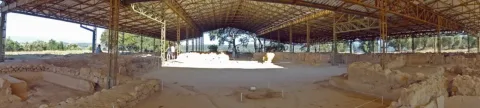
Later campaigns exposed residential quarters, workshops, and monumental buildings, including the Cyclopean Terrace Complex. Successive construction layers and pottery deposits allowed archaeologists to trace changes in the settlement’s layout and development.
Excavations in 2025, conducted within and south of Megaron Γ, revealed further evidence of successive building phases. An extensive destruction layer separated earlier structures from later construction, helping researchers refine the chronology of Iklaina’s architectural changes.
Inside Iklaina: Monumental Buildings and Urban Life
The largest structure at Iklaina was the Cyclopean Terrace Complex, built on a massive stone platform measuring approximately 24.3 by 8.2 meters. It supported a monumental building that may have stood two or three stories high. Its ashlar masonry and painted decoration suggest an important public structure, although its exact function remains uncertain.
Fragments of frescoes depict ships with rowers, human figures, and animals. Nearby stood Building X, another substantial structure separated from the Cyclopean Terrace Complex by a paved square. Paved streets and an entrance gateway connected this monumental area with other parts of the settlement.
Iklaina also had an extensive system of water management. Stone-built drains removed wastewater and runoff, while terracotta pipes formed part of the settlement’s water infrastructure. The paved streets, drainage channels, and water supply installations required planning and regular maintenance.
Excavations beyond the monumental center have revealed houses, workshops, and storage rooms. Finds include pottery, spindle whorls, stone tools, and large vessels for storing agricultural products and liquids. Hearths and specialized working areas provide evidence of domestic life and craft production.
A pit near the monumental buildings has been interpreted as an open-air shrine. It contained plaster offering tables, pottery cups, animal figurines, charcoal, and burned bones, including remains of pigs and sheep or goats. These finds suggest rituals involving animal offerings and possibly communal drinking, although the deities associated with the site remain unknown.
The Linear B Tablets of Iklaina
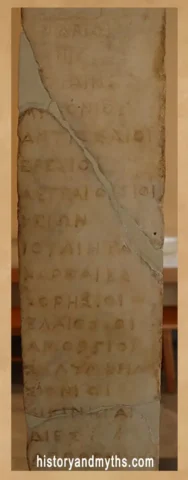
Two Linear B tablet fragments discovered at Iklaina provide evidence of written administration beyond the major Mycenaean palaces. Linear B was a syllabic script used to write Mycenaean Greek, primarily for recording personnel, goods, and economic activities. Both fragments predate the main surviving archives from the Palace of Nestor at Pylos.
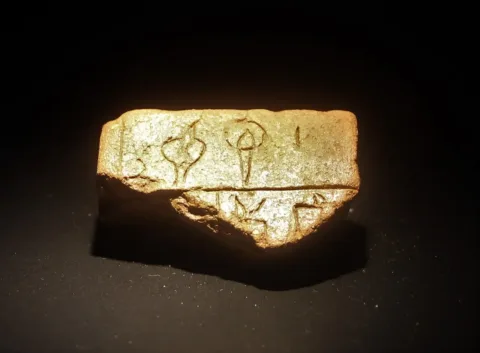
The first tablet was discovered in 2010 in a burned refuse pit containing pottery dated to approximately 1450–1350 BCE. The fire accidentally preserved the unfired clay. One side contains a probable personal name followed by the numeral one, suggesting a personnel record. The other preserves part of a word resembling forms found at Knossos and Pylos, possibly connected with manufactured goods. Much of the original text is missing, preventing a secure reconstruction.
A second fragment was discovered in 2025 in Room Γ3 of Megaron Γ and announced publicly in November 2026. Measuring approximately 1.3 centimeters in height, it preserves one syllabic sign on each face, alongside marks that may represent numbers. The surviving inscription is too incomplete to reveal what was being recorded.
The tablets show that administrative recordkeeping took place at Iklaina well before the destruction of the Pylian palace. Their discovery outside a major palace is particularly important for understanding how writing was used at regional centers. Neither fragment, however, identifies the authority under which its records were produced.
Was Iklaina an Independent Mycenaean State?
The debate over Iklaina’s political independence centers on when the settlement came under the authority of the palace at Ano Englianos. Its monumental architecture and administrative records suggest a powerful regional center, but neither proves that it governed an independent territory.
In a 2019 study published in the American Journal of Archaeology, Michael Cosmopoulos argued that Iklaina and Ano Englianos developed as separate political centers for much of the Mycenaean period. Each may have governed a small territory, or micropolity, before the expanding Kingdom of Pylos absorbed Iklaina during the 13th century BCE.
Archaeologist Cynthia Shelmerdine proposes an earlier date for Iklaina’s incorporation into Pylos. Her interpretation draws on pottery sequences, construction phases, and administrative evidence. Linear B records were already being produced at Ano Englianos during the Late Helladic IIIA period, around the time of Iklaina’s earliest surviving tablet. She therefore considers it more likely that Iklaina was already a subordinate administrative center rather than an independent state.
The disagreement extends to a widespread destruction at Iklaina in the middle of Late Helladic IIIB. Cosmopoulos connects this event with the possible expansion of Pylian control, while Shelmerdine questions whether it marked a political conquest. Burned buildings and pottery establish the approximate date of the destruction, but cannot identify who caused it or whether warfare was involved.
Iklaina has sometimes been called one of Greece’s earliest city-states. That description remains problematic: its political institutions are too poorly documented to compare directly with those of the later Greek polis. Whether it once functioned as an independent center remains an open archaeological question.
Iklaina Within the Kingdom of Pylos
By the final phase of Mycenaean palace rule, Iklaina was probably part of the territory administered from Ano Englianos. Linear B records describe the Kingdom of Pylos as divided into two provinces: the Hither Province, with nine administrative districts, and the Further Province, with seven. One district center in the Hither Province was called a-pu₂, a name plausibly identified with Iklaina.
The Pylian administration relied on local officials known as ko-re-te and po-ro-ko-re-te, generally interpreted as district governors and their deputies. Tablet Jn 829 records their obligations to supply bronze, apparently from sanctuaries, for the manufacture of spear and javelin points. Such records show how the palace collected resources through officials stationed across its territory.
Archaeological surveys around Iklaina suggest a four-tier settlement hierarchy. Below the palace stood Iklaina as a probable district center, followed by smaller agricultural villages and scattered rural installations. Katsimigas, one of the nearby settlements, may have served as a specialized production center.
The identification of Iklaina with a-pu₂ has also prompted comparisons with Aipy, a town listed among Nestor’s territories in Homer’s Iliad (2.592). Thomas Palaima has argued that the names could refer to the same place, although the connection remains unproven.
Iklaina’s probable role as a district center suggests that it retained administrative importance under Pylian authority. No surviving document, however, describes how the settlement entered the kingdom, whether through military conquest, negotiation, or another political arrangement.
What Happened to Iklaina?
Iklaina’s monumental center was destroyed by fire around the middle of Late Helladic IIIB, during the 13th century BCE. Archaeologists uncovered burned building materials and collapsed masonry across much of the settlement, including the Cyclopean Terrace Complex. The monumental buildings were never rebuilt.
Iklaina remained inhabited after the destruction, although its character changed. Workshops continued operating in the northern sector, while residential activity survived farther east. Some later structures were built over earlier buildings with a different orientation. Activity around the former monumental center became much more limited.
The settlement appears to have been abandoned by the transition from Late Helladic IIIB to IIIC, around 1200 BCE, without evidence of another widespread destruction. Its disappearance coincided broadly with the collapse of the Mycenaean palatial system, including the Palace of Nestor, but the archaeological record does not establish a direct connection between these events.
Why Iklaina Matters to the History of Ancient Greece
Most surviving Linear B tablets from the Palace of Nestor at Pylos were preserved during its destruction around 1200 BCE. They document the kingdom’s administration near its end, but reveal little about how that system developed over previous centuries. Iklaina provides a longer archaeological record through successive building phases, changes in settlement organization, and earlier evidence of local recordkeeping.
These remains allow researchers to trace the development of a regional center rather than study it solely through the palace’s final records. They also provide evidence for testing how Mycenaean kingdoms formed, particularly whether powerful palaces gradually absorbed previously autonomous communities or exercised regional authority from an earlier stage. Iklaina cannot settle that debate, but its excavations help reconstruct the political changes that preceded the fully developed Pylian kingdom.
Conclusion
Iklaina was a substantial Mycenaean center with monumental architecture, written administration, and a history that extended beyond the destruction of its major public buildings. Its archaeological remains document changes in the settlement that the surviving records from Pylos cannot fully explain.
Whether Iklaina once governed an independent territory or came under Pylian authority earlier remains unresolved. Its history shows that the formation of the Mycenaean kingdoms was a complex process, whose political details are still being reconstructed from archaeological evidence.
Academic Sources & Archaeological Reports
- Cosmopoulos, Michael B. (2019).
“State Formation in Greece: Iklaina and the Unification of Mycenaean Pylos.”
American Journal of Archaeology, 123(3), 349–380.
View study. - Shelmerdine, Cynthia W. (2022).
“Pottery and Stratigraphy at Iklaina in the 14th–13th Centuries BC.”
In Synchronizing the Destructions of the Mycenaean Palaces, pp. 149–160.
Austrian Academy of Sciences Press.
Read study. - Cosmopoulos, Michael B. (2018).
Iklaina: The Monumental Buildings.
Archaeological Society at Athens, Library No. 316.
Architectural remains, construction phases, and the Cyclopean Terrace Complex.
View publication. - Cosmopoulos, Michael B. (2006).
“The Political Landscape of Mycenaean States: A-pu2 and the Hither Province of Pylos.”
American Journal of Archaeology, 110(2), 205–228.
View study. - Cosmopoulos, Michael B., ed. (2016).
The Political Geography of a Mycenaean District: The Archaeological Survey at Iklaina.
Archaeological Society at Athens, Library No. 306.
Regional surveys, settlement patterns, and material culture.
View publication. - Cosmopoulos, Michael B. (2015).
“A Mycenaean Open-Air Cult Place in Iklaina.”
Journal of Ancient Egyptian Interconnections, 7(3), 41–48.
Archaeological evidence for ritual activities at the settlement.
View study. - Palaima, Thomas G. (2020).
“Iklaina, Traganes, a-pu2, and Aipy.”
In Kydalimos: Festschrift for Professor Georgios S. Korres, Vol. 2.
Study of the proposed identification of Iklaina with names found in Linear B records and Homeric tradition.
Read study (PDF). - Archaeology in Greece Online. (2026).
Iklaina: 2025 Excavation Report.
Record 22778, based on Ergon 72 (2025), published 2026, pp. 25–31.
Excavation evidence for building phases, destruction deposits, and the second Linear B tablet fragment.
Read excavation report.
Copyright & Editorial Notice
© 2026 History & Myths. All rights reserved. This article is an original editorial work based on archaeological reports, historical evidence, and academic research. Interpretations concerning Iklaina’s political status and its relationship with the Kingdom of Pylos are distinguished from established archaeological findings. Reproduction of the article’s original text without permission is prohibited, except as permitted by applicable copyright law.