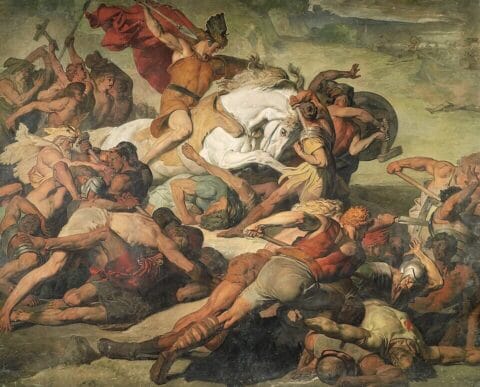
What If Constantine Had Lost the Battle of the Milvian Bridge?
On October 28, 312 CE, Constantine defeated Maxentius at the Battle of the Milvian Bridge outside Rome. Maxentius drowned in the Tiber, leaving Constantine in control of Italy. The victory strengthened Constantine’s claim to imperial power and marked a turning point in Rome’s relationship with Christianity.
But what if Constantine had been killed and Maxentius had won? Maxentius would have remained emperor in Rome, while Constantine’s territories in Gaul, Britain, and Hispania faced an uncertain future. Licinius and Maximinus Daia would still have been rivals in the East. Christianity, already granted toleration under Galerius in 311, was unlikely to disappear, but its rise to imperial prominence might have taken a different course.
Without Constantine, the Council of Nicaea, the founding of Constantinople, and the political future of the empire would have developed under different circumstances.
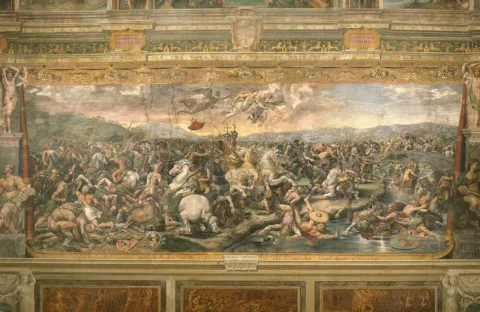
The Battle of the Milvian Bridge in 312 CE
By 312 CE, Diocletian’s Tetrarchy had broken down, leaving the Roman Empire divided among rival emperors. Constantine controlled Britain, Gaul, and Hispania, while Maxentius ruled Italy and North Africa from Rome. Constantine had married Maxentius’ sister Fausta, but the family connection did not prevent their rivalry from developing into war.
Constantine invaded Italy in 312, crossing the Alps and defeating Maxentius’ forces at Turin. Milan submitted, and another victory at Verona cleared his route to Rome. Despite the protection offered by the city’s Aurelian Walls, Maxentius chose to fight outside them on October 28, the sixth anniversary of his accession. Lactantius connects this decision with unrest in Rome and a prophecy drawn from the Sibylline Books, although Maxentius’ actual motives remain uncertain.
The armies met near the Milvian Bridge, where the Via Flaminia crossed the Tiber north of Rome. Maxentius’ troops were defeated and retreated toward the river. Eusebius describes the collapse of a temporary bridge of boats, while other ancient accounts differ over the circumstances of Maxentius’ death. He drowned in the Tiber, and Constantine entered Rome the following day.
Christian writers also associated the victory with divine intervention. Lactantius describes a dream instructing Constantine to mark his soldiers’ shields with a Christian symbol. Eusebius later recorded a vision of a cross in the sky. These accounts differ in their details and cannot establish precisely what Constantine experienced before the battle.
The Alternate Scenario: Maxentius Defeats Constantine
On October 28, 312 CE, Maxentius’ troops withstand Constantine’s assault outside Rome and launch a counterattack. Constantine’s forces lose cohesion, and he is killed while attempting to rally his men. His surviving troops retreat north, ending the invasion of Italy. Maxentius retains enough soldiers to defend Rome, avoiding the disastrous withdrawal toward the Tiber that ended his reign in actual history.
Maxentius could now present himself as the defender of Rome against an invading rival, reinforcing his established emphasis on the city’s traditional prestige.
Constantine’s death would leave the armies and provincial authorities of Gaul, Britain, and Hispania without their established emperor. Whether they accepted Maxentius or supported another claimant would determine how far his victory extended beyond Italy.
Could Maxentius Have Secured the Western Empire?
Maxentius would still have faced obstacles within Italy. Milan and Verona had fallen to Constantine during his invasion, and restoring control over northern Italy would require securing their garrisons and local officials. The Praetorian Guard and his surviving troops could support him, but his earlier defeats had weakened his military position.
Gaul presented a greater challenge. Constantine had ruled from Trier since 306, with substantial forces stationed along the Rhine frontier. Senior officers could organize resistance or proclaim a successor.
Constantine’s young son Crispus might have served as a dynastic figurehead, although he was still a child and had not been granted the title of Caesar.
Britain and Hispania would also have to choose their allegiance. Their governors and military commanders might recognize Maxentius in exchange for guarantees of office and security. Others could remain loyal to Constantine’s family or support a new claimant. Maxentius would need their cooperation, since his victory outside Rome gave him no immediate control over their armies.
North Africa posed a different problem. Maxentius had already faced a rebellion there under Domitius Alexander, whose control of the African provinces threatened Rome’s grain supply. The revolt had been suppressed before Constantine’s invasion, but it demonstrated the vulnerability of Maxentius’ authority outside Italy. Another provincial rebellion could disrupt essential supplies and force him to divert troops from campaigns in the northwest.
Licinius, Maximinus Daia, and the Struggle for Power
After Galerius’ death in 311 CE, Licinius controlled the Balkan provinces, while Maximinus Daia ruled Syria, Egypt, and Asia Minor. The two emperors had agreed to divide Galerius’ territories, but their rivalry remained unresolved.
By 312, opposing alliances had begun to form. Constantine had arranged the marriage of his half-sister Constantia to Licinius, strengthening their political partnership. According to Lactantius, Maximinus responded by sending envoys to Maxentius, seeking an alliance against their common rivals. The agreement was publicly acknowledged through the display of both emperors’ portraits.
In the alternate scenario, Maxentius’ survival would preserve Maximinus’ western ally while depriving Licinius of Constantine’s political backing. The marriage to Constantia, celebrated in actual history in 313, might never have taken place. Maximinus and Maxentius could have coordinated their opposition to Licinius, although Maxentius’ need to secure Italy would have limited his ability to intervene immediately in the East.
The rivalry between Licinius and Maximinus could still have led to war. In actual history, Maximinus crossed the Bosporus in 313, captured Byzantium and Heraclea, and was defeated near Tzirallum on April 30. Without Constantine, the timing and diplomatic circumstances of such a campaign might have changed. Licinius could have sought an agreement with Maxentius, while Maximinus might have attempted to exploit his rival’s isolation. Neither outcome was assured, and a prolonged division of imperial power remained possible.
Would Christianity Have Survived Without Constantine?
Christianity was already firmly established across the Roman Empire by 312 CE, with bishops, clergy, and organized communities stretching from Rome and North Africa to Syria and Egypt. Despite the persecution launched under Diocletian in 303, these communities endured. Galerius’ edict of 311 permitted Christians to assemble again, although its implementation varied across the empire.
Maxentius had generally tolerated Christians in Italy and North Africa, despite his attachment to Rome’s traditional religious institutions. Evidence also indicates that his government took steps to restore confiscated church property. Had he survived, he might have continued this policy without becoming a Christian himself or providing extensive financial support to the churches.
Constantine’s importance lay partly in the resources he placed at Christianity’s disposal. He financed church construction, granted privileges to clergy, and involved bishops in imperial affairs. Without his patronage, Christian communities would have depended more heavily on local donations and wealthy supporters. Their institutions could still have expanded, but without the same access to imperial funding and political influence.
The situation in the East was less secure. Maximinus Daia had renewed anti-Christian measures after Galerius’ edict. Had he defeated Licinius, persecution might have continued in his territories, while other emperors maintained toleration. Christianity’s survival did not depend on Constantine alone, but its expansion and political influence could have developed at a different pace, with greater differences between regions.
What Happens to the Edict of Milan and the Council of Nicaea?
In 313 CE, Constantine and Licinius agreed at Milan to permit religious worship and restore property confiscated from Christian communities. The agreement commonly called the Edict of Milan survives in an imperial letter published by Licinius at Nicomedia that June. Galerius had already permitted Christian worship in 311, but the new measures went further by requiring the return of church property, even when it had passed into private hands. Without Constantine, this particular agreement would not have existed. Licinius might still have introduced similar measures, depending on the outcome of his struggle with Maximinus Daia.
The Council of Nicaea would have been harder to reproduce. After defeating Licinius in 324, Constantine summoned bishops from across the empire in 325 to address the theological dispute involving Arius and Alexander of Alexandria, disagreements over the date of Easter, and the Melitian schism in Egypt. The council adopted a creed affirming that the Son was of the same substance as the Father, although theological disagreements continued for decades afterward.
Christian bishops had held regional synods before Constantine and could have continued resolving disputes through such gatherings. Without a single emperor willing to sponsor a wider council, however, bringing bishops together from distant provinces and securing acceptance of their decisions would have been more difficult. The controversies themselves might also have developed differently without Constantine’s involvement in church affairs.
A later ruler could have convened a comparable council, but neither the Nicene Creed of 325 nor the particular settlement reached there was inevitable. Both emerged from theological debates shaped by the political circumstances of Constantine’s reign.
Would Constantinople Ever Have Become an Imperial Capital?
After defeating Licinius in 324 CE, Constantine began transforming the ancient city of Byzantium on the Bosporus into a new imperial residence. He expanded its walls and commissioned a palace, public buildings, and monumental spaces. Formally dedicated on May 11, 330, Constantinople occupied a strategic position between the Black Sea and the Mediterranean, with access to major routes connecting Europe and Asia. Its development into the principal center of the Eastern Roman Empire, however, took several decades.
Without Constantine, Maxentius would have had little reason to undertake such a project. He had made Rome the center of his government and invested heavily in its monuments, including the great basilica later associated with Constantine. A victory over his rival would likely have strengthened his commitment to Rome rather than encouraged the establishment of another imperial residence at Byzantium.
The East already possessed cities capable of supporting an imperial court. Diocletian had governed from Nicomedia, Galerius maintained residences at Thessalonica and Serdica, and Antioch was an important administrative and military center. If Licinius or Maximinus Daia had established lasting authority in the eastern provinces, one of these cities could have remained the principal seat of government.
Byzantium’s strategic advantages might still have attracted a later emperor, but its transformation into a monumental capital was not inevitable. An eastern imperial administration could have continued without Constantinople becoming its political center, leaving the region’s established cities to compete for that role.
Read Also
What If the Western Roman Empire Never Fell? Rome’s Second Chance
Could Rome have survived beyond 476 CE? Explore how a different outcome to the failed campaign against the Vandals might have changed the Western Empire’s fate.
How Different Could the Later Roman Empire Have Been?
Constantine’s death in 312 CE would have prevented the dynastic succession that followed his actual death in 337. His three sons, Constantine II, Constantius II, and Constans, were all born after 312 and later divided the empire among themselves. Their civil wars, including the conflict of 340, could not have occurred in the same form. The next generation of rulers would instead have emerged from the struggles among the surviving emperors and their successors.
Much of the Roman state would still have been recognizable. Diocletian had already reorganized provincial administration, taxation, and the military before Constantine came to power. Later emperors could have modified these arrangements, but Constantine’s absence would not have erased them. Government through several imperial courts might have continued, although another successful ruler could eventually have reunited the empire.
Rome would also have faced familiar military pressures. Its armies still had to defend the Rhine and Danube frontiers, while the territorial settlement imposed on Persia in 298–299 remained a source of tension. Shapur II later challenged Roman influence in Mesopotamia and Armenia. Prolonged civil wars could have weakened Rome’s ability to respond, though a stable government in the East might have maintained its frontier defenses.
Beyond the fourth century, the consequences become increasingly uncertain. The separate imperial courts that endured after 395 and the deposition of Romulus Augustulus in 476 arose from later political and military developments. Neither can be treated as an inevitable result of Constantine’s victory or something that Maxentius’ survival would necessarily have prevented. A different emperor could have inherited Rome’s existing institutions and frontier problems, but the political decisions made over the following generations would have determined the empire’s fate.
Sources & Primary Texts
Primary Historical Sources
- Lactantius.
De Mortibus Persecutorum (On the Deaths of the Persecutors), chapters 34 and 43–48. A contemporary Christian account of imperial rivalries, Constantine’s campaign, the Battle of the Milvian Bridge, and religious toleration.
Read Primary Text. - Eusebius of Caesarea.
Ecclesiastical History, Book IX, chapter 9, and Life of Constantine, Book I, chapters 28–38. Ancient accounts of the battle, the emperor’s religious vision, and the Christian interpretation of his victory.
Ecclesiastical History |
Life of Constantine. - Edicts of Toleration, 311 and 313 CE.
English translations of Galerius’ toleration decree and the religious settlement associated with Constantine and Licinius, including provisions concerning confiscated Christian property.
Fordham University, Primary Sourcebook.
Academic Studies
- Van Dam, Raymond.
Remembering Constantine at the Milvian Bridge.
Cambridge University Press, 2011. A study of Constantine’s victory, Maxentius, and the formation of historical and religious narratives surrounding the battle.
Cambridge University Press. - Serfass, Adam.
“Maxentius as Xerxes in Eusebius of Caesarea’s Accounts of the Battle of the Milvian Bridge.”
The Classical Quarterly 72, no. 2 (2022): 822–833. An examination of the boat-bridge narrative and its literary parallels.
Read Academic Article. - Curran, John R.
Pagan City and Christian Capital: Rome in the Fourth Century.
Oxford University Press, 2002, chapter 2, “Conservator Urbis: Maxentius in Rome,” pp. 43–69. Examines Maxentius’ political position, building projects, and treatment of Christians.
Oxford Academic. - Corcoran, Simon.
The Empire of the Tetrarchs: Imperial Pronouncements and Government, AD 284–324.
Oxford University Press, 1996. A study of imperial institutions, administration, and the political breakdown of Diocletian’s Tetrarchy.
Oxford Academic. - Cameron, Averil.
“Constantine and the ‘Peace of the Church’.”
In The Cambridge History of Christianity, vol. 1. Cambridge University Press, 2006. An analysis of the transition from Christian persecution to imperial patronage.
Cambridge University Press. - Kim, Young Richard, ed.
The Cambridge Companion to the Council of Nicaea.
Cambridge University Press, 2021. Scholarly studies of the council’s historical setting, theological debates, imperial involvement, and later reception.
Cambridge University Press. - Matthews, John.
From Byzantium to Constantinople: An Urban History.
Oxford University Press, 2024. Examines Byzantium before Constantine and the city’s transformation into an imperial center.
Oxford Academic. - Lewis, William.
Division of Empire: The Reign of the Sons of Constantine.
Oxford University Press, 2024. An examination of Constantine’s successors, the civil wars of the fourth century, and the development of divided imperial government.
Oxford Academic.
Copyright & Attribution
© 2026 History & Myths. All rights reserved. Original historical analysis and alternative history scenarios by History & Myths. Historical events are examined using the primary texts and academic sources cited above. Speculative outcomes are fictional interpretations, not documented historical events. Images, where used, remain subject to their respective copyright and licensing terms.