What If Adapa Had Accepted Immortality? A Mesopotamian Myth
Adapa, the sage of Eridu, was summoned before Anu after breaking the wing of the South Wind. Before his journey to heaven, Ea warned him that the food and drink offered there would bring death. Yet Anu presented him with the food and water of life. Adapa obeyed Ea and refused, a decision traditionally interpreted as a lost opportunity for immortality.
What if Adapa had accepted Anu’s gift? He might have escaped death without becoming a god, while the rest of humanity remained mortal. His new existence would raise questions about his relationship with Ea, his place in Anu’s heavenly court, and whether he could ever return to Eridu.
This possibility rests on a debated reading of the myth. Scholars disagree over whether Anu’s offering originally promised eternal life, particularly when comparing the surviving versions. Our alternative scenario follows the traditional interpretation, exploring how immortality might have changed Adapa’s fate without assuming it would transform the human world.
The Myth of Adapa and the Food of Life
Adapa served the god Ea (Enki) at Eridu, one of southern Mesopotamia’s oldest religious centers. His duties included preparing offerings and catching fish for the god’s household. During one fishing expedition, the South Wind overturned his boat. Enraged, Adapa cursed the wind and broke its wing, preventing it from blowing for seven days. Anu, the ruler of heaven, summoned him to explain the disturbance.
Before Adapa departed, Ea instructed him how to secure a favorable reception. He was to wear mourning clothes and tell Dumuzi and Ningishzida, the deities stationed at heaven’s gate, that he mourned their absence from the earth. Ea also warned him against accepting food or water, claiming they would bring death. Clothing and anointing oil, however, were safe to receive.
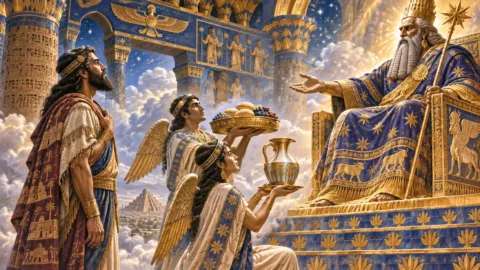
The instructions worked at first. Dumuzi and Ningishzida spoke on Adapa’s behalf, and Anu listened to his explanation. The heavenly king then questioned why Ea had revealed such extraordinary knowledge to a human being. Instead of the deadly provisions Adapa expected, Anu ordered the food and water of life to be brought before him.
Adapa refused both offerings but accepted the clothing and oil. When Anu asked why he had neither eaten nor drunk, Adapa explained that he was following Ea’s instructions. Anu then ordered him to return to earth.
The meaning of this refusal remains disputed. The best-preserved account comes from a fourteenth-century BC tablet discovered at Amarna in Egypt, while later Neo-Assyrian fragments preserve additional material. These later texts explicitly contrast the wisdom Ea granted Adapa with the eternal life he withheld. Sara J. Milstein argues that this emphasis on wisdom and immortality reflects revisions to the story, rather than necessarily expressing the original purpose of the older narrative. Although Adapa’s refusal is commonly understood as a lost opportunity for eternal life, the precise significance of Anu’s offering remains open to interpretation.
The Point of Divergence: Adapa Accepts Anu’s Offer
The turning point comes when Anu’s attendants present Adapa with the food and water of life. Despite Ea’s warning, Adapa decides to accept the offerings. Anu’s favorable reception has given him reason to question the danger his divine patron described, and he chooses to trust the heavenly king.
For this scenario, we assume that Anu’s gift grants Adapa eternal life, following the traditional interpretation of the myth. The earlier Amarna text leaves the precise meaning of the offering open to debate, while later versions place greater emphasis on the distinction between human mortality and divine immortality. Adapa’s transformation is therefore a deliberate assumption, not an outcome established beyond dispute by the surviving sources.
What happens afterward is less certain. In the original account, Anu orders Adapa to return to earth after his refusal. Accepting the gift removes the circumstances behind that decision, opening the possibility that Anu might instead retain him in heaven. Whether Adapa remains at the divine court or returns to Eridu becomes the next question in this alternative history.
The Alternate Scenario
Adapa accepts the food and water offered by Anu. The death Ea warned him against does not follow. Instead, the offerings grant him eternal life, leaving Anu to decide what place a human sage with extraordinary wisdom and immortality should occupy in heaven.
Rather than sending Adapa back to Eridu, Anu retains him at the heavenly court. His knowledge of earthly rituals and human affairs earns him a position among the divine attendants. He has entered a world ordinarily beyond human reach, although his duties and privileges remain subject to Anu’s authority.
When Ea learns of the decision, he discovers that Adapa has disregarded his warning and entered another god’s service. In this imagined outcome, Ea does not challenge Anu or attempt to reclaim his former servant. The wisdom he bestowed on Adapa remains intact, but it is no longer exercised within Ea’s own household. Their relationship has changed without requiring a conflict between the gods.
Back in Eridu, Adapa’s responsibilities pass to others. The temple continues to prepare offerings, supply provisions, and perform the rituals associated with Ea. His absence does not bring these traditions to an end, but the sage who once served the sanctuary will no longer take part in its daily ceremonies.
Generations pass, and Adapa remains in Anu’s court. The people who knew him disappear, while successive priests assume the duties he left behind. His familiarity with earthly life continues to distinguish him from the other inhabitants of heaven, though his knowledge does not give him authority over their decisions.
Over time, Eridu becomes a place Adapa remembers rather than one to which he belongs. His life is no longer measured by human generations, and the responsibilities that once defined his existence have passed beyond his reach. He remains a servant of the gods, but his service now belongs to the heavenly court.
Would Immortality Make Adapa a God?
Eternal life would not automatically grant Adapa the status or authority of a god. The Epic of Gilgamesh offers a useful comparison: Utnapishtim and his wife receive immortality after surviving the great flood, but they do not become members of the divine assembly or acquire power over the gods. Their exceptional fate shows that escaping death need not involve assuming divine authority.
Adapa already occupied an unusual position in Mesopotamian tradition. Later accounts identify him as an apkallu, one of the ancient sages associated with Ea and the transmission of divine wisdom to humanity. His ability to break the South Wind’s wing demonstrates the extraordinary power attributed to his knowledge. Yet wisdom, however exceptional, was not equivalent to the authority exercised by the gods over the cosmic order.
Later traditions suggest that Adapa’s position could extend beyond that of a gifted human. The Neo-Assyrian fragment K 8214 describes Anu taking Adapa into his service and releasing him from Ea’s authority. Amar Annus connects this account with other Mesopotamian traditions that portray Adapa’s heavenly elevation in terms approaching divine status, including associations with Anu’s throne. These sources complicate any strict separation between Adapa and the divine world.
In our alternative scenario, Adapa remains an immortal sage serving Anu. His position gives him access to the heavenly court, but any further elevation would require recognition from the gods rather than follow automatically from eating the food of life. His immortality changes the nature of his existence, while his precise standing within the divine hierarchy remains dependent on Anu.
How Would Ea and Anu Respond?
Adapa’s decision would alter his relationship with the god who had granted him extraordinary wisdom. Ea had prepared him for his encounter with Anu, providing instructions intended to secure his safety. Whether the warning against accepting food and water was deliberate deception or a genuine precaution remains disputed. The surviving texts offer no certain explanation of Ea’s motives, making his reaction to Adapa’s disobedience equally uncertain.
Ea might regard the decision as a rejection of his guidance, particularly if Adapa entered Anu’s permanent service. Yet the myth provides no basis for assuming that he would punish his former servant or challenge Anu. The immediate consequence would be the loss of a sage whose knowledge and ritual duties had been closely associated with Ea’s household at Eridu.
Anu had originally summoned Adapa to account for breaking the South Wind’s wing. His favorable reception and offer of food created an opportunity that Ea’s instructions had not anticipated. If Adapa accepted the gift, Anu would have to decide whether to return him to Ea or grant him a place in heaven. In our scenario, he chooses the latter, retaining Adapa as an immortal attendant whose responsibilities remain subject to his authority.
The Neo-Assyrian fragment K 8214 provides a precedent for this change of allegiance, although it does not connect the transition to accepting the food of life. Nor does it establish that Adapa’s new position caused hostility between Ea and Anu.
Could Adapa Return to Eridu?
Immortality would not necessarily prevent Adapa from returning to Eridu, but his departure from heaven would depend on Anu’s decision. In the Amarna account, Anu orders him sent back to earth after he refuses the food and water of life, although the relevant passage is partly damaged. The surviving myth offers no equivalent outcome for someone who accepts the divine gift. Adapa might therefore return as an immortal, but neither his return nor his permanent residence in heaven follows automatically from the transformation.
Eridu remained closely tied to Adapa’s identity as a servant of Ea. He prepared ritual provisions, supplied fish, and attended to the god’s table. If permitted to return, he could resume these responsibilities, bringing with him knowledge gained in Anu’s court. His experience might enhance his reputation among those responsible for preserving the city’s religious traditions. Yet there is no reason to assume that immortality would give him authority over Eridu’s priesthood or allow him to change its established rituals.
A return would also depend on the obligations attached to his new position. If Anu retained Adapa in his service, leaving heaven might require a special arrangement between the gods. Occasional visits to Eridu are conceivable, but no surviving version describes such an arrangement or establishes that Adapa could move freely between the two realms.
In our alternative scenario, Anu keeps Adapa at his court. Eridu continues its religious life without him, while his association with Ea and the city’s sacred traditions remains part of his identity.
Would the Rest of Humanity Become Immortal?
If Adapa accepted the food and water of life, there is no clear reason to assume that humanity would share his immortality. Anu’s offering was addressed to Adapa, and the surviving narrative describes no means by which its effects could pass to his descendants or other humans. Under our scenario, he would remain an exception while the people of Eridu continued to age and die.
Some scholars, however, have interpreted Adapa as a representative of humankind, making his refusal an explanation for why humans lost the opportunity for eternal life. This reading gives his decision consequences beyond his personal fate. It remains an interpretation rather than an explicit account of how immortality could have been granted to everyone. Sara J. Milstein further challenges the assumption that human mortality was the original focus of the story, arguing that its emphasis on wisdom and eternal life developed through later revisions.
Accepting the divine gift would therefore raise a question the ancient narrative does not resolve: was Anu offering immortality to one exceptional sage or, through him, to humanity? Our alternative scenario adopts the narrower possibility. Adapa escapes death, but the distinction between his extraordinary fate and the lives of ordinary humans remains. Extending his gift to all humanity would require a separate assumption that the surviving evidence cannot establish.
Read Also: Mesopotamian Mythology
How Would Adapa’s Immortality Change the Meaning of His Myth?
In the traditional interpretation, Adapa’s story presents a paradox: a man endowed with extraordinary wisdom loses the opportunity for eternal life by obeying the god who taught him. His knowledge cannot protect him from a decision whose consequences he does not understand. If Adapa accepted Anu’s offering, the central tension would shift. His willingness to question Ea’s instructions, rather than his obedience, would determine his fate.
The offering also carried a meaning beyond the promise of immortality. Mario Liverani interprets the food, water, clothing, and anointing oil through ancient Near Eastern conventions of hospitality. He distinguishes between external gifts, which Adapa accepts, and food and drink, whose consumption would signify fuller acceptance into the host’s community. From this perspective, eating Anu’s food could represent Adapa’s integration into the divine world, not merely his escape from death.
Yet his success would not necessarily turn the story into a lesson about the virtues of disobedience. Ea’s intentions remain uncertain, and accepting Anu’s hospitality would place Adapa under a different set of divine obligations. The alternative ending would therefore explore the consequences of crossing the boundary between human and divine existence. Adapa would gain the life he was traditionally thought to have lost, but his independence and place within the heavenly order would remain open questions.
Conclusion
If Adapa had accepted Anu’s food and water of life, he might have escaped death without changing the fate of humanity. In this alternative scenario, Anu grants him a place in the heavenly court, where his wisdom remains valuable but his position depends on divine authority.
The greater change lies in Adapa’s connection to Eridu. Its religious traditions continue without him, while generations of people live and die beyond his reach. The traditional story centers on a lost opportunity for immortality; this alternative raises a different question: what would Adapa sacrifice by gaining it? Eternal life would preserve the sage, but not the human world to which he once belonged.
Academic Sources & Primary Texts
Ancient Mesopotamian Texts
- Adapa and the South Wind, Amarna tablet EA 356 (fourteenth century BCE). Edited and translated in Shlomo Izre’el, The Amarna Scholarly Tablets (Groningen: Styx Publications, 1997). The principal surviving account of Adapa’s journey to heaven, Ea’s warning, and Anu’s offering of the food and water of life.
Text Reference. - Adapa and the South Wind, Neo-Assyrian fragment K 8214 (first millennium BCE). A variant account describing Adapa’s elevation in heaven and his entry into Anu’s service. Translation and discussion in Izre’el (2001) and Annus (2024).
Translation and Analysis. - The Epic of Gilgamesh, Standard Babylonian Version, Tablet XI. The account of Utnapishtim and his wife receiving eternal life provides a comparison for exceptional human immortality in Mesopotamian mythology.
Akkadian Text and Translation.
Modern Academic Studies
- Izre’el, Shlomo. Adapa and the South Wind: Language Has the Power of Life and Death. Mesopotamian Civilizations 10. Winona Lake, IN: Eisenbrauns, 2001. A critical edition, translation, and linguistic analysis of the surviving Adapa texts.
Publisher. - Milstein, Sara J. “A Second Wind: Revision through Introduction in Adapa.” In Tracking the Master Scribe: Revision through Introduction in Biblical and Mesopotamian Literature, 76–109. Oxford: Oxford University Press, 2016. Examines the development of the Adapa tradition and the later emphasis on wisdom and immortality.
Oxford Academic. - Liverani, Mario. “Adapa, Guest of the Gods.” In Myth and Politics in Ancient Near Eastern Historiography, edited by Zainab Bahrani and Marc Van De Mieroop, 3–26. Ithaca, NY: Cornell University Press, 2004. Interprets Adapa’s acceptance and rejection of divine offerings through hospitality, ritual status, and admission into the divine community.
Book Reference. - Annus, Amar. “The Story of the Watchers as a Counter Narrative: Enochic Responses to the Authority of Mesopotamian Sages.” Religions 15, no. 9 (2024): 1024. Discusses Adapa’s heavenly elevation, the Neo-Assyrian fragment K 8214, and traditions associating the sage with divine status.
Open Access Study.
Source Note: The surviving versions of the Adapa myth differ in their treatment of wisdom, immortality, and the sage’s heavenly status. The alternative scenario presented in this article follows the traditional interpretation that Anu’s offering could grant eternal life. Adapa’s acceptance, his imagined immortality, and the consequences described here are speculative, not events recorded in the ancient texts.
Copyright Notice
© 2026
History & Myths.
All rights reserved. The original writing, mythological analysis, and imagined alternative scenario in this article are protected by copyright. The ancient Mesopotamian texts and traditions discussed are cited for historical and academic reference. Images and other third-party materials remain subject to their respective licenses and attribution requirements.