Grottasöngr: The Norse Myth of Two Giantesses and a Magic Mill
In the Old Norse poem Grottasöngr, two giantesses named Fenja and Menja are forced to turn a magical mill called Grótti for the Danish king Fróði. The mill can produce gold, peace, and prosperity, but Fróði allows the women almost no rest. Their song gradually changes from a blessing on his reign to a warning of his approaching downfall.
The poem ends with the mill breaking and Fróði’s destruction foretold. The famous story of the mill sinking at sea and explaining why seawater is salty comes from the prose account preserved in Snorri Sturluson’s Skáldskaparmál, not from the poem itself.
What Is Grottasöngr, and Where Does the Poem Survive?
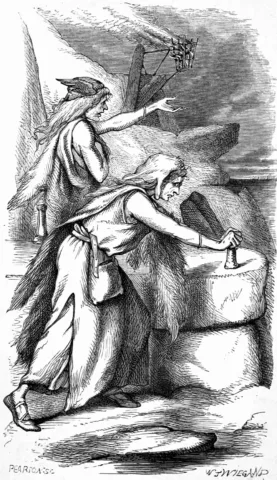
Grottasöngr, meaning “The Song of Grótti,” is a 24-stanza Old Norse poem presented as a work song sung by Fenja and Menja while turning the magical mill. Although often included in editions of the Poetic Edda, it is absent from that collection’s principal medieval manuscript.
The complete poem survives in two manuscripts of Snorri’s Edda: the early fourteenth-century Codex Regius (GKS 2367 4to) and Codex Trajectinus, a sixteenth-century copy of an older manuscript. A third manuscript, AM 748 II 4to, preserves only its opening stanza. In Skáldskaparmál, the mill legend explains why gold could be called “Fróði’s meal” in Old Norse poetry.
The story was known long before these manuscripts were written. A verse attributed to the tenth-century poet Egill Skallagrímsson uses “Fróði’s meal” as a name for gold, while Eyvindr skáldaspillir refers to the grinding performed by Fróði’s enslaved women. These references show that the legend circulated in skaldic poetry, although they cannot establish when Grottasöngr itself was composed.
The poem’s author is unknown, and its date remains disputed. Some scholars have proposed a Viking Age origin, but Clive Tolley argues that the surviving composition most likely dates to the twelfth century.
King Fróði, Fenja and Menja, and the Magic Mill
Fróði was a legendary Danish king whose reign became associated with Fróðafriðr, the Peace of Fróði. According to the prose account in Skáldskaparmál, violence and theft had nearly disappeared from his kingdom. A gold ring could remain untouched on Jalangr Heath, so secure was the peace. Snorri places Fróði’s reign around the time of Augustus and the birth of Christ, a medieval literary chronology rather than a verifiable historical date.
This peace was already established before Fróði acquired his magical mill. The poem, however, presents peace as something Fenja and Menja seek to produce through their grinding. As literary scholar Judy Quinn observes, the promised golden age never actually takes hold during the poem’s events.
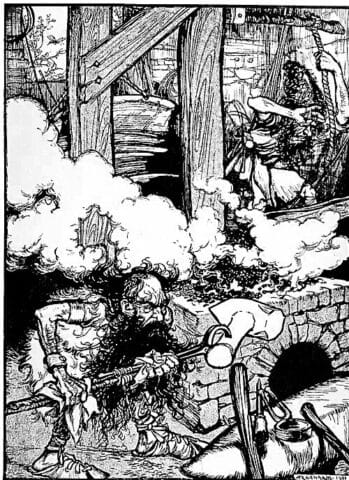
While visiting King Fjölnir in Sweden, Fróði purchased Fenja and Menja, two enslaved women of exceptional size and strength. Back in Denmark, enormous millstones had been discovered that no ordinary person could turn. They formed Grótti, a magical mill capable of producing whatever its operator requested. Snorri identifies Hengikjǫptr as the person who gave Fróði the mill, but does not explain who made it.
Fróði put the women to work grinding gold, peace, and prosperity. Although the prose initially describes them as unusually powerful enslaved women, the poem reveals their giant ancestry and connections to figures such as Hrungnir and Þjazi. Their strength was obvious to the king, but their origins remained unknown to him.
The Song of Grotti: Forced Labor and Revenge
Fenja and Menja begin by singing of prosperity for Fróði. As the millstones turn and the royal household sleeps, Menja wishes him wealth, comfort, and happiness. In stanza 6, she imagines a peace in which even a man confronting his brother’s murderer would refrain from violence.
Fróði allows them almost no rest. According to Snorri’s prose account, they may sleep only as long as a cuckoo remains silent or a single song takes to sing. The same command appears in stanza 7, although its surviving wording required editorial reconstruction. The giantesses’ goodwill soon disappears.
Menja challenges the king for purchasing them without asking about their ancestry. In stanzas 10 to 12, she recalls their youth beneath the earth, when they dislodged enormous stones from the mountains and sent them rolling through the giants’ territory until humans found them. The stones that formed Grótti had reached the human world through their own actions.
Fenja and Menja had also fought in Sweden, breaking shields and marching through armored warriors. They describe overthrowing one ruler while supporting another, Gotþormr, and continuing the struggle until a king named Knúi fell. Their former freedom stands in sharp contrast to their present condition. In stanza 16, they complain of standing in mud and cold, forced to grind for Fróði without pity or relief.
In stanza 17, one voice declares that her hands should rest and the millstone stand still. The other refuses to stop before Fróði has received all the grinding he deserves. The speakers are not explicitly identified, but Clive Tolley interprets the exchange as Menja wishing to stop and Fenja insisting on continuing. Their work now takes a different purpose.
The giantesses call on Fróði to wake. Their song speaks of weapons, fire rising east of the fortress, and an approaching army that will burn his residence. He will lose his throne at Hleiðr (Lejre), his golden treasures, and Grótti itself.
In Tolley’s reconstructed reading, stanza 22 invokes Yrsa’s son avenging Hálfdan’s death, linking the poem to other Danish royal legends. The surviving text is corrupt, however, and Tolley considers the stanza a probable later interpolation. Its connection to Fróði’s approaching downfall therefore remains uncertain.
The giantesses continue grinding until the mill’s supports give way and its heavy stone splits in two. In the final stanza, they announce that they have worked enough. The poem ends without narrating the battle or naming the king’s killer.
The Fall of Fróði and Why the Sea Became Salty
The prose account in Skáldskaparmál describes the attack that Grottasöngr leaves unnarrated. Before their song ends, Fenja and Menja grind out an army against Fróði. That night, a sea-king named Mýsingr arrives, kills the king, and seizes his treasures, bringing the celebrated Peace of Fróði to an end.
Mýsingr takes Grótti and the two giantesses aboard his ship, ordering them to grind salt instead of gold. At midnight, Fenja and Menja ask whether he has had enough, but he tells them to continue. They produce so much salt that the ship sinks.
In Snorri’s account, the salt explains why the sea became salty. The submerged millstone also creates a whirlpool where seawater pours through its central opening. This ending belongs to the prose narrative, not the surviving verses of Grottasöngr.
Grottasöngr vs. Snorri’s Prose: What Changes?
The poem and its accompanying prose preserve different parts of the Grótti legend. Four distinctions are particularly important:
| Aspect | The Poem | Snorri’s Prose |
|---|---|---|
| Fróði’s Peace | Fenja and Menja sing of a peaceful, prosperous reign, but the poem never depicts this golden age being realized. | Fróði’s celebrated peace already exists before he acquires the mill and puts the giantesses to work. |
| The King’s Fall | The giantesses foretell an attack, but the poem does not narrate Fróði’s death or name his killer. | The sea-king Mýsingr arrives with an army, kills Fróði, and takes his treasures. |
| Grótti’s Fate | The mill’s supports break and its great stone splits apart as the giantesses finish their work. | Mýsingr carries Grótti aboard his ship, where its continued grinding eventually sinks the vessel. |
| The Salty Sea | The surviving verses contain no account of grinding salt or a mill sinking into the sea. | The mill produces salt until the ship sinks, explaining the sea’s saltiness and a whirlpool above the submerged stone. |
Why the difference matters: The poem ends with the collapse of Fróði’s power, while the prose continues the legend as an explanation of a natural phenomenon. The broken millstone is especially significant because it conflicts with the mill’s continued operation in the sea.
What Does Grottasöngr Reveal About Kingship and Power?
The poem calls Fenja and Menja framvísar, meaning “foreknowing,” in stanzas 1 and 13. Their accounts of warfare carry particular significance: they have already helped determine which kings would gain power and which would fall. Fróði has enslaved two beings capable of influencing royal fortunes without recognizing the danger they represent.
Literary scholar Judy Quinn connects their abilities with those of the prophetic völur and the Valkyries, who influence the fate of warriors. The poem does not explicitly identify Fenja and Menja as either. Instead, it brings together different forms of supernatural power in two giantesses who can both foresee events and help bring them about. Their encounter with Fróði becomes a test of his judgment as a ruler.
Quinn also interprets Grótti as a resource whose benefits could extend to the whole kingdom. Its stone originated in the giants’ world, but Fróði uses its power chiefly to accumulate wealth. His treatment of the women reveals the limits of his authority: he can compel their labor but cannot ensure their loyalty.
The tension between foreknowledge and personal choice is central to this reading. Fenja and Menja anticipate the king’s destruction, yet his refusal to grant them rest helps set it in motion. His fate is inseparable from the decisions he makes while possessing the power to rule.
Read Also:
Völundarkviða: The Smith’s Revenge in Norse Mythology
Another Old Norse poem in which a king exploits extraordinary skills, only to face a devastating act of revenge.
Conclusion
Grottasöngr ends with the mill breaking and Fenja and Menja declaring their work complete, but the poem does not narrate Fróði’s death. Snorri’s prose carries the story further, describing the king’s downfall and the mill’s eventual sinking at sea. The poem centers on the consequences of Fróði’s misuse of supernatural power, while the prose extends the legend into an explanation of why the sea is salty.
Sources & Primary Texts
This article draws on critical editions of the Old Norse texts and academic studies of the poem’s literary context, manuscript tradition, and treatment of kingship.
- Tolley, Clive (ed. and trans.). (2008).
Grottasöngr: The Song of Grotti.
London: Viking Society for Northern Research.
Critical edition and translation. - Snorri Sturluson.
Edda: Skáldskaparmál.
Edited by Anthony Faulkes (1998).
London: Viking Society for Northern Research.
Old Norse text and scholarly notes. - Quinn, Judy. (2013).
“Death and the King: Grottasöngr in Its Eddic Context.”
Scripta Islandica, 64, 39–65.
Read academic study. - Vésteinn Ólason. (2005).
“Grottasöngur.”
Gripla, 16, 115–135.
Journal article.
Copyright & Attribution
© 2026 History & Myths. All rights reserved. Original article and commentary by H. Moses. Ancient Norse texts and historical traditions are discussed with reference to the scholarly editions and studies cited above. Copyright in modern translations and academic publications remains with their respective rights holders. Image credits and licensing information are provided separately.