Lludd and Llefelys: The Three Plagues of Britain in Welsh Mythology
In the Welsh tale Lludd and Llefelys, three mysterious plagues threaten the kingdom of Britain. The Coraniaid, a people who can hear even the quietest conversations, are impossible to defeat by ordinary means. A terrifying scream spreads across the island every May Eve, while the king’s food and drink disappear from his stores. Unable to end these disasters, King Lludd seeks the help of his brother Llefelys, who rules France.
Preserved in medieval Welsh manuscripts and included in The Mabinogion, the story follows how the brothers overcome each plague through a series of unusual solutions. Among them is the capture of two fighting dragons, an episode connected to the wider Welsh traditions surrounding Vortigern and Merlin.
Who Were Lludd and Llefelys?
In medieval Welsh tradition, Lludd and Llefelys were sons of Beli Mawr (Beli the Great), himself the son of Manogan. The tale names Lludd, Caswallawn, and Nyniaw as Beli’s three sons, with Llefelys mentioned as a fourth. After Beli’s death, Lludd, the eldest, inherited the kingship of Britain.
Lludd was portrayed as a capable warrior and a generous ruler who provided food and drink to those seeking his hospitality. He rebuilt London’s walls, surrounded the city with towers, and ordered the construction of impressive houses. Although he possessed other fortified cities, London remained his favorite residence. The tale attributes the name Caer Lludd (Lludd’s Fortress) to his reign, offering a legendary explanation rather than a historically established origin for the city’s name.
Llefelys was particularly valued by Lludd for his wisdom and judgment. When the king of France died, leaving his only daughter as heir, Llefelys sought his brother’s advice and support in marrying her. With Lludd’s approval, he sailed to France accompanied by armed knights. The French nobles accepted the marriage, and Llefelys became king through his wife.
Where Does the Story of Lludd and Llefelys Come From?
Lludd and Llefelys, known in Welsh as Cyfranc Lludd a Llefelys, survives in medieval Welsh prose. Its earliest surviving version appears in Llanstephan MS 1, copied between 1225 and 1250. The tale was incorporated into Brut y Brenhinedd, a Welsh adaptation of Geoffrey of Monmouth’s History of the Kings of Britain. Geoffrey’s original Latin work mentions King Lud but contains neither Llefelys nor the three plagues.
The story also survives as a separate narrative in two major Welsh manuscripts. The White Book of Rhydderch, dating to the first half of the fourteenth century, preserves only its opening, while the Red Book of Hergest, compiled around the end of that century, contains the complete tale. Both manuscripts preserve stories now grouped under the title The Mabinogion, although Lludd and Llefelys is not one of the Four Branches of the Mabinogi. That collective title became widely established through Lady Charlotte Guest’s nineteenth-century English translation.
The tale’s precise date of composition remains uncertain. Some of its traditions appear to predate the surviving manuscripts, but its earliest written form is closely connected to medieval Welsh historical literature. Brynley F. Roberts argues that the version preserved in The Mabinogion developed from the written Brut tradition, although elements of the story may come from earlier Welsh storytelling.
Why Did Lludd Seek His Brother’s Help?
Lludd knew that the Coraniaid were the first plague, but the causes of the other two remained unknown. Unable to find a remedy, he consulted his nobles, who advised him to seek help from his brother Llefelys, king of France.
The journey required secrecy. Since the Coraniaid could overhear conversations carried by the wind, Lludd quietly prepared a fleet and sailed toward France with a chosen company. When Llefelys heard of the approaching ships, he did not know why his brother had come and sailed out with a large fleet of his own.
Rather than risk a confrontation, the brothers approached each other in separate ships, leaving their fleets behind. They embraced, and Lludd explained his visit. But they still faced a problem: discussing how to end the plagues without the Coraniaid overhearing their plans.
The First Plague: The Coraniaid Who Heard Everything
The Coraniaid (also spelled Coranieid) could overhear any conversation in Britain if the wind carried the words, making it almost impossible to organize resistance against them. To keep their discussion private, Llefelys had a long brass horn made for the brothers to speak through. Instead, they heard only hostile words. Realizing that a demon was interfering, Llefelys washed the horn with wine and drove it out.
Once they could speak freely, Llefelys gave Lludd some unusual insects. He instructed him to keep some alive for breeding in case the Coraniaid returned, and to crush the others in water. The resulting mixture would kill the Coraniaid without harming Lludd’s own people.
Llefelys also explained how to use it. Lludd was to summon both peoples to an assembly under the pretense of making peace, then sprinkle the water over everyone. When he returned to Britain, Lludd carried out the plan. The Coraniaid perished, while the Britons survived.
Who Were the Coraniaid?
The Coraniaid also appear in Welsh Triad 36 as the first of the Three Oppressions of Britain, alongside the Gwyddyl Ffichti and the Saxons. The triad describes their arrival from Arabia, but its earliest surviving version places this event during the reign of Caswallawn son of Beli, rather than Lludd. This difference shows that the traditions did not preserve a single account of their arrival.
Despite such geographical references, the Coraniaid cannot be securely identified with any historical population. Their origins remain uncertain, and their extraordinary hearing belongs to the supernatural world of the tale.
The Second Plague: The Terrifying Cry of Two Dragons
Every May Eve, a terrible scream swept across Britain. Men grew pale and lost their strength, pregnant women miscarried, and young people lost their senses. Even animals, trees, the land, and the waters became barren. Llefelys revealed that the cries came from Britain’s own dragon, which was struggling against a dragon of a foreign people.
To capture them, Llefelys instructed Lludd to measure Britain and dig a pit at its exact centre. Inside it, he was to place a cauldron of mead covered with satin. The creatures would first fight as terrifying beasts, then as dragons in the air. Exhausted, they would eventually fall onto the satin in the form of two pigs, sink into the mead, drink it, and fall asleep.
Back in Britain, Lludd had the island measured and found its centre at Oxford. He prepared the trap and kept watch as the dragons fought and eventually fell asleep, just as his brother had predicted. Lludd wrapped them in the satin and buried them in a stone chest at his strongest place in Snowdonia. The site was thereafter called Dinas Emrys, having previously been known as Dinas Ffaraon.
The terrible screaming ceased. According to Llefelys, keeping the dragons buried would also protect Britain from plagues arriving from foreign lands.
The Third Plague: The Magician Who Stole the King’s Food
The third plague was the work of a powerful magician who stole food and drink from Lludd’s court. Using spells and enchantments, he put everyone to sleep before carrying away the royal provisions.
Following Llefelys’s advice, Lludd prepared a great feast and stood guard in full armour, with a tub of cold water beside him. During the third watch of the night, he heard enchanting music and songs that made him increasingly drowsy. To resist the spell, he repeatedly plunged into the water.
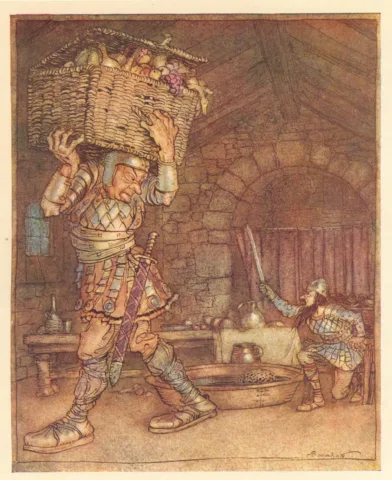
Eventually, an enormous man in heavy armour entered the hall carrying a hamper. He filled it with the feast’s provisions, astonishing Lludd with how much it could hold. As the intruder attempted to leave, the king challenged him.
The magician set down his hamper, and a fierce fight followed, with sparks flying from their weapons. Lludd eventually overpowered his opponent and threw him to the ground.
The defeated magician begged for mercy, promising to repay everything he had stolen, never repeat his crimes, and serve Lludd faithfully. The king accepted his surrender, bringing the last of Britain’s three plagues to an end.
Read Also
The Mabinogion Explained: The Great Stories of Welsh Mythology
Explore the medieval Welsh tales, their surviving manuscripts, and the stories that make up The Mabinogion.
The Dragons in Welsh Tradition: Vortigern, Merlin, and the Triads
The dragons buried by Lludd at Dinas Emrys are closely connected to traditions about King Vortigern, though the surviving accounts differ in important details.
In the ninth-century Historia Brittonum, Vortigern attempts to build a fortress, but his construction materials repeatedly disappear overnight. A boy named Ambrosius reveals a hidden pool containing two sleeping serpents, one red and one white. When they begin to fight, he interprets the red as representing the Britons and the white as the Saxons, predicting that the Britons will eventually drive out the invaders. Lludd does not appear in this account.
Geoffrey of Monmouth retold the episode in his twelfth-century History of the Kings of Britain, giving the prophetic role to Ambrosius Merlin. He expanded the dragons’ struggle into a lengthy prophecy concerning Britain’s political future.
Welsh Triad 37 makes a more direct connection to Lludd. It lists the dragons he buried at Dinas Emrys among the Three Concealments of Britain. An alternative version, describing the Three Fortunate Concealments, identifies Vortigern as the person who later uncovered them. These concealments were associated with protecting Britain from foreign oppression.
Unlike the Vortigern accounts, Lludd and Llefelys does not specify the dragons’ colours or identify them directly with the Britons and Saxons. Although the surviving written account in Historia Brittonum is older, the evidence does not establish how these related traditions developed before they were recorded.
What Does Lludd and Llefelys Mean in Welsh Tradition?
In Lludd and Llefelys, the three plagues threaten the foundations of royal authority. The Coraniaid prevent confidential communication, the dragons devastate the population and the land, and the magician deprives the king’s household of its provisions. Lludd’s task is not simply to defeat these threats, but to restore the conditions that allow his kingdom to function.
The story also lends itself to political interpretations. The presence of foreign intruders and the struggle between native and foreign dragons may reflect concerns about invasion and control of Britain. Yet the tale does not identify these enemies with specific historical peoples or explain its events as deliberate political allegories.
A different perspective comes from Matthew Siôn Lampitt, who examines the Coraniaid’s ability to hear and understand every conversation. He connects this power, together with the demon that distorts the brothers’ speech, to anxieties about language and the appropriation of Welsh historical traditions by Anglo-Norman writers.
Neither interpretation can be shown to reflect what the tale’s earliest storytellers intended.
Conclusion
Lludd and Llefelys ends with Britain restored to peace, but the story’s influence extends beyond Lludd’s reign. The burial of the dragons at Dinas Emrys connects the tale to other Welsh traditions about the island’s rulers and its fate. Unlike the prophetic accounts associated with Vortigern and Merlin, however, this story focuses on overcoming threats to the kingdom rather than foretelling its future.
Sources & Primary Texts
This article draws on editions and translations of medieval Welsh texts, manuscript studies, and academic research into the literary traditions surrounding Lludd and Llefelys.
- Roberts, Brynley F. (ed.). Cyfranc Lludd a Llefelys. Dublin Institute for Advanced Studies, 1975.
Bibliographic record. - Davies, Sioned (trans.). The Mabinogion. Oxford World’s Classics, Oxford University Press, 2007.
Publisher information. - Ford, Patrick K. (trans.). The Mabinogi and Other Medieval Welsh Tales. 2nd ed., University of California Press, 2019.
Publisher information. - Visser, G. J. “Cyfranc Lludd a Llefelys.” Études Celtiques, vol. 1, no. 2, 1936, pp. 261–271.
Read the study. - Bromwich, Rachel (ed. and trans.). Trioedd Ynys Prydein: The Triads of the Island of Britain. 4th ed., University of Wales Press, 2014. See Triads 36 and 37.
Publisher information. - Roberts, Brynley F. “Oral Tradition and Welsh Literature: A Description and Survey.” Oral Tradition, vol. 3, nos. 1–2, 1988, pp. 61–87.
Journal article. - Lampitt, Matthew Siôn. “The Language(s) of Networks.” In Literary Culture in the Medieval Welsh Marches: Networks, Places, Politics. Oxford University Press, 2025, pp. 145–174.
Academic chapter. - Guest, Lady Charlotte (trans.). The Mabinogion, “Lludd and Llevelys.” Nineteenth-century English translation.
Read the historical translation.
Copyright & Editorial Notice
© 2026 History & Myths. All rights reserved. This article is an original historical and literary analysis based on medieval Welsh texts and academic scholarship. The underlying traditional narratives are part of the historical literary record, while the article’s original wording, organization, and commentary are protected by copyright. Reproduction without permission is prohibited, except where permitted by applicable law.