Appu and His Two Sons: The Hittite Tale of Good and Evil
Appu was a wealthy but childless man from Šudul. In the Hittite tale Appu and His Two Sons (CTH 360), he seeks help from the Sun God and eventually becomes the father of two boys named Evil and Good. When the brothers grow up, Evil deceives his younger brother during the division of their father’s property, turning a long-awaited inheritance into a family dispute.
The conflict reaches the Sun God, who rules in Good’s favor. Evil refuses to accept the judgment, and the case is referred to Ištar of Nineveh. Although the surviving tablets do not preserve the final outcome, the story offers a distinctive account of family inheritance, deception, and divine justice in Hittite literature.
Who Was Appu in Hittite Mythology?
Appu is the human protagonist of an ancient Hittite tale, not a deity or a known historical ruler. His story survives in cuneiform tablets from Hattusa and is catalogued as CTH 360. It belongs to the narrative literature preserved by Hittite scribes.
The tale places Appu in Šudul, in the coastal land of Lulluwa. Neither the city’s precise location nor its identification with a known archaeological site has been established.
Before introducing Appu, the narrator invokes a deity who protects the righteous and destroys the wicked. This opening establishes the importance of divine judgment in a story concerned with human conduct rather than conflicts between gods.
Appu’s Wealth and His Desire for Children
Appu owns large herds of cattle and sheep, while his silver, gold, and lapis lazuli are piled up like harvested grain. Yet for all his wealth, he has neither a son nor a daughter.
His childlessness becomes particularly painful during a gathering of the elders of Šudul. As they eat, the men give their sons bread, roasted meat, and drink. Appu watches, unable to share anything with a child of his own.
After the gathering, Appu returns home and lies down without removing his shoes. His wife first asks their servants whether Appu has finally had any success in their efforts to conceive.She then joins him in bed without undressing and asks him directly. Appu dismisses her question. The exchange hints at difficulties in their intimate relationship, although the tale does not explain the precise cause of their childlessness.
How Did the Sun God Help Appu Have Children?
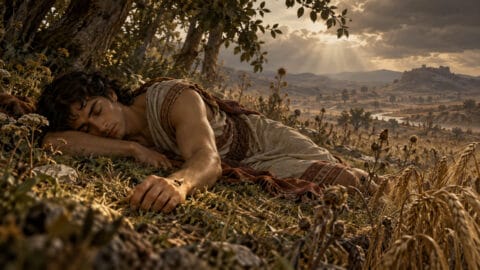
Appu takes a white lamb and sets out to seek the Sun God. Looking down from heaven, the deity transforms himself into a young man and approaches him. When asked what troubles him, Appu explains that the gods have given him wealth and livestock, but neither a son nor a daughter.
The Sun God tells Appu to get drunk, return home, and sleep with his wife, promising that the gods will grant him a son. Appu returns home, while the Sun God ascends to heaven.
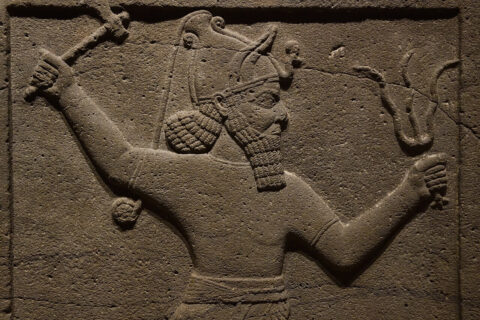
There, the Storm God Teššub receives him and orders food and drink to be prepared. Their conversation is interrupted by a substantial gap in the tablet. When the narrative resumes, Appu’s wife is pregnant. She eventually gives birth to a son in the tenth month.
Why Were Appu’s Sons Named Evil and Good?
When Appu’s first son is born, the nurse places the child on his father’s knees. Appu rejoices, fondles the baby, and names him Evil, or Bad (Idalu). He explains his choice by saying that his ancestral gods had followed the wrong path rather than the right one. The name therefore reflects Appu’s judgment of the gods’ treatment of his family, not anything the newborn has done.
Appu’s wife later gives birth to a second son, whom he names Good, or Righteous (Ḫandanza). This time, Appu declares that his ancestral gods have followed the right path. The two names express opposite judgments of divine conduct.
The distinction also anticipates the brothers’ characters. Evil will deceive his younger brother during the division of their inheritance, while Good becomes the victim of that deception. Their names establish this contrast long before either brother has acted upon it.
The Brothers’ Dispute Over Their Inheritance
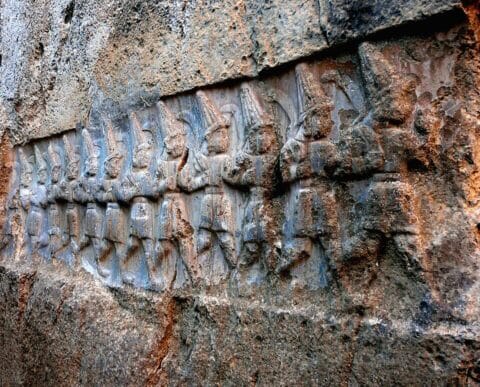
When Appu’s sons reach adulthood, Evil proposes that they divide their father’s property and establish separate households. He argues that even the gods have their own dwelling places: the Sun God resides in Sippar, the Storm God in Kummiya, and Šauška in Nineveh. Good agrees to the separation.
As the brothers divide the estate, the Sun God watches from heaven. Evil takes advantage of his younger brother, keeping a healthy plow ox for himself while giving Good an unhealthy cow. Although the property is divided between them, Evil ensures that he receives the more valuable livestock.
The Sun God witnesses the deception and intervenes on Good’s behalf. He declares that the unhealthy cow should recover and bear offspring, reversing the disadvantage Evil intended to impose on his brother. The tablet breaks off before the full consequences of the god’s intervention are described.
The Sun God’s Intervention and the Judgment of the Brothers
The brothers eventually bring their dispute before the Sun God at Sippar. The fragmentary account indicates that the Sun God ruled in Good’s favor. Evil responds with curses, prompting the deity to refer the dispute to Ištar of Nineveh.
Hearing the curses, the Sun God declines to settle the matter further and directs the brothers to Šauška, the goddess known as Ištar of Nineveh. They travel to Nineveh and appear before her for another hearing.
The account of this second hearing is badly damaged. A surviving passage refers to a measure of land (IKU), but the surrounding lines are too fragmentary to establish how it figured in the dispute.
How Does the Story of Appu End?
The conclusion of Appu and His Two Sons has not survived. In the damaged account of the hearing at Nineveh, Ištar appears to speak favorably of Good, but no complete judgment is preserved. We do not know how the inheritance was finally divided or whether Evil received any punishment.
The tale’s opening offers a clue to its intended ending. It praises a deity who protects the righteous and destroys wrongdoers, suggesting that justice would ultimately prevail. Together with the favorable treatment Good receives from the Sun God and Ištar, this supports the interpretation that he was meant to emerge victorious. The precise resolution, however, remains unknown.
What Does the Tale Reveal About Hittite Society and Justice?
Appu’s childlessness carries a social significance beyond his need for an heir. At the gathering of Šudul’s elders, other men share food and drink with their sons, while Appu has no child to receive anything from him. The scene presents fatherhood as part of a man’s standing within his community, something that even considerable wealth cannot replace.
The brothers’ inheritance dispute introduces a distinction between ownership and fairness. Evil persuades Good to establish a separate household, invoking the gods’ own dwelling places as justification. Yet he exploits the division to secure the better livestock for himself. The story treats an agreed division of property as insufficient when one party uses deception to benefit at another’s expense.
The involvement of the Sun God and Ištar of Nineveh places this family dispute within a framework of divine justice. Wrongdoing can be challenged even when the injured party has accepted an unfavorable arrangement. These episodes offer evidence of ideals expressed in Hittite literature, particularly the importance of family continuity and fair dealing. They do not, however, establish how inheritance disputes were handled in actual Hittite courts. The tale is a moral narrative, not a legal document.
The Origins and Literary Parallels of the Tale of Appu
The Tale of Appu survives in twelve Hittite manuscripts dating to the Hittite Empire period. Linguistic features indicate that the composition is older, although its original date and place of composition remain unknown. Earlier scholars sometimes attributed the story to Hurrian tradition, but no Hurrian version has been found, and the surviving evidence does not establish a Hurrian origin.
The story has parallels in other ancient Near Eastern and Greek literature. In the Ugaritic Epic of Keret, a king seeks divine help to secure a wife and heirs after losing his family. Hesiod’s Works and Days presents a different resemblance: the poet’s quarrel with his brother Perses over their inheritance. Both works address problems familiar from Appu’s story, but their narratives and literary purposes differ.
The comparison with Hesiod is particularly instructive. While Works and Days uses a family dispute to deliver moral instruction, the Tale of Appu presents its conflict through characters named Good and Evil and a sequence of divine judgments. These similarities have attracted scholarly attention, but they do not establish direct borrowing or a common literary source.
Conclusion
Appu’s greatest wish is to have children who can inherit his wealth, yet the sons he finally receives turn that inheritance into a source of conflict. Their names, Good and Evil, give the family dispute a moral dimension, while the intervention of the Sun God and Ištar of Nineveh places their conduct under divine judgment.
Although the final verdict is lost, the surviving story offers a distinctive example of Hittite storytelling in which the gods become involved in questions of human fairness rather than struggles over their own power.
Academic Sources & Primary Texts
Primary Text and Translation
- The Tale of Appu and His Two Sons (CTH 360). Hittite cuneiform text, preserved in multiple manuscript fragments from Hattusa. Text edition in the TITUS Corpus of Hittite Mythological Texts, Goethe University Frankfurt.
Original Hittite text. - Hoffner, Harry A., Jr. Hittite Myths. 2nd ed. Edited by Gary M. Beckman. Writings from the Ancient World 2. Atlanta: Scholars Press, 1998. See “Appu and His Two Sons,” pp. 82–85.
SBL Press.
Academic Studies
- Reyhan, Esma, and Tülin Cengiz. “Bir Hitit Çağı Masalı: Appu ve İki Oğlu” (A Hittite Period Tale: Appu and His Two Sons). OANNES: International Journal of Ancient History 6, no. 1 (2024): 203–220.
DOI. - Beckman, Gary. “Hittite Literature.” In From an Antique Land: An Introduction to Ancient Near Eastern Literature, edited by Carl S. Ehrlich, 215–254. Lanham, MD: Rowman & Littlefield, 2009.
Academic text. - Giusfredi, Federico, and Valerio Pisaniello. “Hurrians and Hurrian in Hittite Anatolia.” In Contacts of Languages and Peoples in the Hittite and Post-Hittite World, vol. 1, The Bronze Age and Hatti, 259–283. Leiden: Brill, 2023.
Open-access chapter. - Canevaro, Lilah Grace. “Fraternal Conflict in Hesiod’s Works and Days.” In Conflict and Consensus in Early Greek Hexameter Poetry, edited by Paola Bassino, Lilah Grace Canevaro, and Barbara Graziosi, 173–189. Cambridge: Cambridge University Press, 2017.
DOI.
Copyright & Editorial Notice
© 2026 History & Myths. All rights reserved. This article presents an original examination of the Hittite tale Appu and His Two Sons, based on surviving ancient texts and published academic research. Interpretations of damaged passages, the story’s origins, and its incomplete ending are distinguished from established textual evidence. Unauthorized reproduction or republication is prohibited, except as permitted by applicable copyright law.