The Hittite Army: Soldiers, Chariots, and Warfare
The Hittite army relied primarily on infantry, supported by chariot crews, royal troops, and soldiers supplied by subject kingdoms. During the Late Bronze Age, these forces defended Hatti’s territories in Anatolia and fought to maintain its power in northern Syria. Their campaigns required coordinated recruitment, experienced commanders, fortified positions, and reliable supplies of food and equipment.
The army is best known for its chariots at the Battle of Kadesh, but the Egyptian accounts of that confrontation offer only a partial picture. Hittite treaties, military instructions, and archaeological discoveries provide evidence of how soldiers were recruited, equipped, and commanded. They also reveal the limits of our knowledge, particularly concerning troop numbers, chariot tactics, and the conduct of battles.
How Was the Hittite Army Recruited and Commanded?
The Hittite kings maintained a permanent military force, but major campaigns required additional soldiers drawn from across the kingdom and its dependent territories. Regular troops served in royal units and garrisons, while men recruited from the population and contingents supplied by subordinate rulers enlarged the army when needed. Landholding could also be tied to obligations to the state, although not all such obligations involved military service.
The king was commander-in-chief and frequently led campaigns himself. When he could not remain with an army, he could appoint a prince or senior noble to take command. A surviving military instruction, CTH 261.II, required soldiers to obey an appointed commander as they would the king. Hittite records also identify officers commanding groups of ten, a hundred, and a thousand men. These titles indicate an established hierarchy, although they do not establish that every Hittite army followed the same unit structure.
Military obligations extended beyond the Hittite heartland. Treaties required dependent rulers to contribute troops, but the conditions varied. The bronze treaty between Tudhaliya IV and Kurunta, ruler of Tarhuntassa, provides a detailed example. Kurunta was required to supply 100 infantrymen for Hittite campaigns, rising to 200 during specified major conflicts. He was exempted from providing horses, and his soldiers could not be retained as permanent garrisons. These restrictions reflected Kurunta’s privileged political position rather than standard obligations imposed on every subject kingdom.
Read Also:
Tudhaliya IV: Power and Crisis in the Hittite Empire
Another document, the oath of Ashapala (CTH 270), records a more localized arrangement. Ashapala and his men pledged loyalty to Hattusa and undertook to provide 30 soldiers, ten each from three named towns, for service under the king. The troops were to travel to Hattusa. The oath also required Ashapala’s group to report suspected enemy attacks immediately to the provincial governor, showing how military obligations combined the provision of soldiers with responsibility for frontier security.
The king also controlled what happened to troops after a campaign. CTH 261.II states that he could decide which contingents remained as occupation forces when resistance continued and which were released from service. Even when another commander led the army, such decisions remained subject to royal authority.
Infantry: The Largest Force in Hittite Warfare
Infantry formed the overwhelming majority of the Hittite army. Historian Trevor Bryce estimates that foot soldiers accounted for more than 90 percent of its fighting strength, although this is a scholarly estimate rather than a figure preserved in military records. Spearmen appear to have been the principal type of infantry. Archers also served in Hittite warfare, but the surviving evidence does not establish how many fought on foot or whether they consistently formed separate units.
Foot soldiers were essential in the mountainous regions of Anatolia, where steep slopes, narrow passes, and fortified heights restricted the use of chariots. They could advance into difficult terrain, confront enemies occupying elevated positions, and secure settlements after their defenders had surrendered or withdrawn. These responsibilities made infantry indispensable throughout a campaign, not merely during open battles.
Mursili II’s campaign against Arzawa provides a particularly clear example. After part of the local population took refuge on Mount Arinnanda, the king pursued them to a steep, wooded, and rocky position occupied by enemy infantry. His annals state that the ascent was unsuitable for chariots, forcing him to proceed on foot ahead of his army. His forces then pressured the people on the mountain until hunger and thirst compelled them to surrender. The operation depended on reaching and containing an enemy in terrain where chariots offered little advantage.
Read Also:
Mursili II: The Hittite King Who Faced War and Plague
The precise formations used by Hittite infantry remain poorly documented. Although surviving texts describe military operations and identify different categories of soldiers, they rarely explain how foot troops were arranged or maneuvered during battle. There is consequently no firm basis for reconstructing a standardized Hittite phalanx or a fixed system of infantry formations.
What Weapons and Armor Did Hittite Soldiers Use?
Hittite soldiers fought with spears, bows, axes, daggers, and swords, with bronze remaining the principal metal used for weapons throughout the imperial period. Archaeological finds include socketed spearheads and numerous arrowheads, particularly barbed and leaf-shaped types. Their distribution across Anatolian sites confirms the widespread use of these weapons, although the finds alone cannot establish how archers were organized on the battlefield.
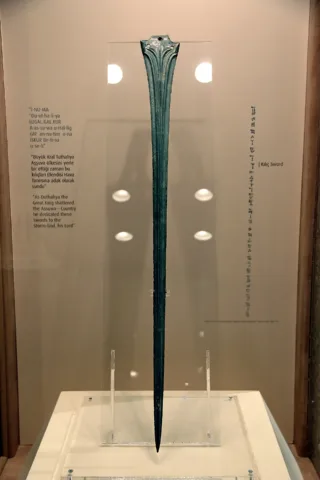
For close combat, warriors used short swords, daggers, and battle-axes. Excavations at Hattusa and other Anatolian settlements have revealed several weapon types, while casting moulds provide evidence of local axe production. One notable discovery is the bronze sword found near Hattusa in 1991. Its Akkadian inscription records King Tudhaliya’s dedication of swords to the Storm God following his victory over Assuwa. The weapon may have been captured during that campaign, but its ceremonial dedication makes it unsuitable as evidence of standard military equipment.
Shields and armor are less well preserved. Egyptian reliefs depict Hittite warriors carrying rectangular shields and others with curved upper and lower edges and inward-curving sides. No complete Hittite shield has survived in Anatolia, probably because wood and leather formed much of their construction. Bronze armor scales discovered at Hattusa and Korucutepe provide evidence for protective body armor, which was probably concentrated among elite warriors and chariot crews rather than ordinary infantry.
Read Also:
Hattusili III: The Hittite King Who Seized the Throne
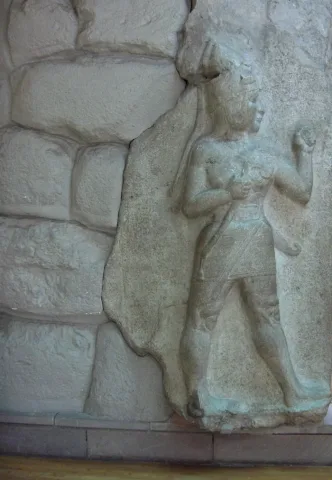
Helmets are documented through both archaeological finds and artistic representations. A rare bronze example discovered at Ortaköy-Šapinuwa has a pointed crown and fittings for cheek protection. A similar style appears on the warrior god carved at Hattusa’s King’s Gate, whose helmet features a high crest and protective cheekpieces. The sculpture depicts a deity rather than an ordinary soldier, but the archaeological find confirms that comparable helmets existed.
Iron was also known to Hittite metalworkers, although it remained far less common than bronze. Surviving iron objects and references in written records demonstrate its use, but there is no convincing evidence that Hittite armies were routinely equipped with iron weapons or that iron technology gave them a decisive battlefield advantage.
Hittite Chariots: Crews, Horses, and Design
Hittite war chariots were two-wheeled vehicles generally drawn by pairs of horses. Their construction relied on wooden frames, spoked wheels, and leather components, combining mobility with the capacity to carry armed men. No complete imperial Hittite chariot has survived, making its exact dimensions and construction difficult to establish. Much of what we know comes from Egyptian representations and comparisons with surviving Bronze Age vehicles.
The Egyptian reliefs of the Battle of Kadesh depict Hittite and allied chariots carrying three men, generally identified as a driver, a warrior, and a shield-bearer. Egyptian chariots typically carried two. Yet an earlier relief from the reign of Seti I shows a Hittite chariot with two occupants, one equipped with a bow. Some scholars have interpreted this difference as evidence of a change in crew arrangements before Kadesh. Anthony Spalinger questioned whether the images prove such a reorganization, noting the influence of artistic conventions. The three-man crew is well documented in the Kadesh representations, but its use throughout Hittite history cannot be assumed.
How these crews fought remains debated. The Kadesh reliefs associate Hittite charioteers with spears, encouraging the view that their primary role was close-range combat. Nicholas Wernick has challenged the practicality of thrusting long spears from moving chariots, drawing attention to earlier Egyptian depictions of Hittite archers and references to projectile weapons in Hittite texts. Other interpretations allow for spear attacks or for warriors dismounting to fight. The surviving evidence establishes that chariot crews had access to different weapons, but not a single method of using them in battle.
Read Also:
Muwatalli II: The Hittite King Who Fought Ramesses II at Kadesh
Training the horses demanded considerable preparation. The Kikkuli text (CTH 284), preserved on tablets from Hattusa, records instructions attributed to Kikkuli, a horse trainer from Mitanni. Its program extends over at least 184 days, combining carefully scheduled exercise with regulated feeding, watering, grooming, and rest. Some instructions specify distances and times of training, while others concern the horses’ physical care. The text provides unusually detailed evidence of how chariot horses could be conditioned, although it does not establish that every Hittite military horse underwent the same program.
How Did Hittite Armies Fight?
Hittite armies used different approaches depending on the enemy and the terrain. In northern Anatolia, Kaska groups frequently avoided open battle, making surprise and the ability to intercept moving enemies particularly important. A successful campaign might require catching an opponent before he could retreat rather than confronting him in a prepared battle.
Mursili II’s campaigns against the Kaska illustrate these difficulties. During one operation, he left his army’s baggage at Altanna before making a night march against part of a Kaska force. In another account, he explained why surrounding the Kaska leader Pittaggatalli would have failed: enemy lookouts could detect his approach, allowing Pittaggatalli to escape. These episodes show how reconnaissance could determine whether an attack was possible.
Against Arzawa, Mursili pursued a more direct confrontation. After its ruler, Uhhaziti, refused to return fugitives from Hittite authority, Mursili challenged him to battle. Uhhaziti did not appear personally, instead sending his son Piyama-Kurunta with infantry and chariots. The opposing armies met near Walma on the Astarpa River, where Mursili claimed victory before pursuing the defeated forces into Arzawa. His account identifies the troops involved and the course of the campaign, but provides little information about their formations or coordinated maneuvers.
Military pressure could also achieve results without another battle. Following his victory in Arzawa, Mursili threatened the neighboring Seha River Land, whose ruler, Manapa-Tarhunda, had supported his enemies. When the ruler’s mother appealed for mercy, Mursili accepted his submission rather than attack. The decision secured Hittite authority without committing the army to another campaign.
Siege Warfare and Frontier Defense
Hittite armies used battering rams, earthworks, and blockades to attack fortified settlements. Breaking through a city’s defenses could take months, particularly when defenders received supplies or assistance from outside. The surviving accounts show that siege warfare required control of the surrounding roads as well as the ability to attack walls.
The Siege of Uršu (CTH 7), an Akkadian literary account generally associated with Hattusili I, describes serious difficulties during an early Hittite siege. The king, directing operations from elsewhere, angrily orders his officers to replace a broken battering ram with one built in the Hurrian manner and to pile earth against the city’s defenses. He also discovers that people are still entering and leaving Uršu despite orders to block its roads. The account is dramatic, and the siege’s final outcome remains uncertain, but its details reveal the practical difficulties of operating siege equipment and isolating a fortified city.
Mursili II used another method during his campaign against Arzawa. After defeating forces led by the Arzawan prince Tapalazunawali, he surrounded the fortified city of Puranda and cut off its water supply. His annals record the operation as part of the campaign to secure western Anatolia. Denying defenders access to water could place a city under severe pressure without requiring an immediate assault on its walls.
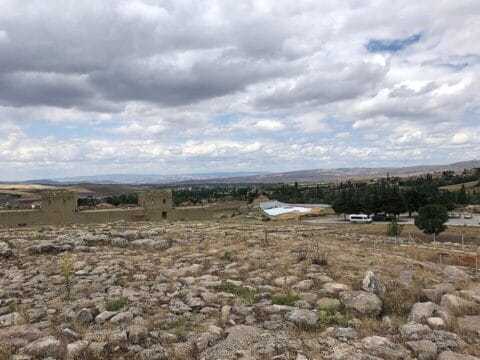
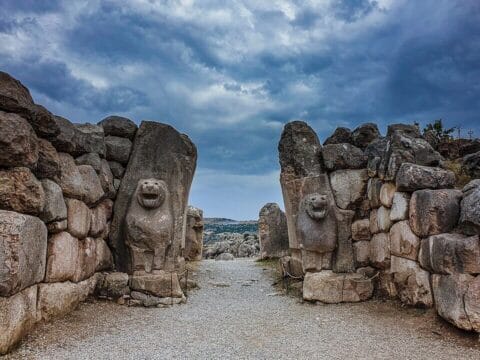
The Hittites also built substantial defenses around their own settlements. At Hattusa and Sarissa, fortification systems incorporated stone foundations, mudbrick and timber superstructures, projecting towers, and protected gateways. These defenses required regular maintenance and organized guards.
Read Also:
Hattusa: The Lost Capital of the Hittite Empire
The instructions of Arnuwanda I for frontier post governors (CTH 261.I) describe how this protection worked. Workers and livestock were brought inside fortified settlements at night, after which guards secured the gates and smaller passages. Scouts inspected the surrounding approaches at dawn, while patrols watched roads for signs of approaching enemies. When a threat was detected, the town was to be closed and protected. The instructions also addressed the construction and maintenance of fortifications, including towers and defensive works.
Campaign Logistics: Moving and Supplying the Army
Keeping a Hittite army supplied during a campaign required arrangements for food, water, fodder, and transport. Soldiers carried provisions, while pack animals and carts moved additional supplies and equipment. Dependent rulers also contributed to military provisioning. Under the treaty between Tudhaliya and Sunashshura of Kizzuwatna, Sunashshura had to provide enough food for his soldiers to sustain them until they joined the Hittite royal army.
Military instructions show that provisions were checked before troops departed. A text associated with the reign of Tudhaliya I (CTH 251) required commanders to inspect the bread and flour prepared for soldiers when an army was mobilized. Hittite correspondence also reveals how the state transported substantial quantities of provisions. A letter (KUB 31.79) records shipments from Pitteyariga to Samuha that included grain and 1,650 loaves described as “soldier-rations.” The cargo was probably intended for religious use rather than military consumption, according to Harry A. Hoffner. The letter nevertheless provides evidence of river transport: shallow water complicated the shipments, and smaller boats were used to move part of the cargo.
Supplies could also be obtained during operations in enemy territory. In his nineteenth-year annals, Mursili II reports that his soldiers collected grain and wine while seeking booty in Kaska territory. Such seizures could supplement an army’s provisions, although the text does not specify how much of the captured food was consumed by the troops.
Read Also:
Samuha: The Hittite Royal City and Cuneiform Archive Found in 2026
The campaigning season imposed further restrictions. Armies generally operated during the warmer months, when travel was less affected by severe winter conditions. In the tenth year of his reign, Mursili II decided against establishing fortifications in Azzi because the year was running short. Instead, he placed the local population under oath and returned to Hattusa for the winter. The decision shows how the remaining campaigning time could determine whether a conquered region was occupied immediately or secured through political arrangements.
Returning from a successful campaign could be equally demanding. Hittite armies frequently brought captured populations and livestock back to their homeland. These groups needed provisions and protection during the journey, sometimes across considerable distances. Soldiers had to prevent prisoners from escaping while ensuring that people and animals survived the march, adding substantial responsibilities to an army already carrying its own supplies and equipment.
What Does the Battle of Kadesh Really Tell Us?
The Battle of Kadesh in 1274 BCE provides unusually detailed evidence of a Hittite army in action, although most of that evidence comes from Egyptian inscriptions and temple reliefs. According to Ramesses II’s accounts, Muwatalli II concealed his forces near Kadesh and used chariots to attack the Egyptian Re division while it was marching separately from the main royal force. The attackers then reached Ramesses’ camp. These descriptions reveal the effectiveness of surprise against an unprepared opponent, but they also reflect the Egyptian king’s desire to portray his own recovery from a dangerous situation as a personal triumph.
The Egyptian records give the Hittites 37,000 infantrymen, divided into groups of 19,000 and 18,000, and 3,500 chariots. Of these, 2,500 are associated with the initial attack and another 1,000 with a later phase of the fighting. Assuming three men per chariot produces a total of 47,500 combatants. These figures are not confirmed by Hittite records. Their unusually rounded character raises doubts about their accuracy, while supplying such a force and its horses would have required considerable resources. The actual size of Muwatalli’s army cannot be established.
The role of the Hittite infantry is another unresolved question. Egyptian descriptions place Muwatalli near Kadesh with his foot soldiers while the chariots carried out the assault. Yet they provide little information about infantry movements or participation in the fighting. Whether these troops were deliberately kept in reserve or played a role omitted from the Egyptian narrative remains uncertain. Kadesh therefore offers a detailed picture of one chariot attack, not a complete account of how the Hittite army fought.
Read Also:
The Egyptian-Hittite Peace Treaty: What It Actually Said
Examine the agreement that later established peace between Egypt and Hatti, including its military and diplomatic obligations.
The battle’s outcome must also be distinguished from its political consequences. Ramesses claimed a decisive victory, but he failed to capture Kadesh. A later Hittite treaty between Tudhaliya IV and Shaushgamuwa of Amurru (CTH 105) states that Muwatalli defeated the Egyptian king and brought Amurru back under Hittite control. Written decades after the confrontation, the treaty reflects Hittite political claims rather than providing an independent account of the fighting. Historians generally regard the battle itself as inconclusive, while recognizing that the subsequent territorial developments favored Hatti.
Kadesh demonstrates that the Hittite king could assemble a large coalition and launch a dangerous surprise attack against a major rival. It does not establish the army’s exact strength or prove that the tactics depicted in Egyptian monuments were standard practice throughout Hittite history.
Sources & Primary Texts
This article draws on Hittite military and administrative texts, archaeological evidence, and modern scholarship. Egyptian accounts of Kadesh are treated separately from Hittite evidence.
Academic Studies
- Beal, Richard H. (1992). The Organisation of the Hittite Military. Texte der Hethiter 20. Heidelberg: Carl Winter.
- Bryce, Trevor (2002). Life and Society in the Hittite World. Oxford University Press, particularly Chapter 6, “The Warrior.”
- Miller, Jared L. (2013). Royal Hittite Instructions and Related Administrative Texts. Society of Biblical Literature.
- Lorenz, Jürgen, and Ingo Schrakamp (2011). Hittite Military and Warfare. In Insights into Hittite History and Archaeology, pp. 125–151.
- Genz, Hermann (2017). Regional or International? Comments on the Origin and Development of Hittite Weapons and Military Technologies. BYZAS 23, pp. 85–103.
- Raulwing, Peter (2009). The Kikkuli Text: Hittite Training Instructions for Chariot Horses.
- Wernick, Nicholas (2013). K(no)w More Spears from the Backs of Chariots: Problems with the Battle of Kadesh’s Thrusting Spears. Journal of Ancient Egyptian Interconnections.
- Beckman, Gary (1995). The Siege of Uršu Text (CTH 7) and Old Hittite Historiography. Journal of Cuneiform Studies 47, pp. 23–34.
- Hoffner, Harry A., Jr. (2009). Letters from the Hittite Kingdom. Society of Biblical Literature.
Primary Hittite Texts
- The Annals of Mursili II (CTH 61). University of Texas at Austin, Linguistics Research Center. Selected Hittite text with English translation and commentary.
- Treaty of Tudhaliya IV and Kurunta (CTH 106). University of Texas at Austin, Linguistics Research Center.
- Hittite military instructions (CTH 251, 261) and the oath of Ashapala (CTH 270), translated and discussed in Miller (2013).
- The Siege of Uršu (CTH 7), discussed in Beckman (1995).
- The Kikkuli horse-training text (CTH 284), examined in Raulwing (2009).
Copyright & Image Credits
© 2026 History & Myths. All rights reserved. Original article text and editorial analysis by History & Myths.
Historical artifacts, inscriptions, and ancient artworks discussed in this article belong to their respective historical and archaeological contexts. Photographs and modern illustrations remain subject to their creators’ applicable copyright and licensing terms. Individual image credits and licenses are provided alongside the images where required.