Tudhaliya IV: Power and Crisis in the Hittite Empire
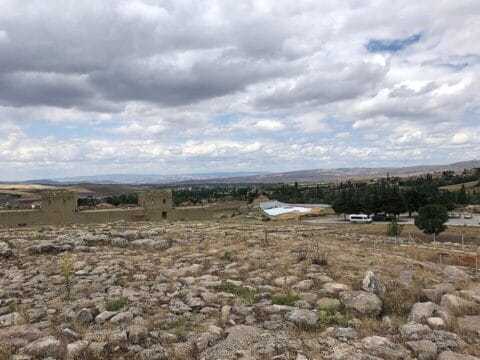
Tudhaliya IV ruled the Hittite Empire around 1237–1209 BCE, succeeding his father, Hattusili III. He inherited a powerful kingdom that controlled much of Anatolia and maintained influence across northern Syria, but faced growing pressure on its borders and within the royal family.
His reign saw a major defeat against Assyria at the Battle of Nihriya and tensions with his cousin Kurunta, ruler of Tarhuntassa. Tudhaliya also conducted campaigns in western Anatolia, maintained diplomatic ties with neighboring kingdoms, and sponsored important religious monuments at Yazılıkaya. His reign raises a central question: how much power did the Hittite Empire still possess as these challenges intensified?
Tudhaliya IV’s Accession and Hattusili III’s Legacy
Tudhaliya IV inherited a throne still marked by his father’s seizure of power. Hattusili III had deposed his nephew Urhi-Teshub, the son of Muwatalli II, leaving members of the displaced royal line with potential claims to the Hittite kingship.
The succession within Hattusili’s own family had also changed. The bronze treaty Tudhaliya later concluded with Kurunta records that his father had initially appointed Tudhaliya’s elder brother as tuhkanti, the designated heir, before replacing him with Tudhaliya. The brother is generally identified as Nerikkaili, although the reason for his removal remains unknown.
Hattusili gave Tudhaliya substantial responsibilities before his accession. The prince served as priest of the Storm God of Nerik, governed Hakpis, and held the office of GAL MĒŠEDI, chief of the royal bodyguards. He also gained military experience campaigning against the Kaska peoples of northern Anatolia. These appointments followed a career path similar to Hattusili’s own. Whether Tudhaliya formally shared royal authority with his father before succeeding him remains disputed.
His relationship with Kurunta was particularly important. A son of Muwatalli II, Kurunta had been raised under Hattusili’s care and developed a close friendship with Tudhaliya. Their mutual pledge of loyalty, recorded in the bronze treaty, appears to have influenced Hattusili’s decision to favor Tudhaliya as his successor. Kurunta’s position within the displaced royal line made that friendship politically valuable.
When Tudhaliya became king, the peace established with Egypt under Hattusili III remained in place. His mother, Puduhepa, also retained her position as Great Queen and continued to exercise influence at court. These provided continuity during the transition, even though the question of loyalty within the wider royal family had not been fully resolved.
Assyria and the Battle of Nihriya
Assyria became a major threat to Tudhaliya IV as its expansion into former Mitanni territories brought the two empires into conflict over northern Mesopotamia. Their rivalry culminated in the Battle of Nihriya, one of the most serious Hittite military defeats of his reign.
The principal account survives in an Assyrian royal letter, RS 34.165, discovered at Ugarit. It describes failed diplomatic negotiations and a confrontation over Nihriya, where Hittite troops had taken up positions. According to the Assyrian account, the king demanded their withdrawal before defeating the Hittite army in battle. His portrayal of himself as seeking peace before resorting to force also served to justify the Assyrian campaign.
Scholars disagree over which Assyrian king commanded the victorious army. The battle has traditionally been attributed to Tukulti-Ninurta I, but Boris Alexandrov’s 2022 reassessment argues that it occurred under his predecessor, Shalmaneser I, near the end of his reign. The precise chronology remains contested.
A fragmentary Hittite document, CTH 123, also refers to a royal withdrawal from Nihriya and criticizes an official for failing to support his king. Its attribution to Tudhaliya IV or Šuppiluliuma II remains disputed, preventing a secure identification of the episode with the battle described in RS 34.165.
Despite the defeat, Assyria did not conquer the Hittite heartland or establish lasting control over northern Syria. Surviving correspondence indicates that diplomatic relations continued, including periods of peace under Tukulti-Ninurta I. Nihriya was a serious military setback, but its political consequences were more limited than the scale of the Assyrian victory might suggest.
Kurunta and the Kingdom of Tarhuntassa
Tarhuntassa occupied a substantial territory in southern Anatolia, extending across the southern Konya Plain toward the Mediterranean coast. Its ruler, Kurunta, was a son of Muwatalli II and belonged to the royal family displaced from power by Hattusili III.
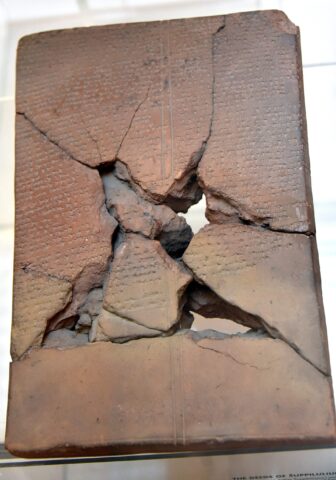
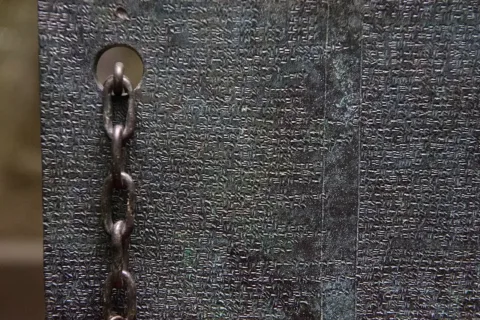
Tudhaliya IV confirmed and expanded Kurunta’s privileges in a treaty preserved on a bronze tablet discovered at Hattusa in 1986. The agreement defined Tarhuntassa’s boundaries, protected Kurunta’s hereditary rights, and limited his military obligations. He was normally required to provide only 100 infantrymen for Hittite campaigns, rising to 200 under specified circumstances. He owed no cavalry and was exempt from supplying permanent garrisons.
Despite these privileges, Kurunta remained subordinate to the Hittite king. The treaty required him to defend Tudhaliya and his descendants and explicitly forbade him from seeking the throne of Hatti. This restriction was particularly significant given Kurunta’s royal ancestry.
Yet seal impressions discovered at Hattusa and a rock relief at Hatip identify Kurunta as Great King, a title normally reserved for the supreme Hittite ruler. Some scholars believe he briefly seized the throne, while others suggest he adopted the title to strengthen his position in Tarhuntassa, possibly with Tudhaliya’s consent. Neither interpretation is firmly established. No surviving text confirms a successful coup, leaving the circumstances of Kurunta’s claim unresolved.
Campaigns in Western Anatolia
Tudhaliya IV campaigned in western Anatolia, where local rulers challenged Hittite authority and Ahhiyawa, generally associated with the Mycenaean Greek world, remained an important political influence.
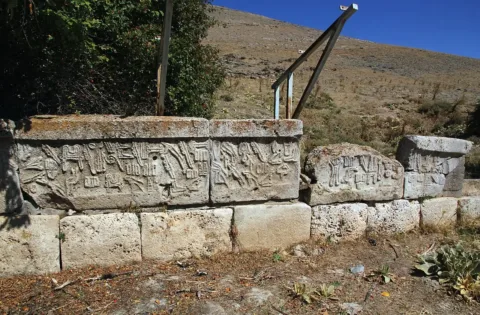
The clearest evidence comes from the Yalburt inscription, carved in Hieroglyphic Luwian on the stone blocks of a monumental pool near modern Ilgın. It commemorates Tudhaliya’s campaign into the Lukka lands of southwestern Anatolia, broadly associated with later Lycia. The places named include Pinali and Awarna, commonly identified with Pinara and the Xanthos region. Although the inscription celebrates military victories, it provides little evidence of how long Hittite control lasted.
A fragmentary text known as the Sins of the Seha River Land describes a rebellion by Tarhunaradu, who sought support from the king of Ahhiyawa. The account reports his defeat and capture, along with his family, by Hittite forces. Traditionally associated with Tudhaliya IV, the document’s dating is disputed. Some scholars consider it a later reworking of an older account, making its attribution to his reign uncertain.
The Milawata Letter (CTH 182) provides clearer evidence of Tudhaliya’s likely diplomatic activity in the west. Probably written by him to Tarkasnawa, ruler of Mira, it concerns the boundaries of Milawata, generally identified with Miletus, and plans to restore the displaced king Walmu to the throne of Wilusa, commonly associated with Troy. Neither the sender’s nor the recipient’s name survives in the damaged opening. The correspondence illustrates how Hittite involvement in western Anatolia extended beyond military campaigns to negotiating borders and restoring allied rulers.
Alashiya and the Limits of Hittite Expansion
Alashiya, generally identified with Cyprus, was an important source of copper and a major participant in eastern Mediterranean trade. A Hittite military victory over the island has traditionally been attributed to Tudhaliya IV, although the surviving evidence leaves the campaign’s leadership uncertain.
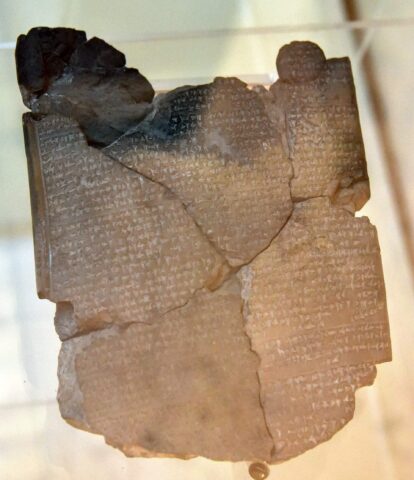
The principal source is KBo 12.38 (CTH 121), a damaged Hittite tablet dating to the reign of his son, Šuppiluliuma II. Its opening account describes the defeat of Alashiya, the capture of its king and members of his family, and the removal of prisoners and valuables to Hattusa. It also records tribute obligations involving copper, gold, and other goods. Hans Güterbock attributed this campaign to Tudhaliya IV, but other scholars, including Andrea Bemporad, argue that Šuppiluliuma himself led it, possibly during his father’s reign.
Another section of the tablet records Šuppiluliuma II’s naval victories against ships from Alashiya. These engagements belong to the later king’s military account and should not automatically be treated as part of a campaign conducted by Tudhaliya.
The Hittite account indicates that Alashiya was subjected to tribute demands, but there is no clear archaeological evidence of permanent Hittite administration across Cyprus. Major centers such as Enkomi, Kition, and Kalavasos maintained extensive trading networks, while the island’s political organization remains debated. Whether the initial campaign was led by Tudhaliya or his son, the surviving evidence cannot establish the extent or duration of Hittite control.
Diplomacy and the Syrian Vassal Kingdoms
Tudhaliya IV governed the Hittite dependencies in northern Syria through treaties with local kings and the regional administration at Carchemish. Kingdoms such as Amurru and Ugarit retained their own rulers, but their military obligations, foreign relations, and dynastic affairs remained subject to Hittite authority.
The Treaty of Šaušgamuwa (CTH 105) illustrates how Tudhaliya sought to secure this loyalty. Šaušgamuwa, king of Amurru and Tudhaliya’s brother-in-law, was required to support the Hittite dynasty and follow its foreign policy. With Assyria identified as an enemy, the treaty prohibited trade between Amurru and Assyria and ordered the detention of Assyrian merchants entering Amurru. A damaged passage also appears to restrict Ahhiyawan ships from reaching Assyria, although its precise meaning remains disputed.
Military obligations could also be settled through payments. Under RS 17.059 (CTH 108), Tudhaliya exempted King Ammistamru II of Ugarit from sending infantry and chariots to participate in the war against Assyria. In return, Ugarit paid 50 minas of gold, allowing its ruler to retain his forces while fulfilling an obligation to Hatti.
Royal intervention extended to disputes within the Syrian kingdoms. Tudhaliya issued a decree regulating Ammistamru’s divorce from a daughter of Bentešina of Amurru, including the return of her property and the succession rights of their son. Another edict (CTH 111) addressed a territorial dispute between Ugarit and Šiyannu. Much of the routine administration passed through Ini-Tešub, the Hittite viceroy at Carchemish, who handled legal disputes and relations among neighboring kingdoms.
Yazılıkaya and Tudhaliya IV’s Religious Projects
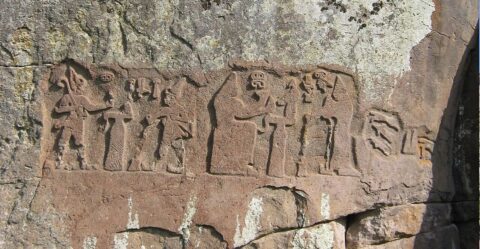
Tudhaliya IV played a major role in the monumental development of Yazılıkaya, a rock sanctuary about two kilometers northeast of Hattusa. The site had been used for religious purposes before his reign, but much of its elaborate sculptural decoration dates to the late thirteenth century BCE. A temple complex provided access to two open-air chambers decorated with images of Hittite and Hurrian deities.
In Chamber A, processions of gods and goddesses converge on the divine couple Teššub and Ḫepat, reflecting the importance of Hurrian religious traditions at the Hittite court. A monumental relief of Tudhaliya IV (Relief 64), accompanied by his name in Anatolian hieroglyphs, places the king within this divine setting and emphasizes his relationship with the gods.
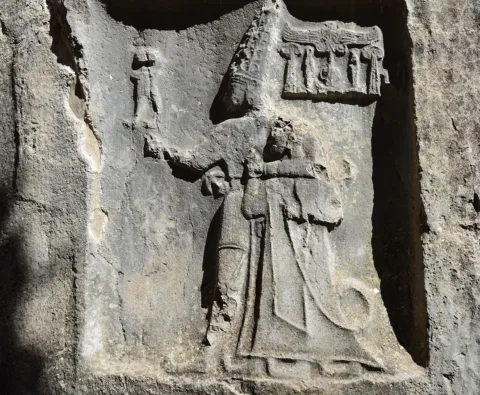
Chamber B contains a second royal image (Relief 81), depicting Tudhaliya embraced by his protective god Šarruma. Other carvings show twelve marching deities associated with the underworld and a large sword-shaped divine figure. These images have prompted interpretations of the chamber as a memorial or sanctuary for Tudhaliya’s funerary cult, possibly completed under his son Šuppiluliuma II. Its precise function remains debated, and no royal burial has been securely identified there.
Beyond Yazılıkaya, Tudhaliya was involved in maintaining established religious practices. A royal edict concerning the monthly festival of the Storm God of Nerik (CTH 672) regulated ritual observances and offerings. Provincial cult inventories also document local festivals, sacred objects, and the upkeep of sanctuaries. Many of these texts were once attributed to a kingdom-wide religious reform under Tudhaliya, but their dating is often uncertain. The securely attributable evidence points primarily to the restoration and maintenance of existing cults rather than the introduction of a new religious system.
Imperial Administration and Economic Pressures
Land grants were an important instrument of Hittite royal administration. A royal grant issued by Tudhaliya IV to the official Šahurunuwa (CTH 225) illustrates the crown’s authority to allocate estates and establish property rights. Such grants also helped maintain relationships between the king and influential members of the administration.
Agriculture, particularly wheat and barley cultivation, formed the foundation of the Hittite economy. Grain could also be obtained from Egypt and the Levant when local supplies proved insufficient. Ura, a port on the southern Anatolian coast, served as an important entry point for shipments destined for the Hittite interior.
The urgency of these supply arrangements appears in RS 20.212, a letter discovered at Ugarit requesting a large ship and crew to transport 2,000 measures of barley from Mukiš to Ura, where food was urgently needed. The letter may date to Tudhaliya’s reign, although its precise attribution remains uncertain. The Egyptian pharaoh Merneptah also claimed to have sent grain by ship to sustain Hatti. These records document efforts to address food shortages, but do not establish a widespread famine throughout the empire.
Tudhaliya’s involvement in water management is reflected in the Karakuyu dam, near Pınarbaşı in central Anatolia. A hieroglyphic inscription bearing his name links the structure to his reign. Its surviving embankment and stone-built outlet provide evidence of substantial investment in water storage, although the dam’s contribution to agricultural production cannot be measured.
The Final Years and Succession of Tudhaliya IV
Little is known about Tudhaliya IV’s final years or the circumstances of his death, conventionally dated to around 1209 BCE. His son Arnuwanda III succeeded him but died after a brief reign, possibly lasting only a year or two. With no known descendants to inherit the throne, the kingship passed to his brother, Šuppiluliuma II.
The succession was not without political difficulties. In a loyalty oath (CTH 122), Talmi-Tešub, the Hittite ruler of Carchemish, recalled his support for Šuppiluliuma during his accession. Other oath texts from the new king’s reign (CTH 124) reveal concerns about dynastic loyalty and potential rivals within the royal family. Although these fragmentary documents do not establish the full circumstances of the succession, they show that questions of royal legitimacy persisted after Tudhaliya’s death.
Conclusion
Tudhaliya IV did not rule an empire on the verge of immediate collapse. Hittite authority remained substantial, supported by military campaigns, royal administration, and ambitious religious projects. Yet the defeat at Nihriya and the tensions surrounding Kurunta exposed weaknesses that these achievements could not resolve.
His reign can be considered one of the Hittite Empire’s last periods of significant power, but not an unquestioned golden age. The empire’s eventual collapse was not inevitable when Tudhaliya died. His legacy lies in the efforts to preserve and strengthen a kingdom whose authority was becoming harder to maintain.
Academic Sources & Primary Texts
This article draws on Hittite treaties, royal inscriptions, diplomatic correspondence, and modern scholarship. Several events, particularly the Battle of Nihriya, Kurunta’s royal claims, and the campaigns against Alashiya, remain subjects of academic debate.
Academic Studies
- Bryce, Trevor. The Kingdom of the Hittites. Revised edition, Oxford University Press, 2005. Chapter 12, “New Enterprises, New Threats: The Reign of Tudhaliya IV,” pp. 295–326.
Oxford Academic. - Weeden, Mark. “The Hittite Empire.” In The Oxford History of the Ancient Near East, Vol. III, Oxford University Press, 2022. A reassessment of late Hittite political history and its surviving evidence.
UCL Discovery. - Alexandrov, Boris. “On the Hittite-Assyrian Military Conflict(s) in the Late 13th Century BCE Once Again.” Journal Asiatique, 310(1), 2022. Reexamines the dating of the Battle of Nihriya and its Assyrian participants.
Journal article. - Beckman, Gary, Trevor Bryce, and Eric H. Cline. The Ahhiyawa Texts. Society of Biblical Literature, 2011. Translations and commentary on Hittite documents concerning Ahhiyawa, including the Šaušgamuwa Treaty and Milawata Letter.
Scholarly edition. - Bemporad, Andrea. “The War with Alašiya in KBo 12.38.” Colloquium Anatolicum, 13, 2014, pp. 81–102. Examines the disputed attribution of Hittite military campaigns against Alashiya.
Read study. - Cammarosano, Michele. “Hittite Cult Inventories, Part Two: The Dating of the Texts and the Alleged ‘Cult Reorganization’ of Tudhaliya IV.” Altorientalische Forschungen, 39(1), 2012, pp. 3–37.
Academic PDF. - d’Alfonso, Lorenzo. “The Making of Hittite Imperial Landscapes: Territoriality and Balance of Power in South-Central Anatolia during the Late Bronze Age.” Journal of Ancient Near Eastern History, 3(2). Examines Hittite territorial administration and the political geography of Tarhuntassa.
Journal article. - Torri, Giulia. “The Hittite King as Administrator of the Land.” In Administrative Practices and Political Control in Anatolian and Syro-Anatolian Polities, Firenze University Press, 2023.
University Press.
Primary Hittite Texts and Inscriptions
- Bronze Tablet Treaty (CTH 106): Tudhaliya IV’s agreement with Kurunta of Tarhuntassa, documenting territorial rights, military obligations, and dynastic loyalty.
University of Texas, text and commentary. - KBo 12.38 (CTH 121): The damaged royal inscription concerning Alashiya and the reign of Šuppiluliuma II.
LAMAN text record. - Šaušgamuwa Treaty (CTH 105) and Milawata Letter (CTH 182): Diplomatic documents concerning Assyria, Ahhiyawa, Amurru, and western Anatolia. English translations appear in The Ahhiyawa Texts.
Text translations. - Catalogue des Textes Hittites (CTH): Reference catalogue for additional documents discussed in this article, including CTH 108, 111, 122, 123, 124, 225, and 672.
Hethitologie Portal Mainz.