Fylgjur in Norse Mythology: Spirits of Identity and Fate
In Norse mythology, a fylgja (plural fylgjur) was a supernatural companion associated with a person’s identity, character, and fate. In the Icelandic sagas, these beings often appear as animals in dreams or waking visions, revealing someone’s presence or foretelling death. Other accounts describe female companions associated with protection and family inheritance.
Although commonly described as guardian spirits, fylgjur did not necessarily protect the people they accompanied. Some merely revealed what was about to happen, while others intervened in human affairs. Their nature is difficult to define because the surviving medieval sources describe different forms of supernatural companionship without treating them as a single, clearly defined category.
What Is a Fylgja in Norse Mythology?
The Old Norse noun fylgja derives from the verb fylgja, meaning “to follow” or “to accompany.” The noun also means afterbirth, a connection that has led some scholars to associate the supernatural fylgja with birth. Whether people were believed to acquire a fylgja at birth remains uncertain.
Animal fylgjur are often interpreted as manifestations of a person’s nature rather than entirely separate beings. They could appear far from the individual while reflecting that person’s condition or circumstances. Female companions, however, display greater independence in some accounts, making it difficult to determine whether the fylgja belonged to the human self or existed as a separate supernatural entity.
Animal Fylgjur: Reflections of Human Identity
In Chapter 23 of Njáls saga, Höskuldr dreams of an exceptionally large bear accompanied by two cubs. He identifies the bear as the fylgja of Gunnar of Hlíðarendi and realizes that Gunnar had visited him in disguise with two companions. The animal’s size reflects Gunnar’s imposing physical stature, while the dream reveals his concealed identity.
Animal imagery could also convey information about ancestry. In Þorsteins þáttr uxafóts, Geitir sees a polar bear cub accompanying the young Þorsteinn. He interprets its appearance as evidence that the boy belongs to a more distinguished family than his supposed parents. Although the passage does not explicitly name the animal a fylgja, it illustrates how supernatural animal companions could signify inherited social identity.
The surviving accounts offer no consistent system assigning fixed meanings to particular animals. Their significance emerges from the circumstances of each story, rather than from a universal set of animal symbols.
Fylgjur in Dreams, Visions and Omens of Death
Not everyone could perceive a fylgja, and encounters did not always involve visible apparitions. In Chapter 12 of Njáls saga, Svanr begins yawning heavily and senses the approach of Ósvífr’s fylgjur. His reaction reveals the presence of approaching enemies before they come into sight.
In Chapter 41, Þórðr sees a goat lying in a hollow, covered in blood. Njáll cannot see the animal but recognizes it as Þórðr’s fylgja and warns him to be cautious. Þórðr replies that caution will do little good if he is destined to die. He is killed in the following chapter.
The episode associates seeing one’s own fylgja with impending death, while perceiving those of other people could disclose their presence or hostile intentions.
Female Fylgjur and the Spirits of Families
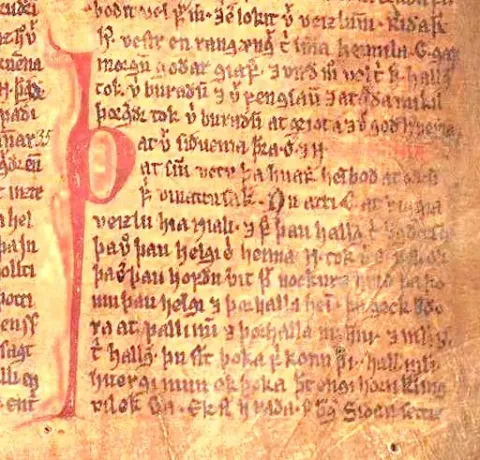
One of the clearest accounts of a female fylgja appears in Chapter 11 of Hallfreðar saga. As the poet Hallfreðr lies dying aboard a ship, a large woman wearing armor approaches across the waves. Identified as his fylgjukona (female companion spirit), she seeks a new companion after he renounces his connection with her. His brother Þorvaldr refuses her, but Hallfreðr’s son accepts.
The spirit’s transfer is not automatic. She chooses whom to approach, while each prospective companion can accept or refuse her. Her existence is not bound to the lifetime of a single individual.
The episode appears in the Möðruvallabók version of the saga but is absent from the version preserved in Óláfs saga Tryggvasonar en mesta. Else Mundal interpreted Hallfreðr’s rejection of the spirit as a final separation from paganism. Clive Tolley questioned this interpretation because the son who accepts her is also Christian. Zuzana Stankovitsová explored its significance as an act of family inheritance, noting that the younger Hallfreðr inherits not only the spirit but also his father’s name, farm, and nickname.
Were Fylgjur Really Guardian Spirits?
In Chapter 36 of Vatnsdæla saga, a woman who had accompanied members of Þorsteinn’s family appears in his dreams on three successive nights, warning him against attending a feast hosted by Gróa. Reluctant to break his promise, Þorsteinn initially resists her advice. He eventually stays home and sends his companions away. A landslide destroys Gróa’s house, killing everyone inside.
Although the woman’s intervention saves Þorsteinn’s life, the passage does not explicitly identify her as a fylgja. Her association with female fylgjur rests on her protective behavior and connection with the family.
The term “guardian spirit” describes the role of such a companion in this episode, but it is too restrictive as a general definition of fylgjur.
Fylgja, Hamingja, Dísir and Hamr: What Is the Difference?
Several Old Norse concepts overlap with the fylgja without being synonymous with it:
- Hamingja: Personal fortune or success, which could take supernatural form and pass between members of a family.
- Dísir: Female supernatural beings associated with protection, fate, and death. Religious offerings to the dísir are documented, whereas evidence for a distinct fylgja cult is lacking.
- Hamr: The physical form or appearance of a being, particularly in accounts of shape-shifting.
- Hugr: The mind, thoughts, desires, or intentions of a person, sometimes associated with supernatural manifestations in animal form.
The overlap is particularly evident in Chapter 9 of Víga-Glúms saga. Glúmr dreams of an enormous woman whose shoulders rise above the mountains. He identifies her as the hamingja of his maternal grandfather, Vigfúss, and believes that his grandfather has died and that his fortune is seeking a new home with him. The woman’s extraordinary size reflects Vigfúss’s prominence.
Despite resembling a female fylgja in appearance and family association, she is explicitly identified as a hamingja. The terminology used in individual accounts is therefore more informative than appearance alone.
What Can the Sagas Tell Us About Norse Beliefs?
Most of the Icelandic family sagas were written in the thirteenth and fourteenth centuries, well after Iceland’s conversion to Christianity around 1000. Their accounts of supernatural beings may preserve older beliefs alongside medieval literary and religious influences.
William Friesen’s 2015 study identifies parallels between animal fylgjur and medieval European bestiaries and dream literature. Zuzana Stankovitsová has also re-examined the traditional distinction between animal and female fylgjur, questioning whether beings described under different names can reliably be grouped into a single category.
Christian influence is particularly visible in Chapter 100 of Njáls saga. Before accepting baptism, Hallr asks that the archangel Michael become his fylgjuengill, or attendant angel. Here, the vocabulary of spiritual companionship is applied to a Christian figure.
How widely belief in fylgjur was shared during the Viking Age, and how closely it resembled the tradition recorded in the sagas, remain open questions.
Conclusion
The Old Norse concept of fylgja was broader than the modern notion of a guardian spirit. Its significance lay in the connection between a supernatural companion and the identity, destiny, or inherited fortune of those it followed, whether or not it offered protection.
Sources & Primary Texts
- Mundal, Else. Fylgjemotiva i norrøn litteratur. Universitetsforlaget, 1974.
- Friesen, William. Family Resemblances: Textual Sources of Animal Fylgjur in Icelandic Saga. Scandinavian Studies, 2015.
- Stankovitsová, Zuzana. Following up on Female fylgjur: A Re-Examination of the Concept of Female fylgjur in Old Icelandic Literature. 2020.
- Tolley, Clive. Shamanism in Norse Myth and Magic. Academia Scientiarum Fennica, 2009.
- Bryan, Eric Shane. Icelandic Fylgjur Tales and a Possible Old Norse Context. Journal of English and Germanic Philology, 2010.
- Cleasby, Richard, and Guðbrandur Vigfússon. An Icelandic-English Dictionary. Oxford, 1874.
- Njáls saga. Chapters 12, 23, 41–42, and 100.
- Hallfreðar saga vandræðaskálds. Chapter 11.
- Vatnsdæla saga. Chapter 36.
- Víga-Glúms saga. Chapter 9.
- Þorsteins þáttr uxafóts. Old Norse text.
Copyright Notice
© 2026 History & Myths. Written by H. Moses. All rights reserved.
The original text, analysis, and editorial content of this article are protected by copyright. Historical sources and academic references remain subject to their respective copyright and licensing terms. Reproduction or republication of this article without prior written permission is prohibited, except as permitted by applicable copyright law.