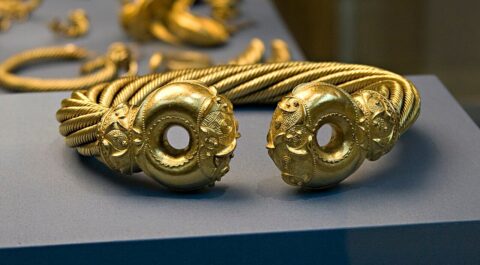
The Gauls Before Rome: Tribes, Society and Power
The Gauls were Celtic-speaking peoples who inhabited much of present-day France and parts of Belgium, Switzerland, and neighboring regions. When Julius Caesar began his campaigns in 58 BCE, Gaul was divided into political communities with their own territories, governing institutions, and competing interests.
Some were ruled by kings, while others elected magistrates and maintained aristocratic councils. Their economies supported specialized industries, extensive trade networks, and fortified urban centers known as oppida.
Greek and Roman writers provide much of the surviving historical information about the Gauls, but archaeological discoveries, inscriptions, and coins also reveal how these communities functioned before the Roman conquest.
Who Were the Gauls?
Roman writers referred to these peoples as Galli, while Greek authors used names such as Keltoi and Galatai. These terms varied in geographical scope and did not necessarily reflect how individual communities identified themselves.
The Gauls belonged to the broader Celtic world, which also included the Celtiberians of the Iberian Peninsula and Celtic-speaking populations elsewhere in Europe. The Gauls formed part of the broader Celtic-speaking world, but the term Celts was not restricted to the peoples of Gaul.
In the opening passage of his Commentaries on the Gallic War, Julius Caesar records that the inhabitants of one region of Gaul called themselves Celtae, while the Romans called them Galli. His account preserves a rare reference to a collective name reportedly used by the inhabitants themselves.
Surviving Gaulish inscriptions, written in Greek and Latin scripts, provide direct evidence of their language and preserve personal names, religious dedications, and aspects of public life.
Read More:
Where Was Ancient Gaul?
Ancient Gaul extended from the Atlantic coast to the Rhine and from the Pyrenees to the North Sea, encompassing most of modern France, Belgium, Luxembourg, and parts of Switzerland, Germany, and the Netherlands.
Caesar divided unconquered Gaul into three broad regions. The Aquitani occupied the southwest between the Garonne and the Pyrenees, the Belgae inhabited the north beyond the Seine and Marne, and the peoples he identified as Celtae occupied much of the intervening territory. These populations were linguistically diverse, particularly the Aquitani, whose language was closely related to ancestral Basque.
Rome established control over much of southern Gaul in the late second century BCE, creating a province later known as Gallia Narbonensis. Caesar’s campaigns in 58 BCE therefore extended Roman power beyond an established provincial frontier.
The Romans also distinguished Cisalpine Gaul in northern Italy from Transalpine Gaul beyond the Alps. This article focuses on the latter.
How Did Gallic Societies Develop Before Rome?
During the sixth and fifth centuries BCE, wealthy elites emerged in parts of eastern Gaul, where fortified settlements and richly furnished graves reflected pronounced social inequality. The burial at Vix, dating to around 500 BCE, contained an enormous Greek bronze vessel, evidence of the wealth and long-distance connections of local aristocracies.
From around 450 BCE, the archaeological culture known as La Tène spread across much of continental Europe. Its distinctive metalwork, weapons, jewelry, and artistic designs are well represented in Gaul. Shared material culture, however, does not necessarily indicate a common ethnic identity or political organization.
Several early centers of aristocratic power declined during the fifth century BCE. From the third century BCE onward, settlement patterns changed again, with increasing population concentration and the emergence of settlements specializing in craft production.
The Major Peoples of Ancient Gaul
The principal peoples of Gaul controlled territories with different resources, economic advantages, and degrees of political influence.
- Aedui: Occupied much of present-day Burgundy between the Loire and Saône rivers. Their principal center was Bibracte, and they maintained diplomatic relations with Rome before Caesar’s conquest.
- Arverni: Based in the Massif Central, particularly around modern Auvergne. They exercised considerable influence over other Gallic peoples during the second century BCE under kings such as Luernius and Bituitus.
- Sequani: Inhabited territories east of the Saône, extending toward the Jura Mountains. Their geographical position placed them in direct competition with the Aedui.
- Helvetii: Occupied much of the Swiss Plateau. Caesar describes their political community as divided into four districts known as pagi.
- Bituriges Cubi: Controlled parts of central Gaul around modern Bourges, a region with substantial agricultural and metalworking activity.
- Carnutes: Inhabited the region around modern Chartres and Orléans. According to Caesar, their territory hosted an annual gathering of Gallic Druids.
- Veneti: Occupied the Atlantic coast of southern Brittany, where maritime trade and control of shipping contributed to their regional power.
Other prominent peoples included the Remi and Suessiones in northern Gaul, the Parisii around the Seine, and the Allobroges in the southeast. Their territorial boundaries shifted over time, making modern maps of Gallic territories approximate reconstructions.
How Were the Gauls Governed?
The term tribe, commonly used to describe Gallic peoples, can obscure the complexity of their political organization. Caesar frequently uses the Latin term civitas to describe a political community with its own territory and governing institutions, sometimes divided into smaller districts called pagi.
Although kingship had a long history in Gaul, some communities had replaced monarchies with elected magistrates and aristocratic councils. Strabo describes aristocratic government as widespread, with leaders appointed annually.
The Aedui provide the best-documented example. Their highest magistrate, known as the Vergobret, was elected annually and held authority over matters of life and death. Despite these extensive powers, Aeduan law prohibited him from leaving the community’s territory during his term of office.
An electoral dispute in 52 BCE between Convictolitavis and Cotus reveals further legal restrictions. Only one individual could hold the supreme magistracy at a time, and members of the same family faced restrictions on holding office and sitting together in the governing council. Religious officials also participated in the electoral process under certain circumstances.
Evidence of the Vergobret exists outside Caesar’s account. First-century BCE coins attributed to the Lexovii bear the inscription VERCOBRETO, confirming that the title was used beyond the Aeduan community. Its precise powers among the Lexovii remain unknown.
These institutions placed legal limits on individual authority, but political power remained concentrated among aristocratic families.
How Was Gallic Society Organized?
Gallic society was strongly hierarchical, with wealthy families drawing much of their influence from land, livestock, and military leadership.
Caesar identifies two particularly influential groups: the Druids and the equites, a Latin term he uses for the warrior aristocracy. The Druids performed religious duties, taught young men, and settled disputes involving inheritance, property, and serious offenses. Their authority extended beyond individual political communities.
The warrior aristocracy maintained networks of clients and armed retainers. According to Caesar, the number of dependents surrounding a nobleman reflected his wealth and standing. These relationships allowed aristocrats to exercise influence independently of formal political office.
Caesar describes the common population as politically marginalized, with debt, taxation, and pressure from powerful families forcing some individuals into dependency. His account provides little insight into differences in status among farmers, artisans, servants, and enslaved people.
The richly furnished female burial at Vix shows that exceptional wealth and social distinction were not restricted to men, although funerary evidence alone cannot establish whether women of such standing exercised political authority.
Read More:
The Economy of Pre-Roman Gaul
Agriculture formed the economic foundation of Gallic communities. Farmers cultivated wheat, barley, and other crops, while cattle, sheep, and pigs supplied meat, hides, and wool. Underground grain pits and raised granaries enabled rural households to store agricultural surpluses.
Ironworking supplied tools and weapons, while salt production, pottery, and bronze working supported regional trade. The Bituriges were particularly associated with metalworking. Pliny the Elder credits them with developing a technique for coating bronze objects with tin.
Gallic coinage developed from Mediterranean prototypes, particularly the gold staters of Philip II of Macedon. Local communities gradually introduced their own designs and produced gold, silver, and copper-alloy coins. Their distribution reflects regional patterns of exchange, although coins also served political, social, and ritual purposes.
Wealth could also become a source of political power. Caesar records that Dumnorix, an Aeduan aristocrat, secured contracts for customs duties and other public revenues at low prices because rival bidders feared opposing him. His wealth enabled him to maintain a cavalry force at his own expense.
Oppida: The Urban Centers of Gaul
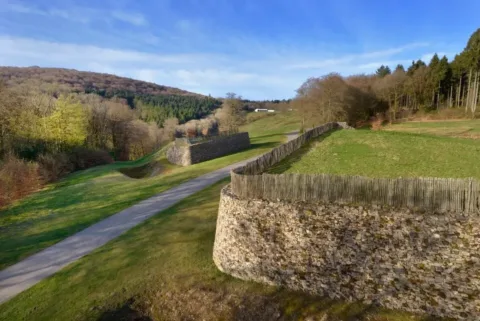
From the late second century BCE, large fortified settlements known as oppida became prominent across Gaul. Beyond their defensive functions, they accommodated residential quarters, workshops, markets, and public gatherings.
Bibracte, the principal center of the Aedui on Mont Beuvray, is among the best-studied examples. Its original fortifications enclosed approximately 200 hectares, while a later defensive circuit reduced the enclosed area to around 135 hectares. Excavations have uncovered streets, residential buildings, workshops, and evidence of extensive commercial activity.
Urban development preceded the construction of these fortified centers. At Levroux in central Gaul, an open settlement supported specialized craft production and exchange before activity shifted to a fortified hilltop. Some oppida thus developed from existing centers of economic activity.
Not all oppida served the same purpose. Some became major population centers and seats of political authority, while others contained extensive areas with little permanent occupation. Their size and fortifications alone cannot establish their population or administrative status.
Gaul and the Mediterranean World
Greek settlers founded Massalia (modern Marseille) around 600 BCE, establishing a major commercial link between southern Gaul and the Mediterranean. Goods traveled inland through the Rhône and Saône valleys, connecting coastal markets with communities across central Europe.
Gallic elites particularly valued imported wine, ceramics, and bronze drinking vessels. Mediterranean merchants, in turn, obtained agricultural products, metals, and enslaved people.
At Lattara, near modern Montpellier, chemical analysis identified wine residues in imported Etruscan amphorae dating to approximately 500–475 BCE. A limestone pressing platform dating to 425–400 BCE also provides evidence of local wine production.
By the late second century BCE, Italian wine imports had become increasingly important. The large quantities of amphora fragments recovered at Bibracte and other inland settlements attest to extensive commercial relations with Italy well before Caesar’s conquest.
The Balance of Power Before Caesar
Powerful Gallic communities extended their influence beyond their own territories through alliances, military protection, and relationships of dependency. Regional dominance shifted as rival peoples competed for the allegiance of smaller communities.
During the second century BCE, the Arverni were among the dominant powers in Gaul. Their defeat by Rome in 121 BCE weakened their position, while the Aedui maintained a privileged diplomatic relationship with the Roman Republic, which recognized them as brothers and kinsmen of the Roman people.
According to Caesar, the Sequani and Arverni recruited the Germanic ruler Ariovistus and his forces against the Aedui. Following their defeat, the Aedui were compelled to surrender hostages, while Ariovistus subsequently demanded territory from the Sequani themselves.
The Aeduan statesman and Druid Diviciacus traveled to Rome seeking assistance. By 58 BCE, Caesar was using the growing influence of Ariovistus and Rome’s existing obligations toward the Aedui to justify military intervention.
How Much Do We Really Know About the Gauls?
Caesar’s Commentaries on the Gallic War provide the most detailed surviving account of Gallic political institutions. Yet Caesar wrote as a military commander seeking to justify his actions. His descriptions of political rivalries, external threats, and appeals for Roman assistance must be understood in that context.
Diodorus Siculus and Strabo drew partly on earlier Greek ethnographic traditions, particularly the work of Posidonius. Similarities between their accounts do not necessarily constitute independent confirmation. Strabo also wrote after the conquest, when Roman rule was already transforming Gallic institutions.
No extensive historical narrative written by the pre-Roman Gauls survives. Their inscriptions and coins preserve personal names, political titles, and linguistic evidence, while excavations document everyday life through rural settlements, workshops, burials, and public buildings.
Interpreting archaeological evidence presents its own difficulties. A wealthy burial does not necessarily identify a ruler, nor does a large fortified settlement establish the existence of a centralized state.
Conclusion
Long before the Roman conquest, Gallic peoples had developed governing institutions, regional economies, and networks of political alliances. Roman rule eventually brought these politically distinct communities under a common authority, ending their autonomy but not erasing their cultural identities.
Sources & Primary Texts:
- Julius Caesar. Commentaries on the Gallic War, Books I, III, VI and VII.
- Strabo. Geography, Book IV.
- Diodorus Siculus. Library of History, Book V, Chapters 25–32.
- Pliny the Elder. Natural History, Book XXXIV.
- Fernández-Götz, Manuel (2014). Identity and Power: The Transformation of Iron Age Societies in Northeast Gaul. Amsterdam University Press.
- Lamoine, Laurent (2006). La pratique du vergobret : le témoignage de César confronté aux inscriptions. Cahiers du Centre Gustave Glotz, 17, 81–104.
- Fernández-Götz, Manuel (2018). Urbanization in Iron Age Europe: Trajectories, Patterns, and Social Dynamics. Journal of Archaeological Research, 26, 117–162.
- Mullen, Alex, and Coline Ruiz Darasse (2020). Gaulish. Palaeohispanica, 20.
- Oppida, Agglomerations, and Suburbia: The Bibracte Environs and New Perspectives on Late Iron Age Urbanism in Central-Eastern France. European Journal of Archaeology, 16(3), 2013.
- McGovern, Patrick E., et al. (2013). Beginning of Viniculture in France. Proceedings of the National Academy of Sciences.
- Coinage and Coin Use. Oxford Academic.
- Bibracte Archaeological Research Centre.
- Lattara Archaeological Site. French Ministry of Culture.
Copyright & Image Credits:
© 2026 History & Myths. All rights reserved. This article is an original editorial work based on historical sources, archaeological evidence, and academic research. All images remain the property of their respective copyright holders and are used in accordance with their applicable licenses.