Lokasenna: When Loki Insulted the Norse Gods
At a feast hosted by Ægir, Loki turns a gathering of the Norse gods into a bitter confrontation. In Lokasenna, a 65-stanza poem preserved in the Poetic Edda, he attacks Odin, Frigg, Freyja, and other deities with accusations of cowardice, betrayal, and sexual misconduct. The prose introduction recounts how Loki kills Ægir’s servant Fimafeng and is expelled from the feast. He returns to confront the gods, and the quarrel continues until Thor threatens him with Mjölnir.
Some of Loki’s accusations refer to myths preserved in other sources, while others cannot be independently verified. This uncertainty makes Lokasenna particularly revealing: the poem exposes tensions over honor, rivalry, and authority among the gods without establishing that every allegation is true.
What Is Lokasenna in the Poetic Edda?
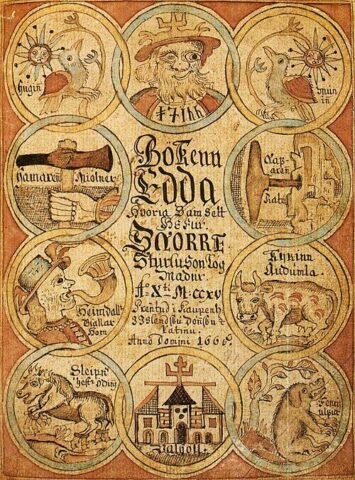
Lokasenna, commonly translated as “Loki’s Quarrel” and often described as “Loki’s Flyting,” is an anonymous Old Norse poem belonging to the mythological section of the Poetic Edda. It survives in the Codex Regius (GKS 2365 4to), an Icelandic manuscript written around 1270, where it appears between Hymiskviða and Þrymskviða, two poems involving Thor.
The poem is composed chiefly in ljóðaháttr, an Eddic verse form suited to dialogue. Its title refers to a senna, a verbal contest involving accusations, ridicule, and challenges to personal honor. Here, Loki confronts a succession of gods rather than a single opponent.
Most of the poem unfolds through direct speech, framed by prose passages that establish the setting and describe events surrounding the confrontation. The distinction matters because the prose and poetry need not share the same compositional history. The exchanges also assume familiarity with earlier myths, some preserved in other Old Norse texts and others known only through Loki’s hostile references.
Ægir’s Feast and the Murder of Fimafeng
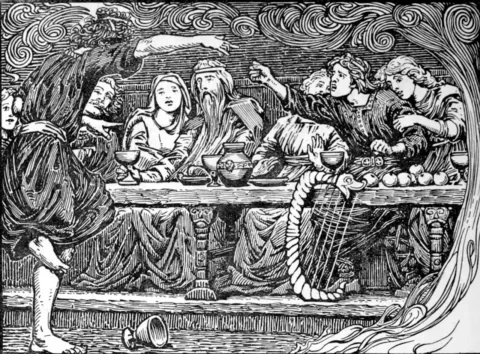
The prose introduction to Lokasenna places the gods at a feast hosted by Ægir, a giant associated with the sea. He had brewed ale after obtaining the enormous cauldron described in Hymiskviða. Among the guests were Odin, Frigg, Freyr, Freyja, Týr, Bragi, Iðunn, Loki, and numerous elves. Thor was absent, having traveled east.
Gold illuminated Ægir’s hall instead of firelight, ale served itself, and the gathering enjoyed the protection of a place of sanctuary. Two servants, Fimafeng and Eldir, attended the guests and received praise for their excellent service. Angered by the attention given to them, Loki killed Fimafeng.
The Æsir responded by shaking their shields, shouting at Loki, and driving him into the forest before returning to their drinks. The killing and expulsion are described in the prose introduction rather than the poem’s verses. Although Loki’s resentment of the servants’ praise is given as the immediate cause, the text offers no deeper explanation for his violence.
Loki Returns: His Challenge to Eldir and Odin
Outside Ægir’s hall, Loki asks Eldir what the gods are discussing over their ale. Eldir replies that they are talking about weapons and achievements in battle, warning that neither the gods nor the elves have a friendly word for him. Loki declares that he will enter the hall and stir up discord. When Eldir warns that the gods will answer his insults, Loki boasts of his ability to defeat opponents in a verbal contest (stanzas 1–5).
Loki enters, and the gathering falls silent. Calling himself Lopt, another of his names, he demands a drink and challenges the gods either to offer him a seat or tell him to leave. Bragi refuses, declaring that the Æsir know whom they should welcome to their feast (stanzas 6–8).
Loki turns directly to Odin, reminding him that they once mingled their blood and that Odin had promised never to drink ale unless Loki was served as well. This oath is mentioned but not explained in the poem, leaving its circumstances unknown.
Rather than dispute the claim, Odin instructs his son Víðarr to make room for Loki, hoping to prevent further insults. Víðarr rises and pours Loki a drink, as described in the brief prose passage following stanza 10.
The First Insults: Bragi, Iðunn and Gefjon
Loki greets the assembled gods and goddesses but deliberately excludes Bragi, the god of poetry. Bragi offers him a horse, a sword, and a gold ring to end his hostility. Loki refuses, accusing him of cowardice and claiming that he is the least willing to fight among those gathered. When Bragi threatens to take his head outside the hall, Loki mocks him as a bench-ornament, a man who makes threats while remaining safely seated (stanzas 11–15).
Bragi’s wife, Iðunn, urges him to stop arguing. Loki turns on her instead, accusing her of sexual misconduct and claiming that she embraced her brother’s killer. Neither her supposed brother nor his killer can be securely identified from surviving myths. Iðunn declines to retaliate, explaining that she only wants to prevent a fight between Bragi and Loki (stanzas 16–18).
Gefjon intervenes, questioning why the gods are exchanging such hostile words. Loki accuses her of a sexual encounter with a young man who gave her a necklace. Scholars have suggested connections with Heimdall and Brísingamen, the necklace associated with Freyja, but neither identification is certain.
Odin defends Gefjon, rebuking Loki for provoking a goddess who knows the destinies of living beings as clearly as he does. This knowledge of fate is a striking attribute of Gefjon that receives little explanation elsewhere in the surviving mythology (stanzas 19–21).
Loki Against Odin, Frigg and Freyja
Loki accuses Odin of granting victory in battle to undeserving warriors. Odin retaliates by claiming that Loki spent eight winters underground living as a woman, milking cows, and bearing children. Loki counters that Odin practised seiðr, a form of magic, on Samsey, often identified with the Danish island of Samsø, while behaving like a sorceress. Both use accusations of unmanly conduct to attack the other’s honor (stanzas 22–24).
Frigg intervenes, urging them to leave their past deeds unspoken. Loki instead accuses her of sleeping with Odin’s brothers, Vili and Vé. Frigg replies that if her son Baldr were present, Loki would not escape without a fight. Loki then claims responsibility for Baldr’s failure to return home. The poem offers no account of his death, making this admission one of its most significant references to another myth (stanzas 25–28).
Freyja condemns Loki’s words and reminds him that Frigg knows the fates of all beings, even when she does not reveal them. Loki accuses Freyja of having taken every god and elf at the feast as a lover. When she warns that his insults will bring him grief, he claims that the gods once caught her in an intimate encounter with her brother, Freyr (stanzas 29–32).
Njörðr, Týr and Freyr: Family Secrets and Lost Power
Njörðr defends his daughter Freyja, arguing that a woman’s lovers are less remarkable than a god who has given birth to children. Loki retaliates by recalling Njörðr’s arrival among the Æsir as a hostage and accusing Hymir’s daughters of once urinating in his mouth. Njörðr responds by praising his son Freyr, prompting Loki to claim that he fathered Freyr with his own sister (stanzas 33–36). This accusation has a parallel in Ynglinga saga, which describes sibling marriage as customary among the Vanir.
Týr intervenes by praising Freyr as a noble god who harms neither maidens nor married women and frees captives from their bonds. Loki mocks Týr’s inability to settle disputes and reminds him that Fenrir tore off his right hand. Týr acknowledges the loss but points out that Fenrir remains bound. Loki then claims to have fathered a son with Týr’s wife, an allegation unsupported by any surviving independent account (stanzas 37–40).
Freyr warns Loki that he too will be bound if he continues speaking. Loki answers by recalling Freyr’s pursuit of Gerðr, the daughter of Gymir, and the sword he surrendered to obtain her. He asks how Freyr will defend himself when the sons of Muspell ride through Myrkviðr (stanzas 41–42).
The threats carry an ominous significance. Fenrir’s imprisonment, Loki’s approaching punishment, and Freyr’s lost weapon all point toward the conflicts surrounding Ragnarök.
The Gods’ Final Attempts to Silence Loki
Byggvir, one of Freyr’s attendants, declares that if he possessed his master’s power, he would beat Loki for his insults. Loki mocks his lowly position, accusing him of whispering at Freyr’s ear and working at the mill. When Byggvir proudly identifies himself, Loki calls him a coward who hides among the straw when fighting begins (stanzas 43–46).
Heimdall blames Loki’s reckless speech on drunkenness and urges him to stop. Loki responds by ridiculing Heimdall’s duties as the gods’ watchman, portraying his constant vigilance as a miserable existence (stanzas 47–48).
Skaði warns that Loki will soon be bound with the entrails of his own son. He answers by boasting of his role in the killing of her father, Þjazi. When she threatens him again, Loki claims that she once invited him into her bed, an encounter unattested in other surviving myths (stanzas 49–52).
Sif, Thor’s wife, offers Loki a cup of mead and asks him to acknowledge that she alone is beyond reproach. He accepts the drink but claims that he himself once slept with her, betraying Thor (stanzas 53–54).
Beyla, Byggvir’s wife and another attendant of Freyr, announces that the mountains are trembling as Thor approaches. She expects him to silence Loki, who responds by insulting her character and calling her filthy (stanzas 55–56).
Thor Arrives: How Loki’s Verbal Battle Ends
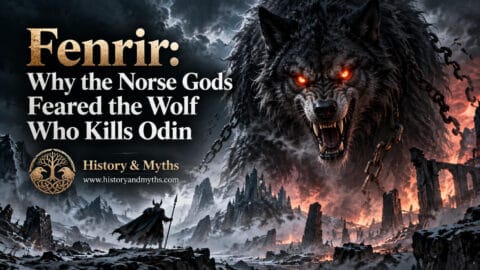
Thor enters Ægir’s hall and orders Loki to be silent, threatening to sever his head with Mjölnir. Loki mocks him as the son of Earth and questions his courage, warning that he will be less confident when Fenrir devours Odin at Ragnarök (stanzas 57–58).
Thor threatens to hurl Loki eastward, beyond the sight of men. Loki retaliates by recalling Thor’s humiliating encounter with the giant Skrýmir, when he sheltered inside the thumb of an enormous glove and later struggled to open Skrýmir’s food bag. Both incidents are described more fully in Snorri Sturluson’s Gylfaginning (stanzas 59–62).
Thor continues threatening him, promising to break his bones with the hammer that killed Hrungnir and send him to the realm of the dead. Loki finally agrees to leave, declaring that he has spoken his mind to the gods but will depart because Thor is capable of fighting (stanzas 63–64).
Before leaving, Loki turns to Ægir, declaring that he will never host another such feast and calling down fire upon his possessions and Ægir himself. The poem ends with this threat, without describing its fulfillment (stanza 65).
Were Loki’s Accusations Against the Gods True?
Some of Loki’s accusations in Lokasenna refer to recognizable myths, while others survive only as insults within the poem. Their appearance in a verbal contest makes it necessary to distinguish established mythological traditions from claims intended to humiliate an opponent.
Several accusations have parallels in other sources. Týr’s loss of his hand to Fenrir appears in Gylfaginning, chapter 34, while Freyr’s surrender of his sword to Skírnir is recorded in Skírnismál. Njörðr’s arrival among the Æsir as a hostage is mentioned in Vafþrúðnismál, stanza 39. Ynglinga saga, chapter 7, also describes Odin’s practice of seiðr, although Loki’s specific account of his activities on Samsey remains unconfirmed.
Loki’s claim concerning Baldr is particularly significant. In stanza 28, he takes responsibility for preventing Baldr’s return. Gylfaginning, chapter 49, describes Loki arranging Baldr’s death through the blind Höðr, whereas Völuspá recounts the killing without explicitly identifying Loki as its instigator.
Other allegations remain uncertain. Ynglinga saga relates that Frigg became involved with Odin’s brothers, Vili and Vé, and that Njörðr had children with his sister. However, these later accounts do not necessarily provide independent confirmation. Freyja’s alleged encounter with Freyr, Loki’s claim that Iðunn embraced her brother’s killer, and Loki’s claim about Týr’s wife lack comparable surviving narratives. His accusation against Sif is likewise unproven, although Hárbarðsljóð contains another insult questioning her fidelity.
The surviving parallels may preserve older traditions, but agreement between medieval texts does not always establish independent evidence. Some of Loki’s accusations may also refer to stories now lost, leaving their original meaning beyond recovery.
Loki’s Punishment: The Prose Ending of Lokasenna
After Loki’s final threat against Ægir, a prose passage describes his capture and punishment. Loki hides in the waterfall of Fránangr in the form of a salmon, but the Æsir catch him.
According to this account, Loki is bound with the entrails of his son Nari, while another son, Narfi, becomes a wolf. Skaði places a venomous serpent above his face, and his wife Sigyn holds a bowl beneath it to catch the poison. Whenever she leaves to empty the bowl, the venom strikes Loki, making him writhe so violently that the earth shakes. The passage explains earthquakes through his suffering.
Snorri Sturluson’s Gylfaginning, chapter 50, gives a fuller account set after Baldr’s death and the failed attempt to bring him back from Hel. The gods pursue Loki with a fishing net, but Thor ultimately catches him by hand. They then transform Loki’s son Váli into a wolf. Váli tears apart his brother Narfi, whose entrails are used to bind Loki against three stones.
The accounts differ in both the names and roles of Loki’s sons. Nari and Narfi appear as separate sons in the prose ending of Lokasenna, although the names are treated as variants elsewhere. The narrative contexts also differ: Lokasenna places the punishment after Ægir’s feast, while Gylfaginning connects it to the aftermath of Baldr’s death. Neither account establishes that Loki was imprisoned solely for insulting the gods.
Read Also
Sigyn: The Norse Goddess Who Protected Loki from Venom
Explore Sigyn’s role in Loki’s punishment, the conflicting accounts of their children, and what the surviving Norse sources reveal about her.
What Lokasenna Reveals About Honor and Power
In Lokasenna, reputation is central to the gods’ authority. Loki questions their courage, loyalty, and sexual conduct before an audience, turning personal accusations into public challenges. Whether the charges are true matters less to the confrontation than the shame they are intended to cause.
Ægir’s feast exposes competing obligations. Loki has violated the peace by killing a servant, yet invokes his oath with Odin to regain admission. Bragi threatens violence, Iðunn urges restraint, and Sif offers reconciliation. Their responses reveal the difficulty of maintaining hospitality while defending personal honor.
Many insults also reflect Old Norse attitudes toward masculinity and sexual shame. The concept of ergi, associated with behavior condemned as unmanly, helps explain the accusations exchanged by Loki and Odin. Such charges could damage a man’s standing regardless of his physical strength or authority.
Thor ultimately silences Loki through threats rather than argument. As Megan Hartman’s 2026 study observes, Loki demonstrates verbal superiority, although the poem leaves the question of his ultimate victory unresolved. The confrontation distinguishes the power to humiliate through speech from the power to enforce silence through violence.
When Was Lokasenna Composed? Dating and Interpretation
The author of Lokasenna is unknown, and its date and place of composition remain disputed. Although the surviving Codex Regius manuscript dates to around 1270, the poem was known earlier. Snorri Sturluson draws on verses resembling those in Lokasenna in Gylfaginning, composed around the 1220s.
Scholars have proposed dates ranging from the Viking Age to the Christian medieval period. Some interpret the ridicule of the gods as evidence of Christian hostility toward the old religion. Others argue that such satire could have developed within pre-Christian traditions, where divine figures were not necessarily beyond criticism.
Linguistic evidence complicates the debate. In a 2023 study, Mikael Males challenged arguments for a twelfth-century date based on similarities with Classical literature. He emphasized archaic alliteration involving an older vr- sound, particularly in stanza 15, as evidence favoring an earlier composition. This feature does not, however, establish an exact date.
The prose introduction and conclusion may also have a different history from the verses. Scholars have suggested that these passages were added or revised during manuscript transmission, possibly under the influence of Snorri’s Edda. As for the poem’s purpose, interpretations range from religious satire to entertainment and the exploration of Loki’s hostility toward the gods. None can be established as the author’s definitive intention.
Conclusion
Lokasenna shows how the gods’ shared history could be turned against them. Loki draws on familiar myths, disputed claims, and stories now lost to challenge their standing before the assembled company.
The poem remains an important source for Norse mythology because it preserves references to traditions that might otherwise have disappeared. Yet its accusations cannot be treated as straightforward accounts of the gods’ actions. This tension between inherited mythology and deliberate mockery makes Lokasenna a distinctive work of Old Norse poetry.
Academic Sources & Primary Texts
Primary Texts and Critical Editions
- Pettit, Edward (2023). The Poetic Edda: A Dual-Language Edition, “Lokasenna,” pp. 283–324. Open Book Publishers.
Read online. - Snorri Sturluson. Edda: Prologue and Gylfaginning. Edited by Anthony Faulkes (2005), 2nd ed. Viking Society for Northern Research. See chapters 34, 49–50.
Critical edition. - Snorri Sturluson. Heimskringla I: The Beginnings to Óláfr Tryggvason. Translated by Alison Finlay and Anthony Faulkes (2016), 2nd ed. Viking Society for Northern Research. See Ynglinga saga.
Academic translation.
Academic Studies
- Dronke, Ursula (1997). The Poetic Edda, Volume II: Mythological Poems. Oxford: Clarendon Press. Critical edition and commentary on Lokasenna and other mythological poems.
- McKinnell, John. “Motivation in Lokasenna.” Saga-Book, vol. XXII, pp. 234–262. Study of Loki’s motivations and the poem’s interpretation.
Read study (PDF). - Hartman, Megan (2026). “Speech Acts in ljóðaháttr: The Case of Lokasenna.” In From Carving Runestones to Digitizing Skaldic Poetry, pp. 130–146. John Benjamins.
Publisher and abstract. - Males, Mikael (2023). “Hear No Sievers, See No Sievers: Metrics and the Eddic Commentary Tradition.” Neophilologus, 107, pp. 257–277.
Open-access study. - Sigurðsson, Marteinn H. (2006). “Bera tilt með tveim: On Lokasenna 38 and the One-Handed Týr.” Arkiv för nordisk filologi, 121, pp. 139–159.
Journal archive.
Copyright & Editorial Notice
© 2026 History & Myths. All rights reserved. This article is an original historical and literary analysis of Lokasenna, based on Old Norse primary texts and academic scholarship. Interpretations and conclusions are presented with attention to the limitations of the surviving evidence. Reproduction or republication of the article without permission is prohibited.