What If Hammurabi Had Never Destroyed Mari?
What if Hammurabi had conquered Mari but never destroyed it? The city might have remained an important administrative and trading center on the Euphrates under Babylonian rule. Its independence would still have ended, but its palace, institutions, and regional connections could have survived.
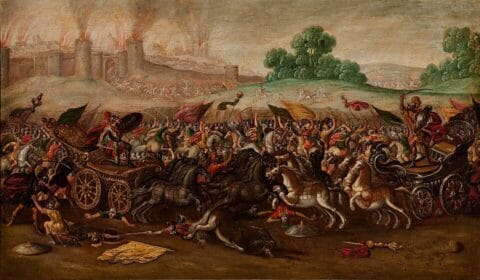
Hammurabi and Mari’s king, Zimri-Lim, had once been allies. Around 1761 BCE, Babylon conquered Mari, and its royal palace was subsequently looted and burned. Why Hammurabi ordered its destruction remains uncertain, especially given the city’s strategic position between Mesopotamia and Syria.
Had Mari been spared, Babylon could have gained a valuable provincial center rather than a ruined former capital. Its survival might also have created new opportunities for local rulers as Babylonian authority weakened after Hammurabi’s death.
What Happened to Mari Under Hammurabi?
Mari had played an important role in Hammurabi’s rise to power. Zimri-Lim supported the Babylonian king against Elam and supplied troops for his campaign against Larsa. Their cooperation reflected the shifting alliances among the kingdoms of Mesopotamia and Syria.
After Hammurabi conquered Larsa in 1763 BCE, the balance of power changed. Babylon’s expansion brought it into increasing competition with other kingdoms, including Mari, which controlled a strategic stretch of the Euphrates and maintained close ties with Syrian rulers. The relationship between the former allies deteriorated, although the precise circumstances of their final break remain uncertain.
Around 1761 BCE, Hammurabi defeated Zimri-Lim and took control of Mari. Zimri-Lim disappears from the surviving records, and his ultimate fate is unknown. His kingdom lost its independence, but the royal palace was not immediately dismantled.
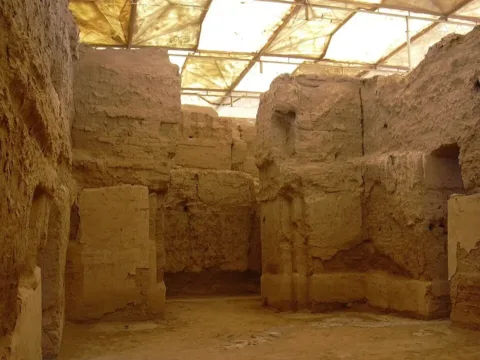
Babylonian officials examined the palace archives, sorting diplomatic correspondence and removing selected documents. The palace was subsequently looted, burned, and extensively damaged. Its destruction is commonly dated to around 1759 BCE, although some scholarly reconstructions place it sooner after the conquest.
The burning brought Mari’s royal administration to an end. It also helped preserve thousands of clay tablets that archaeologists would recover centuries later.
Hammurabi’s reason for ordering Mari’s destruction remains unknown. Preventing renewed resistance is one possible explanation, but the surviving evidence does not establish his motive.
Could Mari Have Remained a Major Trade Center?
Mari’s position on the middle Euphrates made it an important link between southern Mesopotamia, Syria, and Anatolia. Its commercial value would not have disappeared simply because Babylon had conquered it.
A transport canal connected the city to the river and served its port, known as the karum. Boats carried timber, metals, oil, and wine downstream, while caravans linked Mari to inland markets. Taxes on river traffic and passing caravans provided a significant source of royal revenue.
Hammurabi could have redirected that income to Babylon while retaining Mari as a center for merchants and shipments moving between the southern cities and the Syrian kingdoms.
But the trade routes would have needed protection. Maintaining the canal, securing caravan routes, and keeping taxation manageable would have mattered more to merchants than the identity of the city’s ruler. Heavy levies or renewed warfare could have diverted business elsewhere.
Agriculture also supported Mari’s economy. Irrigated fields along the Euphrates supplied grain, although the city sometimes relied on additional food brought from the Khabur region or western Syria.
Mari could have remained an important commercial center under Babylonian rule, provided its new administration kept the transport routes secure and the local economy functioning.
What Would Have Happened to Mari’s Royal Palace and Archives?
Had Hammurabi spared Mari, its vast royal palace could have remained in use under Babylonian rule. But preserving the building would not necessarily have meant preserving its archives intact.
Excavations uncovered approximately 15,000 complete and fragmentary clay tablets, including royal letters, administrative accounts, and legal records. They provide an unusually detailed picture of Mari’s government and its dealings with neighboring kingdoms.
The Babylonians had already seized selected diplomatic documents after the conquest. Even if the palace survived, some records would have been lost to Mari, while its scribes might have continued producing new documents for the Babylonian administration.
The destruction itself created an archaeological paradox. Fire could harden clay tablets, while the rubble of collapsed rooms protected records from later disturbance. Without that destruction, older documents might have been relocated, discarded, or lost during subsequent changes to the palace.
A surviving Mari could therefore have maintained its scribal traditions for generations while leaving modern historians fewer records of Zimri-Lim’s kingdom than the ruined palace actually preserved.
Would Mari Have Challenged Babylon Again?
Keeping Mari intact would also preserve the local networks that had supported its former rulers. A Babylonian garrison could secure the palace, but it could not guarantee the loyalty of everyone who had served Zimri-Lim.
Former court officials and influential families might have resented losing their positions or privileges. Disputes over taxes, appointments, or military obligations could have given that resentment a political focus. Support from neighboring rulers might then have turned local unrest into a wider challenge.
Yet resistance was not the only possibility. Merchants, landowners, and officials whose livelihoods depended on stability might have preferred cooperation with Babylon to another conflict. Hammurabi could have strengthened their loyalty by allowing some continuity in local government.
The outcome would have depended on how Babylon exercised its authority. A city governed through cooperation might have remained secure, while heavy-handed rule could have encouraged opposition.
Sparing Mari would therefore have left Hammurabi with a political challenge: how to govern a former royal capital without destroying the local connections that made it worth preserving.
How Would Mari’s Survival Have Affected Syria and Northern Mesopotamia?
Mari’s relationship with Yamhad, the powerful kingdom centered on Aleppo, would have been one of the first challenges for its new Babylonian rulers.
Yarim-Lim I of Yamhad had helped Zimri-Lim recover his throne, and their alliance was reinforced when Zimri-Lim married Yarim-Lim’s daughter, Shibtu. By the time Babylon conquered Mari, Yarim-Lim had been succeeded by his son, Hammurabi of Yamhad.
Zimri-Lim’s removal would have ended Aleppo’s close relationship with Mari’s ruling dynasty. If the city remained intact under Babylonian control, Yamhad would instead face a neighboring administrative and military center governed by another powerful kingdom.
Open conflict was not inevitable. Babylon and Yamhad had reasons to maintain diplomatic contact, particularly where their interests met along the Euphrates. But Aleppo would also have sought to protect its influence in northern Syria.
Farther east, the Khabur region presented another difficulty. Zimri-Lim had exercised authority over several local rulers, but those arrangements depended on alliances and personal loyalties. Babylon could not assume that conquering Mari meant inheriting its former political network.
A surviving Mari might therefore have extended Babylon’s diplomatic reach into Syria while giving Yamhad a new power to reckon with on its eastern approaches. Neither outcome would have guaranteed Babylonian control over the northern kingdoms.
Could Mari Have Regained Independence After Hammurabi’s Death?
Hammurabi died in 1750 BCE, leaving his son Samsu-iluna a kingdom that soon faced serious rebellions. Babylon struggled to maintain control over territories conquered during Hammurabi’s reign.
The middle Euphrates became contested territory. During Samsu-iluna’s reign, rulers associated with the kingdom of Hana exercised power in the region. Documents from Terqa provide much of the surviving evidence, although the location of the kingdom’s early political center remains debated. In 1722 BCE, Samsu-iluna claimed victory over Yadih-Abu, a ruler of Hana, showing that Babylon was still fighting to assert its authority along the middle Euphrates.
Had Mari remained intact, its palace and established institutions could have provided a political center for rulers seeking independence from Babylon.
That would not necessarily have restored Zimri-Lim’s dynasty. A former Babylonian governor or a new local ruling family might have taken power, drawing on Mari’s royal traditions to establish its authority.
Alternatively, Samsu-iluna could have tried to retain Mari through agreements with its local leaders rather than another military campaign.
The city’s survival would have given the middle Euphrates an established royal center at a time when Babylonian control was increasingly contested.
The Most Plausible Outcomes
Mari’s political future could have taken three different paths.
Continued Babylonian Rule
If Babylon maintained its authority over the middle Euphrates, Mari could have remained a provincial center governed by Babylonian officials.
Greater Local Autonomy
As Babylonian power weakened, local leaders might have gained control over the city’s affairs while continuing to acknowledge Babylon’s authority.
Renewed Independence
If Babylon lost the region entirely, Mari could have become the seat of a new independent dynasty, without necessarily restoring Zimri-Lim’s family.
These outcomes were not mutually exclusive. Mari might have moved from direct Babylonian rule to local autonomy and eventually independence as political conditions changed.
Conclusion
Hammurabi’s conquest did not have to mean the end of Mari as an important city. Had he spared its palace and institutions, Mari could have continued serving Babylon before potentially becoming a center of local power again.
The greatest change would not have been the survival of Zimri-Lim’s kingdom, but the survival of a city capable of influencing the political future of the middle Euphrates.