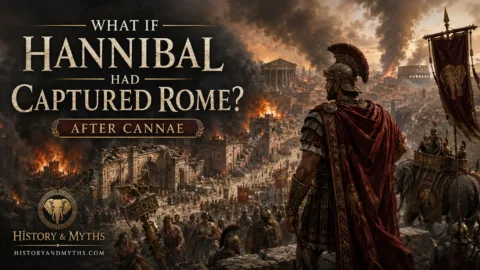
What If Hannibal Had Captured Rome After Cannae?
Hannibal came closer than any foreign commander of his generation to breaking Roman power. After crushing a massive Roman army at Cannae in 216 BCE, he had opened a crisis inside the Republic. Capua and several communities in southern Italy abandoned Rome, while the Romans suddenly faced the possibility that more of their allies might follow.
Yet Rome itself never fell.
What if Hannibal had reached the city while the shock of Cannae was still fresh and succeeded in capturing it?
The immediate consequences could have been severe. More Italian allies might defect, Roman political leadership could be scattered, and Carthage would gain enormous leverage in any peace settlement. But capturing the capital would not automatically destroy the Roman Republic. Rome still possessed armies, colonies, loyal allies, overseas forces, and a political system capable of continuing the war beyond the city walls.
That distinction changes the entire scenario. Hannibal might win the greatest victory of the Second Punic War without gaining permanent control of Italy. Rome could collapse, negotiate, or attempt to fight on from elsewhere.
The real question is therefore not whether Hannibal could capture Rome. In this scenario, he does. The question is whether the fall of the city would be enough to end Roman power.
The Historical Turning Point
The Battle of Cannae in 216 BCE brought Rome closer to strategic collapse than any earlier defeat in the Second Punic War.
Hannibal destroyed the largest Roman field army yet assembled against him. Tens of thousands of Roman and allied soldiers were killed or captured, one consul died, and the surviving consul withdrew with what remained of the army. In the days that followed, several communities in southern Italy began abandoning Rome.
The damage, however, stopped short of total political collapse. Capua joined Hannibal, as did important communities in Apulia and elsewhere, but other cities remained loyal. Naples, Cumae, Nola, Luceria, Venusia, and Canusium were among the places that continued resisting Carthaginian pressure.
Rome also refused to negotiate. It raised new forces and shifted toward a longer war of attrition rather than risking another immediate battle on Hannibal’s terms.
That survival is the historical turning point.
In this alternate scenario, Hannibal converts the shock of Cannae into something he never achieved historically: the capture of Rome itself before the Republic can stabilize.
The Scenario Used in This Article
This is a hypothetical scenario, not a claim about what actually happened.
This article assumes that Hannibal follows his victory at Cannae with an immediate move against Rome and, unlike in the historical timeline, has enough supplies, siege capability, and reinforcements to take the city before the Republic can recover.
Rome falls, but the scenario stops there. It does not assume that the Senate is completely destroyed, every Roman army surrenders, or all of Italy immediately joins Carthage.
Roman forces still exist outside the capital. Loyal colonies and allied communities remain in Italy, while Roman armies continue operating in Sicily and Spain. Carthage also retains the same political and logistical limits it faced historically.
Hannibal therefore gains possession of Rome, not automatic control of the Roman state.
The question that follows is whether capturing the Republic’s political center would trigger a wider collapse, force Rome into peace, or leave Hannibal holding a spectacular prize while Roman resistance continues elsewhere.
What Would Hannibal Actually Do With Rome?
Hannibal would have more to gain from a defeated Rome than from a destroyed one.
His wider strategy in Italy was aimed at breaking the alliance system that supplied Rome with soldiers, territory, and political influence. Capturing the capital after Cannae would give him the strongest possible leverage to finish that process.
The most plausible outcome would be a harsh peace rather than the permanent occupation of Rome. Hannibal could demand the loss of Roman territory, recognition of Carthaginian interests in Spain and the western Mediterranean, and greater independence for Italian communities that had joined him.
Rome might also be forced to surrender hostages, money, ships, or strategic positions to make another war more difficult.
Destroying the city completely would offer fewer advantages. It would require more time and resources while risking resistance from Romans who still controlled armies and territory elsewhere.
Hannibal’s real prize would therefore not be Rome’s buildings. It would be the political surrender of the system Rome had built around them.
Would the Roman Republic Collapse After Rome Fell?
Not necessarily.
Losing Rome would be a political and psychological disaster, but the Republic’s ability to wage war extended beyond the capital. Roman armies were still operating elsewhere, colonies and fortified positions remained under Roman control, and the state could continue raising troops and collecting resources from territories that had not surrendered.
The crucial factor would be the survival of Rome’s leadership. If enough senators, magistrates, and commanders escaped the city, they could attempt to preserve the Republic from another base and continue the war. Capturing Rome would disrupt government, but it would not automatically erase the institutions or military commands already functioning outside it.
There is even evidence that Hannibal expected some form of Roman state to survive a Carthaginian victory. His later treaty with Philip V allowed for the possibility of making peace terms with the Romans rather than eliminating them entirely.
The Republic could still collapse, especially if the fall of the capital triggered wider political desertion. But Hannibal would have to defeat more than a city to make that collapse permanent.
Would Rome’s Italian Alliance System Finally Collapse?
It could fracture far more seriously than it did historically, but a complete collapse would still be unlikely.
Hannibal’s greatest success after Cannae was convincing parts of southern Italy that Rome could be beaten. Capua changed sides, as did several communities in Apulia and elsewhere. Yet many strategically important cities and Latin colonies remained loyal even after Rome had suffered its worst battlefield disaster.
The capture of Rome would alter that calculation. Communities that had stayed loyal because they expected the Republic to recover might now decide that resistance was too dangerous or no longer worthwhile. More defections would weaken Roman recruitment, communications, and control of key roads and territory.
But Italian alliances were not held together by fear alone. Local rivalries, existing privileges, Roman citizenship ties, and distrust of Carthage all shaped individual decisions. Some communities could still prefer a weakened Rome to dependence on Hannibal.
The most likely result is therefore not that all Italy changes sides at once, but that Rome loses enough allies to make recovery far more difficult.
Could Rome Be Retaken?
Yes, if the Republic survived the first shock.
Capturing Rome would force Hannibal to defend a large hostile city while maintaining supply lines through an Italy that was still only partly under his control. Every soldier left to hold the capital would be unavailable for campaigns elsewhere.
Roman armies outside the city would therefore matter enormously. If enough forces, commanders, and loyal communities remained active, they could isolate Rome, threaten Hannibal’s communications, or eventually concentrate for a counterattack.
Rome had already shown an ability to fight on several fronts at once. In 211 BCE, when Hannibal actually marched toward the capital, the Senate did not abandon the campaign against Capua. Part of the Roman force returned to defend Rome while the siege continued.
Retaking the city would still be difficult, especially if its fall triggered widespread defections. But Hannibal would face a new problem after his greatest victory: holding Rome might require resources that were more valuable elsewhere.
Capturing the capital and keeping it were two different military problems.
What Happens to Scipio and the War in Spain?
The war in Spain would not necessarily end when Rome fell.
Roman forces had been fighting there since the beginning of the conflict because Spain was central to Carthaginian manpower, money, and military strategy. As long as those armies remained intact, Rome would still possess a way to attack Hannibal’s wider war effort from outside Italy.
That makes the future of Scipio Africanus uncertain rather than irrelevant. His later rise depended on Rome continuing to commit men and resources to Spain after earlier Roman commanders were killed there. If the Republic survived the capture of its capital, Spain could become even more important as a front where Roman resistance remained organized.
A successful Roman campaign there could still cut Carthage off from troops and revenue, weakening Hannibal even while he held Rome.
But the opposite is also possible. If the fall of the capital shattered Roman finances and political coordination, Spain might be one of the first distant theaters the Republic could no longer sustain.
Scipio’s career would therefore depend less on whether Rome had fallen than on whether the Roman state still had the resources and will to keep fighting abroad.
Would Macedon and Syracuse Join Hannibal More Effectively?
Probably.
Philip V of Macedon allied with Hannibal in 215 BCE, while Syracuse later abandoned its Roman alignment and moved toward Carthage. Historically, neither development changed the war decisively. Rome contained Macedon across the Adriatic and eventually captured Syracuse.
The fall of Rome would make both alliances more valuable.
Philip would have stronger reason to believe that Roman power in the Adriatic could be rolled back, potentially encouraging a more aggressive Macedonian campaign. Syracuse, meanwhile, could expect greater Carthaginian support in Sicily if Rome were struggling to preserve its position in Italy.
That would force the surviving Roman state to divide men, ships, and money between several theaters at the moment when its resources were already under extreme pressure.
Neither Macedon nor Syracuse could destroy Rome alone. Their importance would lie in making Roman recovery harder by turning Hannibal’s victory in Italy into a wider Mediterranean crisis.
Could Carthage Actually Control Italy?
Probably not in the way Rome had.
Hannibal’s strategy worked best when Italian communities abandoned Rome and regained greater freedom under Carthaginian protection. That did not require Carthage to annex every city or administer the peninsula directly.
If Rome fell, the same pattern would likely continue. Capua, Samnite communities, Greek cities, and other former Roman allies could expect more autonomy rather than replacement by Carthaginian governors.
That would make Italy politically weaker and more fragmented, but also harder for Carthage to control. Local rivalries had already complicated Hannibal’s alliances, and Rome later reconquered several cities because Hannibal could not defend them all at once.
Carthage could dominate the western Mediterranean and shape Italian politics without turning Italy into a centralized Carthaginian province.
The more plausible result is a broken Roman alliance system surrounded by semi-independent Italian states, with Carthage acting as the strongest outside power rather than as a direct ruler of the peninsula.
Would Carthage Become the Dominant Power of the Mediterranean?
In the western Mediterranean, quite possibly. Across the entire Mediterranean, much less certainly.
A Roman defeat would remove Carthage’s most dangerous rival and could preserve its position in Spain while reopening opportunities in Sicily and other western territories lost after the First Punic War.
But Carthaginian victory would not erase every competing power. Macedon, the Ptolemaic kingdom in Egypt, and the Seleucid Empire would still dominate large parts of the eastern Mediterranean, while independent cities and regional states pursued their own interests.
Carthage would also need to rebuild the naval advantage it had once enjoyed. During the Second Punic War, Rome remained capable of moving armies by sea and restricting Carthaginian operations despite Hannibal’s victories in Italy.
The most plausible outcome is therefore a Carthaginian-led western Mediterranean, not a single Carthaginian empire stretching across the entire sea.
Rome’s defeat could stop Roman Mediterranean supremacy before it began. It would not automatically create an equal Carthaginian replacement.
Would There Still Be a Roman Empire?
A Roman Empire on the historical timeline would become much less likely.
Rome’s later Mediterranean expansion depended heavily on surviving the Second Punic War. Victory left it dominant in Italy, established its position in Spain, and allowed Roman armies to intervene increasingly in Macedonia, Greece, and eventually North Africa.
A defeat after Cannae would interrupt that sequence before it began. If Rome lost allies, territory, overseas possessions, and freedom of action under a Carthaginian peace settlement, it could spend decades rebuilding rather than expanding.
That would not make a future Roman recovery impossible. A surviving Republic might eventually regain strength, especially if Carthaginian influence weakened or Italian alliances shifted again.
But the empire that later conquered Greece, destroyed Carthage, expanded through Spain and Gaul, and dominated the Mediterranean depended on opportunities created by Roman victory in this war.
Hannibal’s capture of Rome could therefore do more than delay expansion. It could prevent the specific chain of victories that produced the Roman Empire we know.
Read Also
What Would Probably Not Change
Hannibal’s capture of Rome would transform the western Mediterranean, but it would not reorganize the entire ancient world overnight.
Macedon, Ptolemaic Egypt, and the Seleucid Empire would still remain major powers in the east. Their rivalries and territorial ambitions existed independently of Rome’s survival and would continue even if Carthage emerged stronger in the west.
Italy would also remain politically diverse. Latin colonies, Greek cities, Samnite communities, and other local powers would still pursue their own interests rather than becoming a single Carthaginian bloc.
Carthage itself would not suddenly acquire unlimited manpower or administrative capacity simply because Rome had fallen.
The biggest change would be the balance of power in the western Mediterranean. The wider Hellenistic world would continue to follow its own competing political paths.
Most Likely
The most likely outcome is a Carthaginian victory that forces Rome into a severe peace rather than the complete destruction of the Republic.
The fall of the capital would probably trigger further defections in Italy, weaken Roman recruitment, and give Hannibal enough leverage to dismantle much of Rome’s alliance system. Carthage could recover lost influence in Spain and the western Mediterranean while Rome survived as a reduced regional power.
Italy would remain politically divided rather than becoming a Carthaginian province.
Hannibal’s greatest achievement would therefore be breaking Roman supremacy before it became Mediterranean supremacy.
Plausible but Uncertain
A surviving Roman Republic could continue the war from outside the capital and eventually recover Rome, especially if enough armies, colonies, and loyal allies remained intact.
It is also plausible that Carthage would emerge as the leading power in the western Mediterranean while leaving Italy politically fragmented rather than ruling it directly.
Scipio, or another Roman commander, might still build a successful resistance in Spain or elsewhere, although the loss of Rome would make that path far harder.
A stronger Macedon and a more secure Carthaginian position in Sicily are also possible if Rome became unable to sustain several fronts at once.
Each outcome fits the pressures already visible after Cannae, but none follows automatically from the capture of the city.
Highly Unlikely
It is highly unlikely that the capture of Rome would instantly erase the Roman Republic or place all of Italy under direct Carthaginian rule.
Roman armies, colonies, and loyal allies would still exist outside the capital, while Italian communities had different political interests and would not all respond to Hannibal’s victory in the same way.
It is equally unlikely that Carthage would simply replace Rome and build an identical Mediterranean empire. Its political system, military resources, and relationships with allied states were fundamentally different.
The fall of Rome could break Roman supremacy and redirect Mediterranean history. It would not create a single predictable Carthaginian world overnight.
Final Verdict: Capturing Rome Could Win Hannibal the War Without Ending Rome
If Hannibal had captured Rome after Cannae, the Second Punic War could have ended very differently.
The fall of the capital would strengthen defections in Italy, damage Roman political authority, and give Hannibal enormous leverage to impose peace. Carthage would likely emerge stronger in Spain and the western Mediterranean, while Rome survived as a reduced power rather than the dominant state it later became.
But capturing Rome would not automatically destroy the Republic. Roman armies, colonies, and loyal allies could still continue the war, and Hannibal would face the difficult task of holding together a coalition of Italian states with different interests.
The most likely result is therefore not the disappearance of Rome, but the end of the Roman rise that followed its historical victory over Carthage.
Hannibal could capture the city. The greater victory would be preventing Rome from becoming an empire.
Frequently Asked Questions
Did Hannibal ever capture Rome?
No. Hannibal defeated several Roman armies and came close enough to threaten the capital, but he never captured Rome. His greatest victory came at Cannae in 216 BCE, after which several Roman allies in Italy changed sides.
Why didn’t Hannibal attack Rome immediately after Cannae?
Hannibal had won a devastating battlefield victory, but taking a fortified city required different resources. His army lacked the siege capability, secure supply system, and reinforcements needed to make an immediate assault on Rome a low-risk decision.
Would capturing Rome have ended the Second Punic War?
Possibly, but not automatically. Roman armies, colonies, allies, and overseas forces would still exist outside the capital. The fall of Rome could force the Republic into a harsh peace, but continued resistance from elsewhere would remain possible.
Would Carthage have ruled Italy if Rome fell?
Probably not through direct rule of the entire peninsula. A more plausible outcome is that Rome’s alliance system breaks apart and several Italian states regain greater independence while Carthage becomes the strongest outside power influencing the region.
Could the Roman Republic survive without the city of Rome?
It could, if enough senators, magistrates, commanders, armies, and loyal allies survived. Rome was the political center of the Republic, but Roman military power and administration were already spread across Italy and other theaters of war.
Would there still have been a Roman Empire?
The Roman Empire as we know it would become much less likely. Rome’s later expansion depended heavily on surviving and winning the Second Punic War. A major defeat in 216 BCE could delay Roman recovery for decades or redirect its history entirely.
Sources & Further Reading
The historical background in this article is based on ancient sources and modern academic scholarship.
The alternate-history conclusions are analytical possibilities built from those historical conditions, not claims about events that actually occurred.
The Histories, Book 3
Ancient account of the Second Punic War, including the Battle of Cannae, Roman losses, and the immediate political consequences of Hannibal’s victory.
The Histories, Book 7
Preserves the treaty between Hannibal and Philip V of Macedon and provides important evidence for Hannibal’s wider diplomatic strategy and the possibility of a negotiated peace with Rome.
History of Rome, Book 26
Account of Hannibal’s march toward Rome in 211 BCE, the Roman response, and the continuing siege of Capua while the capital itself was threatened.
Between Rome and Carthage: Campania
Academic analysis of Capua’s defection after Cannae, the continued loyalty of cities such as Naples, Cumae, and Nola, and the limits of Hannibal’s strategy for breaking Rome’s Italian alliance system.
Hannibal and Scipio: Hannibal Frustrated in Italy, 216–208 BCE
Modern academic discussion of Hannibal’s position after Cannae, Carthaginian support, the alliance with Macedon, Syracuse, Capua, and the strategic limits that prevented his victories from producing Roman collapse.
Research Note
Dates, battles, alliances, Roman and Carthaginian military positions, and the behavior of Italian communities are drawn from the sources above.
Predictions about what might have happened if Hannibal had captured Rome after Cannae are counterfactual analysis and should be read as historically grounded possibilities rather than established fact.
Copyright & Use
Written by H. Moses
This article is original content published by History & Myths. Its alternate-history analysis, structure, and written interpretation may not be reproduced, republished, or redistributed in full without permission.
Short quotations may be used for reference or discussion when accompanied by clear attribution and a link to the original article on HistoryAndMyths.com.