What If Julius Caesar Had Not Been Assassinated? How Rome Changed
If Julius Caesar had not been assassinated in 44 BCE, Rome would probably still have moved toward one-man rule but the empire that emerged could have looked very different.
Caesar was preparing for a major campaign against Parthia, while his dictatorship had already weakened the traditional balance of the Roman Republic. Surviving the conspiracy would give him more time to expand his authority, continue his reforms, and decide how power should pass after his death.
The biggest change might be Octavian. Without Caesar’s murder, Octavian would not rise through the same crisis that eventually turned him into Augustus. Mark Antony, Cleopatra, Caesarion, and Caesar’s other allies would also face a very different political future.
Caesar’s survival could therefore prevent the exact civil wars that followed his assassination, but it would not necessarily save the Republic. The more likely question is whether Caesar himself could build a stable Roman monarchy and whether that system could survive him.
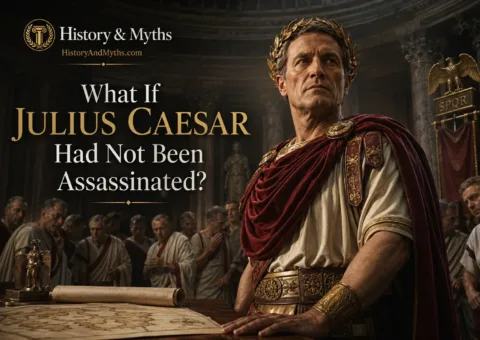
Rome on the Ides of March, 44 BCE
By March 44 BCE, Julius Caesar had defeated his main rivals in the civil wars and accumulated powers no Roman politician had held before him. He was dictator for life, controlled the military and much of the state’s political agenda, and had filled the Senate with new members loyal to his government.
That authority brought stability after years of war, but it also created fear. Many senators believed the Republic was becoming a monarchy in everything but name. The extraordinary honors granted to Caesar, combined with his refusal to surrender power after the civil wars, convinced some members of the elite that killing him was the only way to restore the old political order.
Rome was also about to lose Caesar’s direct presence. He was preparing to leave Italy for a major eastern campaign against Parthia, while the young Octavian was already in the Greek world preparing for military service. Mark Antony remained one of Caesar’s most important political allies, and Cleopatra was closely connected to him through both Egypt and their son, Caesarion.
If the assassination failed, Caesar would therefore survive at a critical moment: politically dominant at home, preparing for war abroad, and still without a clear system for transferring his unprecedented power to a successor.
The Scenario Used in This Article
This scenario assumes that the assassination plot of March 44 BCE fails and Julius Caesar survives. He remains in control of Rome and is able to continue with the eastern campaign he was already preparing.
It does not assume that Caesar automatically conquers Parthia, eliminates political opposition, or lives for a fixed number of additional years. Military defeat, illness, rebellion, and another succession crisis all remain possible.
The analysis therefore follows the changes that flow most directly from his survival: the fate of the conspirators, the Parthian campaign, the future of the Republic, and above all the question of who would eventually inherit Caesar’s power.
What Happens to Brutus, Cassius, and the Conspirators?
If the plot failed, Caesar would almost certainly move against the men who had tried to kill him. Brutus, Cassius, and the other conspirators could expect arrest, exile, loss of office, or execution.
Caesar had shown clemency toward defeated enemies before, including several men who later joined the conspiracy. After an attempted assassination, however, repeating that policy would be politically dangerous. Allowing the conspirators to remain influential would invite another attempt and make him appear unable to protect his own rule.
The response would probably be selective rather than indiscriminate. Caesar could punish the leading organizers while sparing lesser participants who surrendered, using the crisis to remove hostile senators and replace them with more reliable supporters.
That would strengthen his position in the short term, but it would also deepen the transformation of Roman politics. The Senate would become less capable of resisting Caesar, and organized republican opposition would lose many of its most determined leaders.
Caesar’s Planned War Against Parthia
Caesar was already preparing a major eastern campaign when he was assassinated. His immediate target was Parthia, the power that had defeated Crassus at Carrhae and captured Roman military standards.
If Caesar survived, the campaign would probably go ahead. It offered military prestige, a chance to avenge an earlier Roman disaster, and an opportunity to strengthen Rome’s position in the east. Caesar also had the resources and experience to prepare more carefully than Crassus had.
Success, however, was far from guaranteed. Parthian armies relied on highly mobile cavalry and could avoid the kind of decisive battle Caesar preferred. Long supply lines, difficult terrain, and the need to protect Roman provinces would make a deep invasion risky.
The most likely outcome is that Caesar would campaign aggressively in the east and could win important victories, but conquering Parthia outright would be much harder than defeating a single army or capturing a few cities.
Would Caesar Actually Conquer Parthia?
Caesar had a better chance against Parthia than Crassus, but that did not make victory certain. He was more experienced, better at adapting to unfamiliar enemies, and far less likely to march blindly into terrain chosen by Parthian cavalry.
Even so, Parthia was not Gaul. Its armies could avoid close combat, stretch Roman supply lines, and retreat deep into territory where occupation became increasingly difficult. Caesar might defeat major forces, recover prestige, and force a favorable settlement without destroying the Parthian state.
A limited Roman victory is therefore more plausible than total conquest. Caesar could strengthen Roman influence in Armenia and Mesopotamia, recover lost standards, and present the campaign as a major success while leaving Parthia intact as a powerful eastern rival.
Would Julius Caesar Become Rome’s First Emperor?
Caesar would probably continue concentrating power in his own hands but calling him Rome’s “first emperor” would be misleading. The later imperial system did not yet exist, and Caesar still ruled through republican offices, extraordinary commands, and the title of dictator.
If he survived, that arrangement could become more permanent. The Senate might continue to meet, elections could still take place, and traditional magistracies could remain, while real authority rested increasingly with Caesar.
The harder problem was presentation. Romans strongly distrusted kingship, and Caesar had already pushed elite tolerance close to its limit. He could build a monarchy in practice, but openly turning himself into a king would risk fresh resistance.
The most plausible path is therefore a personal regime that preserved republican institutions on the surface while reducing their independence. In that sense, Caesar might move Rome toward something resembling the later Principate but probably in a less subtle form than Augustus eventually created.
Could the Republic Still Survive?
The Republic might survive in form, but probably not in its old political balance. By 44 BCE, repeated civil wars had already weakened the system, and Caesar’s dictatorship had placed powers once divided among several offices under one dominant figure.
If Caesar remained alive, the Senate and magistracies could continue functioning, but increasingly within limits set by him. Elections might still matter, yet the most important military commands, appointments, and political decisions would depend on Caesar’s approval.
A genuine restoration would require him to surrender much of the authority he had fought to acquire, which is unlikely. The more plausible outcome is a republic that still existed legally while operating under permanent personal rule.
Rome might therefore avoid the exact constitutional settlement later created by Augustus, but not the broader shift away from competitive republican government.
What Happens to Octavian?
Octavian would still matter because Caesar had named him as his principal heir, but that did not make him the automatic successor to Caesar’s political power.
If Caesar lived, Octavian would probably continue gaining military and political experience under his great-uncle’s supervision. His future would depend on Caesar’s decisions, and the will that later transformed his position could still be changed.
This matters because Octavian’s historical rise began in the chaos created by Caesar’s death. He inherited the name Caesar, claimed his legacy, won support from veterans, and presented himself as the man who would avenge the assassination.
Without that crisis, he would begin as a promising young relative of the dictator rather than as an independent political force. Caesar’s survival might prepare Octavian for high office—but it could just as easily delay, limit, or completely redirect the path that eventually made him Augustus.
No Assassination, No Augustus as We Know Him?
Without Caesar’s murder, Octavian would lose several of the advantages that made his historical rise possible. There would be no campaign to avenge Caesar, no immediate struggle over his inheritance, and no deified Caesar whose adopted son could use the title Divi Filius “Son of the Deified One” as a source of political legitimacy.
He might still become one of Rome’s leading figures, especially if Caesar continued promoting him. But he would have to build authority gradually under Caesar’s shadow rather than seize it during a political vacuum.
The result is not necessarily a Rome without Octavian. It is a Rome in which the man later known as Augustus might never acquire power in the same way or create the same political system.
Mark Antony, Cleopatra, and Caesarion
Caesar’s survival would also reshape the futures of Mark Antony and Cleopatra. Antony would remain an important lieutenant, but without Caesar’s death he would have far less opportunity to become an independent power in Rome.
Cleopatra’s position would depend more directly on Caesar. Egypt was strategically valuable, and their relationship gave her unusual access to Roman politics, but Caesarion’s existence did not make him a recognized heir to Roman power.
That distinction matters. Caesar could favor Caesarion privately or strengthen his position in Egypt, yet Octavian remained the stronger candidate within Roman political tradition unless Caesar deliberately changed his plans.
The real uncertainty would emerge later. If Caesar died without a clearly established successor, Antony, Octavian, Caesarion, and other members of the ruling circle could still become competing centers of loyalty only under very different circumstances from the civil wars that actually followed 44 BCE.
Explore More Alternate History
Would Rome Avoid Another Civil War?
Caesar’s survival would probably prevent the exact civil war that followed his assassination, because the coalition of Antony, Octavian, and Lepidus would never form in the same way and Brutus and Cassius would not gain control of large eastern armies.
That does not mean Rome would become peaceful. Caesar still faced senators who feared permanent dictatorship, ambitious commanders, and a political system accustomed to resolving major disputes through military force.
As long as Caesar remained healthy and controlled the army, another large civil war was less likely. The greater danger would come later, especially if he died without a successor strong enough to command both the legions and the political elite.
His survival could therefore postpone Rome’s next internal war and change its participants, but it could not remove the conditions that had already made civil conflict part of Roman politics.
Could Caesar Create a Stable Succession?
Caesar’s hardest long-term problem would not be winning another war but deciding what happened to his power when he died. Rome had no constitutional mechanism for inheriting a dictatorship, and naming an heir in a will did not automatically transfer control of the Senate, provinces, or legions.
If Caesar wanted his political system to survive, he would need to prepare a successor while still alive. That could mean granting Octavian or another chosen heir military experience, major offices, loyal supporters, and a visible place beside him in government.
Even then, succession would remain dangerous. Commanders such as Antony could possess stronger military reputations, while senators might use Caesar’s death as an opportunity to recover lost authority.
A prepared heir could make the transition far more orderly than the crisis of 44 BCE, but Caesar could not simply pass personal dominance down like private property. Unless he turned his authority into a durable political system, Rome could face another struggle for power the moment he disappeared.
What Would Probably Not Change
Caesar’s survival would not remove the deeper weaknesses of late Republican Rome. Political competition among elite families, dependence on military loyalty, provincial corruption, and tension between the Senate and powerful commanders would remain.
Nor would Caesar become unbeatable. A failed eastern campaign, illness, another conspiracy, or resistance from ambitious generals could still disrupt his plans. His authority was immense, but much of it rested on personal prestige and control of the army rather than on institutions designed to function without him.
Rome would therefore continue moving through a dangerous transition. Caesar might control that transition more effectively than his successors did after 44 BCE, but he could not eliminate the rivalries and structural pressures that had already weakened the Republic.
Most Likely
Caesar survives the conspiracy, removes its leading organizers, and proceeds with the Parthian campaign. He wins enough in the east to strengthen his prestige but does not permanently conquer the entire Parthian Empire.
At home, republican institutions continue to exist while real authority remains concentrated around Caesar. Octavian develops under his influence rather than rising independently through the crisis of 44 BCE.
The civil wars that followed Caesar’s historical death do not occur in the same form. Rome instead moves toward personal rule under Caesar himself, with the greatest uncertainty postponed until the question of succession can no longer be avoided.
Plausible but Uncertain
Caesar could return from the east with even greater authority and begin shaping a more durable system of personal rule. He might also choose a successor early enough to reduce the risk of another immediate civil war.
A stronger position for Cleopatra and Caesarion is possible, especially if Caesar tied Egypt more closely to his wider plans, but Caesarion would still face serious obstacles to acceptance in Roman politics.
It is also plausible that Octavian eventually becomes Caesar’s preferred political heir. If that happened, Rome could still move toward something resembling the later imperial system only through a slower and very different path.
Highly Unlikely
Caesar was unlikely to conquer the entire Parthian Empire, eliminate political opposition, and create a perfectly stable hereditary monarchy within a few years. Rome’s military reach was enormous, but distance, logistics, elite rivalry, and the loyalty of the legions still imposed real limits.
It is equally unlikely that his survival would permanently prevent civil war or restore the old Republic. Caesar could reshape Rome’s transition, but he could not remove the forces that had already made one-man rule increasingly likely.
Final Verdict: Caesar’s Survival Changes Rome—But Not in the Simplest Way
If Julius Caesar had not been assassinated, Rome would probably avoid the exact crisis that followed the Ides of March. Brutus and Cassius would never lead the same republican resistance, Mark Antony would remain under Caesar’s shadow, and Octavian would lose the extraordinary circumstances that later helped turn him into Augustus.
Caesar would likely continue toward Parthia and return, if successful, with even greater political authority. The Republic might survive in name, but genuine power would remain concentrated around him.
The deepest uncertainty would come after Caesar’s death. If he prepared a capable successor and gave that person real military and political authority, Rome could move into stable one-man rule without repeating the civil wars of 44–30 BCE. If he failed, another succession struggle would remain likely.
Caesar’s survival therefore would not save the Roman Republic. It would change who ended it, how quickly the transition happened, and whether Augustus as history knows him ever emerged at all.
Frequently Asked Questions
What would have happened if Julius Caesar had not been assassinated?
Caesar would probably have continued his planned campaign against Parthia while strengthening his control over Rome. The exact civil wars that followed his death would likely have been avoided or delayed.
Would Julius Caesar have become Rome’s first emperor?
Not in the later Augustan sense. Caesar might have developed a permanent form of personal rule while keeping the Senate and republican offices formally in place.
Would Octavian still have become Augustus?
Possibly, but his path would have been very different. Caesar’s assassination created the political crisis that allowed Octavian to inherit Caesar’s name, claim his legacy, and rapidly build independent power.
Would Caesar have conquered Parthia?
A campaign was highly likely, but complete conquest was not. Caesar could have won important victories and strengthened Rome’s eastern position without destroying the Parthian Empire.
Could Caesar have saved the Roman Republic?
Probably not in its traditional form. The Republic had already been weakened by civil war and the concentration of power in Caesar’s hands. His survival was more likely to accelerate controlled one-man rule than restore the old political balance.
Would Rome have avoided civil war completely?
>>>>>Caesar’s survival could prevent the specific wars that followed 44 BCE, but future conflict would remain possible, especially if he died without a successor capable of controlling the army and political elite.
Sources and Further Reading
This alternate-history analysis is grounded in surviving ancient accounts and modern historical scholarship. The counterfactual conclusions are interpretive, but the political conditions, planned campaigns, and individuals discussed are based on historical evidence.
1. Suetonius, The Life of Julius Caesar — Caesar’s political career, reforms, honors, planned eastern campaigns, assassination, and will.
2. Plutarch, Life of Caesar — Caesar’s dictatorship, political tensions in Rome, the conspiracy, and the events surrounding the Ides of March.
3. Appian, The Civil Wars, Book II — The final period of Caesar’s rule, the assassination, public reaction, and the political crisis that followed.
4. Cassius Dio, Roman History, Book XLIV — Caesar’s extraordinary powers, royal honors, the conspiracy, assassination, and plans connected with the Parthian campaign.
5. Suetonius, The Life of Augustus — Octavian’s family background, adoption, inheritance of Caesar’s name, and eventual rise as Augustus.
6. Robert Morstein-Marx, Julius Caesar and the Roman People — “En Route to the Parthian War.” A detailed study of Caesar’s preparations for the eastern campaign and the political situation immediately before his death.
7. Luciano Canfora, Julius Caesar: The People’s Dictator — “The Lupercalia Drama.” Examines Caesar’s final political position, Antony, the kingship controversy, Octavian, Cleopatra, and the approaching Parthian war.
8. Oxford Classical Dictionary, “Dictator” — Historical analysis of the Roman dictatorship and how Caesar transformed the office during the final years of the Republic.
9. David Potter, Master of Rome: A Life of Julius Caesar — “Caesar’s Legacies.” Examines the consequences of Caesar’s assassination, the failure of the conspirators, and Octavian’s use of Caesar’s political and military legacy.
10. Bruce Marshall, “‘Slogans’ on Coins in Julius Caesar’s Dictatorship Years (49–44 BC)” — Study of Caesar’s political messaging and ideology during the dictatorship through contemporary coinage.
© Copyright Notice
Copyright Notice: This article is an original alternate-history analysis published by History and Myths. It uses established historical evidence to examine a hypothetical scenario and should not be interpreted as a record of actual events.
Copying, republishing, translating, adapting, or substantially reproducing this content, in whole or in part, without prior written permission is prohibited.
All rights reserved ©
History and Myths