What If Boudica Had Defeated Rome in Britain?
What if Boudica had won the battle that ended her revolt?
By 60 or 61 CE, her uprising had already destroyed Camulodunum, Londinium, and Verulamium, pushing Roman Britain into one of its most serious crises. Historically, Suetonius Paulinus stopped the revolt in a decisive final battle. In this scenario, he fails.
A British victory would not automatically drive Rome from the island. Roman forces would still remain elsewhere, not every tribe supported Boudica, and the empire would still have the resources to respond.
The real question is what Boudica could do with the opportunity. If she turned battlefield success into a stable coalition and secure territory before Rome recovered, the revolt might become something much larger: a genuine challenge to Roman rule in Britain.
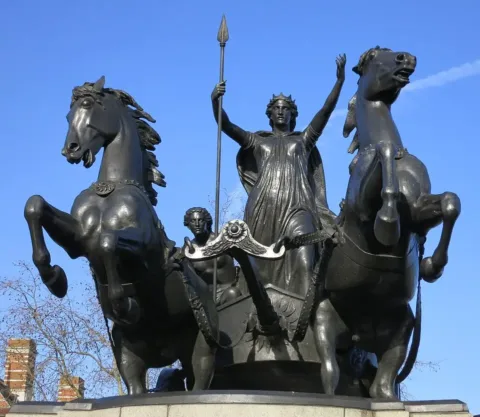
What Actually Happened in Boudica’s Revolt?
Boudica’s revolt began after the death of Prasutagus, king of the Iceni, in 60 or 61 CE. He had ruled as a client king under Roman authority, but after his death the arrangement collapsed. Ancient sources describe Roman seizures of property, the flogging of Boudica, and the abuse of her daughters.
The Iceni were soon joined by the Trinovantes and other disaffected Britons, turning a local crisis into a wider rebellion against Roman rule.
Their first major target was Camulodunum, a Roman colonia populated by veterans. The town was poorly defended and was destroyed. A force from Legio IX Hispana sent to intervene was also heavily defeated, though part of the legion survived.
Boudica’s army then moved on Londinium. Suetonius Paulinus, the Roman governor, reached the settlement but decided he did not have enough troops to defend it. He withdrew, and Londinium was abandoned and destroyed. Verulamium followed.
The revolt had now devastated several major Roman centers, but destroying settlements was not the same as defeating Rome’s main field army.
Suetonius gathered a force drawn largely from Legio XIV Gemina, detachments of Legio XX Valeria Victrix, and auxiliary troops. He chose ground that narrowed the battlefield and reduced the advantage of Boudica’s larger army.
The exact location of the battle is unknown, although it is traditionally associated with Watling Street.
The Romans held formation, disrupted the British advance with missile volleys, and counterattacked in disciplined ranks. The rebel army collapsed. Tacitus says the wagons and families gathered behind the British force made the retreat even more chaotic.
That defeat ended the immediate threat to Roman control. Boudica disappears from the record soon afterward, and Roman rule in Britain survived.
The Point of Divergence: Suetonius Loses the Final Battle
The point of divergence is the final battle between Boudica’s coalition and the army of Suetonius Paulinus.
Historically, Suetonius chose ground that favored Roman discipline and reduced the value of the Britons’ numerical advantage. In this scenario, he is forced to fight on less favorable terrain, or the British attack begins before the Romans can fully exploit their position.
The Roman line breaks, casualties mount, and Suetonius either dies in the fighting or escapes with only part of his force. Legio XIV Gemina and the detachments supporting it suffer heavy losses, leaving the province without the field army that historically ended the revolt.
Camulodunum, Londinium, and Verulamium have already been destroyed. The only change is that the force sent to restore Roman control now fails.
Boudica emerges from the battle with something she never achieved historically: a decisive victory over the governor’s main army and a short window in which Roman authority is at its weakest.
The Alternate Scenario: Boudica Breaks Rome’s Field Army
A victory over Suetonius would turn the revolt into a much deeper crisis for Roman Britain.
With the governor’s main field force shattered, Roman authority in the southeast would weaken sharply. Garrisons and surviving units might still hold some positions, but they would no longer have the strength to restore control quickly across the region.
For the first time, Boudica would have more than a rebellion. She would have territory, momentum, and a brief opportunity to build a political order before Rome recovered.
Her victory would not end Roman power in Britain, but it would create the opening from which a larger struggle for control of the province could begin.
Could Boudica Realistically Have Won?
A British victory was possible, but the battle would have needed to unfold on very different terms.
Ancient sources portray Boudica’s coalition as much larger than the Roman force, although their figures cannot be treated as reliable troop counts. Suetonius’ real advantage was that he chose ground that narrowed the front, protected his flanks, and prevented the Britons from making full use of their numbers.
The Romans also had superior discipline, formation, command, and experience in close combat. Once the British advance lost momentum, those advantages became decisive.
Boudica’s best chance would have come on wider or less defensible ground, where her forces could put greater pressure on the Roman flanks. Better coordination, an earlier attack, or disruption of the Roman formation could also have changed the battle.
She did not need to annihilate the Roman army. Killing Suetonius, forcing a retreat, or inflicting losses severe enough to break his field force would have been enough to turn the confrontation into a British victory.
So the scenario does not require the Britons to become a better army than Rome. It requires the tactical conditions that favored Suetonius to disappear.
What Happens to Suetonius Paulinus and His Army?
The fate of Suetonius would shape the immediate aftermath of the battle.
If he were killed, Rome would lose both its governor and the commander who had organized the main response to the revolt. That would create a short-term command crisis at the moment when Boudica’s coalition was strongest.
If Suetonius survived, he would probably retreat with whatever troops remained and try to preserve a core fighting force. His priorities would be restoring communication, reaching a defensible position, and preventing the defeat from turning into a wider collapse.
His army would also suffer heavily. Legio XIV Gemina and the detachments fighting beside it could be badly weakened, depriving Rome of the force that historically ended the revolt.
Even then, the defeat would not destroy every Roman military presence in Britain. That question becomes more important in what happens next.
Would Roman Rule Collapse Across Britain?
A defeat of Suetonius would not bring down Roman rule everywhere at once.
The greatest immediate damage would be in eastern and southeastern Britain, where the revolt had already destroyed major settlements and disrupted Roman administration. Elsewhere, forts, garrisons, and surviving units could still hold territory.
Legio II Augusta would be especially important because it had not taken part in Suetonius’ final battle. If it remained intact, Rome would still possess a substantial military force inside Britain even after losing the governor’s army.
The larger danger would be political. News that Suetonius had been defeated could persuade neutral tribes to reconsider their position and weaken rulers whose authority depended on Roman support.
Roman control might therefore fragment rather than disappear. Some regions could remain firmly under imperial authority while others fell under Boudica’s coalition or became contested ground.
Would Other British Tribes Join Boudica?
A major victory over Suetonius would make Boudica far more attractive to tribes that had stayed neutral.
The Iceni were already fighting alongside the Trinovantes and other rebels, but Britain was never a single united front against Rome. Some tribal elites had adapted to Roman rule, benefited from client relationships, or simply had too much to lose from joining a revolt.
A Roman defeat could change that calculation. Communities with grievances over taxation, land, or local administration might decide that resistance was now worth the risk.
But wider support would still be uneven. Rivalries between tribes, local interests, and existing ties to Rome would shape each decision. Some leaders might join Boudica, others would remain neutral, and some could continue to support the Romans.
Her victory could therefore expand the rebellion significantly, but as a broader coalition of tribes rather than a unified British nation.
Could Boudica Hold Her Coalition Together?
Keeping the coalition together after victory could be harder than building it during the revolt.
The Iceni, Trinovantes, and other supporters shared an enemy, but they did not form a single political community. Each group would still have its own leaders, rivalries, territory, and priorities.
Boudica’s authority would be strongest immediately after defeating Suetonius, when her military prestige was at its height. The real test would come once the fighting slowed and questions of leadership, tribute, territory, and relations with neutral tribes had to be settled.
A durable alliance would need some form of shared political arrangement between the major tribal powers, not just loyalty to Boudica as a wartime leader.
If such an arrangement emerged, the revolt could develop into a lasting anti-Roman confederation. Without it, Rome would have every opportunity to exploit divisions between Boudica’s allies.
Would Nero Abandon Britain?
A major Roman defeat would make withdrawal from Britain a serious possibility, but not an inevitable one.
Ancient sources indicate that Nero considered giving up Britain at some point, although the timing and its connection to Boudica’s revolt remain uncertain. The destruction of Suetonius’ field army would make that question much harder to avoid.
Rome would have to compare the cost of reconquest with the value of retaining the province. Replacing lost troops, rebuilding destroyed settlements, and suppressing a wider tribal coalition could require a major new campaign.
Nero might choose to pull back from the most unstable regions while preserving Roman control in stronger positions elsewhere. That would be very different from abandoning the entire island.
A full withdrawal would become more plausible only if the rebellion spread beyond Boudica’s original coalition and Roman military control collapsed across much of southern Britain. If major bases and loyal territories remained secure, reconquest would still be the more likely response.
What Happens to Londinium and the Roman Settlements?
Londinium, Camulodunum, and Verulamium had already suffered severe destruction before Boudica’s final battle. A British victory would make their immediate recovery far less likely.
Londinium was becoming an important commercial center. If Roman authority collapsed across the southeast, merchants, officials, and surviving settlers might hesitate to return, leaving the settlement damaged or only partly inhabited for some time.
Camulodunum would face an even harder recovery. As a colonia closely associated with Roman veterans, it had become a visible symbol of occupation and a major target of the revolt. Rebuilding it would require renewed military protection and a restored Roman administration.
Some settlements might recover under local British control, while others could lose the administrative and commercial roles they had begun to develop under Rome.
A later Roman reconquest would probably bring rebuilding and renewed urban development. Without that reconquest, these centers could follow a very different path, shaped more by local political needs than by Roman planning and government.
What Kind of British State Could Boudica Create?
A single centralized kingdom covering all of Britain would be unlikely.
Boudica’s revolt was built around a coalition of tribes, not a unified state. Even after defeating Suetonius, she would still have to deal with powerful local rulers who controlled their own territories and had their own interests.
A more realistic outcome would be an Iceni-led confederation. Boudica could emerge as the dominant war leader while allied tribes retained much of their internal authority.
That would give the coalition a political structure without requiring every tribe to surrender its independence to a single crown.
The result might be a powerful anti-Roman bloc in eastern and southeastern Britain, centered on Boudica’s leadership but held together by alliance rather than by a fully centralized kingdom.
Would Rome Return with a Larger Army?
A Roman attempt to recover lost territory would be the greatest long-term threat to Boudica’s victory.
Rome had suffered serious reverses before and often answered them with reinforcements rather than withdrawal. The destruction of Suetonius’ army would be a major humiliation, but it would also give the imperial government a strong reason to rebuild its position.
A new campaign would likely bring fresh troops from the continent, a new commander, and a more cautious strategy. Rome could first secure ports, roads, and loyal territories before advancing into areas controlled by Boudica’s coalition.
That would leave Boudica with a narrow window. She would need to strengthen alliances, secure supply lines, and prepare defensible territory before another Roman army arrived.
If Rome returned quickly, the rebels would face a much harder war than the first. A delayed response, however, would give Boudica more time to turn a battlefield victory into a durable political position.
Could an Independent Celtic Britain Survive?
An independent British state could survive, but only if Boudica’s victory produced something more durable than a wartime coalition.
Long-term independence would require stable leadership, cooperation between major tribes, and enough military strength to deter another Roman campaign.
Geography would help. Rome could move troops across the Channel, but every reconquest would still depend on transport, supply, secure ports, and reliable bases inside Britain.
The decisive factor would be political cohesion. A confederation that remained united could make reconquest slow and expensive. A divided one would give Rome opportunities to support friendly rulers, isolate hostile tribes, and recover territory piece by piece.
So independence was possible, but only if military victory was followed by a political system strong enough to survive both Roman pressure and internal rivalry.
Read Also
How Would Romanization of Britain Change?
Roman influence would not disappear simply because Boudica defeated Suetonius.
Trade, coinage, imported goods, military technology, and contact with Roman-controlled regions could continue even beyond direct imperial rule. Communities that had already adopted parts of Roman material culture would not suddenly abandon them.
What would change most is the pace and geography of Romanization. In territories outside Roman control, Latin administration, Roman-style towns, villas, roads, and civic institutions would develop more slowly or remain limited. Eastern Britain could become a mixed zone where local traditions existed alongside selected Roman influences.
Areas later reconquered by Rome might resume a more intensive process of urban and administrative change. Regions that remained independent would preserve stronger native political traditions while still absorbing Roman goods and ideas through trade and contact.
Boudica’s victory would therefore make Romanization more uneven and contested, rather than ending Roman influence altogether.
How Would Boudica’s Victory Change Later British History?
The first consequences would be felt in the first and second centuries, not centuries later.
If Boudica’s coalition preserved control over part of Britain, Roman expansion in the southeast would slow, urban development would follow a different path, and more political power would remain with local tribal elites.
Britain could develop as a patchwork of Roman-controlled and independent territories rather than as a province steadily brought under a single imperial system.
That would reshape alliances and conflicts within the island. Independent rulers would have to deal with Rome, neighboring tribes, and each other without the same provincial framework that historically defined Roman Britain.
Beyond the next few generations, the scenario becomes much harder to predict. Later effects on post-Roman kingdoms, migration, language, or settlement patterns would depend on centuries of events that Boudica’s victory alone cannot determine.
What the Sources Support, and What Is Speculation
The historical basis for this scenario comes mainly from Tacitus, especially the Annals and Agricola, with Cassius Dio providing a later account of the revolt. Suetonius’ Life of Nero is also relevant to the question of whether Nero considered abandoning Britain, although it does not securely connect that idea to Boudica’s revolt.
These sources support the main sequence of events: the Iceni uprising, the destruction of Camulodunum, Londinium, and Verulamium, the defeat of part of Legio IX Hispana, and the final Roman victory under Suetonius Paulinus.
They also show that the revolt created a serious crisis. Major settlements were destroyed, Londinium was abandoned, and Suetonius had to concentrate his available forces for a decisive battle.
What the sources cannot tell us is what Boudica would have done after winning that battle. We do not know whether more tribes would have joined her, whether the coalition could have remained united, or whether Nero would have chosen withdrawal over reinforcement.
Everything after Suetonius’ defeat is therefore counterfactual. The scenario changes only one event while keeping the wider political divisions, surviving Roman forces, and imperial resources intact.
Conclusion
If Boudica had defeated Suetonius, Roman rule in Britain would have entered a far more dangerous phase.
Her victory could have broken imperial control across much of the southeast and given the Iceni and their allies time to build a broader political coalition. But the future of that coalition would depend on what happened after the battle, not on the victory itself.
Boudica might have created a temporary independent zone, or even a durable anti-Roman confederation. Whether it survived would come down to political unity, control of territory, and Rome’s willingness to return.
Academic & Primary Sources
Tacitus, Annals, Book 14.
The fullest surviving ancient narrative of Boudica’s revolt, including the attack on Roman settlements, the movements of Suetonius Paulinus, the final battle, and the Roman response.
Read on Perseus Digital Library
Tacitus, Agricola, Chapter 16.
A shorter independent account by Tacitus that places the revolt within the wider history of Roman conquest and administration in Britain.
Read on Perseus Digital Library
Cassius Dio, Roman History, Book 62.
A later account of Boudica’s uprising that preserves a different version of the campaign and battle, useful for comparison with Tacitus. Its troop figures and dramatic speeches should be treated cautiously.
Read the text at LacusCurtius
Suetonius, Life of Nero, Chapter 18.
Relevant to the question of whether Nero considered withdrawing Roman forces from Britain. The passage does not securely date that idea to Boudica’s revolt, so it should not be treated as proof that her uprising directly caused a planned withdrawal.
Read on Perseus Digital Library
Richard Hingley and Christina Unwin. Boudica: Iron Age Warrior Queen. Hambledon and London, 2005.
A major modern study combining the classical accounts with archaeological evidence and examining how much can actually be known about Boudica and the revolt.
Durham University research record
Gil Gambash. “To Rule a Ferocious Province: Roman Policy and the Aftermath of the Boudican Revolt.” Britannia 43 (2012): 1–15.
A focused academic study of Roman policy after the revolt, especially useful for assessing how Rome might have responded to a more serious defeat in Britain.
View on JSTOR
