What If Vercingetorix Had Defeated Caesar at Alesia?
What if Vercingetorix had defeated Julius Caesar at Alesia in 52 BCE? Breaking the Roman siege could have saved his army from surrender, shaken Caesar’s control over Gaul, and weakened the general at a dangerous moment in Roman politics.
Caesar’s position was more exposed than his eventual victory suggests. His legions had surrounded Alesia but were themselves threatened by a Gallic relief army. During the final assault, an attack on a vulnerable northern position nearly overwhelmed the Roman defenders. A breakthrough there could have forced Caesar to retreat.
Victory, however, would not have created a united, independent Gaul overnight. Vercingetorix still had to hold together rival peoples, while Rome retained the resources to continue the war.
What Really Happened at the Battle of Alesia?
In 52 BCE, Vercingetorix led a major Gallic rebellion against Caesar’s conquest. Earlier that year, he had repelled a Roman assault at Gergovia, but a subsequent cavalry defeat forced him to withdraw to Alesia, a fortified settlement of the Mandubii in present-day eastern France.
Caesar pursued him and surrounded the town rather than attempt a direct assault. Roman soldiers built two lines of fortifications: an inner circuit to prevent the defenders from escaping and an outer circuit to protect the besiegers against a relief army. Trenches, ramparts, watchtowers, and concealed obstacles strengthened the defenses.
Before the encirclement was complete, Vercingetorix had sent cavalry to summon reinforcements. As his army waited inside Alesia, food supplies dwindled. The Mandubii civilians were expelled from the town, but Caesar refused to admit them through his lines.
The Gallic relief army eventually arrived under several commanders, including Commius and Vercassivellaunus, a relative of Vercingetorix. Its cavalry failed to overcome the Roman defenders, and a subsequent night assault was repulsed.
The Gallic commanders then targeted a Roman position on the northern heights, where the terrain made the defenses particularly vulnerable. Vercassivellaunus led the main attack while other forces pressed the outer fortifications. Vercingetorix simultaneously launched a sortie from Alesia, forcing the Romans to defend both sides of their siege lines.
Caesar sent Titus Labienus to reinforce the threatened northern sector and committed additional troops as the fighting intensified. He eventually joined the battle himself, ordering cavalry to circle the outer fortifications and strike the Gallic relief force from behind.
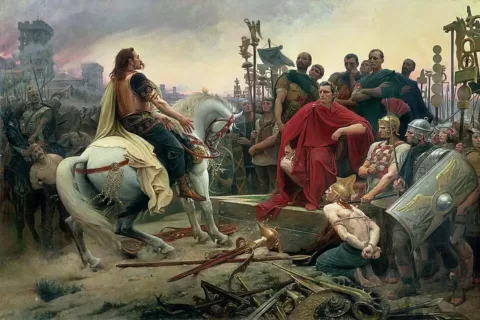
The attack broke the Gallic assault. Vercassivellaunus was captured, and the relief army retreated. With no prospect of further assistance, Vercingetorix surrendered the following day.
The victory shattered the main Gallic coalition, although Roman campaigns continued in 51 BCE. Caesar’s account remains our principal written source for the battle, but his troop estimates and portrayal of his own command should be treated critically.
ALTERNATE HISTORY · 52 BCE
The Alternate Scenario
The Point of Divergence: The Gallic Breakthrough
The final assault begins as it did historically. Vercassivellaunus attacks the vulnerable Roman position on the northern heights while Vercingetorix presses the defenses from inside Alesia. But this time, the northern rampart gives way before Labienus can organize an effective counterattack.
Gallic warriors pour through the breach, forcing Caesar to redirect troops from other sections of the siege. Vercingetorix exploits the weakening inner defenses, opening a passage that allows his men to join the fighting beyond the town.
Caesar attempts to restore the line, but his troops are now fighting in several threatened positions. The cavalry maneuver that historically struck the Gallic relief force from behind cannot be completed in time.
With the northern defenses overrun and the inner siege line breached, Caesar can no longer maintain the encirclement.
Caesar’s Defeat and the Roman Retreat
Caesar orders a fighting withdrawal rather than risk losing his entire army. Rearguard units hold back the Gallic advance while other cohorts abandon the siege works. Equipment and supplies are left behind, and Roman formations separated during the retreat suffer heavy casualties.
Caesar survives with a substantial part of his army, but his remaining forces are in no condition to resume the siege.
With the siege broken, Vercingetorix and the relief commanders regroup outside Alesia. Caesar’s withdrawal has saved the rebellion from the defeat it faced only hours earlier.
The victory gives the Gallic rebellion an opportunity it had nearly lost: time to reorganize its forces and prepare for the next Roman campaign.
Could Vercingetorix Have United Gaul?
Victory at Alesia would have strengthened Vercingetorix’s standing among the Gallic leaders. It would not, however, have given him authority over every tribe.
The divisions were already visible. At the council of Bibracte, the Aedui demanded supreme command, but the assembled leaders chose Vercingetorix. The Aeduan chiefs accepted the decision reluctantly, while the Remi and Lingones remained aligned with Rome.
Even among those resisting Caesar, cooperation had limits. When the Gallic relief army was assembled, the Bellovaci refused to provide their full contingent, insisting on fighting under their own authority. They eventually sent 2,000 men after an appeal from Commius.
A victory might have brought more communities into the alliance, but Vercingetorix would still have needed their consent to raise troops and secure supplies. He could have strengthened cooperation through a council of tribal leaders responsible for coordinating campaigns and negotiations, rather than attempting to impose a single monarchy.
Such an arrangement would have preserved local authority while giving the allies a common military strategy. Its success would depend on whether powerful peoples such as the Arverni and Aedui could continue sharing decisions after the immediate danger had passed.
Vercingetorix might have built a lasting Gallic confederation. Turning it into a unified kingdom would have been a much greater challenge.
Could Rome Have Reconquered Gaul?
Caesar’s defeat at Alesia would have disrupted the Roman conquest, but Rome still controlled Transalpine Gaul along the Mediterranean coast. That province could provide a base for rebuilding the army and launching another campaign.
The condition of Caesar’s surviving legions would be decisive. An organized retreat might allow him to regroup and resume operations, while heavy losses among experienced soldiers would make recovery more difficult. Rome could recruit replacements, but restoring an army’s effectiveness required more than filling its ranks.
Vercingetorix would also have greater freedom to choose how the war continued. Rather than defend a besieged stronghold, he could threaten Roman supply routes, attack isolated detachments, and force the legions to operate across hostile territory.
Roman commanders had ways to counter these tactics. They could secure important settlements, protect supply lines, and negotiate separately with Gallic communities. Rome had already demonstrated its ability to combine military pressure with diplomacy.
The campaigns of 51 BCE offer a useful comparison. Even after Caesar’s actual victory at Alesia, Roman forces faced continued resistance from the Bellovaci and at Uxellodunum. Defeating the main Gallic army had not immediately secured the entire region.
Rome could have attempted another conquest, but success would have depended on the strength of its remaining forces and its ability to sustain a prolonged campaign. A defeat at Alesia might have turned what Caesar expected to be a decisive victory into another costly phase of the Gallic Wars.
What Would Caesar’s Defeat Mean for His Political Future?
A defeat at Alesia would have handed Caesar’s political opponents a powerful argument against him. His victories in Gaul had brought him wealth, prestige, and the loyalty of veteran legions. Losing a major battle could weaken all three advantages, especially if the defeat threatened Rome’s control of conquered territory.
The political situation was already changing. Crassus had died at Carrhae in 53 BCE, leaving Caesar’s alliance with Pompey increasingly fragile. In 52 BCE, Pompey became Rome’s sole consul and moved closer to influential senators who opposed Caesar’s growing power.
Figures such as Cato the Younger and Lucius Domitius Ahenobarbus could use a defeat to demand Caesar’s replacement in Gaul. For Caesar, losing his command carried a personal risk. He hoped to seek a second consulship without first returning to Rome as a private citizen, where political enemies might bring legal proceedings against him.
Although arrangements had been made to allow Caesar to stand for election in his absence, the timing of his departure from provincial command remained contentious. A serious military setback could strengthen those demanding an earlier replacement.
Caesar would still have political allies and loyal soldiers, but his position in negotiations with Pompey and the Senate would be weaker. A defeat at Alesia might not have ended his career, but it could have cost him the military leverage that made his political ambitions possible.
Would the Roman Civil War Still Have Happened?
Caesar’s defeat at Alesia might have changed the course of the Roman Civil War, which began in 49 BCE. Whether it could have prevented the conflict altogether is less certain.
Historically, the crisis centered on Caesar’s refusal to surrender his provincial command while Pompey retained military forces of his own. Proposals for both men to relinquish their commands failed. In January 49 BCE, Caesar crossed the Rubicon with his troops, bringing the dispute into open warfare.
After losing at Alesia, Caesar would have faced a different calculation. A weakened army and an unfinished campaign in Gaul would make an invasion of Italy more dangerous. His opponents might press for his recall, believing he could no longer challenge Pompey successfully.
Negotiation was another possibility. Caesar had already sought arrangements that would protect his political position without surrendering every military advantage. Defeat might make him more willing to compromise, although his opponents could become less inclined to offer favorable terms.
Yet armed conflict could still follow if Caesar retained loyal troops and considered the loss of his command unacceptable. The underlying dispute over military power and political authority would remain unresolved.
The crossing of the Rubicon was not inevitable. A Gallic victory at Alesia might have led to Caesar’s political defeat, a negotiated settlement, or a different confrontation with Pompey. It would not, by itself, have settled the Republic’s wider struggle over the power of its generals.
Read Also
Explore More Roman Alternate History
Could an Independent Gaul Have Survived?
A victory at Alesia could have preserved the independence of much of Gaul, but it would not have driven Rome from the entire region. The Republic already controlled Transalpine Gaul along the Mediterranean coast. Central and northern Gaul might therefore have remained outside Roman administration, with their southern frontier subject to negotiation and occasional conflict.
Political independence would not have required economic isolation. Before Caesar’s conquest, settlements such as Bibracte and Corent were established centers of trade, craft production, and political activity. Archaeologists have uncovered evidence of Mediterranean imports, including Italian wine amphorae. Gallic communities could have continued trading with Roman merchants while governing themselves.
The greater challenge would have emerged after Vercingetorix’s lifetime. Agreements between independent communities needed to survive changes in leadership, territorial disputes, and competing interests. Maintaining common defenses without surrendering local authority would have required lasting political arrangements.
An independent Gaul might have endured as a network of allied states rather than a unified kingdom. Its survival would have depended on whether those states could establish a stable relationship with Rome while preserving their freedom to govern themselves.
How Might Western Europe Have Changed?
If much of Gaul had remained independent after Alesia, the consequences might have become most visible generations later, particularly in language and the direction of Roman expansion.
Roman rule gradually established Latin as the dominant language across much of Gaul, although Gaulish continued to be spoken for centuries. Without the same extent of Roman administration and settlement, Gaulish might have survived much longer. Modern French developed from the Latin spoken in the region, so a different linguistic balance could have changed the languages that eventually emerged there.
Rome’s northern frontier might also have developed along different lines. Historically, the conquest of Gaul gave Roman armies access to the Rhine, where military bases supported operations across the river. Independent Gallic states between Roman territory and the Rhine could have complicated those campaigns and altered Rome’s relations with Germanic peoples.
Britain presents a longer-term consequence. Caesar’s expeditions across the Channel in 55 and 54 BCE had already taken place, but the Roman conquest under Claudius began in AD 43. That invasion depended on assembling and transporting a large army across the Channel, probably from the coast of Roman Gaul.
If independent Gallic powers had controlled important Channel ports, a comparable invasion might have required different preparations, a different departure point, or a later date. Roman conquest of Britain would no longer follow the same historical path.
Read Also
More Battles That Could Have Changed Roman History
The Most Plausible Outcomes
Three outcomes remain plausible. If Caesar recovered quickly and resumed military operations, Rome might eventually reverse the defeat. A delayed Roman response could instead allow several Gallic states to preserve their independence without forming a single kingdom.
A more lasting change would require the Arverni, Aedui, and their allies to establish a durable military confederation. That possibility depended on cooperation extending beyond Vercingetorix’s personal leadership.
The decisive factor would be whether Rome rebuilt its military position before the Gallic leaders established a workable political settlement.
Conclusion
Victory at Alesia would have kept Vercingetorix in command and forced Caesar to rethink his conquest. It might also have weakened Caesar at a moment when his political position in Rome was becoming increasingly precarious.
What followed would depend on Rome’s response and the willingness of Gallic leaders to defend their victory together. Alesia could have opened a different future for Gaul, but it could not have secured that future on its own.
Academic Sources & Historical References
This article draws on ancient accounts and modern historical scholarship to establish the events surrounding the Battle of Alesia, the political position of Julius Caesar, and the wider history of Roman Gaul. The alternate scenario is a reasoned counterfactual interpretation, not a claim about events that actually occurred.
Primary Historical Sources
- Julius Caesar — Commentarii de Bello Gallico, Book VII, 63–90.The principal ancient narrative of the Gallic coalition, the siege of Alesia, the relief army, and Vercingetorix’s surrender.
- Aulus Hirtius — Commentarii de Bello Gallico, Book VIII, 1–48.Documents the continued Roman campaigns in Gaul during 51 BCE, including resistance by the Bellovaci and the siege of Uxellodunum.
- Julius Caesar — Commentarii de Bello Civili, Book I, 1–29.Caesar’s account of the political confrontation that preceded the civil war of 49 BCE.
Modern Academic Research
- Fields, Nic. (2014). Alesia 52 BC: The Final Struggle for Gaul.Osprey Publishing, Campaign 269. A military study of the siege, opposing armies, defensive works, and battlefield tactics.
- Riggsby, Andrew M. (2006). Caesar in Gaul and Rome: War in Words.University of Texas Press. Examines Caesar’s presentation of the Gallic campaigns and the political and literary purposes of his narrative.
- Morstein-Marx, Robert. (2021). Julius Caesar and the Roman People.Cambridge University Press, especially Chapters 5–6. Explores Caesar’s political position during the Gallic Wars and the crisis surrounding his return to Rome.
- Woolf, Greg. (1998). Becoming Roman: The Origins of Provincial Civilization in Gaul.Cambridge University Press. Studies the cultural, political, and social transformations associated with Roman rule in Gaul.
- Mullen, Alex. (2013). Southern Gaul and the Mediterranean: Multilingualism and Multiple Identities in the Iron Age and Roman Periods.Cambridge University Press. Provides evidence and analysis of linguistic and cultural interaction in Gaul before and during Roman rule.
Copyright & Content Rights
© 2026 History & Myths. All rights reserved.
The original writing, historical analysis, and alternate-history scenario presented in this article are the editorial work of History & Myths. Unauthorized reproduction or republication of the original content is not permitted, except as allowed by applicable law.
Historical facts and primary sources remain subject to their respective legal status. Third-party images and materials retain their original ownership and licensing terms, with attribution provided separately where applicable.