What If Harald Hardrada Won at Stamford Bridge in 1066?
What if Harald Hardrada had won the Battle of Stamford Bridge on September 25, 1066? The Norwegian king would have survived, but England would still have two rival claimants: Harold Godwinson, its crowned king, and William of Normandy, who was preparing to invade from across the Channel.
In this alternate scenario, Harald receives early warning of the approaching English army and prepares for battle. His forces defeat Harold’s troops, though at considerable cost. Harald and his ally Tostig survive, while Harold Godwinson escapes with part of his army. Three days later, William lands at Pevensey, as he did in real history.
Harald now holds the advantage in the north, Harold has an opportunity to regroup, and William is establishing a foothold on the southern coast. With three rival leaders still capable of fighting, the struggle for England could take a very different course.
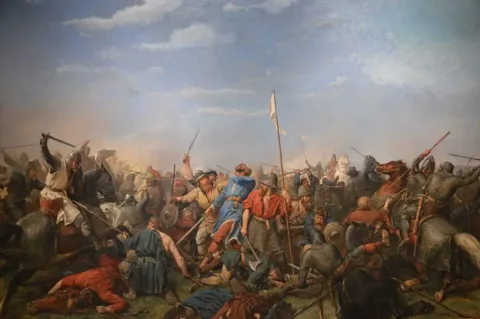
Alternate History Scenario
Point of Divergence:
September 24, 1066.
What Changes:
Norwegian scouts warn Harald Hardrada of Harold Godwinson’s approaching army, allowing him to prepare for battle at Stamford Bridge.
Immediate Outcome:
The Norwegians win a costly victory. Harald and Tostig survive, while Harold Godwinson escapes with part of his army.
What Remains Unchanged:
William of Normandy lands at Pevensey on September 28, 1066.
What Actually Happened at Stamford Bridge in 1066?
On September 25, 1066, King Harold Godwinson defeated Harald Hardrada’s invading Norwegian army at Stamford Bridge, near York. Hardrada and Harold’s exiled brother Tostig were killed, ending the Norwegian invasion.
Five days earlier, Hardrada and Tostig had defeated the northern English earls Edwin and Morcar at the Battle of Fulford. York subsequently submitted, providing supplies and hostages. More hostages were expected at Stamford Bridge, a crossing over the River Derwent east of the city.
Meanwhile, Harold Godwinson had marched north from London, gathering troops along the way. He reached Tadcaster on September 24 and advanced through York the following day, catching the Norwegians by surprise.
The Anglo-Saxon Chronicle confirms the surprise and describes fighting that continued for much of the day. Later Norse accounts claim that Hardrada had left part of his army guarding the ships and that many of his warriors lacked mail armour. These details, preserved in accounts written long after the battle, cannot be verified with the same confidence as the earlier evidence.
Later Norse accounts describe reinforcements arriving from the fleet during the fighting, but they could not prevent the Norwegian defeat.
The survivors withdrew to their ships, and only a small fraction of the original fleet was needed to carry them home.
Harold had defeated the Norwegian invasion, but both armies had suffered heavy losses. Three days later, William of Normandy landed in southern England, forcing the English king to confront another threat to his crown.
The Turning Point: Harald Hardrada Wins the Battle
The turning point comes on September 24, 1066. In this scenario, Norwegian scouts discover that Harold Godwinson’s army has reached Tadcaster. Their warning reaches Harald Hardrada before the English king begins his advance through York.
Hardrada abandons his expectation of receiving hostages at Stamford Bridge without a fight. He summons available troops from Riccall, where his fleet is stationed, and organizes the men already with him near the River Derwent. Not everyone can arrive in time, but the warning allows him to prepare a defensive position.
When Harold attacks on September 25, he encounters an organized Norwegian force rather than an army caught off guard. His troops press forward near the river crossing, but their initial assault fails to break Hardrada’s line.
The fighting continues as both sides suffer heavy losses. With the English attack losing momentum, Hardrada orders a counterattack against the weakened front. Harold withdraws west through York and continues toward Tadcaster with his surviving troops.
Hardrada does not pursue far. His warriors are exhausted, and the losses sustained during the battle leave him in no position to risk another engagement immediately.
By the end of the day, the Norwegians hold Stamford Bridge. Harald and Tostig are alive, while Harold Godwinson has escaped with part of his army.
Could Harald Hardrada Take the English Throne?
Harald’s immediate concern would be York. The city had submitted after his victory at Fulford, providing hostages and supplies, but its loyalty was far from secure. With Harold Godwinson retreating west after Stamford Bridge, the Norwegian king would need to reassert his authority over the city before advancing farther into England.
Edwin, Earl of Mercia, and his brother Morcar, Earl of Northumbria, remained influential despite their defeat at Fulford. Both had strong regional connections, and their sister Ealdgyth was married to Harold Godwinson. They might negotiate to preserve their earldoms, but supporting Hardrada would mean abandoning a king with whom they had close political ties.
Tostig offered valuable knowledge of English affairs, although his presence complicated any settlement in the north. His unpopular rule had triggered the Northumbrian rebellion of 1065. Restoring him as earl could provoke renewed resistance among the landowners Harald needed on his side.
Hardrada’s claim to the crown also faced questions. Later Norse accounts linked it to an alleged succession agreement between Magnus of Norway and Harthacnut, but the agreement’s existence and application to England remain uncertain. Harold Godwinson, meanwhile, had been crowned in January and survived the Norwegian invasion.
Harald could strengthen his position by securing York, establishing garrisons, and negotiating with local nobles. Advancing toward London immediately would risk stretching an army already weakened by battle. Yet remaining in Yorkshire would give Harold time to gather fresh forces and rebuild his support.
What Happens When William of Normandy Invades?
On September 28, 1066, William of Normandy lands at Pevensey, as he did in real history. With Harold Godwinson’s forces recovering from defeat in Yorkshire, the Norman army encounters no immediate opposition on the Sussex coast.
William moves east to Hastings, establishes a fortified base, and sends his troops to raid the surrounding countryside. The raids provide supplies and put pressure on Harold to defend his lands.
Having withdrawn from Yorkshire, Harold must decide how quickly he can assemble another army. He could return to London, summon additional troops, and organize a defence against William. Doing so would leave Harald Hardrada free to strengthen his position around York.
For Hardrada, the Norman landing creates an opportunity. English forces diverted south would give his depleted army time to recover and secure northern territory. Yet allowing William to advance unchecked could prove dangerous. If the Norman duke gained control of London and secured the support of influential nobles, Hardrada would face another claimant with a stronger political position.
William also has decisions to make. Remaining near Hastings would protect his coastal base, but a prolonged delay could allow Harold to gather more troops. Advancing inland might increase pressure on the English king, although it would expose the Norman army to greater risks.
The Battle of Hastings, fought on October 14 in real history, might therefore never occur on that date. Harold’s defeat in Yorkshire has disrupted the sequence of events that originally brought the English and Norman armies together.
Harald Hardrada vs William of Normandy: Who Had the Advantage?
If Harald Hardrada and William of Normandy eventually met in battle, the outcome would depend heavily on where they fought. Their armies had different strengths, and both commanders had extensive military experience.
Infantry, Cavalry, and Battlefield Tactics
Hardrada had fought in Scandinavia and served in the Byzantine Empire before becoming king of Norway. His army consisted primarily of infantry equipped with shields, spears, swords, and axes. Experienced Norwegian warriors could hold a defensive formation, although their losses at Stamford Bridge would reduce the number available for another major engagement.
William commanded infantry, archers, and mounted knights from Normandy and neighbouring territories. At the historical Battle of Hastings, this combination allowed his forces to employ missile attacks and repeated assaults against the English shield wall.
On open ground, Norman cavalry could threaten the Norwegian flanks while archers disrupted their formations. Hardrada, however, could reduce those advantages by defending a river crossing, narrow approach, or elevated position where mounted troops had less room to manoeuvre.
Supplies and Strategic Position
William’s army had crossed the Channel with horses, equipment, and provisions. His fortified base near Hastings provided access to the coast, but an advance inland would require additional supplies and protection for his communications.
Hardrada’s fleet remained near Riccall, south of York. The Norwegians could obtain provisions from territory under their control, although their ability to do so would depend on cooperation or compliance from local communities. Losses at Stamford Bridge would also be difficult to replace quickly.
Neither commander could concentrate entirely on the other. William risked encountering English resistance if he marched north, while Hardrada would expose his position in Yorkshire by advancing south before securing it.
A direct encounter on open ground could favour William’s more varied army. A battle fought against a prepared Norwegian defensive position would present different difficulties. Harold Godwinson’s surviving forces could also intervene before either invader achieved a decisive victory.
Could England Have Been Divided Between Norway and Normandy?
England could have remained divided if none of the three claimants secured a decisive victory. Hardrada might control York and parts of northern England, while William strengthened his position in Sussex. Harold Godwinson, still alive, could retain support in London and other regions, creating three competing centres of power.
There was a historical precedent for dividing the kingdom. In 1016, Cnut and Edmund Ironside agreed to share England after a prolonged military struggle. Edmund retained Wessex, while Cnut controlled the remaining territories. The arrangement ended when Edmund died later that year, leaving Cnut as king of all England.
A similar agreement in 1066 would be difficult to negotiate. Harald and William both sought the English crown, while Harold had already been crowned and had no reason to surrender his claim voluntarily. A temporary truce might allow rival armies to recover, but it would not resolve who had the right to rule.
Control of London would be particularly important. A claimant who secured the city could seek the support of leading churchmen and nobles while gaining access to an important centre of royal authority. Elsewhere, fortified crossings, roads, and ports would determine how effectively each ruler could defend his territory.
England might therefore become divided through military occupation rather than a formal agreement. Its boundaries would remain vulnerable to renewed campaigns, and any settlement would depend on whether the rival kings could maintain their positions.
What If Harald Hardrada Became King of England?
If Harald Hardrada secured the English throne, he would inherit a kingdom with established shires, courts, taxation, and royal officials. Dismantling that system would make England harder to govern. Cnut, who conquered the kingdom in 1016, had retained English laws and methods of government while relying on powerful English and Danish earls.
Harald could adopt a similar approach, keeping local administration intact while rewarding trusted Norwegian commanders with land and offices. The difficulty would be balancing those rewards against the interests of English nobles. Confiscating too many estates could provoke resistance, while leaving powerful opponents in place might threaten his authority.
Religion would not require a fundamental break with the past. Harald was a Christian ruler, and Norway had undergone decades of Christianisation. A Norwegian conquest would not restore pagan worship as England’s state religion. English bishops and monasteries would remain influential, making cooperation with the Church an important part of establishing his rule.
Read More on History & Myths
England’s foreign connections could change more noticeably. A king ruling both England and Norway would have strong reasons to encourage trade and political ties across the North Sea. Yet maintaining authority in two kingdoms would require trusted representatives and regular communication between them.
The effects on language would develop gradually. Old English would remain the everyday speech of most inhabitants, while Scandinavian linguistic influence, already present in parts of England, might become stronger. Without a Norman ruling dynasty, French would be less likely to acquire the position it gained among England’s aristocracy after 1066, although contact with continental Europe would continue.
Succession would present another long-term challenge. Harald’s sons, Magnus and Olaf, would have interests in the Norwegian crown, while English nobles might favour a different arrangement. Cnut’s dominion had fractured after his death in 1035, demonstrating how difficult it was to preserve a realm spanning several kingdoms through successive reigns.
Would a Viking Victory Have Changed English History?
If Harald Hardrada ultimately secured the English throne, the greatest change might have been the absence of the Norman Conquest as it unfolded under William. Historically, William redistributed vast estates to his followers, replaced much of the English aristocracy, and established castles to secure his rule. A Norwegian conquest could also bring confiscations and resistance, but the new ruling elite would have different connections and interests.
The consequences would extend beyond England. Without William ruling both England and Normandy, relations with the French monarchy would develop from a different political position. Later conflicts over continental territories might take another course, although their precise outcomes cannot be predicted.
Yet Hardrada’s victory at Stamford Bridge would not settle the succession. Harold Godwinson could recover his forces, William might eventually defeat the Norwegians, or England could remain divided until one claimant gained the upper hand.
The Norman Conquest shaped England for centuries, but its outcome was not inevitable. A Norwegian victory at Stamford Bridge would have opened another path through 1066, with the English crown still to be won.
Academic Sources & Historical References
The historical background draws on medieval chronicles, specialist scholarship, and heritage research. The alternate outcomes are reasoned counterfactual possibilities, not documented historical events.
Primary Historical Sources
The Anglo-Saxon Chronicle, Eleventh Century
Yale Law School, Avalon ProjectAn essential early English account of the events of 1066, including the Norwegian invasion, Stamford Bridge, and the Norman Conquest.
King Harald’s Saga
Snorri Sturluson. Translated by Magnus Magnusson and Hermann Pálsson. Penguin Classics.A later Norse account of Harald Hardrada’s career and final campaign. Its military details require caution because the saga was written long after 1066.
Academic Research
The Norwegian Invasion of England in 1066
Kelly DeVries. Boydell Press, Warfare in History.A specialist military history examining Hardrada’s invasion, its leadership, and the campaign culminating at Stamford Bridge.
A Mislocated Battlefield? Battle Flats: The Battle of Stamford Bridge, 1066
Michael C. Blundell. Journal of Medieval Military History, Vol. XIX, 2021.Reassesses the battlefield’s location and the limitations of reconstructing the fighting from medieval accounts.
Cnut and William: A Comparison
Elisabeth van Houts. In Conquests in Eleventh-Century England: 1016, 1066. Boydell & Brewer, 2020.Compares Scandinavian and Norman conquest, providing historical context for evaluating a possible Norwegian kingship in England.
Conquered England: Kingship, Succession, and Tenure 1066–1166
George Garnett. Oxford University Press, 2007.Examines royal legitimacy, succession, and landholding after the Norman Conquest, offering a basis for assessing how alternative rule might have differed.
Historical Research & Battlefield Context
Fulford and Stamford Bridge: The Northern Battles of 1066
English HeritageA researched overview of the Norwegian campaign, the battles of Fulford and Stamford Bridge, and differences between early chronicles and later Norse narratives.
These references support the documented events, political institutions, and military context of 1066. Harald Hardrada’s hypothetical victory and its consequences are speculative reconstructions. The sources do not establish what would have happened in an alternative timeline.
Copyright Notice
© 2026 History & Myths. All rights reserved.
The original written content of this article is protected by copyright. Reproduction or republication of substantial portions requires prior permission, except as permitted by applicable copyright law.
Historical sources and third-party materials remain subject to their respective rights and licenses. Sources are acknowledged in the references above.
