What if Cleopatra and Antony had defeated Octavian at Actium?
What if Cleopatra and Mark Antony had defeated Octavian at the Battle of Actium? The most likely result would not have been Cleopatra ruling Rome. Victory would instead have preserved Ptolemaic Egypt, ended Octavian’s immediate bid for supreme power, and left Antony as the strongest Roman commander in the Mediterranean.
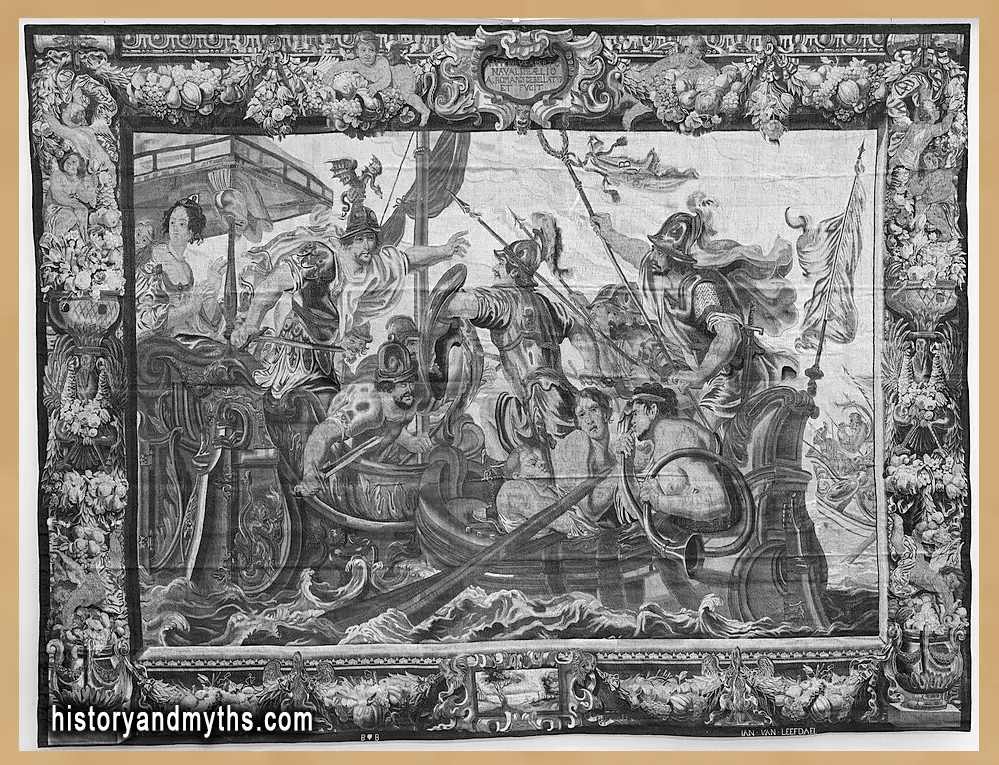
The Turning Point: How Could Cleopatra and Antony Win at Actium?
A victory at Actium would have required more than Cleopatra’s fleet remaining in battle for a few additional hours. Before the confrontation on September 2, 31 BCE, Antony’s position had already been weakened by disease, desertion, declining morale, and disrupted supply lines. Marcus Agrippa, Octavian’s most effective naval commander, had captured strategic positions along the western Greek coast and threatened the routes supplying Antony’s forces near the Gulf of Ambracia.
Even on the day of battle, he did not need to destroy Octavian’s entire force. An organized breakthrough that preserved most of the fleet, the treasury carried by Cleopatra’s squadron, and the land army could have allowed Antony to continue the war from a stronger position. In a Roman civil war, military survival could matter as much as possession of the battlefield. If Antony retained his legions, money, ships, and eastern territories, Octavian’s allies might begin to doubt that his victory was inevitable.
The Scenario Used in This Article
- Agrippa fails to cut Antony’s main supply routes completely.
- Antony and Cleopatra enter the battle with a healthier and more loyal force.
- Their combined fleet breaks through Octavian’s naval line.
- Antony’s land army remains intact instead of surrendering.
- Octavian survives but retreats with part of his western forces.
- Antony and Cleopatra retain their fleet, treasury, army, and control of Egypt.
Important: In this scenario, victory at Actium changes the direction of the civil war. It does not mean that Rome surrenders immediately or that Octavian’s political support disappears overnight.
Winning at Actium Would Not Automatically Win the War
Victory at Actium would restore Antony and Cleopatra’s military position, but it would not immediately give them control of the Roman world. Octavian’s power extended beyond his fleet. He still possessed supporters in Italy, allies in the Senate, veteran colonies, and commanders whose careers depended on his success.
In Roman civil wars, a major defeat often mattered because it triggered defections rather than because it destroyed the enemy completely. Antony would need to exploit that momentum quickly. He could offer pardons and positions to Octavian’s supporters, secure the legions, and advance west before his opponent raised another army. Delay would allow Octavian to present Actium as a temporary setback and prolong the conflict.
What If Octavian Survived?
If Octavian escaped with part of his forces, he would remain Antony’s most dangerous opponent. He could return to Italy, rely on his political network, and continue the war from the western provinces. His recovery, however, would not be guaranteed.
The most plausible result would be a second phase of the civil war. Antony might move toward Italy while Cleopatra protected Egypt, the treasury, and the eastern supply network. Their objective would be to isolate Octavian before he rebuilt his army or divisions emerged within their own coalition.
What If Octavian Was Captured or Killed?
Octavian’s capture or death would make Antony’s final victory far more likely. No other western leader combined his political organization, financial resources, and claim to Julius Caesar’s legacy. Resistance might continue in parts of Italy or the western provinces, but it would lack a single figure capable of uniting it.
Removing Octavian would settle the immediate struggle, not the future political system. Antony and Cleopatra would still need to determine how Rome and Egypt were governed, how authority was divided between them, and whether Caesarion or one of their own children would inherit any part of the new order.
The First Crisis After Victory: The Senate, Italy, and the Legions
Antony and Cleopatra’s first challenge after Actium would be preventing their victory from appearing to Romans as a foreign conquest. Octavian had spent years portraying Cleopatra as a threat to Rome, and one naval defeat would not immediately erase that message.
Actium could open the road to supreme power, but control of Rome would depend on defections, legal recognition, and financial guarantees. The struggle after the battle would be fought less with warships than with pardons, payments, and competing claims to Roman legitimacy.
Would Cleopatra Have Ruled Rome?
Victory at Actium would not make Cleopatra queen or empress of Rome. She held no Roman office, commanded no independent political support in Italy, and represented a monarchy many Romans already viewed with suspicion. Any attempt to place her openly above the Senate would strengthen Octavian’s claim that Antony had surrendered Roman authority to a foreign ruler.
Cleopatra would also have little reason to settle permanently in Rome. In Alexandria, she controlled taxation, grain production, administration, and a wealthy royal court. In Rome, her position would depend on Antony’s political survival and expose her to hostility from senators who regarded Egyptian influence as dangerous. Her most realistic role would therefore be that of an independent monarch whose wealth, navy, and diplomatic network made her indispensable to the strongest Roman leader.
Power Without a Roman Throne
Cleopatra possessed resources Antony could not easily replace. Egypt could supply money, grain, ships, and a secure base in Alexandria, while its treasury helped pay soldiers and reward political allies. She also understood the network of client kingdoms linking Egypt, Syria, and Asia Minor.
Their partnership united two rulers without merging Rome and Egypt into one political system. The most plausible outcome is therefore not Cleopatra ruling Rome directly. She would preserve Ptolemaic Egypt, shape Antony’s eastern policy, and strengthen Alexandria as a second center of Mediterranean power while Rome continued to be governed through Roman institutions.
What Would Victory Mean for Egypt?
For Egypt, the clearest consequence of victory would be survival as an independent kingdom. Without Octavian’s conquest in 30 BCE, Cleopatra could continue the Ptolemaic dynasty and preserve control of Egypt’s treasury, ports, agricultural revenues, and grain production. These resources would strengthen her influence within the victorious alliance.
Alexandria would gain the most visible advantage. Its harbor, court, fleet, merchants, and financial resources could make it a major center for diplomacy and military planning. Roman commanders, client kings, and foreign representatives might spend more time there, increasing the city’s influence across the eastern Mediterranean. Victory would not eliminate the costs of war. Cleopatra would still need to pay troops, reward allies, repair ships, and support the political settlement that followed Actium. Egypt would keep its wealth out of direct Roman control, but part of that wealth would be used to maintain the alliance with Antony.
Egypt Would Survive—But Not Conquer Rome
Cleopatra’s victory would not turn Rome into part of an Egyptian empire. Egypt possessed wealth, grain, naval strength, and strategic ports, but it lacked the manpower and political networks required to govern Italy and the western provinces. The legions remained Roman institutions shaped by Roman command, patronage, and military loyalty.
Egyptian money could help pay them, but openly placing Cleopatra above Roman government would risk uniting senators, soldiers, and provincial commanders against Antony. The more realistic result would be a division of authority. Antony would dominate Roman military and political affairs, while Cleopatra continued to govern Egypt and shape policy in the eastern Mediterranean. Her greatest achievement would therefore be preserving Ptolemaic independence and raising Alexandria’s political importance—not replacing Rome as the center of Mediterranean power.
Antony, Cleopatra, and Caesarion: Who Would Inherit the Victory?
Succession would become one of the greatest threats to Antony and Cleopatra’s new order. Their alliance joined two different political systems: Egypt was a hereditary monarchy, while Roman authority still depended on military command, public office, and recognition from powerful political institutions. Cleopatra’s succession was relatively clear.
Caesarion could succeed Cleopatra in Egypt, while Antony prepared a Roman son, allied commander, or political partner to preserve his authority in the west. The younger children might receive eastern territories or dynastic marriages without claiming control of Rome itself. Such an arrangement could survive while Antony and Cleopatra remained alive. After their deaths, however, the Egyptian court, Roman Senate, legions, and royal children might disagree over whether the alliance should continue or whether its territories should be divided.
Caesarion Could Become an Asset—and a Threat
Caesarion would strengthen Cleopatra’s position by connecting the Ptolemaic dynasty to the name of Julius Caesar. She could present him as Egypt’s legitimate future king and as a living continuation of Caesar’s bloodline. That same claim would make him dangerous in Roman politics. Octavian had built much of his authority on being Caesar’s adopted son and heir.
Would Alexandria Replace Rome as the Capital?
Alexandria would become more influential after victory, but it would not replace Rome as the center of Roman government. Rome remained the home of the Senate, the symbolic center of Roman authority, and essential to Antony’s legitimacy. Alexandria would instead serve as the alliance’s eastern base. Its treasury, grain, fleet, and strategic location made it valuable for diplomacy, naval operations, and campaigns in the eastern Mediterranean. The most plausible result would be two centers of power.
Antony would rely on Rome for political recognition and control of the western legions, while Cleopatra governed from Alexandria and influenced eastern policy through Egypt’s resources. This arrangement could strengthen both rulers during their lifetimes, but it might later deepen tensions between Roman elites and the Ptolemaic court.
Would the Roman Republic Still Become an Empire?
Defeating Octavian would prevent the Augustan system, but it would not restore the old Republic. Decades of civil war had already placed armies, provinces, and political authority in the hands of powerful commanders. Antony could preserve the Senate, elections, and republican language to strengthen his legitimacy. In practice, however, he would still need exceptional military and provincial powers to control Rome and prevent another civil war. The result would likely be personal rule without Augustus’s carefully organized principate. Rome would still move toward empire, but through a looser and less stable system built around Antony’s army, senatorial cooperation, and his alliance with an independent Egypt.
How Would the Mediterranean Balance of Power Change?
Victory would shift Roman strategy toward the eastern Mediterranean. Egypt, Syria, Asia Minor, and the Parthian frontier would receive greater attention, while western expansion might slow. Antony would likely preserve client kingdoms and rely on Cleopatra’s wealth to support diplomacy and military campaigns. Rome would remain the dominant military power, but Alexandria and eastern rulers would gain greater influence over imperial priorities. The result would be a Roman-led Mediterranean with a stronger eastern political and cultural center.
What Probably Would Not Change
Victory at Actium would change the ruling coalition, not transform the Roman world overnight. Rome would remain the dominant military power, while Italy, the Senate, and the western legions continued to shape political legitimacy. Latin would remain dominant in the west, Greek in the east, and local religious traditions would survive despite greater Egyptian influence at court. Most importantly, Rome’s deeper problems would remain: ambitious commanders, armies loyal to individuals, and no secure system of succession. Antony and Cleopatra could redirect the Mediterranean, but one victory could not remove the forces that had produced decades of civil war.
Could the New Order Survive Antony and Cleopatra?
The alliance could function while Antony controlled Rome and the legions and Cleopatra governed Egypt and financed eastern policy. Its weakness was that it depended on their personal authority rather than on durable institutions. If Antony died first, Cleopatra could not inherit command of Roman armies. If Cleopatra died first, Egypt would pass to Caesarion or another heir, forcing Antony to renegotiate the alliance with a new Ptolemaic ruler.
The System Was Easier to Win Than to Inherit
No single heir could easily inherit both Rome and Egypt. Caesarion had the strongest claim in Egypt, while Antony’s Roman children or senior commanders would be more acceptable to the Senate and legions. A divided succession might preserve the alliance briefly, but it would create competing courts, armies, and claims. Antony and Cleopatra could defeat Octavian and build a powerful new order, yet another civil war after their deaths would remain likely.
The Most Plausible Outcome
The most credible result is not an Egyptian conquest of Rome, but a divided partnership between Roman military power and an independent Ptolemaic Egypt.
Most Likely: Antony Dominates Rome While Cleopatra Preserves Egypt
Antony would become Rome’s leading commander, secure the Senate and legions through pardons and payments, and govern through republican offices backed by personal military power. Cleopatra would remain queen of Egypt. Her treasury, fleet, grain, and eastern alliances would make her indispensable, while Alexandria became a stronger second center of power. The arrangement could survive during their lifetimes, but succession would remain unstable.
Plausible but Uncertain: A Lasting Roman–Ptolemaic Partnership
Rome could retain Italy and the western provinces while Egypt influenced eastern diplomacy, trade, and client kingdoms. Such a partnership was possible, but rival heirs, commanders, and courts could easily divide it after Antony or Cleopatra died.
Highly Unlikely: Cleopatra Rules a Roman–Egyptian Empire
Cleopatra was unlikely to rule Rome directly or move its political center permanently to Alexandria. Roman soldiers and senators might accept Antony’s dominance, but not open government by a foreign queen. The strongest conclusion is narrower: victory could prevent Augustus’s rise, preserve Egypt, and shift Roman strategy eastward—but not replace Rome with an Egyptian empire.
The Likely Consequences of Victory at Actium
| Area | Most Plausible Outcome | Unlikely Outcome |
|---|---|---|
| Egypt | Remains an independent Ptolemaic kingdom. | Conquers and governs Rome. |
| Antony | Becomes the dominant Roman military and political leader. | Creates the same political system later built by Augustus. |
| Cleopatra | Rules Egypt and influences eastern Mediterranean policy. | Becomes queen or empress of Rome. |
| Alexandria | Becomes a second financial, naval, and diplomatic center. | Permanently replaces Rome as the capital. |
| Caesarion | Survives and remains the likely heir to Egypt. | Automatically inherits Antony’s Roman authority. |
| Roman government | Continues under dominant military leadership. | Fully restores the old Republic. |
| Long-term stability | Possible during Antony and Cleopatra’s lifetimes. | A secure and peaceful dynastic succession. |
Final Verdict: Cleopatra’s Victory Would Save Egypt, Not Conquer Rome
Victory at Actium would most likely preserve Ptolemaic Egypt and prevent Octavian from creating the Augustan order. Antony would emerge as Rome’s dominant commander, while Cleopatra retained her throne and influenced Mediterranean policy through Egypt’s wealth, fleet, and strategic position. She would not rule Rome directly. Roman legitimacy still depended on the Senate, the legions, and Italian support. The new order could shift power eastward and strengthen Alexandria, but its survival would remain uncertain. Antony’s authority was difficult to inherit, Caesarion’s status could provoke rivalry, and no clear system united Roman command with Ptolemaic succession. Cleopatra could save Egypt and reshape Rome’s future—but not replace Rome with an Egyptian empire.
FAQ — What If Cleopatra Had Defeated Octavian?
1) What would have happened if Cleopatra and Mark Antony had won at Actium?
Their victory would most likely have preserved Egypt’s independence, prevented Octavian from establishing the Augustan regime, and made Antony the dominant Roman leader. Cleopatra would remain queen in Alexandria rather than rule Rome directly.
2) Could Cleopatra have become empress of Rome?
Probably not. Cleopatra held no Roman office and lacked a political base in Italy. Roman senators and soldiers were more likely to accept Antony as their leader while Cleopatra exercised influence through Egypt’s wealth, fleet, and alliance with him.
3) Would Egypt have conquered Rome?
No. Egypt had considerable wealth and naval strength, but it lacked the armies and political networks required to govern Rome’s western territories. Victory would protect Egypt from annexation rather than turn Rome into an Egyptian possession.
4) Would Alexandria have replaced Rome as the capital?
Alexandria could have become a powerful second center for finance, diplomacy, and eastern government, but Rome would remain essential to senatorial authority, military legitimacy, and control of Italy and the western provinces.
5) What would have happened to Caesarion?
Caesarion would probably have survived and remained Cleopatra’s co-ruler and likely successor in Egypt. His claimed descent from Julius Caesar could strengthen the Ptolemaic dynasty, but it might also create rivalry with Antony’s children and Roman political heirs.
6) Would the Roman Republic have survived?
The old Republic was unlikely to return fully. Antony might preserve the Senate and traditional offices, but real power would still depend on military command, personal alliances, and control of the provinces.
7) Would Antony and Cleopatra’s new order have lasted?
It might remain stable during their lifetimes, but succession would be difficult. No single heir possessed an uncontested claim to Cleopatra’s Egyptian throne, Antony’s Roman authority, and the loyalty of the legions.
8) What is the most realistic outcome of Cleopatra’s victory?
The most realistic outcome is an independent Ptolemaic Egypt allied with a Roman state dominated by Antony. Alexandria would gain influence, but Rome would remain the leading military and political power in the Mediterranean.
Sources & Historical Method
Method note: The historical background in this article is based on ancient literary accounts, archaeological evidence, coinage, inscriptions, and modern scholarship. The alternate outcomes discussed are reasoned historical inferences based on the political, military, and economic conditions of 31 BCE. They describe plausible possibilities, not events documented as having occurred.
Primary Ancient Sources
- Appian. The Civil Wars. Book 5.
- Augustus. Res Gestae Divi Augusti.
- Cassius Dio. Roman History. Books 49–51.
- Horace. Odes 1.37 and Epodes 9.
- Josephus. Jewish Antiquities. Books 14–15.
- Josephus. The Jewish War. Book 1.
- Plutarch. “Life of Antony.” In Parallel Lives.
- Propertius. Elegies 3.11 and 4.6.
- Strabo. Geography. Book 17.
- Suetonius. “The Life of Augustus.” In The Twelve Caesars.
- Velleius Paterculus. Roman History. Book 2.
- Virgil. Aeneid 8.675–713.
Actium, Antony, and the Roman Civil War
- Strauss, Barry. The War That Made the Roman Empire: Antony, Cleopatra, and Octavian at Actium. Simon & Schuster, 2022.
- Gurval, Robert Alan. Actium and Augustus: The Politics and Emotions of Civil War. University of Michigan Press, 1995.
- Murray, William M., and Photios M. Petsas. Octavian’s Campsite Memorial for the Actian War. Transactions of the American Philosophical Society 79, no. 4. American Philosophical Society, 1989.
- Murray, William M. The Age of Titans: The Rise and Fall of the Great Hellenistic Navies. Oxford University Press, 2012.
- Goldsworthy, Adrian. Antony and Cleopatra. Yale University Press, 2010.
- Huzar, Eleanor Goltz. Mark Antony: A Biography. University of Minnesota Press, 1978.
- Pelling, C. B. R., ed. Plutarch: Life of Antony. Cambridge University Press, 1988.
- Osgood, Josiah. Caesar’s Legacy: Civil War and the Emergence of the Roman Empire. Cambridge University Press, 2006.
- Syme, Ronald. The Roman Revolution. Clarendon Press, 1939.
- Raaflaub, Kurt A., and Mark Toher, eds. Between Republic and Empire: Interpretations of Augustus and His Principate. University of California Press, 1990.
- Bowman, Alan K., Edward Champlin, and Andrew Lintott, eds. The Cambridge Ancient History, Volume X: The Augustan Empire, 43 BC–AD 69. 2nd ed. Cambridge University Press, 1996.
- Galinsky, Karl. Augustan Culture: An Interpretive Introduction. Princeton University Press, 1996.
- Zanker, Paul. The Power of Images in the Age of Augustus. Translated by Alan Shapiro. University of Michigan Press, 1988.
- Green, Peter. Alexander to Actium: The Historical Evolution of the Hellenistic Age. University of California Press, 1990.
Cleopatra and Ptolemaic Egypt
- Roller, Duane W. Cleopatra: A Biography. Oxford University Press, 2010.
- Tyldesley, Joyce. Cleopatra: Last Queen of Egypt. Profile Books, 2008.
- Chauveau, Michel. Cleopatra: Beyond the Myth. Cornell University Press, 2002.
- Kleiner, Diana E. E. Cleopatra and Rome. Belknap Press of Harvard University Press, 2005.
- Walker, Susan, and Peter Higgs, eds. Cleopatra of Egypt: From History to Myth. British Museum Press, 2001.
- Grant, Michael. Cleopatra. Weidenfeld and Nicolson, 1972.
- Hölbl, Günther. A History of the Ptolemaic Empire. Translated by Tina Saavedra. Routledge, 2001.
- Manning, J. G. The Last Pharaohs: Egypt Under the Ptolemies, 305–30 BC. Princeton University Press, 2010.
- Thompson, Dorothy J. Memphis Under the Ptolemies. 2nd ed. Princeton University Press, 2012.
- Roller, Duane W. The World of Juba II and Kleopatra Selene: Royal Scholarship on Rome’s African Frontier. Routledge, 2003.
- Draycott, Jane. Cleopatra’s Daughter: Egyptian Princess, Roman Prisoner, African Queen. Head of Zeus, 2022.
Hellenistic Government, Economy, and Royal Power
- Bagnall, Roger S., and Peter Derow, eds. The Hellenistic Period: Historical Sources in Translation. 2nd ed. Blackwell Publishing, 2004.
- Erskine, Andrew, ed. A Companion to the Hellenistic World. Blackwell Publishing, 2003.
- Shipley, Graham. The Greek World After Alexander, 323–30 BC. Routledge, 2000.
- Chauveau, Michel. Egypt in the Age of Cleopatra: History and Society Under the Ptolemies. Cornell University Press, 2000.
- Lewis, Naphtali. Greeks in Ptolemaic Egypt: Case Studies in the Social History of the Hellenistic World. Clarendon Press, 1986.
Material Evidence and Archaeology
- The British Museum. Ptolemaic and Roman coinage depicting Cleopatra VII, Mark Antony, and Octavian.
- The American Philosophical Society. Archaeological documentation of Octavian’s Actium campsite memorial.
- The Metropolitan Museum of Art. Ptolemaic royal portraiture and late Hellenistic Egyptian collections.
- The British Museum. Sculptures, coins, inscriptions, and exhibition research concerning Cleopatra VII and Ptolemaic Egypt.
- Oxford Classical Dictionary. Entries on “Actium,” “Cleopatra VII,” “Marcus Antonius,” “Augustus,” and “Ptolemaic Egypt.”
Copyright & Image Rights
Text © 2026 History and Myths. This article is an original historical analysis written exclusively for History and Myths. Its structure, explanations, counterfactual reasoning, and conclusions may not be copied, republished, translated, or redistributed without prior written permission.
The historical background is based on the ancient sources and modern academic works listed above. The alternate outcomes represent the author’s evidence-based interpretation of what might plausibly have followed a different result at the Battle of Actium; they are not presented as documented historical events.
Images are used solely for educational and illustrative purposes. Copyright remains with the original museums, archives, photographers, artists, or rights holders identified beneath each image. Historical artworks and objects believed to be in the public domain are credited to their holding institutions whenever that information is available.
Written by H. Moses — All rights reserved © History and Myths.