What If Alexander the Great Had Lived 20 Years Longer?
What if Alexander the Great had lived another twenty years? His most likely next move would have been the planned campaign in Arabia, followed by the more difficult task of stabilizing an empire stretching from Macedonia to India.
The Starting Point in 323 BCE
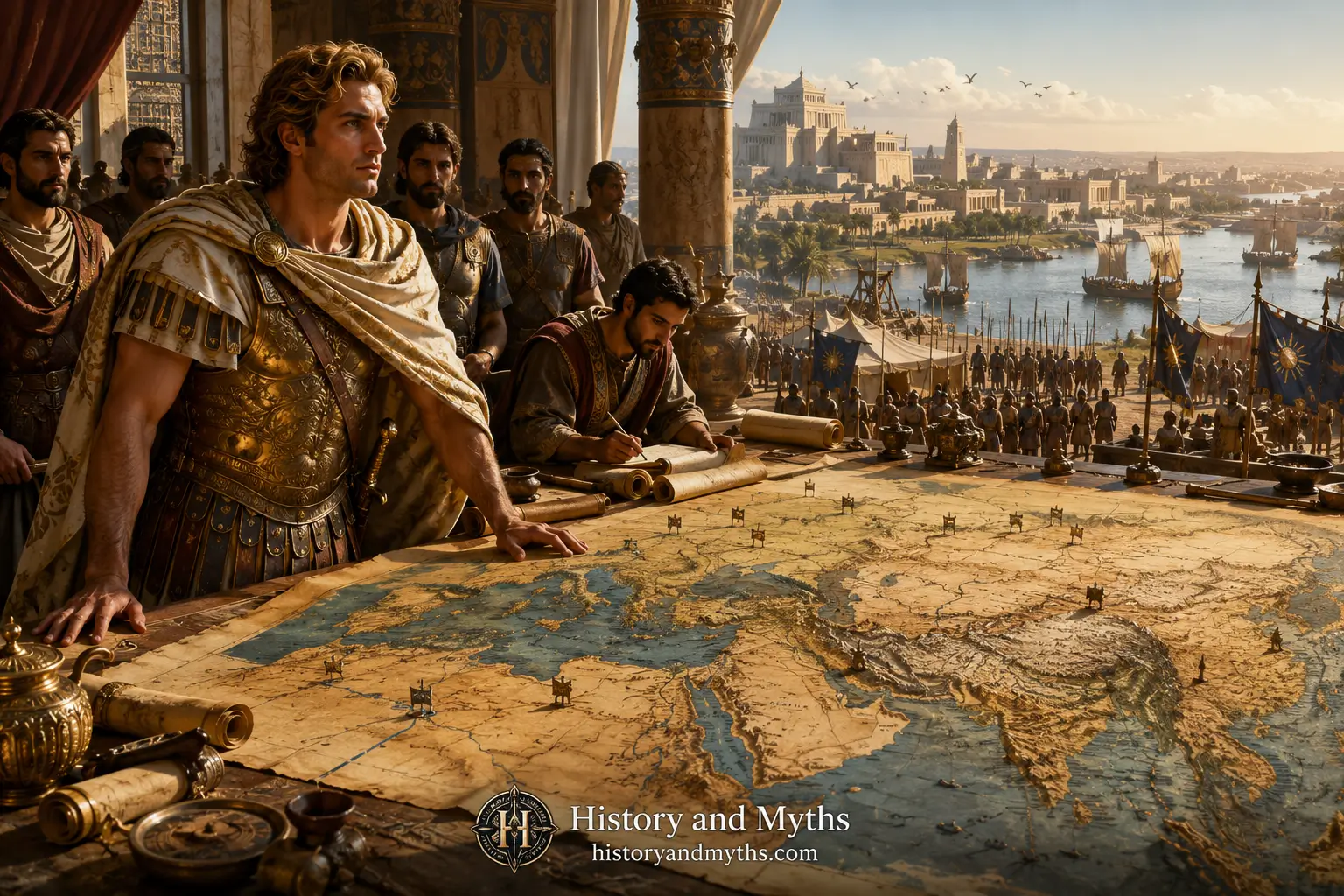
When Alexander fell ill in Babylon in 323 BCE, his empire stretched from Macedonia and Egypt to Central Asia and northwestern India. It was rich and powerful, but its unity still depended heavily on his personal authority. Distant satraps controlled large territories, communication was slow, and several regions had only recently been conquered.
Yet survival would force him to balance expansion with more urgent tasks: securing the army, controlling the satrapies, and creating a workable succession. The central challenge was no longer conquest alone, but whether Alexander could turn his victories into a state capable of surviving without him.
The Scenario Used in This Article
| Point of Divergence | Alexander recovers from his illness in Babylon in 323 BCE. |
| Timeframe | He lives for another twenty years and dies around 303 BCE at approximately fifty-two years of age. |
| What Remains Unchanged | Alexander remains ambitious and willing to campaign, but victories, military loyalty, and political stability are not guaranteed. |
| Immediate Priority | The planned Arabian expedition, followed by imperial consolidation and tighter control of the satrapies. |
| Central Question | Could Alexander turn a conquest-based empire into a stable monarchy with a functioning succession? |
| Most Likely Effect | The empire avoids its immediate breakup in 323 BCE, while Alexander IV reaches adulthood as a recognized heir. |
Why Twenty More Years Matters
Twenty additional years would give Alexander time to turn conquest into government. He could tighten control over the satrapies, limit powerful commanders, reorganize the army, and clarify how the empire would be ruled.
The First Five Years: Arabia or Imperial Consolidation?
Alexander would probably proceed with the planned Arabian campaign, using the fleet and supplies already assembled to secure coastal ports and trade routes. Yet a long absence would worsen problems within the army, satrapies, and royal court.
The Arabian Campaign Was the Most Immediate Possibility
Arabia was Alexander’s most immediate target because preparations were already advanced. His likely aim was to secure coastal ports, maritime trade, and the Persian Gulf rather than occupy the entire peninsula. Desert conditions and limited water made conquest of the interior costly and difficult.
Why Alexander Could Not Ignore Greece and the Satrapies
While Alexander campaigned in Arabia, powerful satraps and uneasy Greek cities could challenge his authority. Several governors had gained wealth, troops, and local influence during his long absence. He would probably continue removing unreliable officials, rotating commands, and tightening financial oversight.
Could Alexander Keep His Army Loyal?
Alexander’s army remained powerful, but many Macedonian veterans wanted pay, land, and retirement after years of campaigning. The dispute at Opis also revealed resentment toward the growing use of Asian soldiers and Persian court customs.
Would Alexander Continue Conquering?
Alexander would probably continue campaigning, but not without limits. Warfare strengthened his authority and rewarded the army, yet every new conquest increased the need for troops, money, supplies, and loyal governors. As the empire expanded, Alexander would face a harder choice between adding territory and securing what he already ruled. His later campaigns would therefore be more selective, aimed at strategic frontiers and trade routes rather than endless conquest.
The Caspian and Central Asian Frontiers
Alexander might return to the northeastern frontier to protect settlements, secure routes, and contain raids rather than pursue unlimited expansion. Central Asia had already proved costly to control, requiring garrisons, diplomacy, and repeated campaigns. He could strengthen the frontier, but conquest alone was unlikely to create a permanent and secure boundary.
The Western Mediterranean
After stabilizing the east, Alexander might intervene in Sicily or southern Italy through alliances with Greek cities. Direct conquest was less likely, since both Carthage and the Italian powers could resist a prolonged occupation.
Could Alexander Have Conquered Carthage?
Carthage would be one of Alexander’s strongest western opponents. Its fleet, wealth, ports, and overseas territories made it far harder to defeat than a single land-based kingdom. Alexander could build a powerful navy from Egypt, Phoenicia, Cyprus, and the Greek cities, but a successful invasion would still require secure bases and long supply lines.
Could Alexander Have Conquered Rome?
Rome around 303 BCE was still a rising Italian power, not yet the Mediterranean empire it later became. Alexander might enter Italy through alliances with Greek cities such as Tarentum and could plausibly defeat a Roman army in open battle. That victory would not guarantee conquest. Rome could raise new forces through its citizens and allies, while Italy’s fortified communities and Alexander’s long supply lines would make occupation costly.
Would Alexander Return to India?
Alexander might return to India to defend the Indus frontier, recover lost influence, or secure trade routes. Yet another deep invasion would require a rested army and reliable supply lines after his troops had already refused to advance beyond the Hyphasis River. More importantly, he would no longer face the same fragmented political landscape. A rising Mauryan state would make renewed conquest far more difficult than his earlier campaign.
The Rise of Chandragupta Maurya
Chandragupta Maurya was creating a stronger and more centralized empire in northern India. Alexander would therefore face a major state rather than a group of divided kingdoms. Alexander had an experienced army, but Chandragupta could fight closer to his own bases with easier access to reinforcements, supplies, and war elephants. Even a Macedonian victory near the Indus would not guarantee control of the Gangetic plain, where distance and vulnerable supply lines would increasingly favor the Mauryans.
Conquest, Border War, or Diplomatic Settlement?
The most likely conflict would center on the Indus frontier, not the conquest of all India. Alexander might defend his eastern satrapies or fight a limited war against Mauryan expansion. A negotiated border was more plausible than a long invasion of the Gangetic plain. Alexander could retain key western territories and trade routes, while Chandragupta controlled the stronger Mauryan heartland. The most credible outcome is therefore a brief frontier struggle followed by diplomacy, trade, and a formal settlement between the two empires.
What Would Happen to Alexander’s Generals?
While Alexander lived, Ptolemy, Seleucus, Antigonus, Perdiccas, Lysimachus, and the other future Successors would remain commanders and governors rather than independent kings. None could openly divide the empire while Alexander controlled the army, treasury, and Argead legitimacy. He would probably rotate commands, separate civil and military authority, and remove officials who built dangerous regional power bases.
Could Alexander Build a Lasting Greco-Persian Empire?
A lasting empire would require more than military occupation. Alexander needed a system that connected Macedonia, Egypt, Persia, and the eastern provinces without depending on his constant presence.
Alexander IV and the Succession Problem
Alexander’s greatest advantage from living another twenty years would be the chance to prepare his son as a recognized heir. Instead of leaving an infant surrounded by regents and rival generals, he could introduce Alexander IV to the army, court, and provincial government while defining the authority of senior commanders before the succession. An adult heir would strengthen the Argead dynasty, but not guarantee stability. Alexander IV would still inherit powerful governors, divided regional interests, and armies whose loyalty had been built around his father.
An Adult Heir Changes Everything
By 303 BCE, Alexander IV would be approaching adulthood, removing the need for a long regency. His father could give him military training, court experience, and a supervised provincial command before succession. This would limit the ability of generals to rule in the name of a child king. Acceptance would still be uncertain, however, especially among Macedonian officers suspicious of the Persian-style court and Asian elites concerned about their future influence.
The Heir Could Also Become a Rival
An adult heir could also become a rival center of loyalty. Dissatisfied generals might support Alexander IV, while court factions encouraged him to demand greater authority from his father. Clear rules over the army, treasury, and succession would therefore be essential. Even with this risk, a trained and recognized adult heir offered the Argead dynasty a far stronger future than the infant king left behind in 323 BCE.
Would the Wars of the Diadochi Still Happen?
The Wars of the Diadochi would not begin in their historical form because Alexander’s survival would remove the power vacuum of 323 BCE. Over the next twenty years, some generals would die, lose influence, or be transferred, while an adult Alexander IV would reduce the need for military regents.
Would the Hellenistic Kingdoms Still Exist?
Ptolemaic Egypt, the Seleucid Empire, and Antigonid Macedonia would probably not emerge in their historical forms while Alexander remained alive. Their territories would continue as provinces governed in the name of the Argead dynasty. Hellenistic culture would still spread through cities, armies, trade, and royal patronage, but without the same political division into independent Successor kingdoms.
Egypt Without the Ptolemaic Kingdom
Egypt would remain one of the empire’s wealthiest provinces, while Alexandria continued developing as a major commercial and administrative center. Ptolemy might govern Egypt temporarily, but Alexander would probably prevent him from creating an independent dynasty. Rotating officials, royal troops, and cooperation with the Egyptian priesthood would keep the province under central control.
Asia Without an Independent Seleucid Empire
Babylon, Syria, Iran, and parts of Central Asia would remain the central body of Alexander’s empire rather than becoming an independent Seleucid kingdom. Seleucus might serve as a leading commander or governor, but his authority would come from the Argead dynasty. Distance and powerful local elites could eventually produce greater regional autonomy, though not necessarily along the borders of the historical Seleucid Empire.
Macedonia Under the Argead Dynasty
Macedonia would probably remain under the Argead dynasty rather than pass to the Antigonids. Alexander could govern it through a trusted commander or give Alexander IV an early role there. This would connect the heir with the dynasty’s homeland, provide military experience, and reassure Macedonian elites who might resent an imperial court centered in Babylon.
What Probably Would Not Change
Alexander’s survival would not remove the basic limits of ancient empire. Distance, slow communication, difficult terrain, and seasonal campaigning would continue to restrict control over provinces stretching from Macedonia to India. Regional languages, laws, religions, and identities would also remain strong.
Could the Empire Survive After 303 BCE?
The empire could survive Alexander’s death if Alexander IV inherited real authority over the army, treasury, and royal court rather than merely the royal title. Its most durable form would be a flexible monarchy in which regional governors retained limited autonomy while supplying taxes and troops to the Argead king.
Most Likely
Plausible but Uncertain
Alexander might intervene in Italy or Sicily, defeat Rome or Carthage in a limited war, and restrict their expansion without permanently annexing them. A frontier conflict with Chandragupta Maurya could also end in a negotiated border. The empire might then survive for several decades after Alexander’s death, although powerful governors would continue seeking greater autonomy.
Highly Unlikely
Alexander was unlikely to conquer Arabia, Carthage, Italy, and the Mauryan Empire within twenty years. Each campaign would require separate armies, fleets, supply lines, and long periods of consolidation. He could not erase regional identities or guarantee an empire that remained permanently united. His most realistic achievement would be turning his conquests into a functioning dynasty and delaying fragmentation beyond his own lifetime.
| Possible Outcome | Assessment | Reason |
|---|---|---|
| A campaign along the Arabian coast | Most likely | Preparations were already underway in Babylon in 323 BCE. |
| The empire remains united during Alexander’s lifetime | Most likely | No general possessed enough legitimacy to divide the empire openly while Alexander lived. |
| Alexander IV becomes the recognized adult heir | Most likely | Twenty additional years would allow Alexander to prepare his son for military and political leadership. |
| Limited intervention against Rome or Carthage | Plausible | Alexander could intervene through Greek allies, but permanent conquest would require a costly western commitment. |
| A border settlement with Chandragupta Maurya | Plausible | Both rulers would have reasons to avoid an open-ended war deep inside India. |
| Conquest of Rome, Carthage, Arabia, and India | Highly unlikely | The campaigns would require different fleets, armies, supply systems, and years of preparation. |
| A permanently unified empire lasting for centuries | Unlikely | Succession disputes, regional autonomy, and military rivalry would remain after Alexander’s death. |
Final Verdict: Twenty More Years Could Delay the Breakup, Not Guarantee Unity
If Alexander the Great had lived another twenty years, his greatest achievement would probably have been preventing the sudden power vacuum of 323 BCE rather than conquering the entire Mediterranean and Asia.
Frequently Asked Questions
What would Alexander the Great have done first if he survived in 323 BCE?
He would most likely have continued the planned Arabian expedition. However, the campaign would probably have focused on coastal ports and trade routes rather than the complete conquest of the Arabian Peninsula.
Could Alexander have conquered Rome?
Alexander could plausibly have defeated Roman forces during this early stage of Rome’s expansion. Permanently occupying Italy would have been more difficult, making an unequal alliance or political settlement more likely than complete annexation.
Would Alexander have fought Chandragupta Maurya?
Conflict over the northwestern frontier was possible, but a negotiated border would probably serve both rulers better than a prolonged war. A complete Macedonian conquest of the Mauryan Empire would be highly unlikely.
Would the Wars of the Diadochi still happen?
They would not begin in their historical form in 323 BCE because Alexander would still control the army and the empire. Rivalry among commanders could return after his later death, but it would develop under different political conditions.
Could Alexander’s empire survive after his death?
It could survive initially if Alexander IV inherited the treasury, royal army, and support of major provincial elites. Long-term unity would remain uncertain because powerful governors and regional interests would continue to challenge central authority.
Sources and Further Reading
- Arrian. The Campaigns of Alexander. Translated by Aubrey de Sélincourt and revised by J. R. Hamilton. Penguin Classics, 1971.
- Diodorus Siculus. Library of History, Books XVII–XVIII. Translated by C. Bradford Welles and Russel M. Geer. Harvard University Press.
- Plutarch. “Alexander.” In Greek Lives. Translated by Robin Waterfield. Oxford University Press, 1998.
- Bosworth, A. B. Conquest and Empire: The Reign of Alexander the Great. Cambridge University Press, 1988.
- Worthington, Ian. By the Spear: Philip II, Alexander the Great, and the Rise and Fall of the Macedonian Empire. Oxford University Press, 2014.
- Heckel, Waldemar. The Marshals of Alexander’s Empire. Routledge, 1992.
- Green, Peter. Alexander to Actium: The Historical Evolution of the Hellenistic Age. University of California Press, 1990.
- Grainger, John D. The Wars of Alexander’s Successors, 323–281 BC. Pen and Sword, 2010.
- Holt, Frank L. Into the Land of Bones: Alexander the Great in Afghanistan. University of California Press, 2005.
- Romm, James. Ghost on the Throne: The Death of Alexander the Great and the War for Crown and Empire. Alfred A. Knopf, 2011.
Copyright Notice: This article is an original alternate-history analysis published by History and Myths. It uses established historical evidence to examine a hypothetical scenario and should not be interpreted as a record of actual events. Copying, republishing, or substantially reproducing this content without permission is prohibited.