What If Babylon Had Never Fallen? Cyrus the Great’s Defeat Reimagined
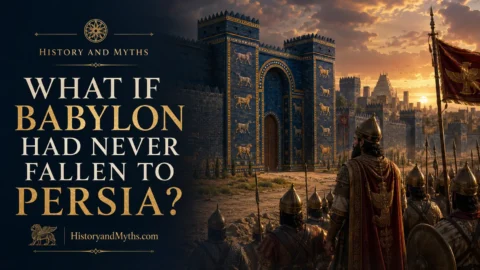
In 539 BCE, Babylon did not simply vanish when Cyrus the Great entered the city. It remained one of the most important urban and administrative centers of the ancient Near East under Persian rule. The real turning point was political: the Neo-Babylonian Empire lost its independence, and Persia gained control of a region that opened the way toward Syria, the Levant, and eventually Egypt.
But what if Babylon had stopped Cyrus before that happened? The most plausible point of divergence is not a last-minute defense of the city itself, but the Babylonian defeat at Opis. If Nabonidus had held his army together, avoided the collapse of support inside Babylonia, and prevented the Persians from breaking through, the balance of power across the Near East could have developed very differently.
That would not automatically mean a permanent Babylonian golden age or the collapse of Persia. Babylon had serious internal weaknesses of its own, while Cyrus already ruled a powerful and expanding empire. The more interesting question is how long an independent Babylon could realistically have survived, and what that survival might have changed for Persia’s western expansion, the Jewish exiles, Egypt, the eastern Mediterranean, and even the conditions that later produced the Greco-Persian Wars.
What Actually Happened in 539 BCE?
Babylon’s fall was decided before Cyrus reached the city itself. The crucial clash came at Opis, on the Tigris north of Babylon, where the Persian army defeated the forces of Nabonidus. Once that line broke, the Babylonian state lost its best chance to stop Cyrus from moving into the heart of the kingdom.
Sippar fell soon afterward without a major fight. Persian forces then entered Babylon with remarkably little resistance, and Nabonidus was captured. Cyrus himself arrived later, presenting his takeover not as the destruction of Babylon but as the restoration of proper order and legitimate kingship. That message mattered in a city where Nabonidus had strained relations with important religious institutions, particularly the priesthood connected with Marduk.
Babylon therefore did not suffer the kind of catastrophic destruction often implied by the phrase “the fall of Babylon.” Its temples, bureaucracy, scholarship, and urban life continued under Persian rule. What ended in 539 BCE was the independence of the Neo-Babylonian state. From that point on, Babylon became part of a much larger imperial system centered on the Achaemenid kings.
That distinction is essential to the counterfactual. For Babylon to “never fall to Persia,” the empire did not need to save the city from destruction. It needed to prevent the political and military collapse that allowed Cyrus to absorb Babylonia almost intact.
Historical Baseline
Babylon was not destroyed in 539 BCE. The city, its temples, administration, and intellectual life continued under Persian rule. The turning point explored in this article is the loss of Babylonian sovereignty. Our alternate timeline therefore asks what might have happened if the Neo-Babylonian state had remained independent, not whether the city itself had survived.
What Would Have Needed to Change for Babylon to Survive?
Babylon’s survival depended first on stopping Cyrus in the field. The defeat at Opis opened the route into central Babylonia; once Sippar fell and Persian forces reached Babylon, the kingdom had little room left to recover. A different outcome therefore requires Nabonidus to avoid that military collapse, whether through a stronger defense at Opis, better coordination among his forces, or a withdrawal that preserved enough of the army to block the Persian advance.
Military success alone, however, would not have solved Babylon’s deeper problem. Nabonidus had spent years away from the capital and pursued religious policies that later Persian propaganda portrayed as offenses against Marduk and Babylon’s traditional cults. The Cyrus Cylinder presents Cyrus as the ruler chosen by Marduk to correct those failures. That text was written after the conquest and served Cyrus’s own claim to legitimacy, so it cannot simply be read as proof that all Babylonians wanted Nabonidus removed. But it does show how vulnerable the king’s position had become politically.
For an independent Babylon to survive, Nabonidus would have needed more than one battlefield victory. He needed the support of the capital, the major temples, provincial officials, and commanders capable of keeping the state together after the immediate Persian threat passed. Cyrus had already built a powerful empire before attacking Babylonia, and defeating one invasion would not have removed that pressure.
The most credible alternate scenario, then, is not a miraculous Babylonian triumph. It is a combination of a Persian setback at Opis and a political recovery inside Babylonia strong enough to prevent Cyrus from turning military pressure into a rapid takeover of the entire kingdom.
The Immediate Result: Persia Loses Its Road to the West
If Babylon had stopped Cyrus in 539 BCE, the immediate consequence would have been larger than the survival of one kingdom. Babylonia controlled the political corridor linking Iran and Mesopotamia to Syria, Phoenicia, and the southern Levant. In the historical timeline, Persian authority spread into these western territories soon after Babylon’s conquest.
A surviving Babylonian state would have stood directly across that route. Cyrus could still have remained the dominant power in Iran and much of the east, but expanding toward the Mediterranean would now require defeating Babylon rather than inheriting territories that had belonged to its empire. That would cost time, troops, and resources, while giving Babylon an opportunity to strengthen its western provinces and seek allies threatened by Persian expansion.
The result would probably not be a permanent barrier between Persia and the Mediterranean. Cyrus had already shown that a military setback did not necessarily end his ambitions. But even a delay of several years could matter. Persian control of the Levant, access to Phoenician naval power, and the later strategic position from which the Achaemenids operated against Egypt would all develop under different conditions.
The first major change, then, would not be the disappearance of Persia but the loss of its rapid westward breakthrough. Persia would still remain a formidable empire: Cyrus had already conquered Media and Lydia before attacking Babylon. A defeat in Mesopotamia would limit Achaemenid expansion rather than destroy Persian power, leaving the Near East divided between two major rivals instead of quickly falling under one expanding empire.
Could the Neo-Babylonian Empire Actually Survive?
Surviving Cyrus in 539 BCE would not guarantee the long-term survival of the Neo-Babylonian Empire. The state itself was only about a century old, and much of its western territory had been acquired through conquest. A victory over Persia might preserve the empire for the moment, but it would leave Babylon facing the harder task of holding that territory together.
Succession would be one of the first tests. Nabonidus was already an aging ruler, and a stable transfer of power would be essential if Babylon hoped to survive another Persian attempt. A disputed succession could erase the benefits of victory almost immediately, especially with a powerful rival waiting to exploit internal division.
Babylon would also need to secure Syria and the Levant rather than assume those regions would remain loyal. Their ports, trade routes, and tax revenues were strategically valuable, but they also lay far from the Babylonian heartland. A weakened government in the capital could invite revolt, local realignment, or renewed Persian pressure from the east.
The most plausible outcome is therefore not an immortal Babylonian empire. A victory over Cyrus could buy Babylon years, perhaps decades, to rebuild its position. Whether that became a lasting recovery would depend less on the battle itself than on succession, political cohesion, and the ability to defend an empire stretched between Mesopotamia and the Mediterranean.
What Happens to Judah and the Babylonian Exiles?
One of the clearest consequences of a surviving Babylon would concern the Judean exiles. In the historical timeline, Cyrus’s conquest of Babylon was followed by a new Persian policy toward displaced communities and local cults. Biblical tradition credits Cyrus with allowing Judeans to return to Jerusalem and rebuild the Temple, while the Cyrus Cylinder records a broader policy of restoring sanctuaries and returning displaced cult objects and populations in other parts of the empire.
If Babylon remained independent, that political opening would disappear. Some Judeans might still return through negotiation or later changes in Babylonian policy, but there would be no Persian conquest in 539 BCE to create the same opportunity. The restoration of Jerusalem and its Temple could therefore be delayed, reshaped, or placed under very different political conditions.
The effect would not be limited to migration. The experience of exile and return became deeply important to Jewish religious identity and historical memory. Changing the timing or circumstances of that return could affect the development of the Judean community in Jerusalem while also strengthening the Jewish population that remained in Babylonia.
What cannot be claimed with confidence is that Judaism would develop into an entirely different religion. Religious change was already underway during the exile, and many Judeans remained in Mesopotamia even after Persian rule began. The stronger conclusion is narrower: if Babylon had resisted Cyrus, one of the most significant political turning points in the history of Judah would probably have been postponed or taken a different form.
How Babylon’s Survival Could Reshape Egypt and Greece
A surviving Babylon would make Persian expansion into the eastern Mediterranean far more complicated. Historically, Persia controlled Babylonia and the Levant before Cambyses II conquered Egypt in 525 BCE. If Babylon remained an independent rival, Persia would have to secure its western flank before mounting such a campaign.
That could delay the conquest of Egypt or force Persia to fight on two fronts. Egypt and Babylon would not automatically become allies, but both had a clear interest in limiting Persian expansion, making some form of cooperation plausible.
The effect on Greece is less direct. Persia had already conquered Lydia and reached the Greek cities of Asia Minor before taking Babylon, so conflict with the Greek world could still occur. What becomes uncertain is the scale and timing of the later wars. A Persia tied down in Mesopotamia and lacking secure control of the Levant would have fewer resources and a weaker strategic position for major campaigns across the Aegean.
Marathon, Xerxes’ invasion, Salamis, and Plataea might therefore happen later, on a smaller scale, or not in the sequence we know. Babylon’s survival would not isolate Persia from Egypt or Greece, but it could prevent the rapid concentration of power that made those later campaigns possible.
Babylonian Religion, Scholarship, and Identity
Babylonian culture did not disappear under Persian rule. Temples remained important institutions, and Babylon continued to be a major center of cuneiform scholarship, including astronomy, mathematics, religion, and literature.
An independent Babylon would therefore not “save” traditions that were otherwise about to vanish. The more meaningful difference would be political. A native monarchy could keep the cult of Marduk more closely tied to royal legitimacy and preserve Babylon as the center of an independent state rather than one of several great cities inside a larger empire.
That might strengthen Babylonian political identity and give its temples greater influence over royal policy. But the intellectual traditions themselves would likely continue in either timeline. The real counterfactual is not cultural survival, but whether Babylonian culture would remain attached to its own sovereign power for longer.
Plausibility Check
Most plausible: Babylon survives the immediate crisis, Persia remains powerful, but its rapid westward expansion is delayed.
Plausible but uncertain: Persian pressure on Egypt develops later, while the return of the Judean exiles occurs under different political conditions.
More speculative: the familiar sequence of the Greco-Persian Wars changes substantially. Persia had already reached the Greek cities of Asia Minor, so conflict could still occur even if Babylon remained independent.
The Most Plausible Alternate Timeline
The most realistic outcome is not a restored Babylonian golden age or the collapse of Persia. It is a temporary balance of power. A Babylonian victory at Opis could keep the Neo-Babylonian state independent, force Cyrus to postpone further western expansion, and give Nabonidus time to repair relations with the institutions and officials needed to hold the kingdom together.
Persia would remain the stronger long-term rival. Cyrus already controlled a large empire, and another attempt to conquer Babylonia would be likely. The key question would be whether Babylon could use the years gained after 539 BCE to secure the Levant, manage succession, and build alliances with states such as Egypt.
If it succeeded, the Near East might remain divided between a Persian sphere in Iran and Anatolia and a Babylonian sphere centered on Mesopotamia and the Levant. That alone could delay Persia’s conquest of Egypt, alter the return of the Judean exiles, and change the conditions that later shaped Persian involvement in the Greek world.
Babylon’s greatest victory, then, would not be defeating Persia forever. It would be preventing one empire from dominating the Near East so quickly.
Frequently Asked Questions
Was Babylon destroyed when Cyrus conquered it in 539 BCE?
No. Babylon lost its political independence, but the city itself remained an important administrative, religious, and intellectual center under Achaemenid rule.
Could Babylon realistically have defeated Cyrus the Great?
A Babylonian victory was possible but would have required more than defending the city. The most credible point of divergence is the Battle of Opis, where stopping the Persian advance while preserving political support inside Babylonia could have kept the kingdom independent, at least temporarily.
Would Persia have collapsed if Babylon had survived?
Probably not. Cyrus had already conquered Media and Lydia before attacking Babylonia. Persia would remain a major power, but its expansion toward the Levant and Egypt could become slower and more difficult.
What might have happened to the Judean exiles?
Without Cyrus’s conquest of Babylon, the political circumstances that allowed a return to Jerusalem would not have appeared in the same way in 539 BCE. A return could still occur later, but its timing and conditions would likely be different.
Would the Greco-Persian Wars still have happened?
Conflict between Persia and the Greek cities could still develop because Persia had already reached western Anatolia. What becomes less certain is whether Marathon, Xerxes’s invasion, Salamis, and Plataea would occur in the same sequence, scale, or timeframe.
Sources and Further Reading
This alternate-history analysis is built from the established historical record of the Persian conquest of Babylon and its wider political consequences. The hypothetical conclusions are distinguished from the documented events on which they are based.
Babylonian Chronicles
Nabonidus Chronicle, Opis, Sippar, and the Persian occupation of Babylon.
Cyrus IV: The Cyrus Cylinder
Historical context and interpretation of Cyrus’s Babylonian royal inscription.
The Cyrus Cylinder
Museum record, provenance, text context, and Cyrus’s presentation of the conquest of Babylon.
Babylon
Babylon before and after the Persian conquest and the city’s continued importance under later empires.
The Cyrus Cylinder and Ancient Persia
Historical context for Cyrus, Babylon, and the formation of the Achaemenid imperial system.
© Copyright Notice
Copyright Notice: This article is an original alternate-history analysis published by History and Myths. It uses established historical evidence to examine a hypothetical scenario and should not be interpreted as a record of actual events.
Copying, republishing, translating, adapting, or substantially reproducing this content, in whole or in part, without prior written permission is prohibited.
All rights reserved ©
History and Myths