How Ancient Greek Commanders Controlled Chaos in Battle
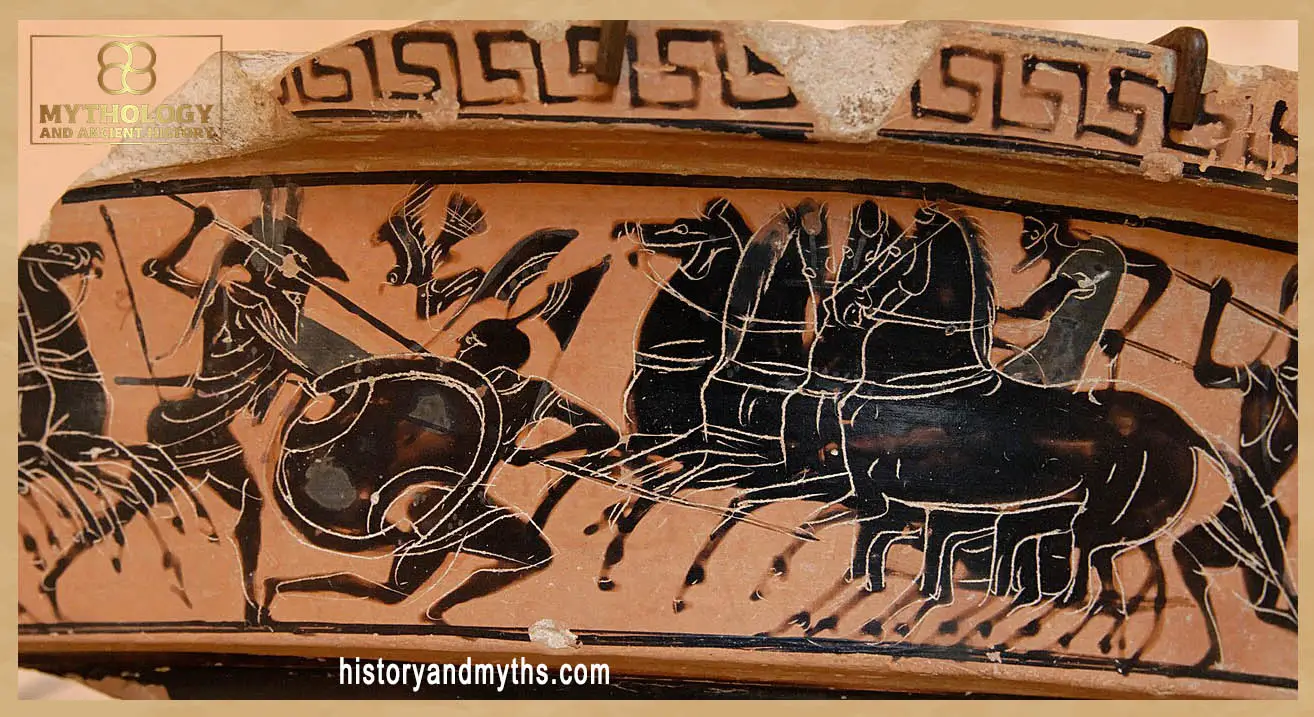
Ancient Greek commanders could not control battles through constant communication or full battlefield visibility. Dust, noise, crowded formations, and close combat made direct command extremely difficult once fighting began. Orders were passed through shouting, runners, horns, flutes, and visual signals, while disciplined formations were expected to continue functioning even when communication weakened. Greek battlefield leadership therefore depended less on precise real-time control and more on preparation, cohesion, and the ability of soldiers to maintain formation under chaotic conditions.
Why Battlefield Control Was So Difficult
Ancient Greek battles became difficult to control because commanders operated inside conditions that severely limited communication and visibility.
Dust obscured large parts of the battlefield. Advancing formations and moving troops quickly reduced the ability to monitor distant sections of the line.
Noise overwhelmed verbal commands. Shields, weapons, shouting, and impact sounds made it difficult for orders to travel clearly once combat intensified.
Formations blocked visibility. Dense ranks prevented commanders from seeing what was happening deep inside crowded fighting zones.
Battle conditions changed rapidly. Small gaps, retreats, or shifts in pressure could alter local situations faster than instructions could spread across the field.
Distance weakened coordination. Units separated across wider battle lines became increasingly difficult to direct in real time without reliable communication systems.
Greek commanders therefore fought against battlefield confusion as much as against the enemy itself.
| Command Challenge | How Greek Armies Responded | Battlefield Effect |
|---|---|---|
| Limited Visibility | Use of positioning and observation | Partial battlefield awareness |
| Communication Problems | Shouting, runners, horns, and flutes | Basic coordination under pressure |
| Formation Drift | Controlled pacing and alignment | Maintained cohesion |
| Battlefield Confusion | Reliance on disciplined troops | Reduced panic and disorder |
| Loss of Control | Local officer initiative | Slowed formation collapse |
Where Greek Commanders Positioned Themselves
Commanders placed themselves where they could influence formation stability without losing awareness of the battlefield entirely.
Some led from the front ranks. Commanders fighting near the line could strengthen morale and demonstrate commitment during critical moments of contact.
Others positioned near the flanks. Side positions offered better visibility across formation movement and reduced the risk of becoming trapped inside compressed fighting.
Rear positions improved oversight. Commanders farther behind the line could observe broader battlefield developments and coordinate supporting units more effectively.
Placement depended on battle conditions. Terrain, army size, troop quality, and tactical goals influenced where leadership could operate most effectively.
Command involved balancing risk and control. Moving too close to combat reduced battlefield awareness, while staying too distant weakened direct influence over the troops.
Greek battlefield leadership required constant compromise between visibility, communication, and physical presence near the fighting line.
How Orders Were Communicated During Battle
Greek armies relied on simple but practical communication methods suited to noisy and unstable battlefield conditions.
Shouting carried basic commands. Officers and nearby leaders passed short instructions through the ranks during movement and close combat.
Runners transmitted information physically. Messengers moved between sections of the army when direct verbal communication became impossible across larger distances.
Musical signals helped coordinate movement. Flutes, horns, and other instruments provided recognizable rhythms or signals for advancing, maintaining pace, or regrouping.
Visual cues supported battlefield control. Soldiers reacted to movement inside neighboring units and followed visible changes in formation direction or speed.
Communication became less reliable after collision. Once formations locked together, confusion and noise reduced the effectiveness of organized command transmission.
Greek commanders depended on limited and indirect communication systems rather than continuous detailed control during battle.
Why Visibility Limited Command
Commanders could rarely observe the battlefield as a complete and organized picture once combat began.
Terrain interrupted line of sight. Hills, uneven ground, and moving formations blocked long-range observation across different sections of the battle.
Front-line combat created visual barriers. Dense ranks, raised shields, and close contact concealed local developments inside the fighting line.
Dust clouds reduced battlefield awareness. Large troop movements quickly obscured distant units and made rapid assessment difficult.
Information arrived slowly and imperfectly. Commanders often depended on messengers or partial observations instead of direct knowledge of unfolding events.
Local situations changed before responses arrived. By the time orders reached struggling units, conditions on that part of the battlefield could already be different.
Ancient battlefield leadership operated under severe informational limits, forcing commanders to rely heavily on preparation and disciplined formations rather than constant oversight.
- Greek commanders faced severe limits in visibility and communication
- Battlefield control relied on discipline more than constant direct orders
- Signals included shouting, runners, horns, and flutes
- Experienced troops helped maintain cohesion during confusion
- Greek leadership focused on preserving formation stability under pressure
© historyandmyths.com — Educational use
How Commanders Controlled Formation Movement
Greek commanders focused heavily on keeping formations organized while they advanced, turned, or reacted under pressure.
Maintaining alignment was critical. Uneven movement could expose gaps between units and weaken the defensive structure of the line.
Pacing affected cohesion. Formations moving too quickly risked disorder, while slow movement reduced momentum and battlefield confidence.
Flank control protected the formation. Commanders monitored the sides of the line carefully because exposed flanks were vulnerable to collapse or encirclement.
Experienced units responded more consistently. Well-trained troops adjusted direction and spacing with fewer disruptions during complex battlefield movement.
Control depended on predictability. Formations worked best when soldiers understood their expected role before battle rather than relying on constant instructions during combat.
Greek battlefield command emphasized preserving organized movement because cohesion often mattered more than tactical complexity once fighting began.
What Happened When Control Broke Down
Once battlefield control weakened, confusion could spread faster than commanders were able to restore order.
Units began reacting independently. Soldiers and local officers responded to immediate pressure rather than following wider battlefield coordination.
Formation timing collapsed. Sections of the army could advance, retreat, or turn unevenly, disrupting collective movement across the line.
Communication became fragmented. Orders failed to travel consistently once noise, panic, and physical separation increased inside the battle.
Local failures spread outward. Disorder in one section often affected neighboring units by exposing flanks or creating uncertainty nearby.
Commanders lost influence rapidly. During severe confusion, maintaining cohesion became more important than executing planned tactics.
Greek battles could shift suddenly once armies stopped functioning as coordinated formations and began reacting through isolated local survival.
Why Experienced Troops Were Easier to Control
Experienced soldiers reduced the need for constant battlefield instruction because they understood how formations were supposed to function under pressure.
Veteran troops recognized standard movement patterns. They could maintain spacing, direction, and formation rhythm without waiting for repeated commands.
Discipline stabilized communication problems. Units familiar with battlefield procedures continued operating even when signals became unclear or delayed.
Experienced formations reacted more calmly. Soldiers who had fought before were less likely to panic during sudden pressure or temporary disorder.
Local officers became more effective. Smaller unit leaders inside disciplined formations could solve immediate problems without depending entirely on senior commanders.
Predictable behavior improved overall coordination. Armies functioned more reliably when commanders trusted units to maintain cohesion independently during chaotic conditions.
Experience strengthened battlefield control by reducing the gap between command intention and soldier response once direct oversight became limited.
How Greek Battlefield Leadership Differed from Modern Command
Ancient Greek commanders operated with far less information, communication speed, and tactical flexibility than modern military leaders.
Real-time control was extremely limited. Commanders could not instantly redirect distant units once combat disrupted visibility and communication.
Battle plans depended on pre-battle preparation. Armies relied heavily on formation discipline and shared expectations established before fighting began.
Local initiative mattered more during chaos. Officers and soldiers near the fighting often made immediate decisions without waiting for detailed instructions.
Formations moved less flexibly. Dense infantry structures restricted rapid maneuvering compared to modern mobile battlefield systems.
Leadership remained physically exposed. Greek commanders frequently operated close enough to the fighting to influence morale directly while risking death or injury themselves.
Ancient battlefield command relied more on cohesion and preparation than on continuous centralized control during combat.
What Greek Battlefield Command Reveals About Ancient Warfare
Greek battlefield leadership reveals that ancient warfare depended on managing instability rather than achieving perfect tactical control.
Command worked through structure more than precision. Armies remained effective when formations continued functioning despite limited communication during combat.
Preparation shaped battlefield performance. Training, discipline, and unit familiarity often mattered more than complex real-time decision-making.
Leadership depended on morale as much as tactics. Commanders influenced battles partly by maintaining confidence and cohesion under pressure.
Control weakened as combat intensified. The closer formations moved toward direct collision, the harder it became to coordinate events across the battlefield.
Ancient warfare operated through controlled limitations. Greek commanders succeeded not by controlling every moment of battle, but by building formations capable of surviving confusion and pressure.
Battlefield command in ancient Greece was therefore a system of organized resilience rather than constant tactical supervision.
- Ancient Greek battlefield command operated under severe communication limits
- Commanders depended heavily on disciplined formations and preparation
- Visibility problems reduced real-time battlefield control
- Experienced soldiers improved coordination during chaos
- Greek warfare emphasized cohesion over precise tactical supervision
Frequently Asked Questions
How did ancient Greek commanders control battles?
They relied on disciplined formations, battlefield signals, runners, and pre-battle organization rather than constant direct communication.
How were orders communicated during Greek battles?
Greek armies used shouting, messengers, horns, flutes, and visual movement signals.
Why was battlefield command difficult in ancient Greece?
Dust, noise, limited visibility, and crowded formations reduced communication and battlefield awareness.
Where did Greek commanders position themselves?
Some fought near the front ranks, while others stayed near the flanks or rear to improve visibility and coordination.
Why were experienced troops easier to command?
Veteran soldiers understood formation behavior and maintained cohesion with less direct supervision.
What happened when battlefield control collapsed?
Units began reacting independently, communication weakened, and formation disorder spread quickly.
Sources & Rights
- Hanson, Victor Davis. The Western Way of War. University of California Press.
- Van Wees, Hans. Greek Warfare: Myths and Realities. Duckworth.
- Anderson, J.K. Military Theory and Practice in the Age of Xenophon. University of California Press.
- Lazenby, J.F. The Spartan Army. Aris & Phillips.
- Krentz, Peter. “The Nature of Hoplite Battle.” Classical Antiquity.
- Sabin, Philip. Lost Battles. Continuum.
- Cartledge, Paul. The Spartans. Vintage Books.
- Snodgrass, Anthony. Arms and Armor of the Greeks. Johns Hopkins University Press.
- Thucydides. History of the Peloponnesian War.
- Xenophon. Hellenica.
- Herodotus. The Histories.
- Plutarch. Life of Lycurgus.
Written by H. Moses — All rights reserved © Mythology and History