What Happened When Ancient Greek Phalanxes Collided in Battle
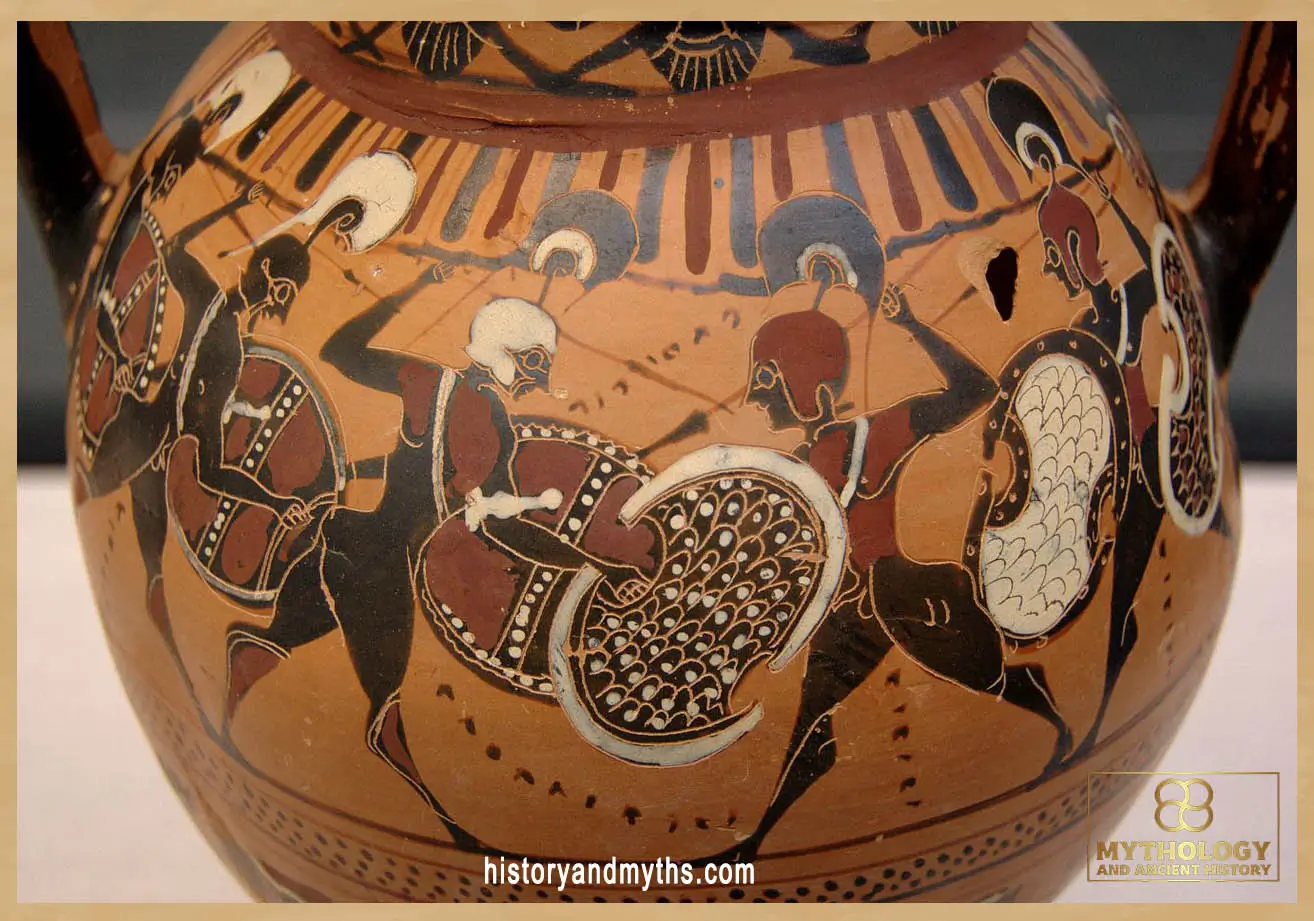
When two Greek phalanxes collided, the battle did not turn into orderly one-on-one combat. The first moments were chaotic, compressed, and physically brutal. Shields crashed together, spears struck from limited space, visibility collapsed behind overlapping ranks, and hundreds of soldiers were forced forward under pressure from the men behind them. Success depended less on individual heroism than on cohesion, discipline, and the ability of the formation to absorb fear and maintain structure during impact. Many battles were decided not when one side was destroyed, but when one formation lost order and began to break apart.
The Advance Before Impact
Before the collision itself, the most important task was keeping the formation intact while moving toward the enemy line.
Alignment mattered immediately. Each hoplite depended on the shield coverage and positioning of the men beside him. Small gaps created vulnerability long before physical contact began.
The advance increased psychological pressure. As the distance closed, soldiers could hear shields, armor, commands, and movement from the opposing formation. Fear intensified before weapons were even used.
Speed had to remain controlled. Moving too slowly weakened momentum and morale, while rushing too early risked disorder inside the ranks.
Formations naturally drifted. Because hoplites carried shields on the left arm, lines often shifted sideways during movement as soldiers tried to stay protected behind neighboring shields.
Command became harder near contact. Noise, dust, and tightening formation density reduced the ability of officers to control the line through verbal orders alone.
The advance was therefore not a passive approach phase but a struggle to preserve cohesion before the violence of impact began.
| Battle Stage | What Happened | Main Effect |
|---|---|---|
| Advance | Formations moved while maintaining alignment | Preserved cohesion before contact |
| Initial Collision | Shields and bodies absorbed impact | Compressed the front ranks |
| Close Combat | Short spear thrusts inside limited space | Reduced freedom of movement |
| Formation Stress | Pressure, fatigue, and confusion increased | Threatened line stability |
| Collapse | Gaps and panic spread through the formation | Triggered retreat or defeat |
The First Seconds of Contact
The collision transformed the battlefield from organized movement into compressed close-range violence almost instantly.
Shields absorbed the initial shock. The first impact came through overlapping shields and body weight rather than through clean sword fighting.
Space disappeared quickly. Front ranks lost freedom of movement as formations pressed into one another, reducing combat to short thrusts and physical pressure.
Spears struck over and around shields. Hoplites attempted to hit exposed areas while maintaining position inside the line instead of chasing individual opponents.
Noise and confusion intensified. Wood cracking, metal impact, shouting, and collapsing visibility made coordination increasingly difficult after contact.
Momentum became collective. Individual movement mattered less once formations locked together. Survival depended on whether the line around a soldier continued to hold.
The first moments of collision were therefore dominated by compression and formation stability rather than by isolated duels between individual fighters.
Why Visibility Collapsed So Quickly
Once the formations met, soldiers could no longer see the battlefield in any complete sense.
Shields blocked forward vision. Hoplites fought behind large overlapping shields that limited awareness beyond the men directly in front of them.
Dust rose immediately. Hundreds of moving feet disturbed dry ground, reducing visibility even further during sustained contact.
Ranks compressed tightly. Soldiers stood so close together that side vision narrowed and movement became restricted by bodies rather than open space.
Noise replaced information. Commands became difficult to hear beneath impact sounds, shouting, and the pressure of the collision itself.
Rear ranks understood little of the front. Men farther back often reacted to movement and pressure inside the formation without clearly seeing what caused it.
Battle awareness fragmented quickly, leaving most soldiers dependent on the stability of the formation rather than on a clear view of the fight around them.
How Spears Were Actually Used During Collision
Spears were used in confined and unstable conditions rather than in wide, controlled motions.
Thrusting replaced sweeping attacks. Hoplites aimed with short forward strikes because dense formations left little room for broad weapon movement.
Targets were limited. Openings appeared briefly around faces, necks, shoulders, or legs exposed beyond shield coverage.
Reach mattered more than flexibility. Longer spears allowed front ranks to attack while keeping some distance from direct body contact.
Broken shafts changed the fight. Spears could snap under pressure or impact, forcing some soldiers to continue with secondary weapons at much closer range.
Weapon control depended on formation stability. A soldier losing balance or spacing inside the line could no longer use the spear effectively, regardless of personal skill.
The spear functioned as part of the formation system itself, not as an independent dueling weapon.
- Greek phalanx battles depended on formation cohesion under pressure
- The first moments of impact created compression and confusion
- Visibility collapsed quickly inside overlapping shield walls
- Front ranks experienced extreme physical and psychological strain
- Battles were often decided when one formation lost stability
© historyandmyths.com — Educational use
What the Front Ranks Experienced
The front ranks absorbed the greatest physical and psychological strain during the collision.
Pressure came from both directions. Enemy contact pressed forward while rear ranks continued advancing from behind, trapping front-line soldiers inside a tightening space.
Fatigue built rapidly. Holding shields, resisting impact, and maintaining balance under constant compression exhausted the body within a short time.
Falling became dangerous immediately. A soldier losing footing near the front risked being crushed or exposing gaps in the line.
Fear spread through physical signals. Panic was often transmitted through movement, hesitation, or instability inside the formation rather than through spoken communication.
Survival depended on collective endurance. Individual strength mattered less than whether the surrounding ranks continued holding position under stress.
The front ranks experienced battle as sustained pressure and confinement rather than as open maneuvering or heroic individual combat.
Did the Famous “Push” Really Happen?
Ancient sources and modern historians disagree on how literal the famous phalanx “push” actually was.
Some scholars support a physical shove. In this interpretation, rear ranks added forward force to break the opposing line through sustained body pressure behind the shields.
Others argue the effect was less mechanical. They view the “push” as a combination of crowd pressure, fear, exhaustion, and formation stress rather than a coordinated mass shove.
Terrain and formation quality mattered. A disciplined line on stable ground could maintain pressure more effectively than a disorganized or uneven formation.
Psychological collapse remained critical. Even without a dramatic physical surge, formations often failed once cohesion weakened and soldiers sensed instability nearby.
Ancient battle descriptions suggest intense compression. Regardless of interpretation, close contact and collective pressure clearly shaped how phalanx combat unfolded.
The debate continues because Greek battles combined physical force with psychological breakdown in ways that are difficult to separate completely.
- How the Greek Phalanx Actually Worked in Battle
- How Greek Soldiers Fought Inside the Formation
- Ancient Greek Warfare Tactics Explained
- How Hoplite Armor Worked in Battle
How Formations Started to Break
Phalanxes rarely collapsed all at once. Breakdown usually began through small failures that spread across the line.
Gaps opened under pressure. Fallen soldiers, hesitation, or uneven movement created weak points that disrupted shield coverage between neighboring hoplites.
Loss of alignment spread instability. Once sections of the formation shifted out of position, nearby soldiers struggled to maintain spacing and coordinated defense.
Fear accelerated collapse. Soldiers noticing disorder nearby often reacted defensively, increasing confusion inside the line instead of restoring cohesion.
Flanks became vulnerable first. Units exposed at the sides faced greater risk of encirclement or lateral pressure once formation integrity weakened.
Retreat turned dangerous quickly. A controlled withdrawal was difficult inside compressed ranks, so panic often transformed localized disorder into wider collapse.
A phalanx usually failed through progressive disintegration of cohesion rather than through total destruction in direct combat.
Why Battles Were Often Decided Quickly
Many Greek battles ended soon after one formation lost stability because phalanx warfare depended heavily on cohesion and morale.
Sustained compression exhausted formations fast. The physical strain of shield pressure, restricted movement, and constant impact could not be maintained indefinitely.
Psychological endurance had limits. Once soldiers sensed collapse nearby, confidence in the line weakened rapidly across connected ranks.
Disorder spread faster than recovery. Rebuilding formation structure during active collision was extremely difficult once spacing and alignment broke down.
Retreat exposed vulnerability. A formation turning away lost shield coverage and collective protection, increasing the risk of pursuit and casualties.
Victory came through collapse, not annihilation. Battles were often decided when one side stopped functioning as an organized formation rather than when most soldiers were killed.
Greek phalanx warfare rewarded collective stability under pressure more than prolonged individual combat endurance.
What This Reveals About Greek Warfare
Phalanx battles reveal a style of warfare built around collective discipline rather than individual freedom inside combat.
Formations mattered more than isolated skill. A capable soldier became ineffective once the line around him failed.
Psychology shaped outcomes continuously. Fear, pressure, exhaustion, and confidence influenced battlefield performance as much as weapons or armor.
Combat operated through compression and cohesion. Greek warfare depended on maintaining structure under extreme physical stress instead of fluid maneuvering.
Disorder became strategically decisive. Small breakdowns inside the formation could spread rapidly and determine the outcome of the battle.
Victory relied on organized endurance. Successful armies preserved alignment, pressure, and morale longer than their opponents during close contact.
Greek phalanx warfare was therefore a system of collective survival where stability inside the formation determined whether an army continued fighting or collapsed.
- Phalanx battles relied on collective discipline rather than individual duels
- Shield impact and compression shaped the first seconds of combat
- Most soldiers fought with limited visibility and restricted movement
- Formation collapse mattered more than total battlefield destruction
- Psychological pressure played a major role in determining victory
Frequently Asked Questions
What happened when two Greek phalanxes collided?
The battle turned into compressed close-range combat dominated by shield pressure, spear thrusts, and formation cohesion.
Did Greek phalanxes physically push each other?
Historians debate whether the famous “push” was literal or mainly the result of collective pressure and formation stress.
Could Greek soldiers see clearly during phalanx combat?
No. Dust, overlapping shields, noise, and compressed ranks severely limited battlefield visibility.
Why were front ranks so vulnerable?
Front-line soldiers absorbed the greatest impact, pressure, fatigue, and risk of collapse during the collision.
How were spears used inside the phalanx?
Hoplites used short forward thrusts because dense formations prevented wide weapon movement.
Why did phalanx formations collapse?
Small gaps, panic, fatigue, and loss of alignment could spread instability across the line and trigger retreat.
Sources & Rights
- Hanson, Victor Davis. The Western Way of War. University of California Press.
- Lazenby, J.F. The Spartan Army. Aris & Phillips.
- Goldsworthy, Adrian. The Complete Roman Army. Thames & Hudson.
- Anderson, J.K. Military Theory and Practice in the Age of Xenophon. University of California Press.
- Van Wees, Hans. Greek Warfare: Myths and Realities. Duckworth.
- Sabin, Philip. Lost Battles. Continuum.
- Krentz, Peter. “The Nature of Hoplite Battle.” Classical Antiquity.
- Cartledge, Paul. The Spartans. Vintage Books.
- Snodgrass, Anthony. Arms and Armor of the Greeks. Johns Hopkins University Press.
- Thucydides. History of the Peloponnesian War.
- Xenophon. Hellenica.
- Plutarch. Life of Lycurgus.
- Herodotus. The Histories.
Written by H. Moses — All rights reserved © Mythology and History