Ancient Greek Warfare: Hoplites, Phalanx, and Naval Battles
War was a constant feature of the Greek world because the region was divided into hundreds of independent city-states, each responsible for its own defense and interests. Without a unified authority, conflicts over territory, alliances, and political influence frequently escalated into armed confrontation. As a result, warfare became deeply integrated into the political and social life of the Greek polis.
Greek warfare developed distinctive characteristics. Citizen soldiers known as hoplites fought in tightly organized formations called the phalanx, where discipline and cooperation mattered as much as individual strength. At the same time, maritime powers such as Athens built powerful fleets that reshaped warfare at sea, while militarized societies like Sparta focused on maintaining elite land armies. These different approaches to war eventually culminated in major conflicts such as the Peloponnesian War, one of the defining struggles of classical Greek history.
Understanding Greek warfare therefore means more than describing battles or weapons. It requires examining how the structure of the city-state, the organization of citizen armies, and the rivalry between major powers shaped the way Greeks fought and how war influenced their society.
Why Warfare Was Common in the Greek World
Conflict was frequent in ancient Greece largely because the region was politically fragmented. Instead of a single kingdom, the Greek world consisted of hundreds of independent city-states, each controlling its own territory and defending its own interests. When disputes arose over borders, resources, or influence, there was no central authority capable of enforcing peace. Rivalries between neighboring poleis therefore often led to armed confrontation.
Competition for power also played a role. Stronger states sought to expand their influence through alliances and leagues, while smaller cities tried to preserve their autonomy. This dynamic produced a landscape where diplomacy, alliances, and warfare were closely connected. The rivalry between major powers such as Athens and Sparta illustrates how political competition could escalate into large-scale conflict involving many Greek states.
Geography further encouraged conflict. Greece is characterized by mountains, narrow plains, and scattered islands, conditions that favored the development of small independent communities rather than a unified state. Each city-state maintained its own army to protect its land and population. In this environment, warfare became not an exceptional event but a recurring element of political life in the Greek world.
Key Elements of Greek Warfare
| Aspect | Description |
|---|---|
| Main Soldier | Hoplite citizen infantry armed with spear and shield |
| Primary Formation | Phalanx formation of tightly packed infantry ranks |
| Naval Warfare | Fast warships called triremes dominated sea battles |
| Major Military Powers | Athens (naval power) and Sparta (land army) |
| Typical Weapons | Dory spear, xiphos sword, bronze armor and shield |
| Major Conflict | Peloponnesian War between Athens and Sparta |
The Hoplite Soldier
The central figure of Greek land warfare was the hoplite, a heavily armed infantryman who fought as part of the citizen army of the polis. Unlike professional soldiers in later empires, hoplites were usually ordinary citizens who equipped themselves for battle and served when their city required it. Military service was therefore closely connected to citizenship and political identity in many Greek communities.
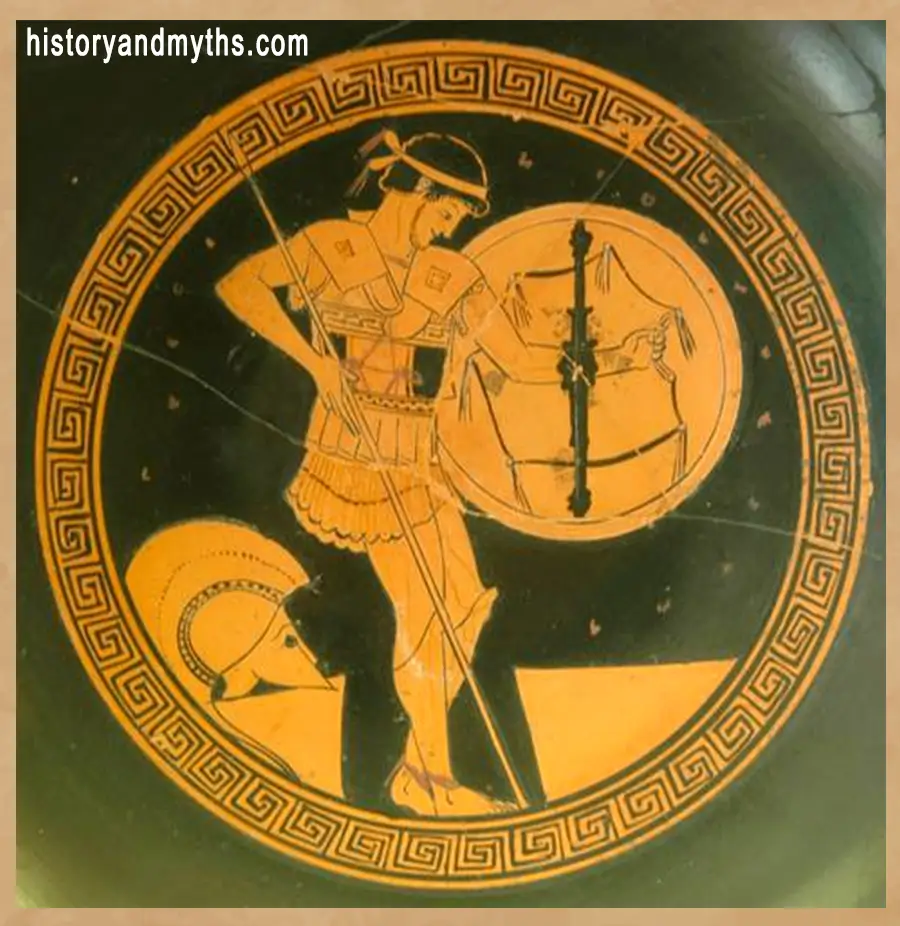
A hoplite’s equipment was designed for close combat and collective fighting. The most important piece was the large round shield known as the aspis, carried on the left arm and used to protect both the soldier and the man standing beside him. Hoplites also carried a long spear as their primary weapon and a short sword as a secondary arm. Bronze helmets, body armor, and greaves completed the typical equipment of the classical Greek infantryman.
Because hoplites fought side by side in organized ranks, individual heroism was less important than discipline and coordination. Victory depended on the ability of the line to remain steady and advance together. This style of fighting shaped the military culture of many Greek city-states, including powers such as Sparta and Athens, where citizen soldiers formed the backbone of the army.
The Phalanx Formation
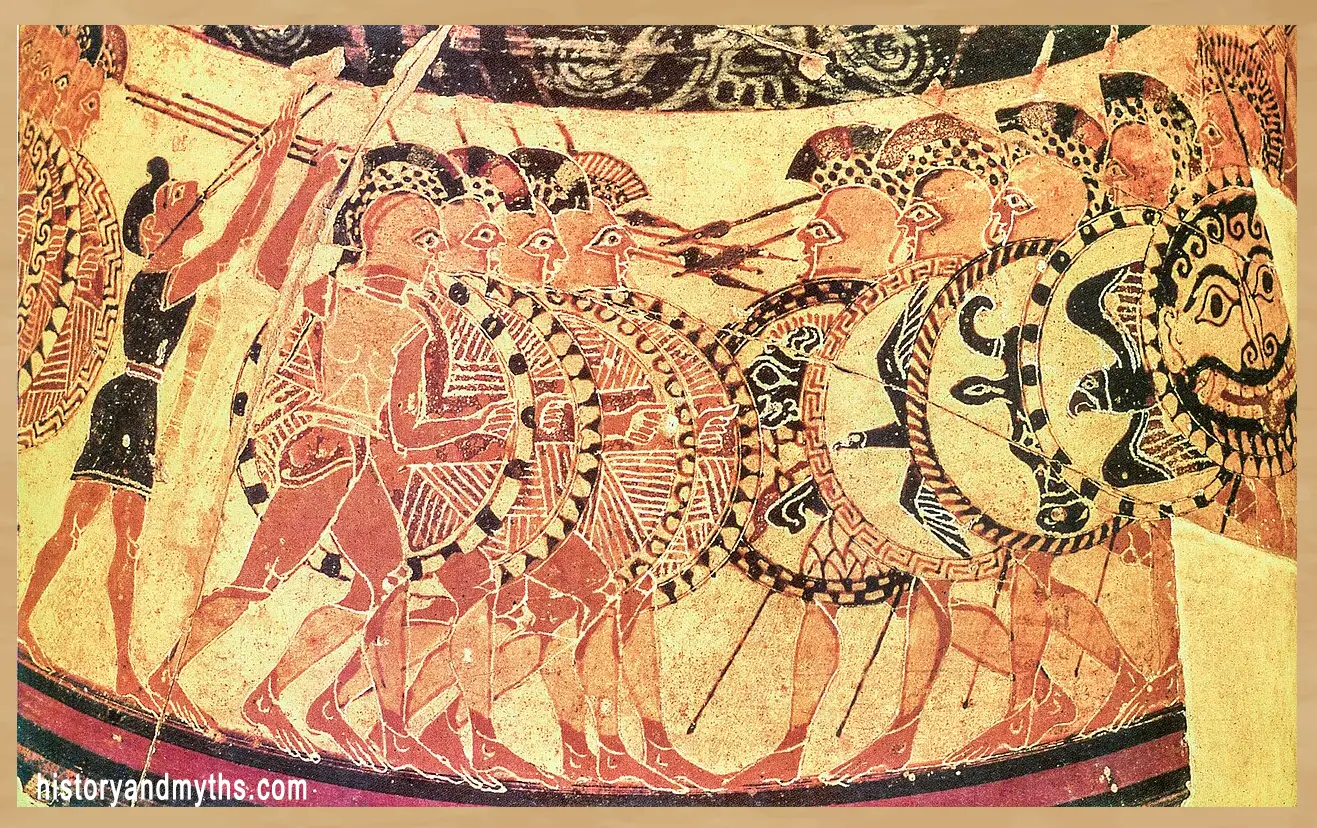
The effectiveness of Greek infantry depended on the phalanx, a tightly organized formation in which hoplite soldiers stood shoulder to shoulder in several ranks. Each soldier carried a large shield on the left arm, which partly protected the warrior beside him. This arrangement created a continuous defensive line that advanced slowly but with considerable force.
Success in the phalanx depended on discipline and coordination rather than individual combat skill. When the formation moved forward, rows of spears projected outward while the shield wall protected the front ranks. If the line held its cohesion, the combined pressure of the advancing formation could push back or break an opposing force. Battles between Greek armies therefore often became contests of endurance and stability as two phalanxes struggled for advantage.
Different city-states relied on this formation, but its effectiveness was especially associated with the disciplined infantry of Sparta, whose soldiers trained extensively to maintain order within the ranks. Other states, including Athens, also deployed hoplite phalanxes, making this formation the dominant method of land warfare in much of the classical Greek world.
Weapons and Armor of Greek Soldiers
Greek warfare relied on equipment designed for close combat within the phalanx. The primary weapon of the hoplite was a long spear known as the dory, which allowed soldiers in the front ranks to strike opponents while maintaining the formation. When the spear broke or the fighting became more chaotic, soldiers used a short sword called the xiphos or sometimes a curved blade known as the kopis.
Defensive equipment was equally important. The large round shield, or aspis, formed the core of the hoplite’s protection and was essential for maintaining the integrity of the phalanx. Helmets made of bronze protected the head, while body armor such as the bronze cuirass or later linen armor (linothorax) shielded the chest. Greaves guarded the lower legs, completing the standard equipment of a classical Greek infantryman.
Although this equipment was widely used across the Greek world, the quality and discipline of soldiers often determined its effectiveness. The heavily armed infantry of city-states such as Sparta and Athens relied on this combination of weapons and armor to fight in organized formations that dominated Greek battlefields for centuries.
Why Greek Warfare Was Unique
- Most Greek soldiers were citizens defending their own city-state.
- The phalanx formation required discipline and cooperation.
- Naval warfare allowed maritime powers to control trade routes.
- Military systems differed between city-states such as Athens and Sparta.
- Wars between Greek states shaped alliances and political rivalries.
- Major conflicts like the Peloponnesian War transformed the balance of power in Greece.
© historyandmyths.com — Educational use
Naval Warfare and the Rise of Athenian Sea Power
While many Greek battles were fought on land, control of the sea became increasingly important during the classical period. Naval warfare allowed city-states to protect trade routes, move troops quickly, and project influence across the Aegean. Among the Greek powers, Athens developed the most formidable navy, transforming maritime strength into a central element of its political power.
The backbone of the Athenian fleet was the trireme, a fast warship powered by three rows of oars on each side. These vessels were designed for speed and maneuverability rather than heavy combat. Naval tactics relied on ramming enemy ships with a reinforced bronze prow or disabling them through precise maneuvering. Success at sea depended on coordination among rowers and commanders, making naval warfare a complex and highly organized form of combat.
Athenian naval power played a decisive role in several conflicts, including the wars against the Persian Empire and later struggles against other Greek states. By controlling the sea, Athens secured trade networks and maintained alliances across the Aegean, strengthening its influence within the Greek world and shaping the balance of power with rivals such as Sparta.
The Spartan Military System
Among the Greek city-states, Sparta developed the most militarized society. Spartan institutions were designed to produce disciplined soldiers capable of maintaining both external defense and internal stability. From an early age, male citizens entered a state-controlled training system known as the agoge, where physical endurance, obedience, and combat skills were emphasized above all else.
This training produced highly coordinated infantry forces that were widely respected across the Greek world. Spartan hoplites were known for their discipline in battle and their ability to maintain formation under pressure. Military service remained the central duty of Spartan citizenship, and adult males continued to live within a structured communal system that reinforced loyalty to the state.
Because of this organization, Sparta maintained one of the most formidable land armies in Greece. Its reputation for military strength influenced alliances and rivalries throughout the Greek world, particularly in its long-standing competition with powers such as Athens.
The Peloponnesian War
The most significant conflict between Greek city-states was the Peloponnesian War, a prolonged struggle that reshaped the balance of power in the Greek world. The war emerged from growing tensions between Athens and Sparta, each leading its own alliance system. Athens dominated the Delian League, while Sparta headed the Peloponnesian League, creating two competing blocs of Greek states.
The conflict lasted nearly three decades and unfolded in several phases marked by shifting strategies. Athens relied heavily on its naval strength and defensive walls, avoiding direct confrontation with the Spartan land army. Sparta, in contrast, focused on land campaigns and attempted to weaken Athenian influence among its allies. The war involved sieges, naval battles, and political upheaval across the Greek world.
Ultimately, Sparta gained the upper hand with support from Persian resources that helped strengthen its fleet. In 404 BCE, Athens surrendered after its navy was defeated and its supply lines were cut. The outcome ended Athenian dominance and temporarily established Spartan leadership in Greece, though the prolonged conflict also weakened many Greek states and altered the political landscape of the region.
Continue Reading
- Greek City-States: How the Polis Shaped Ancient Greece
- Greek Democracy: How Athenian Democracy Worked
- Sparta vs Athens: Key Differences Between the Two Greek Powers
- The Peloponnesian War: Athens and Sparta in Conflict
The Impact of Warfare on Greek Society
Warfare influenced many aspects of life in the Greek world beyond the battlefield. Because citizen soldiers formed the core of most armies, military service became closely connected to political identity. In many city-states, participation in defense reinforced the idea that citizens had both the right and the responsibility to take part in public life. This connection between military duty and civic participation was especially visible in states such as Athens, where citizens who defended the polis also engaged in its political institutions.
War also shaped alliances, diplomacy, and economic activity across the Greek world. City-states frequently formed leagues or partnerships to strengthen their security, while prolonged conflicts could disrupt agriculture, trade, and population stability. The long struggle between Sparta and its rivals demonstrated how warfare could transform regional politics and shift the balance of power among Greek states.
Over time, repeated conflicts weakened many independent city-states and created conditions that larger powers could exploit. By the fourth century BCE, the political fragmentation that had characterized the Greek world made it increasingly difficult for individual poleis to maintain independence. Warfare therefore played a central role not only in shaping Greek military practices but also in influencing the broader political and social development of ancient Greece.
Key Takeaways
- Greek warfare was shaped by the political independence of city-states.
- The hoplite soldier formed the backbone of Greek armies.
- The phalanx formation dominated land battles.
- Athens built a powerful navy based on trireme warships.
- Sparta developed one of the strongest land armies in Greece.
- The Peloponnesian War reshaped power among Greek states.
Frequently Asked Questions
What was Greek warfare?
Greek warfare refers to the military systems, battles, and strategies used by the city-states of ancient Greece.
Who were the hoplites?
Hoplites were heavily armed citizen soldiers who formed the main infantry of Greek armies.
What was the phalanx formation?
The phalanx was a tightly packed formation of hoplite soldiers fighting side by side with shields and spears.
Why was Sparta famous for its army?
Sparta organized its entire society around military training and discipline, producing highly effective soldiers.
Why was Athens powerful at sea?
Athens developed a large navy of trireme warships that controlled sea routes across the Aegean.
What was the Peloponnesian War?
The Peloponnesian War was a major conflict between Athens and Sparta that lasted from 431 to 404 BCE.
How did warfare affect Greek society?
Military service shaped citizenship, alliances, and political power among the Greek city-states.
Sources & Rights
- Encyclopaedia Britannica — Ancient Greek Warfare.
- Encyclopaedia Britannica — Hoplite.
- Encyclopaedia Britannica — Phalanx.
- Encyclopaedia Britannica — Trireme.
- World History Encyclopedia — Greek Warfare.
- World History Encyclopedia — Hoplite.
- World History Encyclopedia — Greek Phalanx.
- World History Encyclopedia — Peloponnesian War.
- Victor Davis Hanson — The Western Way of War.
- Peter Connolly — Greece and Rome at War.
- Donald Kagan — The Peloponnesian War.
- Paul Cartledge — Spartan Reflections.
- Oxford Classical Dictionary.
- Cambridge Ancient History — Classical Greece.
- Thomas R. Martin — Ancient Greece.
- Robin Osborne — Greece in the Making.
- Ian Morris — The Rise of the Greek City-States.
- Walter Scheidel — The Cambridge Economic History of the Greco-Roman World.
- Christopher Blackwell — Athenian Democracy Sourcebook.
Written by H. Moses — All rights reserved © Mythology and History.