Ancient Greek Coinage: How Money Shaped Trade and the Economy
Ancient Greek coinage did more than introduce money—it made everyday exchange faster, more consistent, and easier to scale. Before coins, trade depended on direct negotiation and comparison of goods. With coinage, value could be measured and transferred quickly, allowing markets to function with greater efficiency.
Why did coins matter so much? Because they provided a shared standard. Instead of negotiating value in every transaction, buyers and sellers could rely on metal weight and recognized designs to establish trust. This did not eliminate other forms of exchange, but it reduced friction in daily trade and made larger transactions more practical.
Greek coinage was not controlled by a single authority. Different city-states produced their own coins, yet these could circulate beyond their origin because their value was tied to metal content. This created a flexible system where multiple currencies could function together without central coordination.
This article explains how that system worked in practice: why coinage emerged, how coins were used in daily transactions, and how they supported trade and economic activity across the Greek world.
What Was Greek Coinage and Why Did It Emerge?
Greek coinage emerged to solve a practical problem: how to measure value quickly and consistently in an expanding market economy. As trade increased—both within the polis and across regions—relying on barter or direct comparison of goods became inefficient.
The shift began in western Asia Minor, particularly in Lydia, where the earliest metal coins appeared. The innovation was not the idea of money itself, but the standardization of value. A piece of metal with a defined weight and recognized quality could be used in transactions without requiring constant reassessment.
For Greek cities, this was a practical solution. As market activity intensified, especially in the agora, there was a need for a system that could:
- reduce negotiation time
- simplify pricing
- support a higher volume of transactions
Coinage provided that system. Instead of evaluating goods individually in each exchange, participants could rely on a shared standard of value.
This development did not come from a centralized authority. Each city-state produced its own coins based on local resources and needs. What made the system functional was not uniform design, but consistency in metal content and weight. This allowed different coins to circulate beyond their place of origin.
The key point is that coinage emerged as a tool to make exchange more efficient, not to replace existing methods entirely. It worked alongside older forms of trade, but introduced a level of speed and consistency that matched the growing complexity of Greek commerce.
| Aspect | Greek Coinage | Barter System |
|---|---|---|
| Value Basis | Metal weight and purity | Direct comparison of goods |
| Speed | Fast transactions | Slow negotiation |
| Flexibility | High (portable value) | Limited |
| Scalability | Supports long-distance trade | Mostly local exchange |
| Standardization | Recognized coin standards | No fixed standards |
| Usage | Markets and trade networks | Simple, local transactions |
How Greek Coins Worked in Practice
Greek coins worked because their value was visible and verifiable at the point of exchange. Unlike later monetary systems based on abstract guarantees, Greek coinage depended on two elements: metal content and recognizable form.
Most coins were made from silver, with value tied directly to weight. Standards such as the drachma created a practical unit for everyday transactions, while larger denominations allowed for higher-value exchanges. What mattered was not just the number stamped on the coin, but the amount and quality of metal it contained.
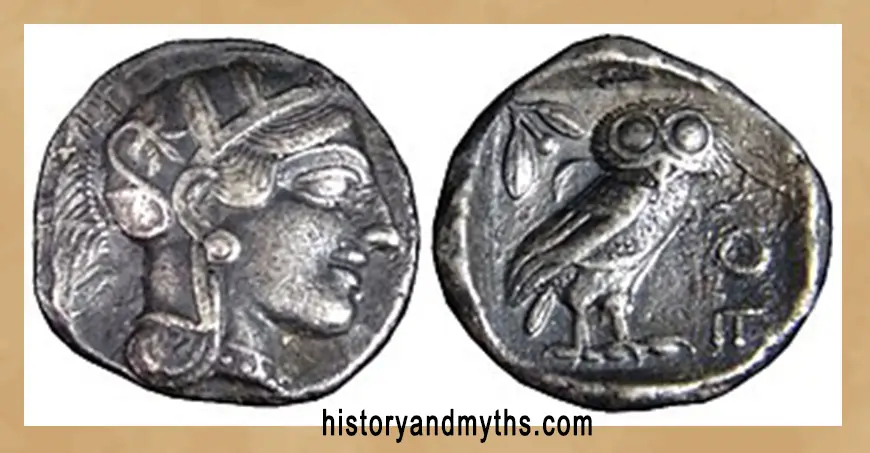
Design reinforced trust. Each polis stamped its coins with specific symbols—images, marks, or patterns—that identified origin and helped users recognize authenticity. For example, coins from Athens became widely accepted because their silver content was consistent and their design was easily identifiable. Over time, this reliability allowed certain coins to circulate far beyond their home city.
Transactions were straightforward. Coins were counted, weighed when necessary, and exchanged directly. There was no need for intermediaries to validate value in most cases. If trust was uncertain—especially with unfamiliar coins—verification could involve checking weight or metal quality before accepting payment.
Multiple coin systems existed at the same time. Different cities used different standards, but exchange remained possible because value could be compared through weight and metal. This created a flexible environment where coins moved across regions without requiring a unified currency.
The system worked because it minimized uncertainty. Instead of negotiating value from scratch in every transaction, participants relied on physical properties that could be checked immediately. This made trade faster, more predictable, and easier to scale across both local and long-distance markets.
Coinage vs Barter: Did Coins Replace Trade?
Coinage did not replace barter; it reduced its limits. Both systems operated together, each used where it made practical sense.
Barter worked best in simple, local exchanges—especially when goods were immediately available and their value was easy to compare. A farmer trading surplus produce for tools or services could complete a transaction without needing coin. In these cases, direct exchange remained efficient.
The problem appeared as trade expanded. When goods were not equal in value, or when exchange involved multiple steps, barter became slow and imprecise. Matching needs between two parties was not always possible, and negotiating equivalent value could delay transactions.
Coinage addressed these constraints. It introduced a transferable unit of value that could be separated from the goods themselves. A seller no longer needed to accept another product in return; they could accept coin and use it later in a different transaction. This increased flexibility and allowed trade to extend beyond immediate, one-to-one exchanges.
The two systems coexisted because they served different conditions. In small-scale, local contexts, barter remained practical. In larger or more complex transactions—especially in markets and long-distance trade—coins became the preferred medium.
The key shift was not replacement, but expansion. Coinage allowed the economic system to operate across wider networks and more varied exchanges, while barter continued to function where simplicity made it sufficient.
- Coins provided a standardized and portable measure of value
- Value was based on metal content, not centralized authority
- Different city-states minted their own currencies
- Widely trusted coins circulated beyond their origin
- Coinage worked alongside barter, not as a replacement
- It enabled faster exchange and expansion of trade networks
Value, Pricing, and Everyday Transactions
In ancient Greek markets, prices were not fixed in advance—they were formed at the point of exchange. Value depended on what was available, what was needed, and how urgent the transaction was.
Supply was the primary driver. When goods were abundant, prices tended to drop; when supply tightened, prices rose. This was especially visible with essential items like grain, where shortages could quickly affect market conditions. Sellers adjusted prices based on what they had and how quickly they needed to sell.
Demand shaped the other side of the equation. Buyers were not passive. Their willingness to pay depended on necessity, alternatives, and timing. A product that was optional or widely available could be negotiated down, while essential goods carried less flexibility.
Coins made this process more efficient, but they did not determine price on their own. They provided a unit for exchange, allowing value to be expressed clearly, but the actual price still emerged through interaction. Bargaining remained part of the process, particularly for non-essential or higher-value items.
Consistency developed over time. Regular trade created expectations about what goods should cost under normal conditions. These expectations were not formal rules, but they helped stabilize transactions by reducing uncertainty between buyers and sellers.
Daily transactions reflected this system. Small purchases—food, tools, basic materials—were completed quickly, often with minimal negotiation. Larger or less common goods required more discussion, especially when supply or quality varied.
The key point is that pricing was dynamic, not imposed. It responded to real conditions inside the market, with coins acting as a tool for measurement rather than a mechanism for control.
Different Coins, One System: How Exchange Worked
Greek coinage was not unified, but it was still functional across regions. Each city-state minted its own coins, often with different standards, designs, and denominations. Despite this, exchange between these currencies remained possible because value was tied to weight and metal, not just to the issuing authority.
In practice, coins were compared rather than converted through a fixed rate. When different currencies met in the same transaction, their value could be assessed by weighing them or by relying on known standards. This meant that familiarity played a role—widely circulated coins were easier to accept because their value was already recognized.
Some currencies became dominant in circulation. Coins from Athens, for example, were widely used beyond their origin because of their consistent silver content and recognizable design. This did not replace local currencies, but it created a common reference point that facilitated exchange.
Intermediaries also helped bridge differences. Merchants who operated across regions were accustomed to handling multiple coin systems and could manage transactions where direct comparison was less straightforward. Their experience reduced friction in trade, especially in long-distance exchange.
The system worked because it allowed flexibility. There was no need for a single currency as long as value could be established through shared criteria. Coins circulated, were accepted, and moved between regions based on trust in their material and consistency.
The key point is that diversity in coinage did not prevent trade. It required practical methods of comparison, but it also allowed local autonomy while still supporting wider economic interaction.
The Role of Coinage in Trade Expansion
Coinage did not create trade, but it allowed trade to scale. By providing a portable and widely understood measure of value, coins reduced the friction that limited exchange across distance.
The first effect was speed. Transactions that once required negotiation or direct comparison of goods could be completed immediately. This mattered in markets with high activity, where time directly affected volume. Faster exchange meant more transactions within the same space.
The second effect was reach. Coins made it easier to move value without moving goods in return. A merchant could sell in one location, carry coin, and purchase elsewhere without needing a matching exchange. This flexibility allowed trade routes to extend beyond immediate, reciprocal networks.
Long-distance trade benefited the most. Transporting bulk goods over sea routes involved risk and delay, but coinage simplified the final stage of exchange. Once goods reached a market, they could be converted into a standard form of value and redistributed efficiently.
Trust also expanded with circulation. Coins that were consistently accepted—especially those with reliable metal content—became easier to use across regions. This reduced uncertainty when dealing with unfamiliar partners, making wider trade more practical.
Cities that produced stable coinage gained an advantage. Their currency could move beyond local use, supporting trade activity in other regions. This did not create a unified system, but it strengthened connections between markets.
The key point is that coinage increased the capacity of the system. It allowed trade to move faster, operate across greater distances, and function with fewer constraints, turning local exchange into a broader economic network.
Who Controlled Coin Production and Value
Coin production in ancient Greece was controlled at the level of the polis. There was no central authority overseeing currency across the Greek world. Each city-state decided when to mint coins, what metal to use, and which standards to follow.
Control began with access to resources. Cities with reliable silver sources—like Athens—were able to produce coinage at scale. This gave them an advantage, not just economically, but also in circulation, since their coins became more widely used.
Minting was a political act as much as an economic one. By issuing coins, a city asserted control over value within its own market. The symbols stamped on coins identified origin and reinforced authority, signaling that the issuing polis stood behind the coin’s weight and quality.
Value itself was not set by decree. It depended on metal content and market acceptance. A coin held value because it contained a measurable amount of precious metal and because others were willing to accept it in exchange. If either condition weakened—through debasement or loss of trust—the coin’s effectiveness declined.
Regulation supported this system. Cities maintained standards to ensure consistency in weight and purity, protecting confidence in their currency. This was essential, since trust allowed coins to circulate beyond local boundaries.
At the same time, control had limits. No polis could enforce its currency universally. Coins moved because they were trusted and practical, not because their use was mandated. This created a system where authority was local, but acceptance was shaped by wider interaction.
The key point is that coinage was controlled but not centralized. Each city managed its own currency, while value emerged from a combination of material consistency and market trust.
- Greek coinage emerged to standardize value in expanding markets
- Coins increased speed and flexibility of transactions
- Multiple currencies coexisted without a central authority
- Trade relied on trust in metal content and consistency
- Coinage supported long-distance trade and economic growth
- The system was effective but lacked financial depth and stability tools
Frequently Asked Questions
What was Greek coinage?
It was a system of metal coins used to standardize value and facilitate trade.
Why did the Greeks start using coins?
To simplify transactions and create a consistent measure of value in markets.
Did coinage replace barter?
No, both systems coexisted and were used in different contexts.
How was the value of coins determined?
By their metal content, weight, and acceptance in the market.
Were all Greek coins the same?
No, each city-state produced its own coins with different standards.
Who controlled coin production?
Individual city-states controlled minting and standards of their coins.
Why were some coins widely accepted?
Because of consistent quality, recognizable design, and trust in their value.
Sources & Rights
- Howgego, Christopher. Ancient History from Coins. Routledge.
- Kraay, Colin. Archaic and Classical Greek Coins. University of California Press.
- Seaford, Richard. Money and the Early Greek Mind. Cambridge University Press.
- Finley, M.I. The Ancient Economy. University of California Press.
- Harris, Edward. The Ancient Greek Economy. Cambridge University Press.
- Bresson, Alain. The Making of the Ancient Greek Economy. Princeton.
- Cartledge, Paul. Ancient Greece. Oxford University Press.
- Hansen, Mogens Herman. Polis: An Introduction. Oxford.
- Osborne, Robin. Greece in the Making. Routledge.
- Snodgrass, Anthony. Archaic Greece. University of California Press.
- Herodotus. Histories.
- Thucydides. History of the Peloponnesian War.
- Aristotle. Politics.
- Xenophon. Oeconomicus.
- Strabo. Geography.
- Diodorus Siculus. Library of History.
- Burnett, Andrew. Coins. British Museum Press.
- Meadows, Andrew. The Oxford Handbook of Greek and Roman Coinage.
- Shipley, Graham. The Greek World After Alexander. Routledge.
- Whitley, James. The Archaeology of Ancient Greece. Cambridge.
Written by H. Moses — All rights reserved © Mythology and History