Ancient Greek Diplomacy and Treaties: How City-States Made Alliances
Ancient Greek diplomacy did not operate through a central government. Each city-state negotiated its own agreements, sent its own envoys, and decided when to form alliances or break them. Treaties were formalized arrangements between independent powers, used to manage conflict, secure cooperation, or gain advantage.
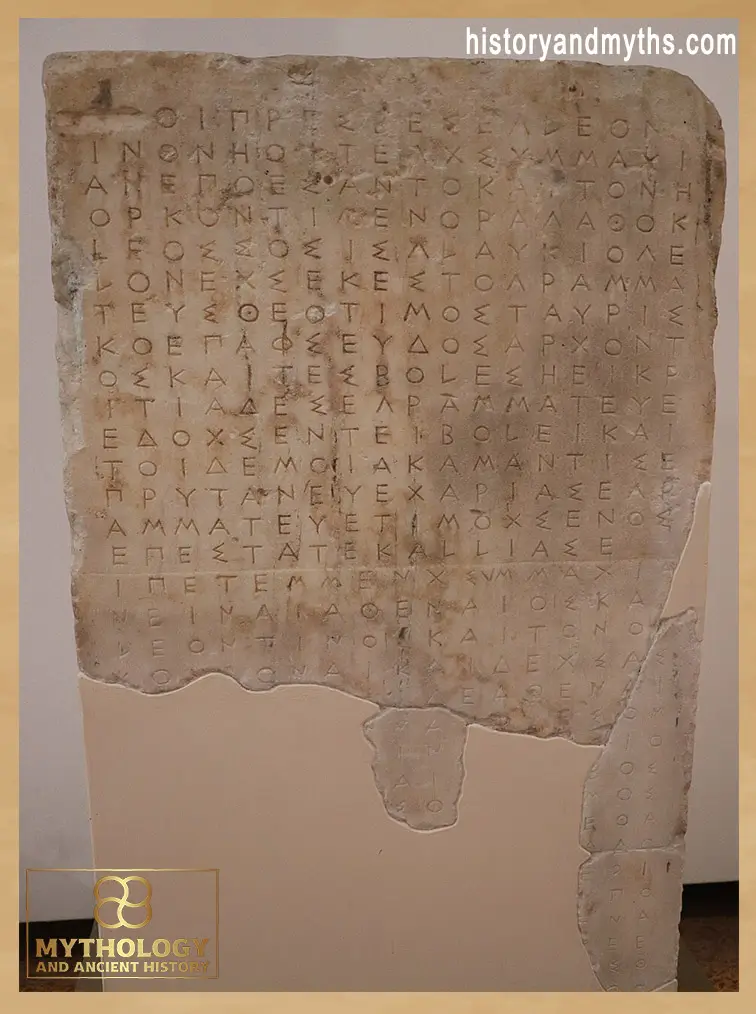
Diplomats—often temporary envoys—carried proposals, negotiated terms, and reported back for approval. Agreements could include alliances, truces, or specific obligations, and were typically recorded and publicly displayed to signal commitment. There was no external authority to enforce them; compliance depended on mutual interest and relative power.
As a result, Greek diplomacy functioned as a practical system of negotiation, where treaties were tools to manage relationships rather than permanent solutions.
Diplomacy Without a Central Authority
Greek diplomacy works because each city-state acts for itself. There is no central body to coordinate policy or enforce agreements. Every decision—whether to negotiate, ally, or withdraw—is taken locally and justified by immediate interests.
This creates a network rather than a hierarchy. Relations are built city to city, and the same pair can cooperate in one context and compete in another. Stability comes from overlapping agreements, not from a single framework that binds everyone.
Decisions are constrained by visibility. Terms are known, commitments are public, and reversals carry costs in reputation. That does not prevent change, but it raises the price of breaking with prior positions. Cities balance short-term gains against the longer effect on future negotiations.
The system remains functional because it is flexible. Agreements can be adjusted, replaced, or abandoned without requiring approval from a higher authority. What holds it together is not enforcement from above but the need to keep negotiating with the same set of actors over time.
| Element | Function | Outcome |
|---|---|---|
| Envoys | Represent city-states | Negotiations initiated |
| Treaties | Define obligations | Structured agreements |
| Alliances | Balance power | Security and influence |
| Public Records | Display agreements | Transparency |
| Compliance | Based on interest | Flexible stability |
Envoys and Representation: Who Negotiated
Negotiation is carried out by envoys sent for a specific task, not by a permanent diplomatic corp. A city selects individuals to represent its position, gives them defined instructions, and expects a report on what was said and agreed. Their authority is limited to the mandate they receive.
Selection is deliberate. Envoys are chosen for credibility and the ability to present terms clearly in another city’s political setting. They must be recognized as legitimate representatives, because acceptance of the negotiation depends on who is speaking as much as on what is proposed.
The role is bounded. Envoys can discuss, clarify, and explore options, but binding commitments typically require approval back home. This keeps control with the city while allowing negotiations to move forward. Agreements reached in principle are carried back for confirmation.
Communication is direct. Envoys meet with officials or assemblies, present proposals, respond to objections, and adjust terms within their mandate. There is no parallel channel that overrides them. What is negotiated in person defines the outcome.
This structure keeps representation flexible. Cities can change their envoys, revise instructions, or end talks without reorganizing a permanent system. The process depends on clear mandates and credible delivery rather than institutional continuity.
Types of Treaties: What Agreements Actually Covered
Greek treaties are defined by what they require, not by formal labels. Each agreement specifies obligations that can be acted on—who supports whom, what actions are restricted, and under what conditions the agreement holds.
Mutual defense agreements commit each side to assist if the other is attacked. The scope matters: some apply broadly, others only against named opponents. Offensive arrangements go further, coordinating action in planned campaigns. Both types depend on timing and clarity—when support is triggered and how it is delivered.
Truces suspend conflict for a fixed period or under set terms. They do not resolve underlying issues; they create space—often tied to seasons, logistics, or immediate pressure. Terms usually define duration, boundaries, and what counts as a violation.
Specific clauses handle practical points: safe passage, exchange of persons, recognition of control over places, or limits on certain actions. These details reduce ambiguity and make compliance observable.
Validity is conditional. Many agreements include triggers for renewal, termination, or adjustment. Obligations hold while the stated conditions are met. When conditions change, the agreement can be revised or replaced.
Across all types, the focus is operational. A treaty is a set of actions each side commits to take or avoid, defined clearly enough to guide behavior without relying on an external enforcer.
The Negotiation Process: From Proposal to Agreement
Negotiation starts with a concrete need—security, access, or advantage—and moves through a defined sequence. One side initiates contact and frames terms that can be accepted or modified. The goal at this stage is clarity: what is being offered, what is expected in return, and under what conditions it applies.
Envoys present the proposal in person. Discussion focuses on scope and triggers: when obligations activate, how long they last, and what counts as compliance. Counteroffers adjust these points rather than rewriting the entire agreement. Progress comes from narrowing differences, not expanding the agenda.
Nothing becomes binding on the spot. Terms reached in principle are taken back for approval. This step is decisive—assemblies or councils confirm, amend, or reject what has been negotiated. Without ratification, there is no agreement.
Once approved, the terms are fixed in a public form. Recording and display make the commitment visible and give both sides a common reference. Precision here matters; vague language creates disputes later.
The process is short by design: proposal → discussion → approval → publication. It aims to produce an actionable agreement quickly, with enough clarity to guide behavior without relying on external enforcement.
Greek diplomacy was a practical system of negotiation where independent city-states formed agreements based on shifting interests. Treaties were tools to manage power, not permanent solutions.
© historyandmyths.com — Educational use
Alliances and Power Balance: Why Agreements Shift
Alliances exist to manage risk and leverage strength. A city aligns with others when the combined position is safer or more advantageous than acting alone. The calculation is practical: current threats, available resources, and the expected behavior of partners.
Balance is not fixed. When relative strength changes—through war, resources, or internal shifts—agreements are reassessed. A partner that was useful can become a liability; a former rival can become a counterweight. Adjustments follow these changes rather than any long-term loyalty.
Commitments are conditional. Most alliances define when support is required and what form it takes. If the triggering conditions are not met, obligations do not apply. This keeps agreements usable but also limits their scope.
Overlap is common. A city can hold multiple agreements at once, each covering a different situation. These can reinforce each other or create tension if their conditions collide. Managing that overlap is part of the system.
What holds alliances together is not permanence but alignment. They persist while interests match and are revised when they do not.
Treaties as Political Tools: Managing Interests, Not Ending Conflict
Treaties are used to shape behavior, not to settle everything at once. They define what each side will do in specific situations and leave the rest open. This makes them useful in unstable conditions, where complete resolution is unlikely.
Terms are chosen for leverage. An agreement can secure time, lock in an advantage, or limit an opponent’s options. The value of a treaty is measured by what it allows a city to do next, not by how long it lasts.
Duration is often limited. Fixed terms or renewal clauses keep agreements adaptable. When conditions change, the treaty can be renegotiated rather than enforced beyond its usefulness.
Language is operational. Clauses specify actions and triggers so that compliance can be recognized without arbitration. Ambiguity is reduced where it would cause immediate conflict, and tolerated where flexibility is needed.
In practice, treaties manage ongoing relationships. They channel conflict into defined terms instead of removing it, allowing cities to operate within a controlled framework while interests continue to evolve.
Enforcement of Agreements: Compliance Without a Central Power
There is no authority that compels obedience to a treaty. Compliance depends on whether the terms still serve the interests of the parties involved. When they do, agreements are followed because they are useful, not because they are enforced from above.
Reputation acts as pressure. Cities that repeatedly ignore commitments lose credibility, which affects future negotiations. This does not guarantee compliance, but it raises the cost of breaking terms. Trust becomes a practical resource that can be gained or lost.
Power remains decisive. A stronger party can push terms or ignore them if the balance allows it. Weaker parties rely on alliances and the visibility of agreements to offset that imbalance. Enforcement, in this sense, is tied to capability rather than formal authority.
Violations lead to response, not arbitration. If one side breaks an agreement, the other adjusts—through countermeasures, new alliances, or direct action. There is no neutral mechanism to settle disputes after the fact.
The system holds because agreements are integrated into ongoing relations. Compliance is maintained when it aligns with advantage, and challenged when it does not.
Limits of Greek Diplomacy: Where It Breaks Down
The system works while interests align; it weakens when they do not. The first limit is durability. Agreements are conditional and often short-lived, so stability depends on constant renewal rather than a single lasting settlement.
Verification is limited. There is no neutral body to confirm compliance or resolve disputes over interpretation. When terms are contested, each side relies on its own reading and responds accordingly. This turns disagreement into action rather than adjudication.
Imbalance distorts outcomes. Stronger cities can shape terms or disregard them with fewer consequences. Weaker cities depend on coalitions to offset that gap, which adds another layer of uncertainty to any agreement.
Coordination is costly. Because decisions remain local, every adjustment requires new approval. Delays, mixed signals, or internal divisions can stall or derail negotiations even when terms are workable.
These limits do not stop diplomacy from functioning, but they define its range. Agreements manage relationships effectively in the short term, yet they require continuous adjustment to remain relevant.
Agreements That Worked While Interests Aligned
Greek diplomacy produces agreements that are clear, limited, and usable. Each treaty defines actions and conditions, moves through approval, and becomes public. There is no layer beyond this that guarantees compliance.
What keeps the system working is alignment. Cities follow terms when they serve current interests and revise them when they do not. Alliances shift, clauses are renegotiated, and commitments are replaced as conditions change.
The process is consistent even as outcomes vary: proposal, discussion, approval, publication, and then use. Diplomacy does not remove conflict; it structures it. Agreements hold as long as they remain advantageous and are set aside when they stop being so.
- Greek diplomacy operated without a central authority.
- Envoys negotiated agreements between independent city-states.
- Treaties defined specific obligations and conditions.
- Alliances shifted based on changing power dynamics.
- Compliance depended on mutual interest, not enforcement.
- Diplomacy managed conflict rather than eliminating it.
Frequently Asked Questions
How did Greek city-states manage diplomacy?
They negotiated directly through envoys without a central authority.
What were Greek treaties used for?
Treaties defined obligations such as alliances, truces, and cooperation.
Were Greek alliances permanent?
No, alliances changed based on shifting interests and power dynamics.
Who represented city-states in negotiations?
Envoys were sent to negotiate and report back for approval.
How were agreements enforced?
Compliance depended on mutual interest and power, not a central authority.
Did diplomacy prevent war?
It helped manage conflict but did not eliminate it entirely.
Sources & Rights
- Hornblower, Simon. The Greek World 479–323 BC. Routledge, 2002.
- Cartledge, Paul. Ancient Greece: A History in Eleven Cities. Oxford University Press, 2009.
- Rhodes, P.J. A History of the Classical Greek World. Wiley-Blackwell, 2006.
- Sealey, Raphael. A History of the Greek City States. University of California Press, 1976.
- Hansen, Mogens Herman. The Athenian Democracy. Blackwell, 1991.
- Meiggs, Russell. The Athenian Empire. Oxford University Press, 1972.
- Kagan, Donald. The Peloponnesian War. Viking Press, 2003.
- Thucydides. History of the Peloponnesian War.
- Xenophon. Hellenica.
- Osborne, Robin. Greece in the Making. Routledge, 1996.
- Snodgrass, Anthony. An Archaeology of Greece. University of California Press, 1987.
- Whitley, James. The Archaeology of Ancient Greece. Cambridge University Press, 2001.
- Morris, Ian. Archaeology as Cultural History. Blackwell, 2000.
- Finley, Moses I. The Ancient Economy. University of California Press, 1999.
Written by H. Moses — All rights reserved © Mythology and History