Ancient Greek Agriculture and Farming: How Food Production Worked
Agriculture in ancient Greece was not efficient or abundant—it was constrained, seasonal, and often just enough to sustain the population. Most Greek land was rocky, uneven, and difficult to cultivate, which meant farmers had to work within strict environmental limits rather than expand production freely.
How did this system still support Greek society? The answer lies in adaptation. Farmers focused on a small number of crops that could survive poor soil and irregular rainfall, organized labor at the household level, and adjusted production to match what the land could realistically provide.
This created a fragile balance. Local farming supplied daily food, but it rarely produced large surpluses. When production fell short—especially with grain—cities relied on trade to fill the gap, linking agriculture directly to wider economic networks.
This article explains how Greek farming actually worked in practice: why it was difficult, how farmers adapted, and how agriculture shaped the limits and possibilities of the ancient Greek economy.
Why Agriculture in Greece Was Difficult
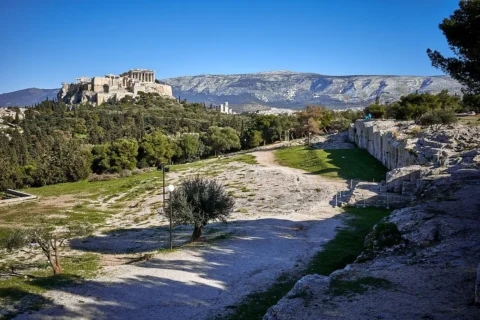
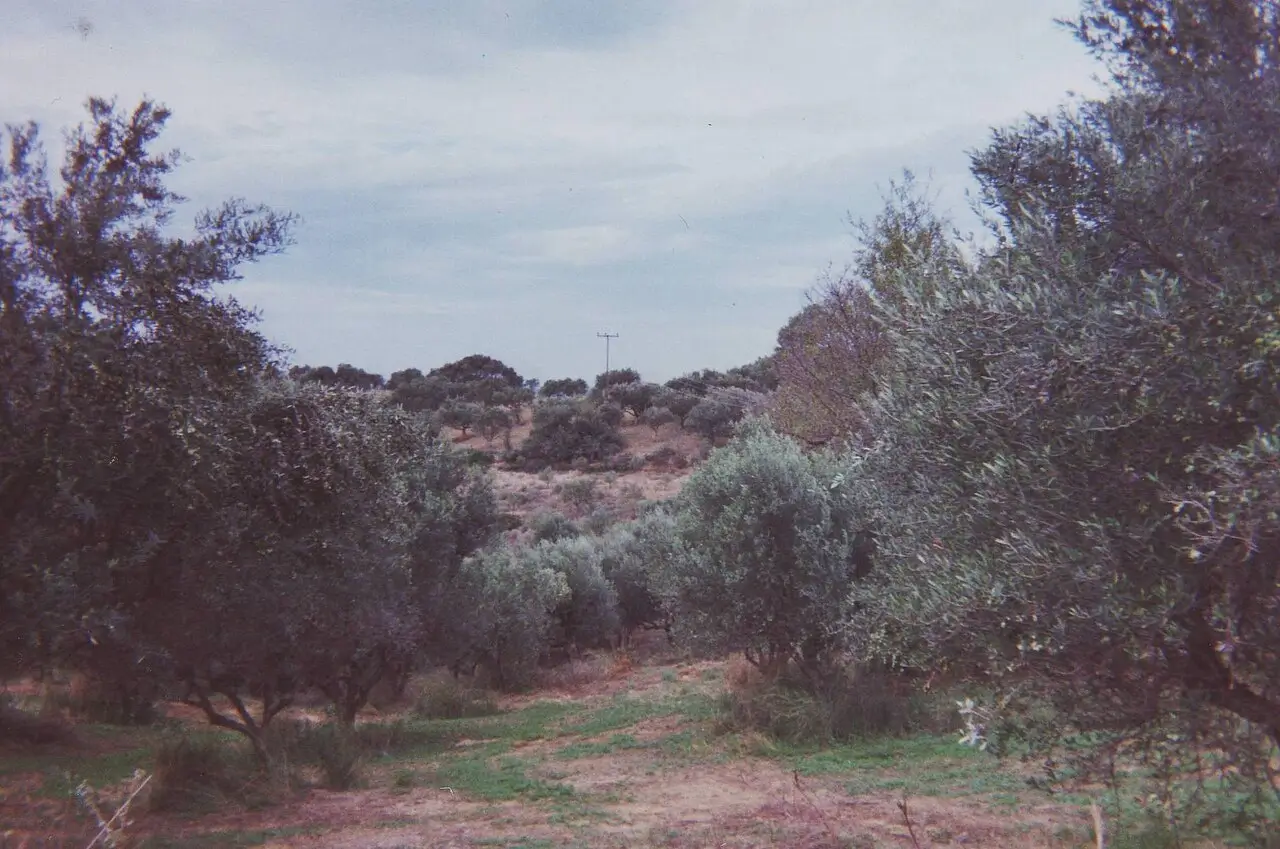
Agriculture in ancient Greece was constrained by the land itself. Most of the territory was mountainous or uneven, leaving limited areas suitable for cultivation. Flat, fertile plains existed, but they were relatively small and often already occupied, which restricted expansion.
Soil quality added another limitation. Much of the available land was thin and rocky, unable to support intensive farming. Continuous cultivation could quickly reduce productivity, forcing farmers to work within narrow margins rather than increase output.
Climate reinforced these constraints. Rainfall was seasonal and unpredictable, with long dry periods that limited crop growth. Without irrigation systems on a large scale, farmers depended heavily on natural cycles, making production uncertain from year to year.
These conditions shaped how agriculture functioned. Instead of maximizing yield, farmers focused on survival and stability—growing crops that could tolerate poor soil and irregular water supply. This approach reduced risk but also limited surplus.
The result was a system defined by restriction rather than abundance. Greek agriculture could sustain communities under normal conditions, but it left little room for error. Any disruption—poor harvest, drought, or conflict—could quickly affect food supply.
| Factor | Impact on Greek Agriculture |
|---|---|
| Terrain | Limited arable land and fragmented farming areas |
| Soil Quality | Thin, rocky soil reduced productivity |
| Climate | Seasonal rainfall created uncertainty in yields |
| Labor | Household-based work limited expansion |
| Core Crops | Grain, olives, and grapes structured production |
| Trade Dependence | Imports (especially grain) were necessary for stability |
The Core Crops and Why They Mattered
Greek agriculture concentrated on a small set of crops because the environment did not support wide diversification. These crops were not chosen randomly—each one solved a specific problem within the system.
Grain was the foundation. It provided the basic food supply for the population, making it essential for daily survival. However, grain cultivation was also the most vulnerable. It required better soil and more consistent rainfall than other crops, which meant local production often fell short. This limitation is why many Greek cities depended on imported grain to maintain stability.
Olives served a different role. Olive trees could grow in poor, rocky soil where grain could not. They required less water and could survive harsh conditions, making them more reliable over time. Olive oil became a versatile product—used for food, lighting, and trade—allowing it to move beyond local consumption into wider markets.
Grapes completed the system. Like olives, they adapted well to difficult terrain and produced a high-value product with relatively low input. Wine could be stored and transported, which made it suitable for exchange beyond the local area. This added an economic layer that grain alone could not provide.
What connects these crops is balance. Grain supported immediate needs but was unstable. Olives and grapes were more resilient and created surplus that could be traded. Together, they formed a system that combined subsistence with limited economic expansion.
The key point is that Greek farming was not about maximizing variety—it was about selecting crops that could function under constraint. Each crop had a role, and the system worked only because those roles complemented each other.
Farming Techniques and Daily Practice
Greek farming relied on simple methods adapted to difficult conditions. There was no large-scale mechanization or advanced irrigation. Instead, productivity came from timing, repetition, and careful use of limited land.
Tools were basic but functional. Wooden plows, often tipped with metal, were used to break the soil, while hand tools handled planting, pruning, and harvesting. These methods limited how much land a single household could manage, keeping farms relatively small in scale.
Seasonal cycles structured all activity. Farmers planted grain in the cooler months when soil retained moisture and harvested before the dry season intensified. Olives and grapes followed longer cycles, requiring ongoing maintenance rather than single-season effort. Timing mattered as much as technique—missing the right window could reduce yield significantly.
Soil management was practical rather than intensive. Fields were sometimes left fallow to recover, and crop rotation could be used where possible, but options were limited by terrain. The goal was not to increase output aggressively, but to prevent decline in already fragile conditions.
Terracing was one of the few structural solutions. On sloped land, farmers built stone terraces to reduce erosion and retain soil. This allowed cultivation in areas that would otherwise be unusable, though it required significant labor to construct and maintain.
Daily work was continuous. Farming households handled multiple tasks—planting, tending, harvesting, and processing—often without specialization. This kept production stable but also limited expansion, since labor was tied directly to the family unit.
The system worked through consistency. Instead of relying on advanced methods, Greek agriculture depended on repeated practice, seasonal awareness, and adaptation to local conditions.
Land Ownership and Farm Structure
Agriculture in ancient Greece was organized around small, privately managed plots rather than large, centralized estates. Most citizens who farmed worked land that was limited in size and directly tied to their household.
This structure came from both geography and social organization. Since fertile land was scarce, it was divided into smaller units that could be managed independently. Large, continuous estates were difficult to maintain in fragmented terrain, so farming remained localized and dispersed.
Ownership mattered because it determined stability. A household that controlled its own land could produce for its needs, even if output was limited. At the same time, small scale meant there was little capacity to absorb failure. A poor harvest affected the household directly, with few alternatives available.
Variation existed. In some regions, wealthier individuals could control larger areas or lease land to others, but this did not transform the overall system. The dominant pattern remained small-scale farming tied to family labor.
This structure also limited productivity. Without large estates or coordinated systems, there was no efficient way to expand output across regions. Each farm operated within its own constraints, which kept total production relatively low.
The key point is that land ownership reinforced the limits of Greek agriculture. It supported independence at the household level, but prevented large-scale growth or centralized control over food production.
- Farming operated under strict environmental constraints
- Production focused on a small number of resilient crops
- Household labor formed the basis of agricultural work
- Surplus was limited, making stability fragile
- Trade was essential to balance food supply
- The system prioritized survival over expansion
Labor: Who Actually Did the Farming?
Greek agriculture was labor-intensive and organized at the household level. Most farming work was done by the family itself, with the citizen farmer directly involved in cultivation rather than acting only as an owner.
Household labor formed the core. Family members handled planting, tending, harvesting, and basic processing. This kept production stable and predictable, but also limited scale. Output depended on how much work the household could sustain, not on expansion through hired labor.
Additional labor existed but was not universal. In some cases, enslaved workers were used, especially by wealthier landholders. Their role was to support routine tasks and increase capacity, but this did not create large-scale agricultural systems comparable to later estates.
Seasonal needs could also increase demand for labor. Harvest periods required more work in a short time, and temporary assistance might be used where available. Even then, coordination remained local and short-term rather than institutionalized.
What matters is the structure. Farming was not separated from daily life—it was embedded within it. The same household that consumed the output was responsible for producing it. This created a direct link between labor and survival.
The limitation is clear. Without a large, organized labor force, production could not scale significantly. Agriculture remained tied to the capacity of individual households, reinforcing the overall constraints of the system.
Production Limits and Food Supply
Greek agriculture produced enough to sustain communities under normal conditions, but it rarely generated large surpluses. The system operated close to its limits, which meant stability depended on consistent harvests rather than excess production.
Grain was the most sensitive point. Local cultivation often could not meet demand, especially in larger or more densely populated cities. When harvests were average, supply could hold. When they fell short, shortages appeared quickly.
This created a structural dependency. Many city-states relied on imported grain to stabilize food supply, especially during periods of poor yield. Trade was not optional—it was necessary to maintain balance between population and available resources.
Storage offered limited protection. Some reserves could be maintained, but without large-scale systems, they could not fully absorb repeated shortfalls. A single bad season might be manageable; multiple disruptions created pressure.
Population growth increased the strain. As cities expanded, the gap between local production and consumption widened. This reinforced the need for external supply and made access to trade routes more critical.
The key point is that Greek agriculture supported survival, not abundance. Food supply remained stable only when local production and external trade worked together. When either side weakened, the system came under pressure.
Agriculture and Trade Connection
Greek agriculture and trade were not separate systems—they were interdependent. The limits of local farming made external exchange necessary, and trade networks existed largely to compensate for those limits.
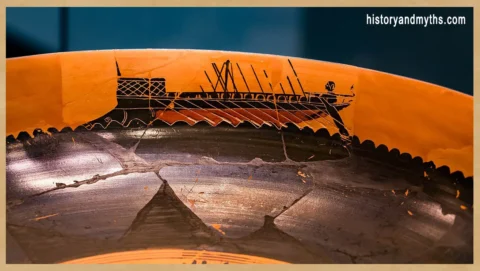
Grain supply shows this connection clearly. When local production could not meet demand, cities turned to external sources. Trade routes brought grain into the polis, stabilizing consumption and preventing shortages from escalating. Without this flow, agricultural limits would have translated directly into crisis.
At the same time, agriculture contributed to trade. Crops like olives and grapes produced goods—oil and wine—that could move beyond local use. These products were more durable and transportable than grain, making them suitable for exchange across regions. They allowed Greek cities to participate in trade even when basic food production was constrained.
This created a functional balance. Imports covered essential needs that local farming could not reliably supply, while exports provided value that sustained exchange. Neither side worked alone. Trade depended on agricultural output, and agriculture depended on trade to remain stable.
Geography reinforced this relationship. Coastal cities, with access to maritime routes, were better positioned to manage this balance. Inland areas were more dependent on local production and faced greater risk when conditions declined.
The key point is that trade extended the capacity of agriculture. It allowed Greek cities to operate beyond the limits of their land by connecting production to wider networks of exchange.
The Limits of the Greek Farming System
Greek agriculture functioned within narrow limits, and those limits were structural, not temporary. The system could sustain populations under stable conditions, but it lacked the capacity to expand significantly or absorb repeated shocks.
The first constraint was land. Arable soil was limited and often of poor quality, which placed a ceiling on how much could be produced regardless of effort. Farmers could adapt techniques, but they could not fundamentally change the terrain.
The second constraint was water. Rainfall was seasonal and inconsistent, and there were no large-scale irrigation systems to stabilize supply. This made agricultural output dependent on climate patterns that could not be controlled.
Labor added another limit. Production was tied to household capacity, with only limited use of additional workers. Without a scalable labor structure, increasing output beyond a certain point was difficult.
These constraints combined to restrict surplus. Most farms produced enough to meet immediate needs, with only limited excess for storage or trade. This left little margin for error. A single poor harvest could be managed; repeated shortfalls could not.
There was also no centralized system to redistribute food across regions. Each polis managed its own supply, and while trade could compensate, it depended on access and stability. Disruption in routes or supply chains exposed the system’s weaknesses.
The key point is that Greek farming was stable but not resilient. It worked under normal conditions, but it lacked the structural depth to handle sustained pressure or large-scale change.
- Greek agriculture was shaped by land and climate constraints
- Grain ensured survival, while olives and grapes supported trade
- Farming relied on small-scale household production
- Limited surplus made food supply vulnerable
- Trade networks compensated for agricultural weaknesses
- The system was stable but lacked resilience under pressure
Frequently Asked Questions
What crops did ancient Greeks grow?
Grain, olives, and grapes were the core crops of Greek agriculture.
Why was farming difficult in ancient Greece?
Mountainous terrain, poor soil, and irregular rainfall limited agricultural productivity.
Did Greek agriculture produce surplus food?
Surplus was limited, and many cities depended on imported grain.
Who worked on Greek farms?
Farming was mainly done by households, with some use of enslaved labor.
How did agriculture affect Greek trade?
Limited local production forced cities to rely on trade for essential goods.
What role did olives and grapes play?
They produced oil and wine, which were valuable for both local use and trade.
Was Greek agriculture efficient?
It was stable under normal conditions but limited in productivity and resilience.
Sources & Rights
- Hanson, Victor Davis. The Other Greeks: The Family Farm and the Agrarian Roots of Western Civilization.
- Osborne, Robin. Classical Greece.
- Foxhall, Lin. Olive Cultivation in Ancient Greece. Oxford University Press.
- Gallant, Thomas. Risk and Survival in Ancient Greece.
- Finley, M.I. The Ancient Economy.
- Bresson, Alain. The Making of the Ancient Greek Economy.
- Harris, Edward. The Ancient Greek Economy.
- Hansen, Mogens Herman. Polis: An Introduction.
- Cartledge, Paul. Ancient Greece.
- Snodgrass, Anthony. Archaic Greece.
- Whitley, James. The Archaeology of Ancient Greece.
- Thucydides. History of the Peloponnesian War.
- Herodotus. Histories.
- Aristotle. Politics.
- Xenophon. Oeconomicus.
- Strabo. Geography.
- Diodorus Siculus. Library of History.
- Burford, Alison. Land and Labor in Ancient Greece.
- Shipley, Graham. The Greek World After Alexander.
- Hornblower, Simon. The Greek World 479–323 BC.
Written by H. Moses — All rights reserved © Mythology and History