Merchants and Middlemen in Ancient Egypt: Trade Without Markets
In most ancient civilizations, merchants stand at the heart of economic life. They buy, sell, negotiate, accumulate wealth, and gradually form an independent social class. Ancient Egypt was different. Despite its vast internal production and long-distance trade networks, Egypt never developed a free merchant class in the modern sense. This contradiction raises a central question: how did goods actually move through Egyptian society, and who managed that movement?
The answer lies not in open markets or entrepreneurial traders, but in a tightly controlled economic system dominated by the state and major temples. Within this system, individuals we might loosely call “merchants” functioned primarily as middlemen-administrative agents who facilitated exchange rather than profiting from it. Their role was essential, yet carefully limited, shaped by bureaucracy, record-keeping, and institutional oversight rather than personal enterprise.
This article examines merchants and middlemen in Ancient Egypt as they truly existed: not as independent businessmen, but as intermediaries embedded within a centrally managed economy. By analyzing administrative texts, occupational titles, and the structure of Egyptian redistribution, we can see how trade operated without markets, how goods moved without money, and why economic power in Egypt belonged not to traders, but to institutions. Understanding this system reveals how one of the world’s most enduring civilizations organized exchange while preventing the rise of a commercial elite.
The Economic System That Shaped Merchants
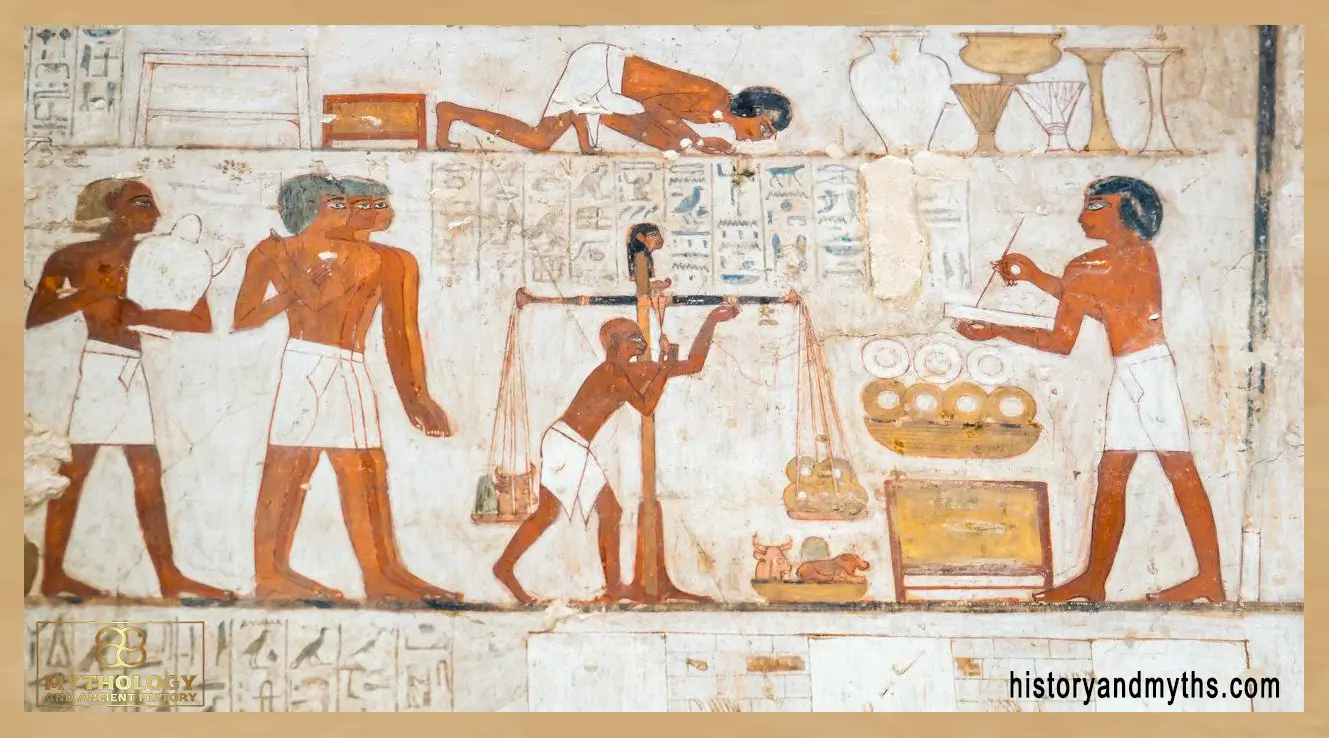
To understand why Egypt never produced an independent merchant class, we must first understand the nature of its economy. Ancient Egypt operated on a centrally managed, redistributive system, where surplus production flowed upward into institutional hands before being redistributed downward. Wealth did not circulate freely; it was collected, recorded, stored, and reassigned.
At the top of this system stood the royal administration and the major temples. These institutions-controlled land, labor, workshops, storage facilities, and transport networks. Agricultural surplus, craft production, and imported goods all entered centralized storehouses. From there, resources were allocated according to rank, function, and state priorities—not market demand.
Within such a structure, there was little room for private commercial initiative. Profit-driven exchange depends on ownership, price negotiation, and competition. Egyptian economic life minimized all three. Prices, where they existed at all, were largely administrative benchmarks, not fluctuating market values. Labor was compensated through rations and assignments rather than wages. Goods moved because the system required them to move, not because someone saw an opportunity for gain.
This environment shaped the role of those involved in exchange. Individuals responsible for moving goods were executors of policy, not economic decision-makers. Their authority came from their institutional backing, and their limits were clearly defined. They could facilitate transactions but not redefine them. They could deliver value but not extract it.
The result was an economy that functioned efficiently without producing commercial autonomy. Egypt maintained stability over innovation, control over flexibility. Trade existed, but it served the state first. Merchants, as later societies would understand them, were unnecessary-and potentially disruptive-to a system built on predictability and hierarchy.
This framework explains why economic power in Egypt consistently aligned with administrative power. Those who controlled records, storage, and redistribution shaped the economy far more than those who physically moved goods. To grasp the true role of merchants, we must therefore shift our focus from trade itself to the intermediaries embedded within this bureaucratic machine.
| Role | Primary Function | Economic Authority | Ownership of Goods | Social Status |
|---|---|---|---|---|
| Merchant / Trader | Facilitated exchange under institutional direction | Very limited | No private ownership | Functional, low visibility |
| Middleman / Agent | Moved goods between producers and institutions | Operational only | Institutional property | Moderate, dependent on role |
| Scribe | Recorded, authorized, and validated transactions | High | Controlled by record | High prestige |
| State / Temple Official | Directed production, storage, and redistribution | Very high | Full institutional control | Elite |
Middlemen and Economic Intermediaries
If merchants in ancient Egypt were not independent traders, then middlemen were the true engines of exchange. These figures connected producers, institutions, and consumers, ensuring that goods moved smoothly through the system without ever leaving institutional control.
Middlemen were not a single profession. They appeared under different administrative roles: agents assigned to estates, supervisors of transport, officials attached to storehouses, and representatives of temples or royal workshops. What united them was function, not title. They did not own goods, nor did they negotiate prices freely. Their task was logistical and bureaucratic-to move, record, and deliver.
At the local level, middlemen linked farmers and craftsmen to centralized storage. Agricultural surplus passed through their hands into granaries; manufactured goods moved from workshops to institutions. At higher levels, similar intermediaries managed long-distance transfers between regions or between Egypt and foreign partners, always under official authorization.
Crucially, middlemen operated within strict limits. They could not redirect goods for personal gain or create parallel trade networks. Every transfer was recorded, supervised, and justified. Their value lay in reliability, not initiative. The system rewarded obedience and accuracy, not innovation.
This structure explains how Egypt sustained large-scale distribution without markets. Middlemen replaced merchants by acting as controlled conduits, not economic actors. They ensured circulation without competition and movement without private accumulation. In doing so, they preserved the balance between economic efficiency and administrative dominance that defined Egyptian civilization.
Merchants vs Scribes vs Officials
In Egypt’s economic hierarchy, those who recorded goods held more power than those who moved them. This is the key distinction that separates merchants, scribes, and officials-and explains why merchants never rose to dominance.
Scribes occupied the core of the system. They documented deliveries, calculated rations, tracked surplus, and authorized redistribution. Without a written record, no transaction officially existed. Control over writing meant control over legitimacy. A scribe did not need to touch goods to command authority over them.
Officials stood above both scribes and intermediaries. They issued orders, supervised estates, managed storehouses, and represented royal or temple interests. Their power was administrative and political, not commercial. Decisions about allocation, labor, and transport flowed from them downward.
Merchants and middlemen, by contrast, operated at the lowest level of authority within the exchange process. They executed tasks rather than shaping outcomes. Even when entrusted with valuable goods, they remained subordinate to those who documented and approved the movement.
This imbalance explains why economic influence in Egypt never shifted toward commerce. Wealth followed records, not circulation. Status followed office, not trade. In a system where administration defined reality, the pen consistently outweighed the caravan.
Trade Without Markets?
For most of Egyptian history, trade functioned without open markets in the modern sense. There were no permanent commercial centers where prices fluctuated freely or private sellers competed openly. Instead, exchange operated through administrative channels.
Goods moved along predefined routes linking estates, workshops, granaries, temples, and royal institutions. Transfers were initiated by need, obligation, or command-not by supply and demand. A shipment of grain, linen, copper, or oil existed because an institution required it, not because a seller sought profit.
Local exchange did occur, particularly in villages and workmen’s communities, but even there it remained limited and supervised. Barter and ration-based compensation replaced monetary trade. Transactions were practical, not speculative. What mattered was fulfillment, not margin.
This absence of markets was not a weakness. It was a deliberate feature of a system designed to prioritize stability over flexibility. By removing free markets, the state minimized economic unpredictability and prevented private actors from accumulating power through trade.
Trade in Egypt, therefore, was not a public arena-it was a managed process. Goods circulated, but always along paths drawn by authority. Understanding this helps explain why middlemen existed, yet merchants as autonomous market actors did not.
Social Status of Merchants
Merchants and middlemen in ancient Egypt occupied a functional but limited social position. They were necessary to the system, yet rarely celebrated within it. Unlike scribes, priests, or high officials, they left little trace as individuals of status or prestige.
Social rank in Egypt was tied to proximity to authority, not economic movement. Those who managed records, rituals, or administration enjoyed visibility and advancement. Middlemen, by contrast, operated behind the scenes. Their work supported the system, but did not define it.
Wealth accumulation through trade was constrained. Since goods remained institutionally owned and transactions were supervised, opportunities for private enrichment were narrow. A middleman might enjoy a stable livelihood, access to rations, or minor privileges, but not lasting economic independence. Their role offered security rather than ascent.
This explains their near absence from monumental inscriptions and elite tomb biographies. Egyptian society honored service to order-Ma’at-not commercial success. Merchants were valued for reliability, not ambition. Their position reflects a civilization that respected economic function while deliberately limiting economic power.
From Production to Distribution
- Producers — Farmers and craftsmen generated surplus under state or temple oversight.
- Collection — Goods entered granaries and workshops as institutional property.
- Middlemen & Agents — Authorized intermediaries transported and coordinated deliveries.
- Scribes — Recorded quantities, validated transfers, and fixed accountability.
- Officials — Directed allocation according to administrative priorities.
- Recipients — Workers, temples, estates received rations and supplies.
Key Insight: Exchange relied on administration, not markets—movement without private ownership.
© historyandmyths.com — Educational use
Evidence from Texts and Papyri
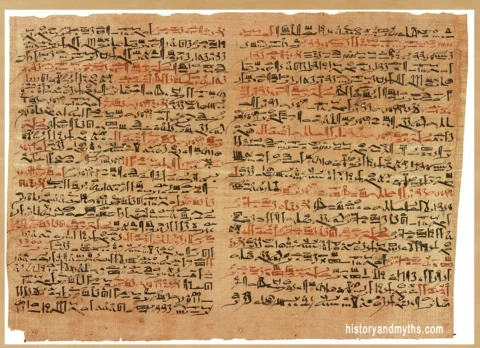
The limited status of merchants and middlemen is not an assumption-it is visible in the administrative record. Egyptian papyri consistently document the movement of goods as an institutional process rather than a private transaction. Texts focus on deliveries, quantities, destinations, and authorization, not profit or ownership.
Administrative archives from sites such as Deir el-Medina are especially revealing. These documents record the distribution of grain, tools, textiles, and rations through official channels. Individuals appear as recipients, carriers, or supervisors, but never as independent sellers. The language is procedural, not commercial.
Occupational titles reinforce this pattern. Terms associated with transport, storage, and oversight emphasize responsibility and accountability. Even when individuals handled valuable materials, their role remained defined by service to an estate, temple, or royal project. Goods moved for institutions, not through markets.
Notably absent from the textual record are contracts of private trade, merchant biographies, or evidence of competitive buying and selling. What survives instead is a paper trail of control. The economy speaks through lists, tallies, and orders-confirming that exchange in Egypt was an administrative act rather than a commercial venture.
Together, these sources anchor the picture presented throughout this article. Merchants and middlemen existed, but only within boundaries drawn by bureaucracy. The written record leaves little doubt: economic movement in Egypt was managed, not negotiated.
- Ancient Egypt did not develop an independent merchant class in the modern sense.
- Economic exchange operated through state and temple institutions, not free markets.
- Middlemen functioned as administrative intermediaries, not private traders.
- Scribes and officials held more economic power than those who physically moved goods.
- Trade prioritized stability and control over profit and competition.
Frequently Asked Questions
Did ancient Egypt have merchants?
Ancient Egypt did not have merchants in the modern, independent sense. Economic exchange was controlled by the state and temples, with individuals acting as agents rather than free traders.
How did trade work in ancient Egypt without markets?
Trade operated through administrative distribution. Goods moved between estates, temples, and workers based on institutional needs, not open market competition.
Who were middlemen in ancient Egypt?
Middlemen were authorized intermediaries who transported, coordinated, and recorded goods on behalf of institutions, without owning or profiting from them privately.
Were merchants wealthy in ancient Egypt?
Merchants and intermediaries could achieve stability, but large private wealth through trade was limited by strict administrative oversight.
What role did scribes play in trade?
Scribes recorded and authorized transactions, giving them greater economic power than merchants who physically moved goods.
Why didn’t Egypt develop a merchant class?
Egypt’s centrally managed economy prioritized control and stability, preventing private commercial activity from developing independently.
Sources & Rights
- Kemp, Barry J. Ancient Egypt: Anatomy of a Civilization. 2nd ed. London: Routledge, 2006.
- Janssen, Jac. J. Commodity Prices from the Ramessid Period: An Economic Study of the Village of Necropolis Workmen at Thebes. Leiden: E. J. Brill, 1975.
- Wilkinson, Toby. The Rise and Fall of Ancient Egypt. New York: Random House, 2010.
- Trigger, Bruce G., Barry J. Kemp, David O’Connor, and Alan B. Lloyd. Ancient Egypt: A Social History. Cambridge: Cambridge University Press, 1983.
- Eyre, Christopher. The Use of Documents in Pharaonic Egypt. Oxford: Oxford University Press, 2013.
- Černý, Jaroslav. A Community of Workmen at Thebes in the Ramesside Period. Cairo: Institut Français d’Archéologie Orientale, 1973.
Written by H. Moses — All rights reserved © Mythology and History