Grain Storage and Distribution in Ancient Egypt: How Food Meant Power
In ancient Egypt, grain storage was not primarily a response to hunger or uncertainty. It was a deliberate system through which the state converted agricultural production into authority. Once grain entered official storage, it ceased to function as private food and became a controlled resource-measured, recorded, and redistributed according to administrative priorities rather than market demand.
This article examines grain storage and distribution as mechanisms of power. It explains why storage was centralized, how grain moved from fields to granaries, and how controlled distribution shaped labor, survival, and social stability. Rather than focusing on structures or techniques, it addresses the core question: how controlling food allowed the Egyptian state to manage people, resources, and crises.
Grain as a Strategic Resource
In ancient Egypt, grain was treated less as food and more as a unit of control. Its value did not lie only in nutrition, but in its suitability for measurement, storage, and redistribution. Unlike perishable goods, grain could be quantified, preserved, and mobilized over time, making it the ideal foundation for a centralized economy.
Because grain was measurable, it became administratively visible. It could be counted, taxed, recorded, and reassigned. This allowed the state to translate agricultural output into predictable supply, supporting officials, workers, temples, and large-scale projects without relying on direct monetary exchange. Grain functioned as a standard unit through which labor and obligation were converted into material support.
Its strategic importance also lay in timing. Grain could be accumulated during surplus years and released selectively during shortages. This capacity transformed storage into leverage. Control over grain meant control over survival, mobility, and compliance. Access to food was no longer determined solely by production, but by position within the distribution system.
Understanding grain as a strategic resource clarifies why storage and distribution were tightly managed. The state did not store grain simply to prevent hunger; it stored grain to stabilize authority, regulate labor, and maintain order across an economy built on agricultural surplus.
| Stage | Function | Administrative Role |
|---|---|---|
| Harvest Collection | Gathering and initial handling of grain | Convert labor output into measurable surplus |
| Transport to Granaries | Movement from fields to storage centers | Extend oversight beyond local production |
| Measurement & Recording | Weighing and documenting quantities | Establish accountability and predict supply |
| Central Storage | Preservation of grain reserves | Maintain strategic control over food supply |
| Controlled Distribution | Issuing rations and allocations | Sustain labor, hierarchy, and stability |
Why Storage Was Centralized
Grain storage in ancient Egypt was centralized by design, not convenience. Allowing surplus to remain dispersed at the household level would have limited oversight and reduced the state’s ability to predict, allocate, and enforce supply. Central granaries solved this problem by concentrating food under administrative supervision.
Centralization enabled standardization. Grain entering official storage was weighed, recorded, and classified before redistribution. This process transformed diverse local yields into a uniform resource that could be moved across regions and reassigned according to need. Storage was therefore inseparable from accounting. Without central records, distribution could not be regulated at scale.
Central granaries also reduced economic autonomy at the local level. Once grain passed into state storage, access depended on administrative status rather than ownership. This weakened informal exchange and reinforced dependence on official channels. Food security became a matter of position within the system, not individual productivity alone.
By centralizing storage, the state minimized uncertainty. Officials could anticipate shortages, plan rations, and sustain non-agricultural labor year-round. The granary functioned as both warehouse and command point-where surplus was transformed into predictable control over resources and people.
From Field to Granary
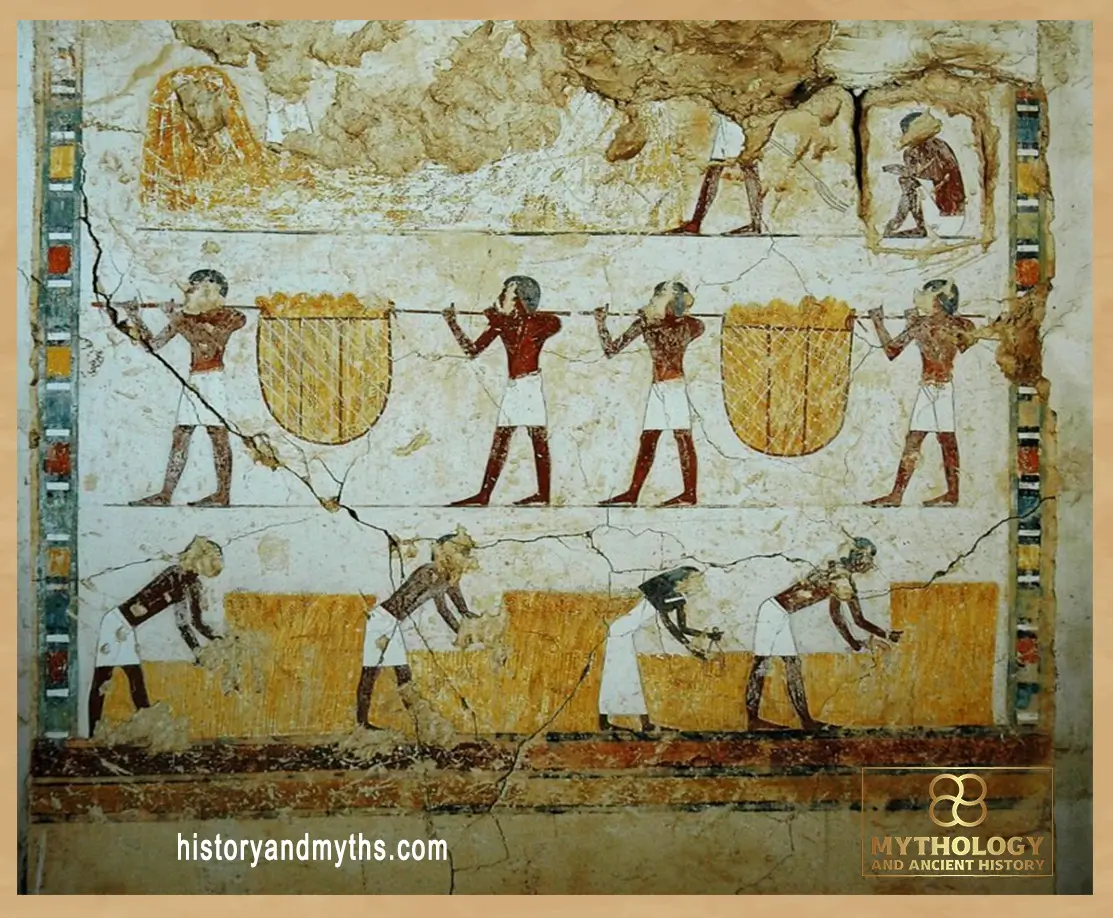
The movement of grain from field to granary marked the moment when agricultural production shifted from private labor to institutional control. This transition was neither informal nor automatic. It followed a regulated sequence designed to ensure visibility, accountability, and compliance at every stage.
After harvest, grain was collected, transported, and delivered to designated storage points under supervision. Measurement was central to this process. Quantities were weighed or measured before entry, recorded by scribes, and checked against expected yields. This step converted physical output into administrative data, allowing discrepancies to be identified and addressed immediately.
Transportation itself was part of the system. Moving grain required organized labor, coordination, and oversight, reinforcing the state’s presence beyond the fields. Once delivered, grain was no longer treated as household property. Entry into the granary finalized its transformation into a controlled resource subject to redistribution rather than exchange.
This process ensured that storage was not merely passive accumulation. It was an active filter through which production passed, stripping grain of personal association and integrating it into a centralized network. From this point onward, access depended on administrative allocation, not proximity to the harvest.
Distribution as Power
Distribution was the point at which stored grain translated into authority. Control over who received grain, when, and in what quantity determined survival, labor continuity, and social stability. Distribution was not driven by market exchange or personal need, but by administrative decision.
Grain left central storage through regulated channels. It was issued as rations to workers, officials, temple personnel, and dependents of the state. These allocations tied food access directly to service and status. Regular distribution sustained labor without wages, while selective distribution reinforced hierarchy and obligation.
Because distribution was centralized, it could be adjusted strategically. Supplies could be increased to mobilize labor, restricted to enforce discipline, or redirected during shortages. This flexibility made grain more than sustenance-it became leverage. Individuals and communities depended on predictable allocation rather than independent reserves.
Distribution also limited alternatives. With grain concentrated in official storage, informal exchange weakened. Access to food shifted from local networks to institutional channels, reinforcing dependence on the state. Power did not reside solely in possession of grain, but in the authority to release it.
Storage and Crisis Management
Grain storage allowed the Egyptian state to respond to shortages without dismantling the existing economic order. In years of low yield, reserves could be released to maintain essential labor and prevent immediate collapse. Crisis management depended less on relief for individuals and more on preserving systemic stability.
Stored grain was deployed selectively. Priority was given to state workers, administrative centers, and institutions critical to continuity. Distribution during crises was not universal; it followed the same hierarchical logic applied in normal years. This approach limited disruption while reinforcing dependence on official channels.
Storage also moderated risk over time. Surplus accumulated in productive years reduced the impact of later shortfalls, smoothing fluctuations rather than eliminating them. However, reserves had limits. Prolonged droughts, administrative failure, or excessive extraction could overwhelm storage capacity, exposing vulnerabilities in the system.
Crisis management through storage reveals a central tension. Granaries protected the state from instability, but they did not guarantee security for all. Survival during shortages depended on access to distribution networks, not proximity to production. Storage mitigated famine, but it did so unevenly.
Grain Storage & Distribution — Core Framework
- Grain as power: Storage converted food into administrative authority.
- Centralization: Granaries concentrated surplus for oversight and prediction.
- Measurement & records: Weighing and accounting turned harvest into data.
- From field to system: Entry into granaries ended private control.
- Distribution: Rations linked food access to service and status.
- Crisis use: Reserves stabilized the system, not equal survival.
- Limits: Administrative failure exposed systemic vulnerability.
© historyandmyths.com — Educational use
The Limits of the Storage System
Despite its effectiveness, the grain storage system had clear limits. Centralization reduced volatility but increased dependence on administration. When records failed, transport broke down, or officials mismanaged reserves, the system’s strengths became liabilities. Control amplified both stability and risk.
Storage prioritized continuity of the state over individual security. While granaries could buffer shortages, access was conditional. Communities outside distribution networks faced vulnerability even when reserves existed elsewhere. The system did not eliminate hunger; it redistributed exposure to it.
Long-term strain exposed structural weaknesses. Extended droughts, political instability, or excessive extraction depleted reserves faster than they could be replenished. In such cases, centralized storage delayed collapse but could not prevent it. The same mechanisms that enabled control also limited flexibility when conditions exceeded administrative capacity.
These limits clarify the nature of grain storage in ancient Egypt. It was not a guarantee of universal survival, but a tool for managing risk at scale. The system succeeded insofar as it preserved order and labor continuity. Where it failed, it revealed the boundaries of control in an economy built on agricultural surplus.
Key Takeaways
- Grain storage transformed food into a tool of administrative control.
- Centralized granaries enabled prediction, oversight, and redistribution at scale.
- Measurement and records converted harvest into accountable data.
- Distribution linked food access to service, status, and obligation.
- Stored reserves stabilized the system during shortages, not equal survival.
Frequently Asked Questions
Why was grain storage so important in ancient Egypt?
Because stored grain allowed the state to control food supply, stabilize labor, and manage resources across the year.
Who controlled grain storage in ancient Egypt?
Grain storage was controlled by state and temple administrations through centralized granaries and official records.
How did grain move from fields to storage?
After harvest, grain was collected, measured, recorded by scribes, and transported under supervision to central granaries.
Was stored grain privately owned?
No. Once grain entered official storage, it became part of a centralized system and was redistributed administratively.
How was grain distributed to the population?
Grain was issued as rations to workers, officials, and institutions according to service, status, and state priorities.
Did grain storage prevent famine?
Storage reduced the impact of shortages but did not guarantee equal survival; access depended on inclusion in distribution networks.
What were the limits of the grain storage system?
Administrative failure, prolonged drought, or excessive extraction could overwhelm reserves and expose systemic weaknesses.
Sources & Rights
- Kemp, Barry J. Ancient Egypt: Anatomy of a Civilization. London: Routledge.
- Shaw, Ian, ed. The Oxford History of Ancient Egypt. Oxford: Oxford University Press.
- Trigger, Bruce G., Barry J. Kemp, David O’Connor, and Alan B. Lloyd. Ancient Egypt: A Social History. Cambridge: Cambridge University Press.
- Janssen, Jac. J. Commodity Prices from the Ramessid Period. Leiden: Brill.
- Moreno García, Juan Carlos. Ancient Egyptian Administration. Leiden: Brill.
- Allen, James P. The Heqanakht Papyri. New York: Metropolitan Museum of Art.
- Butzer, Karl W. Early Hydraulic Civilization in Egypt: A Study in Cultural Ecology. Chicago: University of Chicago Press.
- Baines, John, and Jaromír Málek. Atlas of Ancient Egypt. New York: Facts On File.
- O’Connor, David, and Andrew Reid, eds. Ancient Egypt in Context. Oxford: Oxbow Books.
- Tyldesley, Joyce. Daily Life in Ancient Egypt. London: Penguin Books.
- Haring, Ben. Divine Households: Administrative and Economic Aspects of the New Kingdom Royal Memorial Temples. Leiden: Brill.
Written by H. Moses — All rights reserved © Mythology and History