Osiris as Judge of the Dead — Silent Authority of Egypt’s Afterlife
In the Egyptian afterlife, judgment did not belong to the one who weighed the heart or recorded the result. It belonged to the one who made judgment legitimate. Osiris stands at the center of the court not as an active judge, but as the source of authority itself.
Unlike modern images of judgment filled with interrogation and punishment, Osiris rarely acts. He does not adjust the scale, speak accusations, or enforce consequences. Instead, he presides in silence. His presence alone transforms procedure into law and outcome into fate. Without Osiris, the weighing of the heart would be a test. With him, it becomes judgment.
This article does not retell the myth of Osiris, nor does it revisit the drama of his death and rebirth. It also does not repeat the mechanics of the weighing ceremony. Instead, it asks a different question: why must the judge remain still? What kind of justice requires authority without intervention, and why did the Egyptians imagine their final judge as a god who rules by presence rather than action?
Understanding Osiris in this role reveals how Egyptian justice worked at its highest level. Judgment was not emotional, reactive, or personal. It was structural. Osiris embodied permanence, continuity, and cosmic legitimacy. He did not decide the verdict—he guaranteed that the verdict mattered.
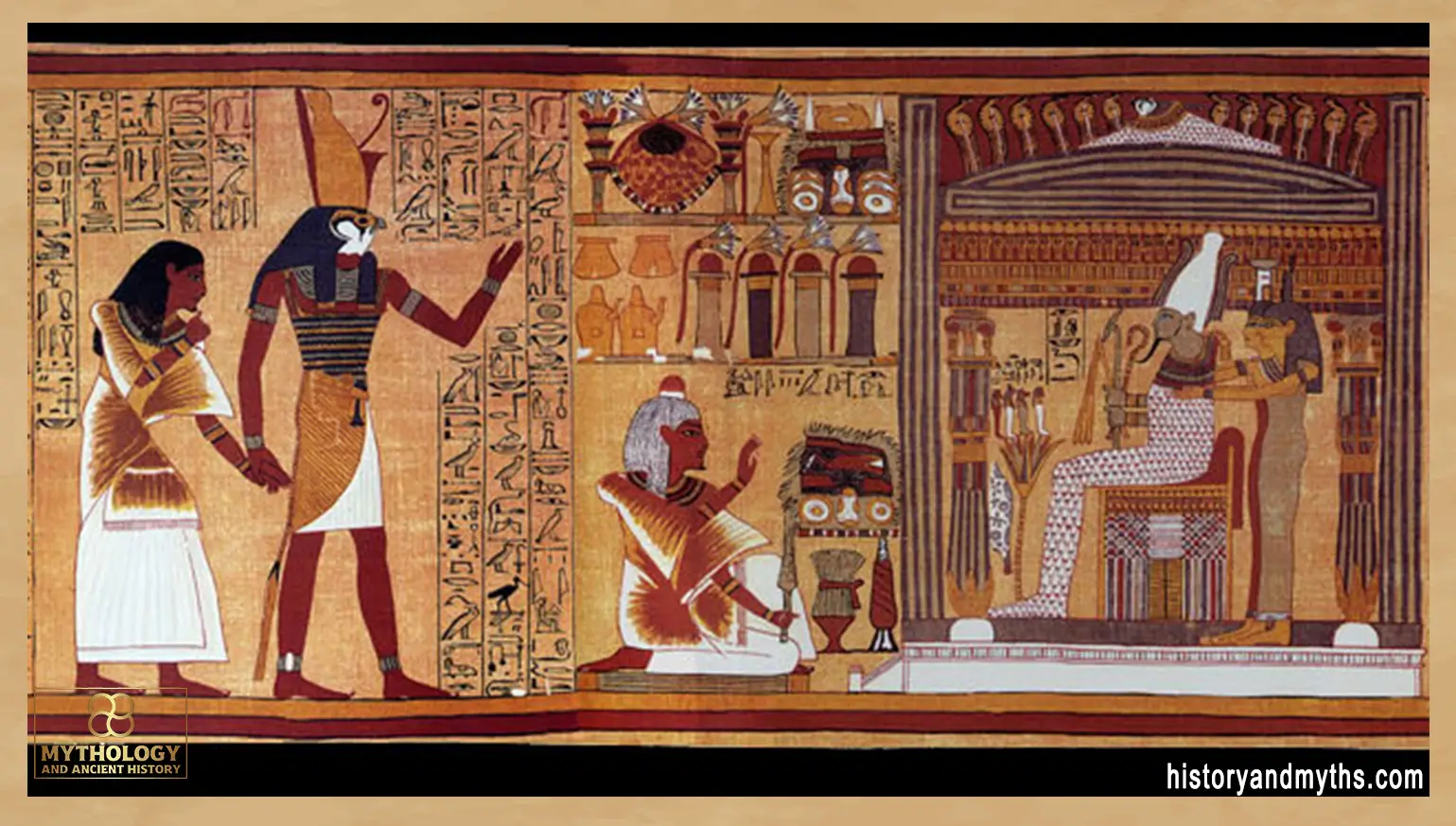
Source: Wikimedia Commons.
Author: Soutekh67.
Date: 2014.
License: (CC BY-SA 4.0).
Osiris as the Final Authority
Osiris’s power in the court of the dead did not come from action, but from recognition. He was not there to investigate or to debate truth; those tasks were already completed by the time judgment reached him. His role was to authorize the outcome, turning a measured result into an irreversible decision.
In Egyptian thought, authority was not the same as activity. The highest power was the one that did not need to intervene. Osiris’s throne symbolized stability and continuity—the assurance that judgment followed cosmic law rather than momentary will. When the heart was weighed and the result recorded, Osiris’s presence confirmed that the process had unfolded within the bounds of ma’at.
This explains why Osiris is so often shown seated and silent. He does not argue the verdict because truth has already revealed itself. His authority lies in accepting the result as final. In doing so, Osiris transforms procedure into destiny, making the judgment binding not just for the soul, but for the cosmic order itself.
| Aspect | Osiris’s Judicial Role |
|---|---|
| Position in the Court | Final authority and source of legitimacy |
| Primary Function | Recognizes and validates the verdict |
| Relation to Judgment | Does not weigh, question, or intervene |
| Relation to Ma’at | Embodies cosmic order and permanence |
| Relation to Anubis | Superior authority; receives the result |
| Relation to Thoth | Thoth records; Osiris legitimizes |
| Mode of Authority | Presence, not action |
| Judicial Philosophy | Judgment is final once truth is revealed |
Judgment Without Intervention
What makes Osiris distinctive as a judge is what he does not do. He does not question the soul, adjust the balance, or negotiate the outcome. By the time judgment reaches him, intervention would be a violation of justice, not an expression of it.
Egyptian belief placed great value on processes that revealed truth naturally. Once the heart had been weighed and the result fixed, the role of authority was not to interfere but to accept. Osiris embodies this restraint. His silence signals that judgment is not subject to revision, emotion, or favor.
This absence of action was deliberate. A judge who interferes risks turning justice into preference. By remaining still, Osiris preserved the idea that fate was determined by alignment with ma’at alone. The court functioned not because Osiris acted, but because he refused to act once truth had been revealed.
Why the Judge Does Not Act
In Egyptian thought, action belonged to lower levels of authority. The closer a power was to the cosmic order, the less it intervened. Osiris’s stillness was not weakness—it was a sign that judgment had moved beyond human-like decision making.
Once truth was revealed through proper procedure, any further action would imply doubt. Osiris did not need to confirm the verdict because the system itself had already done so. His role was to embody permanence, ensuring that the outcome could not be undone or challenged.
This idea reflects a broader Egyptian view of kingship and divinity. The highest authority ruled by stability, not motion. By remaining inactive, Osiris affirmed that justice was complete. The verdict did not require enforcement by the judge—it required recognition by the source of cosmic order.
Osiris as Judge — What He Actually Does
- Final authority: Osiris gives the verdict legitimacy, even when silent.
- Judgment by presence: he does not act, question, or intervene.
- Truth is already revealed: the weighing and record come before his recognition.
- A seal of finality: Osiris makes the outcome irreversible.
- Cosmic legitimacy: the court protects ma’at, not personal opinion.
- Roles stay separated: Anubis oversees, Thoth records, Osiris authorizes.
- Justice without emotion: authority exists to preserve order beyond time.
© historyandmyths.com — Educational use
Osiris and Cosmic Legitimacy
Osiris’s authority extended beyond the individual soul. By presiding over judgment, he anchored the entire process in cosmic legitimacy. The court of the dead was not merely a moral tribunal—it was a mechanism that protected the order of the universe itself.
Because Osiris had already passed through death and renewal, he stood outside ordinary time. This made him uniquely suited to validate judgments that were meant to last forever. A verdict recognized by Osiris could not be overturned because it was aligned with the eternal structure of ma’at, not with temporary circumstance.
In this role, Osiris functioned less like a judge issuing rulings and more like a seal of finality. His presence affirmed that the judgment belonged to the cosmos, not to the court alone. Through Osiris, the fate of the soul became part of a larger, unchanging order—one that ensured continuity between life, death, and eternity.
The Court Exists Because of Him
The court of the dead did not operate independently of Osiris—it existed because of him. Without his authority, the weighing of the heart would be a test without consequence, a measurement without final meaning. Osiris did not create the process, but he gave it binding force.
Every role in the court pointed toward this moment of recognition. Anubis ensured accuracy, Thoth preserved the record, and the assessors witnessed the truth. Yet none of these steps could complete judgment on their own. Only Osiris’s presence transformed the revealed truth into an unchangeable fate.
This is why Osiris remains central even when silent. The court does not revolve around debate or action; it revolves around legitimacy. Osiris embodies the idea that justice is real only when it is acknowledged by a power greater than the process itself. In the Egyptian afterlife, judgment was not complete when truth was found—it was complete when Osiris recognized it as final.
Key Takeaways — Osiris as Judge of the Dead
- Osiris is the final authority, not an active judge.
- Judgment becomes binding through recognition, not intervention.
- The weighing and record precede Osiris’s role.
- Silence signifies permanence and legitimacy.
- Justice is structural, grounded in ma’at, not emotion.
- Roles remain distinct: Anubis oversees, Thoth records, Osiris authorizes.
- The court exists because Osiris gives verdicts cosmic force.
Frequently Asked Questions About Osiris as Judge of the Dead
Was Osiris an active judge in the Egyptian afterlife?
No. Osiris did not question souls or intervene in the process; his role was to legitimize the final verdict.
Why did Osiris remain silent during judgment?
Silence signified permanence and authority, showing that truth had already been revealed through proper procedure.
Did Osiris weigh the heart or decide its outcome?
No. The weighing occurred before Osiris’s recognition; he did not alter or reassess the result.
How was Osiris’s role different from Anubis’s?
Anubis oversaw accuracy and fairness, while Osiris provided final authority without intervention.
What was Osiris’s relationship to Thoth in judgment?
Thoth recorded the outcome; Osiris confirmed its legitimacy within cosmic order.
Why was Osiris chosen as the final authority?
Because he embodied continuity, permanence, and alignment with ma’at, making verdicts binding beyond time.
Could Osiris overturn a verdict?
No. Once truth was revealed and recorded, the verdict stood as final.
What did Osiris’s presence add to the court?
His presence transformed procedure into destiny, giving judgment irreversible force.
Sources & Rights
- Assmann, Jan. Death and Salvation in Ancient Egypt. Ithaca: Cornell University Press, 2005.
- Hornung, Erik. The Ancient Egyptian Books of the Afterlife. Translated by David Lorton. Ithaca: Cornell University Press, 1999.
- Taylor, John H. Journey through the Afterlife: Ancient Egyptian Book of the Dead. London: British Museum Press, 2010.
- Faulkner, Raymond O. The Egyptian Book of the Dead: The Book of Going Forth by Day. San Francisco: Chronicle Books, 1994.
- Allen, James P. Middle Egyptian: An Introduction to the Language and Culture of Hieroglyphs. 2nd ed. Cambridge: Cambridge University Press, 2010.
- Quirke, Stephen. Exploring Religion in Ancient Egypt. Chichester: Wiley-Blackwell, 2015.
- Griffiths, J. Gwyn. The Origins of Osiris and His Cult. Leiden: Brill, 1980.
Written by H. Moses — All rights reserved © Mythology and History