Rewards in the Afterlife: Eternal Life in Ancient Egypt
In ancient Egyptian belief, the afterlife was not a vague promise of happiness, nor a single reward granted automatically after death. Rewards were specific, earned, and deeply practical—designed to preserve identity, dignity, and balance beyond the grave. What awaited the justified dead was not escape from life, but its ideal continuation, shaped by moral conduct and cosmic order.
Egyptians understood reward as restoration: food without hunger, land without loss, community without conflict, and recognition without injustice. These rewards followed judgment and justified existence within maat, the principle that sustained both the universe and society. To be rewarded in the afterlife meant to belong—to land, to people, and to a moral system that no longer failed. In this way, Egyptian afterlife rewards reveal how closely ethics, daily life, and eternity were bound together.
Source: British Museum
Author: Soutekh67
License: GNU Free Documentation License (GFDL), Version 1.2 or later
What Did Egyptians Mean by “Rewards” in the Afterlife?
When ancient Egyptians spoke about rewards in the afterlife, they were not referring to pleasure, luxury, or spiritual bliss in the modern sense. A reward meant being restored to a complete and functional existence after death. Survival alone was not enough; the true reward was continuity with dignity—to live again with food, land, social belonging, and moral recognition intact.
Rewards were therefore conditional and structured. They came only after judgment and were tied directly to how a person had lived. A justified individual did not receive a single abstract prize; instead, they gained access to a set of conditions that made eternal life possible: nourishment without shortage, work without suffering, and community without conflict. These elements together formed what Egyptians understood as a successful afterlife.
Crucially, reward was never separated from maat. To be rewarded was to be accepted into a state of balance, where chaos no longer interfered with daily existence. This explains why Egyptian texts focus less on joy and more on stability. Happiness was assumed to follow naturally once order was secured. In this worldview, the greatest reward was not indulgence, but a life that finally worked as it should.
| Reward Type | What It Included | Purpose |
|---|---|---|
| Material Rewards | Food, drink, fertile land, eternal provision | To guarantee survival without hunger, loss, or scarcity |
| Social Rewards | Family reunion, community belonging, name remembrance | To restore identity, recognition, and social continuity |
| Moral Rewards | Justification (maa-kheru), honor, moral acceptance | To confirm alignment with maat and ethical order |
| Cosmic Stability | Protection from chaos, permanence of status | To ensure eternal life remains secure and balanced |
| Personal Continuity | Preservation of role, work, and personal identity | To allow life to continue in perfected form |
Material Rewards: Food, Land, and Eternal Provision
Material rewards were central to Egyptian ideas of the afterlife because existence itself depended on provision. To be rewarded meant never facing hunger, loss, or dispossession again. Funerary texts repeatedly emphasize bread, beer, water, and fertile land—not as symbols of luxury, but as guarantees of survival without anxiety. Eternal life was only meaningful if it was materially secure.
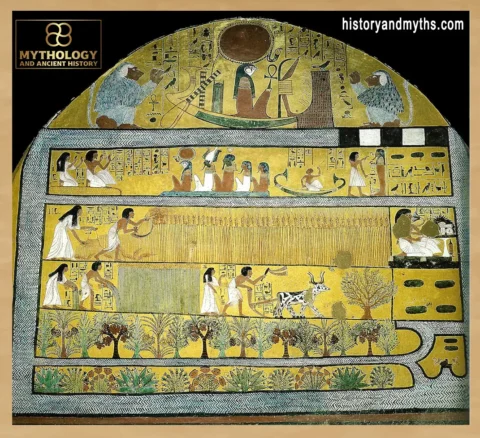
Land was especially important. Ownership of fields in the afterlife reflected the Egyptian belief that identity was tied to land and labor. The justified dead were promised plots that never failed and canals that never dried, ensuring uninterrupted sustenance. This promise mirrors the deepest fear of Egyptian society: famine and disorder. Material reward was therefore a direct answer to the most fundamental human vulnerability.
Offerings also played a crucial role. Tomb inscriptions and ritual formulas were designed to activate continuous provision, allowing the dead to receive food eternally through remembrance and ritual. These offerings were not charity; they were part of a reciprocal system linking the living and the dead. As long as balance was maintained, nourishment flowed.
What defines these material rewards is their absence of excess. The goal was not abundance for its own sake, but sufficiency without risk. Food never spoiled, land was never taken, and labor never became suffering. In Egyptian belief, material reward was the foundation upon which all other forms of afterlife fulfillment rested.
Social Rewards: Belonging, Family, and Recognition
Beyond material provision, one of the most meaningful rewards in the Egyptian afterlife was social restoration. To be justified after judgment meant to belong again—to family, to community, and to a recognized place within an ordered society. Isolation was never imagined as a reward; continuity of social identity was.
Egyptian texts repeatedly emphasize reunion. The dead hoped to see loved ones again, to live among others who had also passed judgment, and to be acknowledged as rightful members of an eternal community. This recognition mattered because social standing in Egypt was inseparable from moral reputation. Being accepted after death confirmed that one’s life had been socially and ethically valid.
Recognition was also formal. To be declared maa-kheru (“true of voice”) was not only a moral verdict—it was public affirmation before divine and communal witnesses. Names were preserved, titles remembered, and identities protected from erasure. In a culture where forgetting a name was a form of annihilation, being remembered and acknowledged was itself a powerful reward.
These social rewards explain why Egyptian funerary culture invested so heavily in names, lineage, and memory. Eternal life without belonging would have been incomplete. In the Egyptian vision, the afterlife succeeded only when the individual was restored not just to existence, but to society—a community finally free from injustice and conflict.
Moral Rewards: Justification, Honor, and Eternal Balance
The highest reward in the Egyptian afterlife was moral vindication. To be declared maa-kheru (“true of voice”) after judgment meant more than survival—it meant public confirmation that one’s life had aligned with cosmic order. This declaration, issued in the presence of Osiris and the divine tribunal, transformed ethical conduct into lasting honor.
Justification carried lasting consequences. The justified dead were no longer subject to accusation, instability, or reversal. Their names endured, their identities were secure, and their place within the afterlife community was unquestioned. In a culture deeply concerned with reputation and remembrance, this moral clearance was a reward equal to material provision.
Honor in the afterlife was inseparable from maat. Eternal balance did not mean emotional bliss; it meant freedom from moral threat—no fear of punishment, no return of chaos, no erosion of standing. To live eternally within maat was to exist in a state where actions, recognition, and outcome were finally in harmony.
This explains why Egyptian texts emphasize ethical declarations as much as offerings or spells. Moral reward was the framework that made all other rewards meaningful. Without justification, land, food, and community could not be trusted to endure. With it, eternal life became stable, dignified, and complete.
Were Rewards the Same for Everyone?
Egyptian afterlife rewards were not identical for all, but they were governed by the same moral standard. In early periods, royal texts emphasized exclusive privileges for kings, reflecting a society where cosmic order was embodied by the ruler. Over time—especially from the Middle Kingdom onward—this model expanded. Access to rewards became ethically inclusive, even if expressions of reward varied.
Differences existed in scale and expression, not in principle. A high official might imagine larger estates or broader recognition; a farmer envisioned stable fields and sufficient harvests. Yet both were measured by the same criterion: alignment with maat. What changed was how reward was imagined, shaped by one’s social role and daily life—not whether reward was possible.
This evolution reveals a key feature of Egyptian belief: moral equality within social difference. The afterlife did not erase identity; it preserved it in perfected form. Rewards were personalized continuations, not uniform distributions. What unified them was permanence—once granted, rewards were no longer vulnerable to loss, corruption, or reversal.
By the New Kingdom, the message was clear. Eternal rewards were available to all who lived rightly, regardless of rank. The afterlife promised justice without flattening individuality—an ordered eternity where fairness and identity could finally coexist.
Rewards in the Afterlife — At a Glance
- Nature of Rewards: Earned, structured, and conditional after judgment
- Material: Food, drink, fertile land, and eternal provision
- Social: Belonging, family reunion, and name remembrance
- Moral: Justification (maa-kheru), honor, and moral security
- Cosmic Aim: Preservation of maat and exclusion of chaos
- Access: Available to all who lived in balance, regardless of rank
- Outcome: A perfected continuation of life without loss or injustice
© historyandmyths.com — Educational use
Rewards vs. Punishment: How Balance Was Preserved
In ancient Egyptian belief, rewards in the afterlife only made sense when paired with the possibility of loss. Eternal balance depended on contrast: acceptance versus exclusion, stability versus annihilation. Punishment was not emphasized for spectacle or fear; it existed to protect order by preventing chaos from entering eternity.
This balance explains why Egyptian texts rarely dwell on suffering. The focus remained on outcomes, not torment. Those who failed judgment did not endure endless punishment; they faced erasure, denial of continuation, or renewed danger. The absence of reward—not prolonged pain—was the true consequence. In this system, eternity was valuable precisely because it was conditional.
Rewards, therefore, were not indulgences granted blindly. They were earned confirmations that a life had aligned with moral and cosmic law. Once granted, they were stable and self-sustaining. Punishment ensured that this stability was not compromised by injustice or imbalance. Together, reward and consequence maintained a universe where order could endure without constant correction.
By framing the afterlife this way, Egyptian belief presented justice as restorative rather than vengeful. The ultimate goal was not to punish wrongdoing endlessly, but to secure a perfected continuation of life for those who upheld balance. In this vision, eternity succeeded not through mercy alone, but through fairness that finally held.
Key Takeaways
- Rewards in the Egyptian afterlife were earned through moral balance, not granted automatically.
- The afterlife promised restoration of life, not escape from responsibility or identity.
- Material, social, and moral rewards worked together to secure eternal stability.
- Justification (maa-kheru) was the highest reward, ensuring honor and permanence.
- The absence of reward—not endless punishment—was the true consequence of failure.
Frequently Asked Questions About Rewards in the Egyptian Afterlife
What were the rewards in the ancient Egyptian afterlife?
Rewards included eternal food and drink, fertile land, social belonging, moral justification, and protection from chaos. Together, these ensured a stable and dignified continuation of life.
Were afterlife rewards automatic after death?
No. Rewards were conditional and granted only after moral judgment. A person had to be declared “true of voice” to receive them.
Were the rewards material or spiritual?
They were both. Egyptians believed in material rewards such as food and land, as well as moral and social rewards like honor, recognition, and eternal balance.
Did everyone receive the same rewards in the afterlife?
The principle was the same for all, but the form of reward varied according to one’s role and life. Identity was preserved, not erased.
What was the most important reward after death?
The highest reward was moral justification (maa-kheru), which confirmed that a person had lived in harmony with cosmic order.
How were rewards connected to judgment?
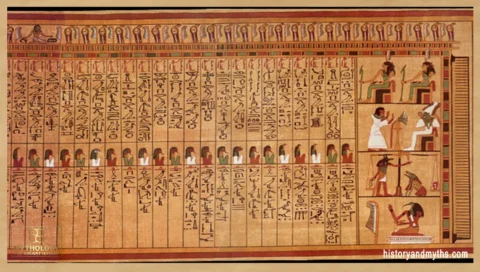
Rewards followed the Weighing of the Heart. Only those who passed judgment were granted access to eternal provision and stability.
What happened to those who failed judgment?
They were denied rewards and continuation. The absence of reward, rather than endless punishment, was the primary consequence.
Sources & Rights
- Allen, James P. The Ancient Egyptian Pyramid Texts. Princeton University Press, 2005.
- Allen, James P. Middle Egyptian: An Introduction to the Language and Culture of Hieroglyphs. Cambridge University Press.
- Assmann, Jan. Death and Salvation in Ancient Egypt. Cornell University Press.
- Assmann, Jan. The Search for God in Ancient Egypt. Cornell University Press.
- Faulkner, Raymond O. The Ancient Egyptian Book of the Dead. British Museum Press.
- Faulkner, Raymond O. The Ancient Egyptian Coffin Texts. Aris & Phillips.
- Hornung, Erik. The Ancient Egyptian Books of the Afterlife. Cornell University Press.
- Hornung, Erik. Conceptions of God in Ancient Egypt. Cornell University Press.
- Pinch, Geraldine. Egyptian Mythology: A Guide to the Gods, Goddesses, and Traditions of Ancient Egypt. Oxford University Press.
- Quirke, Stephen. Ancient Egyptian Religion. British Museum Press.
- Shaw, Ian (ed.). The Oxford History of Ancient Egypt. Oxford University Press.
- Taylor, John H. Death and the Afterlife in Ancient Egypt. British Museum Press.
- Teeter, Emily. Religion and Ritual in Ancient Egypt. Cambridge University Press.
- Wilkinson, Richard H. The Complete Gods and Goddesses of Ancient Egypt. Thames & Hudson.
- UCLA Encyclopedia of Egyptology.
- British Museum Collection Online.
- The Metropolitan Museum of Art, Heilbrunn Timeline of Art History.
Written by H. Moses — All rights reserved © Mythology and History