Crocodile Symbolism in Ancient Egypt, Meaning and Sacred Power
The crocodile symbolized far more than danger in ancient Egypt. Living in the Nile, it represented raw natural power, survival, fertility, kingship, and the delicate balance between order and chaos. While feared as one of the river’s deadliest predators, it was also revered through the god Sobek, whose strength and protective authority transformed the crocodile into a sacred symbol.
This complex symbolism reflected how Egyptians understood the natural world. Rather than seeing the crocodile as simply good or evil, they viewed it as a force that demanded respect, reminding people that life, power, and danger could exist side by side. This article explores what the crocodile symbolized, why it became sacred, and how its meaning shaped Egyptian religion, art, and beliefs.
The Crocodile as a Symbol of Uncontrolled Power
To ancient Egyptians, the crocodile symbolized power without restraint. It was not evil by nature, but it was unpredictable, sudden, and lethal. Unlike storms or droughts, the crocodile moved silently within the same waters people depended on every day. This made it a constant reminder that danger could exist inside what sustained life.
The crocodile did not destroy order from outside; it threatened it from within. This distinction mattered. Chaos was not always distant or supernatural—it could emerge from familiar spaces. The Nile fed the land, yet it also concealed a predator capable of killing without warning. The crocodile became the perfect symbol of that contradiction.
Because of this, the crocodile represented a force that could not be ignored or eliminated. Egyptians did not imagine a world without crocodiles, just as they did not imagine a world without risk. Instead, they developed ways to acknowledge, appease, and symbolically manage this power. Respect was a form of control.
This understanding shaped how the crocodile appeared in symbolic contexts. It was linked to strength, dominance, and threat—but also to vigilance and awareness. To recognize the crocodile was to recognize the limits of human control. In Egyptian thought, survival depended not on denying danger, but on understanding its presence and learning how to live alongside it.
| Symbolic Context | Meaning | Cultural Function |
|---|---|---|
| Crocodile as an Animal | Uncontrolled natural power | Representing danger embedded within daily life |
| Crocodile and the Nile | Life intertwined with risk | Expressing the balance between sustenance and threat |
| Crocodile vs. Sobek | Power versus control | Distinguishing raw force from divine authority |
| Protective Symbolism | Redirected danger | Using the symbol to guard boundaries and individuals |
| Punitive Symbolism | Consequences of imbalance | Representing judgment and moral accountability |
The Crocodile and the Nile — Life and Risk Entwined
The Nile was the foundation of Egyptian life, but it was never imagined as harmless. Within its waters lived the crocodile—a reminder that survival always carried risk. This made the crocodile inseparable from the river’s meaning. It embodied the danger hidden inside abundance.
For Egyptians, the Nile was generous yet unpredictable. It flooded at the right time, but it could also drown. It fed communities, yet it could take lives. The crocodile expressed this duality more clearly than any other creature. It lived where life flourished, but it struck without warning.
This relationship shaped symbolic thinking. The crocodile did not represent chaos invading order; it represented risk embedded within order itself. The river could not be rejected, and neither could the crocodile. Both had to be acknowledged and respected.
As a symbol, the crocodile taught restraint and awareness. It warned that power must be approached carefully, even when it comes from a source of life. In Egyptian thought, balance was not achieved by removing danger, but by recognizing its place and limits.
By linking the crocodile to the Nile, Egyptians expressed a deeper truth about existence: life and threat were intertwined. The crocodile was not an anomaly—it was part of the system that sustained the world.
Crocodile Symbolism Beyond Sobek — Animal and God Distinguished
Ancient Egyptians did not confuse the crocodile as an animal with the gods associated with it. This distinction was essential. The crocodile represented raw, uncontrolled power, while gods like Sobek embodied authority over that power.
The animal itself symbolized danger in its natural state. It acted without intention or morality. It killed because it was powerful, not because it was evil. This made the crocodile a symbol of force that existed beyond human control. It demanded respect, not worship.
Sobek, by contrast, represented what happened when that force was contained and directed. He was not the crocodile itself, but the divine principle that ruled over crocodile power. Where the animal was unpredictable, the god was ordered. Where the crocodile threatened life, Sobek protected fertility, strength, and stability.
This separation allowed Egyptians to understand danger without surrendering to it. They could acknowledge the crocodile’s power while still believing in divine control. The symbol and the god worked together: one represented the threat, the other its regulation.
By maintaining this distinction, Egyptian belief avoided fear-based worship. Power was recognized, categorized, and managed. The crocodile symbolized what had to be controlled, while the god symbolized the ability to control it.
Why Did Ancient Egyptians Revere Crocodiles?
Ancient Egyptians revered crocodiles because they believed dangerous forces could also sustain and protect life when placed under divine order. The crocodile was one of the Nile’s most powerful creatures, making it a natural symbol of strength, authority, and survival. Rather than trying to separate themselves from this danger, Egyptians sought to understand and respect it.
This belief became especially visible in regions where crocodiles were common, such as the Faiyum and Kom Ombo. There, sacred crocodiles were cared for in temple sanctuaries, decorated with jewelry during religious festivals, and, in some cases, mummified after death. These practices were not acts of animal worship alone. They reflected the belief that the crocodile could serve as a living expression of divine power when associated with the god Sobek.
The contrast between fear and reverence was central to Egyptian thought. A wild crocodile remained a dangerous animal that demanded caution, while a sacred crocodile represented strength brought under divine control. This distinction allowed Egyptians to respect the animal’s natural power without viewing every crocodile as a god.
By treating the crocodile as both a real predator and a sacred symbol, Egyptians expressed one of the central ideas of their religion: powerful forces were not meant to be destroyed, but understood, honored, and integrated into the balance that sustained the world.
Crocodile Symbolism in Protection and Punishment
Because the crocodile symbolized uncontrolled power, it naturally became associated with both protection and punishment. Egyptians believed that the same force capable of killing could also defend boundaries and enforce order.
As a protective symbol, the crocodile warned against complacency. Its presence reminded people to remain alert near the Nile and to respect limits. Amulets and images of crocodiles were sometimes used not to invite danger, but to turn danger outward—a way of saying that destructive power would strike enemies rather than the protected individual.
In funerary belief, the crocodile also appeared as an agent of judgment. Those who failed moral balance could be imagined as vulnerable to forces they had not respected in life. The crocodile here did not act out of malice; it acted as a natural consequence. Punishment was not arbitrary—it followed imbalance.
This dual role reflects a broader Egyptian principle: power itself is neutral. Its outcome depends on how it is approached. When acknowledged and respected, it can protect. When ignored or misused, it destroys. The crocodile symbol captured this lesson perfectly.
Through this symbolism, Egyptians expressed a disciplined view of danger. Fear alone was useless. Understanding and proper orientation toward power determined survival.
Crocodile Symbolism — At a Glance
- Power without restraint: The crocodile symbolized raw natural force that could not be fully controlled.
- Life and danger combined: Living in the Nile, the crocodile embodied risk within the source of life itself.
- Not good or evil: The crocodile represented neutral power rather than moral judgment.
- Symbol vs. god: The animal symbolized danger, while Sobek represented divine control over that danger.
- Protection through respect: Crocodile imagery could redirect harmful power away from individuals or spaces.
- Agent of consequence: In funerary belief, the crocodile could symbolize punishment following imbalance.
Where Crocodile Symbolism Appeared in Ancient Egyptian Culture
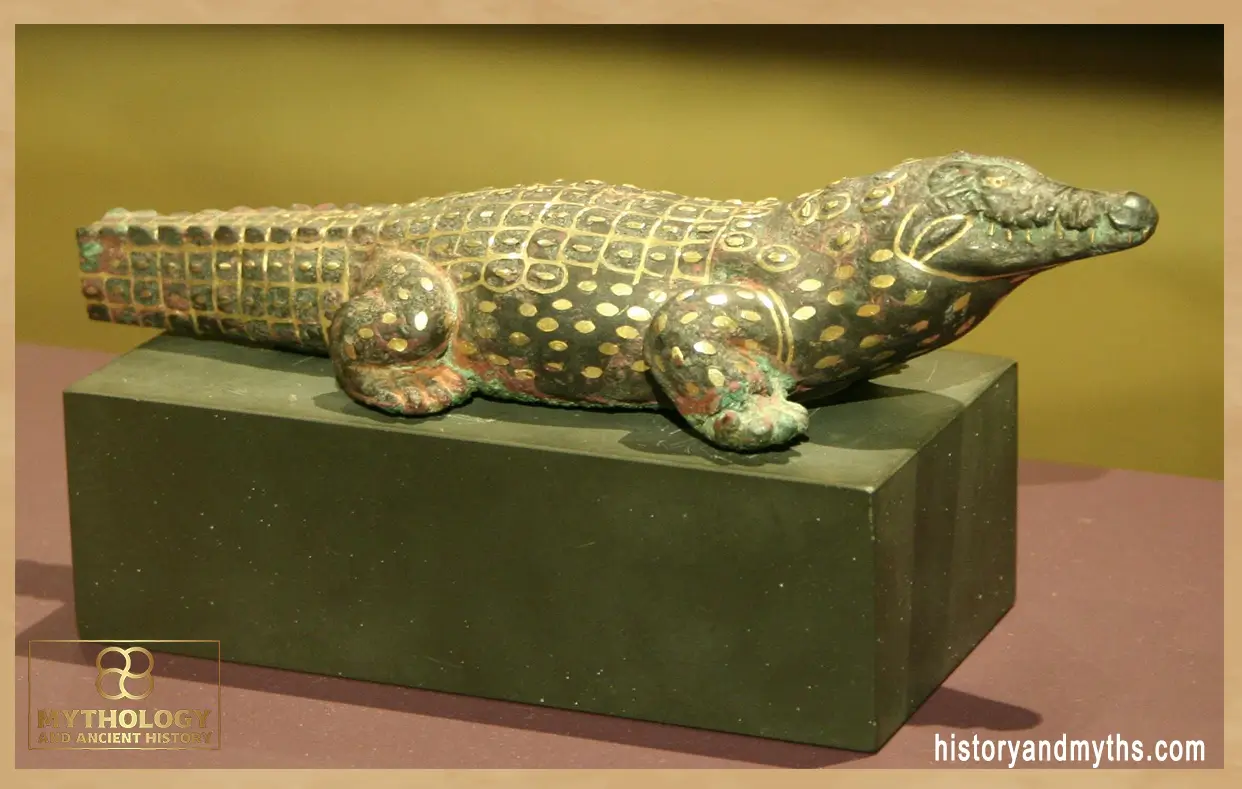
Crocodile symbolism extended far beyond religious belief. It appeared in temples, protective amulets, statues, and ceremonial objects, reflecting the animal’s importance in Egyptian daily life and sacred traditions. Rather than serving as simple decoration, these images reminded people of the balance between natural power and divine protection.
In temples dedicated to Sobek, crocodile imagery emphasized strength, fertility, and the life-giving force of the Nile. Small amulets shaped like crocodiles were also worn as protective objects, expressing the hope that dangerous forces could be turned into guardians rather than threats. Crocodile statues and sacred animal burials reinforced the belief that divine power could be present through symbols found in the natural world.
These representations show that the crocodile was more than a feared predator. It became a visual reminder that power could protect as well as destroy, depending on how it was understood and respected. Through art, ritual, and sacred objects, Egyptians transformed one of the Nile’s most dangerous animals into one of their most enduring religious symbols.
What Crocodile Symbolism Reveals About Egyptian Belief
Crocodile symbolism reveals a belief system that did not divide the world into simple categories of good and evil. Ancient Egyptians understood power as something real, dangerous, and unavoidable. The crocodile embodied that understanding.
Rather than denying danger, Egyptians integrated it into their worldview. The crocodile showed that life depended on forces that could not be fully controlled, only recognized and managed. Respect was not fear, and power was not evil—it was part of the natural order.
By separating the crocodile as a symbol from gods like Sobek or protective figures like Taweret, Egyptians demonstrated a sophisticated approach to belief. They acknowledged raw power while also affirming the possibility of control through divine order and moral balance.
In this way, the crocodile symbol expressed a core Egyptian principle: survival required awareness, restraint, and respect for forces larger than human intention. Danger was not chaos—it was a reality that demanded understanding.
Through the crocodile, Egyptians articulated a worldview in which life and risk were inseparable, and balance depended not on eliminating threats, but on knowing how to live alongside them.
Key Takeaways
- In ancient Egypt, the crocodile symbolized raw power that could not be fully controlled.
- Because it lived in the Nile, it embodied risk within the very source of life.
- The crocodile was not a symbol of pure evil, but of neutral force with dangerous potential.
- Egyptians distinguished the animal symbol from Sobek, who represented divine authority over that power.
- Crocodile imagery could serve protective roles by redirecting danger outward.
- It could also symbolize punishment as a consequence of imbalance rather than random cruelty.
Frequently Asked Questions about Crocodile Symbolism in Ancient Egypt
What did the crocodile symbolize in ancient Egypt?
The crocodile symbolized raw, uncontrolled natural power—danger that existed within everyday life, especially through the Nile.
Was the crocodile considered evil?
No. The crocodile was not viewed as evil but as a neutral force capable of destruction if not respected or properly managed.
Why was the crocodile associated with the Nile?
Because it lived in the Nile, the source of life itself. This made it a symbol of risk embedded within sustenance and survival.
What is the difference between the crocodile and the god Sobek?
The crocodile represented raw danger, while Sobek represented divine control and authority over that dangerous power.
Did Egyptians worship crocodiles?
No. Egyptians respected and symbolized the crocodile, but worship was directed toward gods who governed its power, not the animal itself.
How was the crocodile used as a protective symbol?
Crocodile imagery could be used to redirect harmful forces outward, serving as a symbolic guardian rather than a threat.
Did the crocodile have a role in the afterlife?
Yes. In funerary belief, the crocodile could symbolize punishment as a natural consequence of moral imbalance.
Sources & Rights
- Assmann, Jan. The Mind of Egypt: History and Meaning in the Time of the Pharaohs. Harvard University Press, 2002.
- Assmann, Jan. Death and Salvation in Ancient Egypt. Cornell University Press, 2005.
- Hornung, Erik. Conceptions of God in Ancient Egypt: The One and the Many. Cornell University Press, 1996.
- Wilkinson, Richard H. The Complete Gods and Goddesses of Ancient Egypt. Thames & Hudson, 2003.
- Pinch, Geraldine. Egyptian Mythology: A Guide to the Gods, Goddesses, and Traditions of Ancient Egypt. Oxford University Press, 2004.
- Ikram, Salima. Divine Creatures: Animal Mummies in Ancient Egypt. American University in Cairo Press, 2005.
- Kemp, Barry J. Ancient Egypt: Anatomy of a Civilization. 3rd ed. Routledge, 2018.
- Baines, John, and Jaromír Málek. Atlas of Ancient Egypt. Facts On File, 2000.
- Teeter, Emily. Religion and Ritual in Ancient Egypt. Cambridge University Press, 2011.
- British Museum. “Sobek.” British Museum Collection Online.
- The Metropolitan Museum of Art. “Egyptian Art Collection.” The Met Collection Online.
- UCLA Encyclopedia of Egyptology. Articles on Egyptian Religion, Sacred Animals, and Sobek.
- World History Encyclopedia. “Sobek.” World History Encyclopedia.
Written by H. Moses — All rights reserved © Mythology and History