The Hall of Two Truths: Judgment in Ancient Egypt’s Afterlife
In ancient Egyptian belief, the journey after death did not begin with punishment or reward it began with judgment. At the center of this judgment stood the Hall of Two Truths, a sacred courtroom where every soul was required to account for its life. This was not a place of chaos or fear, but a space governed by order, balance, and law.
Inside the hall, the fate of the dead was decided through a precise process. The heart was tested against ma’at, the principle of truth and cosmic balance, before a divine court. What mattered was not status, power, or devotion, but whether a person had lived in harmony with order itself.
Understanding the Hall of Two Truths is essential to understanding the Egyptian afterlife. It explains how justice worked, why punishment came only after judgment, and how moral responsibility extended beyond death into eternity.
What Was the Hall of Two Truths?
The Hall of Two Truths was the formal courtroom of the Egyptian afterlife. Every soul, regardless of rank or status in life, was required to appear there after death. It was not symbolic theater, but a necessary stage in the journey through the Duat where truth was examined and fate determined.
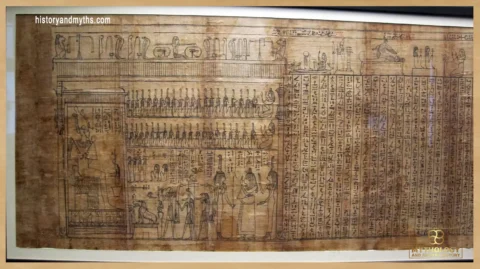
Ancient texts describe the hall as a structured space governed by law. It contained a divine court, witnesses, a recorder, and a presiding judge. The soul did not wander into judgment by chance; it was brought deliberately to this place because justice was considered unavoidable. No one could bypass the hall, delay judgment, or negotiate its outcome.
The purpose of the hall was simple but absolute: to determine whether the deceased had lived according to ma’at truth, balance, and moral order. Only after this determination could the soul continue toward renewal or face destruction. In this way, the Hall of Two Truths functioned as the gateway between existence and non-existence in the Egyptian afterlife system.
| Element | Function in the Hall of Two Truths |
|---|---|
| The Deceased | Appears before the court to account for life and actions. |
| Negative Confessions | Declarations asserting innocence of specific moral offenses. |
| The Heart | Carries the moral record of a lifetime and is tested for truth. |
| Feather of Ma’at | Represents truth, balance, and cosmic order. |
| Anubis | Oversees the weighing to ensure accuracy and fairness. |
| Thoth | Records the result of the weighing without interpretation. |
| Osiris | Presides as the final authority of judgment. |
| The Forty-Two Assessors | Represent moral standards and witness the judgment. |
Why It Was Called “The Two Truths”
The name “Hall of Two Truths” was not poetic decoration. It reflected a core Egyptian idea about justice: truth existed on two levels what a person claimed about their life, and what their heart revealed.
The first truth came from the soul itself. Upon entering the hall, the deceased recited declarations asserting innocence of wrongdoing. These statements expressed how the person understood their own life and actions. They represented intention, memory, and self-identity.
The second truth was objective and unavoidable. It was revealed through the weighing of the heart against ma’at. Unlike spoken words, the heart could not lie. It carried the moral weight of a lifetime and exposed whether a person had truly lived in balance with order.
Only when these two truths aligned what the soul declared and what the heart proved could harmony be confirmed. The hall bore its name because justice required both: asserted truth and tested truth.
Who Was Present in the Hall?
The Hall of Two Truths was never an empty chamber. Judgment unfolded before a carefully ordered divine assembly, with each figure serving a precise role in the legal process.
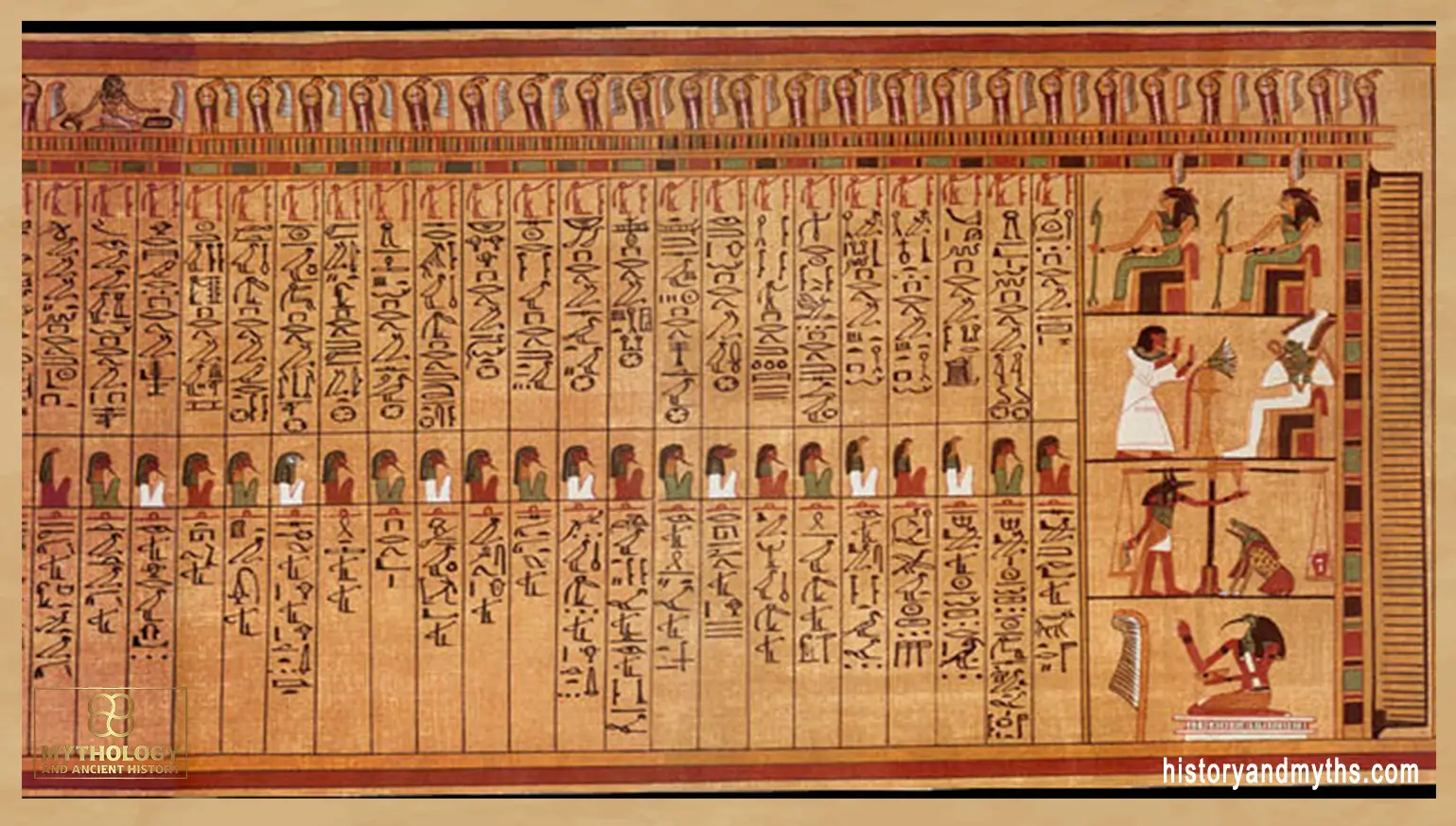
At the center of the proceedings stood Osiris, presiding as the final authority. He did not weigh the heart or record results; his role was to embody lawful judgment itself. Before him sat the divine court, often described as forty-two assessors, each representing a specific moral standard. Together, they formed the collective voice of justice.
Anubis oversaw the weighing of the heart. His task was technical and impartial ensuring the balance functioned correctly and that the test was fair. Thoth, the divine scribe, recorded the outcome without emotion or interpretation. What was written became permanent.
The presence of these figures made one thing clear: judgment was not personal or arbitrary. It was procedural, witnessed, and documented. Every role existed to ensure that truth once revealed could not be denied or altered.
The Judgment Process, Step by Step
Judgment in the Hall of Two Truths followed a fixed sequence. Nothing happened out of order, and nothing was left to chance.
First, the soul was formally introduced into the hall. It did not arrive silently or unnoticed; judgment required presence and acknowledgment. The deceased then recited the Negative Confessions statements denying specific moral offenses. This step established the soul’s own account of its life.
Next came the decisive test. The heart was weighed against the feather of ma’at. Anubis ensured the balance was correct, while Thoth recorded the result exactly as it appeared. No argument or explanation followed this moment the scale itself delivered the answer.
Finally, the verdict was recognized before Osiris and the divine court. If the heart proved light and truthful, the soul was allowed to proceed. If it failed, judgment ended and consequence began. The process was brief, formal, and irreversible justice completed through order rather than emotion.
What Happened After the Verdict
Once the verdict was delivered in the Hall of Two Truths, the process of judgment was complete. There was no reconsideration and no appeal. The outcome determined the soul’s fate immediately and permanently.
If the heart was found true and balanced, the soul was admitted into the ordered afterlife. It could move forward toward renewal, joining the blessed dead and continuing existence in harmony with ma’at. Judgment, in this case, was not a reward but a confirmation that balance had been maintained.
If the heart failed the test, the soul did not wander or suffer uncertainty. It faced final consequence. Existence itself was ended, preventing disorder from entering the cosmic cycle. Punishment followed judgment, but judgment always came first.
This final step shows why the Hall of Two Truths mattered so deeply. It was not a place of fear it was the point where truth became destiny, and where order was preserved beyond death.
The Hall of Two Truths — The Judgment in One Glance
- A courtroom, not a myth scene: the hall is a formal space where justice is decided.
- “Two Truths” means two tests: what the soul declares vs. what the heart reveals.
- Negative Confessions come first: the deceased denies specific moral offenses.
- The heart is weighed: the heart is tested against the feather of ma’at.
- Anubis oversees the scale: he ensures the weighing is accurate and fair.
- Thoth records the result: the outcome is written and cannot be undone.
- Osiris presides: the final authority recognizes the verdict.
© historyandmyths.com — Educational use
Why the Hall Mattered to the Living
The Hall of Two Truths was not only a destination for the dead it was a moral reference point for the living. Egyptians understood judgment as something prepared for during life, not feared after death. Every action, choice, and word contributed to the weight of the heart long before the soul entered the hall.
This belief shaped daily behavior. Living according to ma’at honesty, restraint, fairness, and balance was not abstract philosophy. It was practical preparation for judgment. Tomb texts, spells, and ethical instructions existed to remind people that the afterlife reflected how one lived, not what one claimed at the end.
By placing justice at the center of the afterlife, the Hall of Two Truths linked mortal life to eternal consequence. It taught that order survived only when individuals upheld it. In this way, the hall governed both worlds ensuring that truth mattered in life because it would be tested in death.
Key Takeaways — The Hall of Two Truths
- The Hall of Two Truths was the courtroom of the Egyptian afterlife.
- Every soul faced judgment, regardless of status in life.
- “Two Truths” refers to declared innocence and proven moral reality.
- The heart was weighed against the feather of ma’at.
- Anubis oversaw the weighing, while Thoth recorded the result.
- Osiris presided as the final authority of judgment.
- The verdict determined continuation or destruction.
Frequently Asked Questions About the Hall of Two Truths
What was the Hall of Two Truths in ancient Egypt?
It was the courtroom of the Egyptian afterlife where every soul was judged after death.
Why was it called the “Hall of Two Truths”?
The name refers to two forms of truth: what the soul declared and what the heart revealed when weighed.
Who judged the dead in the Hall of Two Truths?
Judgment occurred before a divine court, presided over by Osiris, with forty-two assessors present.
What role did Anubis play in the hall?
Anubis supervised the weighing of the heart to ensure accuracy and fairness.
What did Thoth do during the judgment?
Thoth recorded the result of the weighing, making the verdict permanent.
Did every soul pass through the Hall of Two Truths?
Yes. All deceased individuals were required to face judgment, regardless of status.
What happened if the heart failed the test?
The soul faced final destruction, preventing disorder from entering the cosmic order.
Why did the Hall of Two Truths matter to the living?
It shaped moral behavior by linking actions in life to judgment after death.
Sources & Rights
- Allen, James P. The Ancient Egyptian Book of the Dead. University of Chicago Press, 2015.
- Allen, James P. Middle Egyptian: An Introduction to the Language and Culture of Hieroglyphs. Cambridge University Press, 2014.
- Assmann, Jan. Death and Salvation in Ancient Egypt. Cornell University Press, 2005.
- Faulkner, Raymond O. The Egyptian Book of the Dead: The Book of Going Forth by Day. Chronicle Books, 1994.
- Faulkner, Raymond O. The Ancient Egyptian Coffin Texts. Aris & Phillips, 1973–1978.
- Hornung, Erik. The Ancient Egyptian Books of the Afterlife. Cornell University Press, 1999.
- Hornung, Erik. Conceptions of God in Ancient Egypt: The One and the Many. Cornell University Press, 1996.
- Quirke, Stephen. Exploring Religion in Ancient Egypt. Wiley-Blackwell, 2015.
- Taylor, John H. Journey through the Afterlife: Ancient Egyptian Book of the Dead. British Museum Press, 2010.
- Wilkinson, Richard H. The Complete Gods and Goddesses of Ancient Egypt. Thames & Hudson, 2003.
- British Museum. Papyrus of Ani (EA10470) Collection Online.
- The Griffith Institute, University of Oxford. Topographical Bibliography of Ancient Egyptian Hieroglyphic Texts.
- UCLA Encyclopedia of Egyptology. Book of the Dead, Ma’at, and Egyptian Afterlife Studies.
- World History Encyclopedia. The Hall of Judgment in Ancient Egypt.
Written by H. Moses — All rights reserved © Mythology and History