How Voting Worked in Ancient Greek Courts: Secret Ballots Explained
In Athenian courts, verdicts were decided directly by large juries through a secret ballot system, not by judges. Each juror received voting disks, chose one in private, and cast it into a designated container, ensuring that individual choices could not be traced. The result was determined immediately by simple majority—no deliberation, no negotiation, no written opinions. This process turned voting into a controlled, repeatable mechanism: distribute ballots, conceal the choice, collect votes, and count them on the spot.
What Voting Meant in Greek Courts
In Athenian courts, voting was the decisive act that ended the case. There was no separate phase for discussion after speeches; once arguments finished, jurors moved directly to casting their votes. Authority did not sit with a judge or panel—it rested with the assembled jurors, who converted their individual choices into a final outcome.
The system treated each vote as final and independent. Jurors were not expected to coordinate or justify their decision to others. There were no written opinions and no requirement to explain reasoning. What mattered was the aggregate result produced at the end of the process.
This structure shaped behavior inside the court. Because there was no deliberation stage, attention shifted to how each juror would decide privately. The process was designed to move from hearing the case to recording choices without interruption, keeping the focus on the act of voting itself rather than on collective debate.
What emerges is a clear sequence: arguments conclude, voting begins, and the case is resolved by count. The system does not extend beyond that moment. Voting is not one step among many—it is the point where judgment becomes binding.
| Stage | Action | Tool | Outcome |
|---|---|---|---|
| Distribution | Jurors receive two ballots | Bronze voting disks | Voting options assigned |
| Selection | Juror chooses privately | Hidden axle design | Choice concealed |
| Casting | One disk deposited | Ballot container | Vote recorded |
| Discard | Second disk removed | Separate container | No trace of choice |
| Counting | Votes sorted and tallied | Manual classification | Final result determined |
What Tools Were Used for Voting
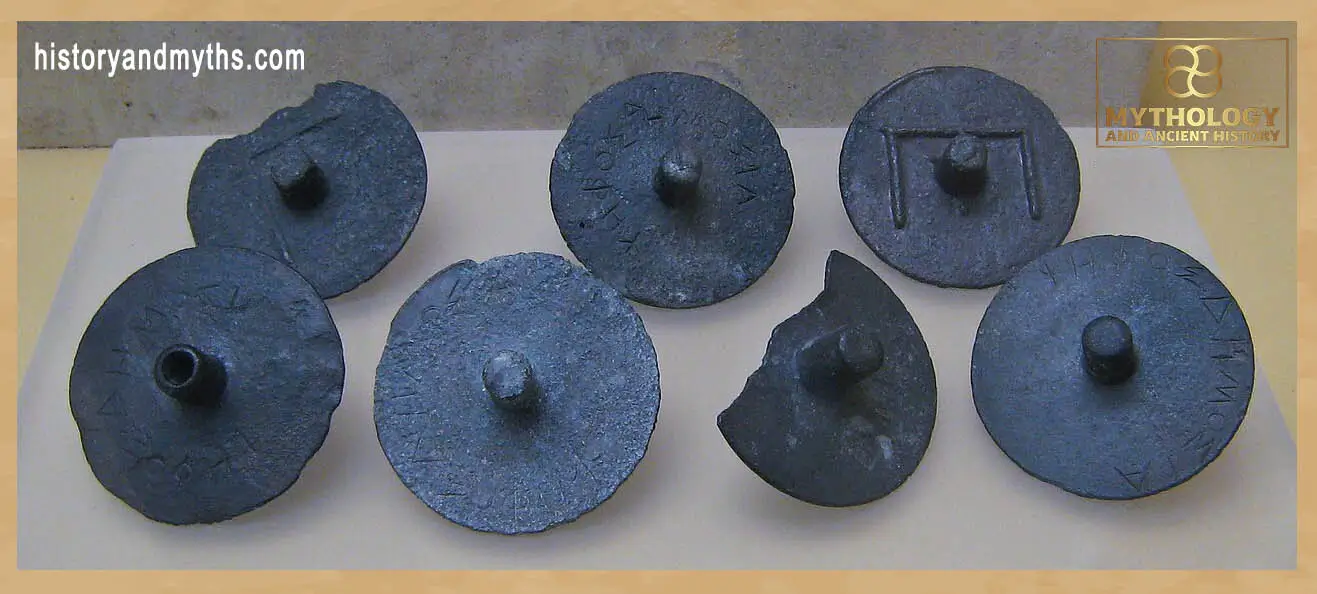
Voting relied on paired bronze ballots issued to each juror. The two disks were identical in size but differed in one hidden feature: a central axle on one was solid, while on the other it was hollow. This difference marked the choice—convict or acquit—without making it visible at a glance.
Each juror also used two containers. One was the official ballot box where the counted vote would be placed; the other received the unused disk. This separation ensured that only one vote entered the count while the second disk acted as a decoy, preventing observers from inferring the juror’s decision.
The design was functional. The axle could be covered by the fingers while carrying the disk, so the distinguishing feature remained concealed until the moment of deposit. No markings, colors, or inscriptions were needed; the system depended on physical structure rather than labels.
Together, these elements—paired disks and dual containers—created a setup where each juror could select and cast a vote without exposing the choice at any stage of handling.
How Secret Ballots Actually Worked
Secrecy was achieved through handling, not markings. Each juror received two disks and kept both in hand while approaching the ballot containers. The distinguishing axle—solid or hollow—was covered by the fingers, so observers could not tell which option the juror intended to cast.
At the point of deposit, the juror committed to one disk and placed it into the official ballot box. The second disk was immediately dropped into a separate container. Because every juror deposited two disks—one counted, one discarded—there was no visible difference in behavior that could reveal the choice.
The containers enforced the separation. Only disks placed in the official box were later counted; the others were collected but ignored. This ensured that selection and disclosure were decoupled: a juror could choose privately and complete the action in public without exposing the decision.
No additional verification was required during casting. The system relied on the physical design of the disks and the fixed sequence of deposits to keep each vote untraceable at the moment it was made.
Step-by-Step Voting Process
- Distribution of ballots
Each juror received two bronze disks, representing the two possible outcomes. No markings were shown publicly.
- Approach to the voting area
Jurors moved forward individually rather than as a group, preventing crowd behavior from revealing patterns.
- Concealment of choice
The juror held both disks while covering the axle with the fingers, keeping the selected option hidden.
- Casting the vote
One disk was placed into the official ballot container. This was the only vote that would be counted.
- Disposal of the second disk
The unused disk was dropped into a separate container, ensuring both hands completed the same visible action.
- Exit from the voting area
After depositing both disks, the juror left without any signal of preference.
The sequence ensured that every participant followed the same visible routine, making individual choices indistinguishable during the process.
Athenian juries decided cases using a structured voting system based on secret ballots and immediate counting. Each juror received two disks, selected one privately, and cast it without revealing the choice. The result was determined instantly by majority rule, with no deliberation or judicial oversight.
© historyandmyths.com — Educational use
How Votes Were Counted
Counting began immediately after the last ballot was cast. The official container—the one designated for valid votes—was opened in view, and its contents were sorted by disk type. The distinction between the two outcomes was read from the axle of each disk, not from any visible mark on the surface.
The process was mechanical and sequential. Each disk was inspected and placed into one of two piles, one for each outcome. There was no interpretation at this stage; classification depended on the physical feature of the ballot. Because the containers had already separated valid from discarded disks, counting focused only on the ballots that mattered.
Tallying followed sorting. The number of disks in each pile was counted directly, and the totals were compared. No further steps—such as review or adjustment—were built into the procedure. The result was derived from the count itself.
Visibility reinforced acceptance. The handling of the ballots and the formation of the two piles could be observed, making the outcome traceable as a process even though individual votes remained concealed.
Majority Rule: How Decisions Were Made
The verdict followed a simple comparison: whichever side had more ballots in the official count determined the outcome. There was no threshold beyond a basic majority and no second stage to confirm the result.
The rule was binary. Jurors chose between two alternatives—convict or acquit—and the system converted those choices into a single decision. Because only one container was counted, every valid ballot contributed equally to the final total.
Close results were resolved the same way as clear ones. If the counts were equal, the procedure defaulted to acquittal, eliminating the need for tie-breaking votes or additional rounds. This built a consistent endpoint into the system.
Once the comparison was made, the decision stood. There was no revision phase, no written reasoning, and no delay. The majority count became the judgment.
Why Secret Voting Was Critical
Secrecy protected the independence of each juror at the exact moment of decision. Because no one could see which disk was chosen, there was no reliable way to verify or pressure an individual vote during the act of casting.
It also removed incentives for coordination. Without visibility into others’ choices, groups could not adjust behavior in real time. The process forced outcomes to emerge from independent selections, not from signaling or alignment inside the room.
Protection extended beyond the court. A concealed vote reduced the risk of retaliation after the verdict, since no record tied a specific juror to a specific choice. That allowed participation without requiring public accountability for the decision itself.
Finally, secrecy made the procedure workable at scale. With large juries, open voting would expose patterns and invite influence. Concealment kept the process uniform and predictable, regardless of how many jurors were present.
How the System Prevented Manipulation
The procedure limited interference by fixing the sequence and reducing discretion. Once ballots were issued and jurors moved through the voting area, there were no adjustable steps where an official could alter how a vote was cast.
It standardized behavior. Every juror handled two disks and used two containers, producing the same visible actions for all participants. Because no one acted differently in public, observers could not infer or influence individual choices during the process.
The design separated inputs. Only ballots placed in the official container were counted; the second container absorbed the unused disks. This split prevented substitution or duplication, since each juror completed a paired deposit and only one of those deposits entered the tally.
Access was controlled. Voting occurred in a defined space with a clear flow—enter, cast, exit—so there was no opportunity to revisit the containers or interact with ballots after deposit.
Finally, counting followed immediately after casting. With no delay between the last vote and the tally, the system minimized exposure to tampering and produced a result while the chain of handling remained continuous and observable.
What Happened After Voting
Once counting finished, the result was announced immediately. The court did not pause for review or commentary; the outcome moved straight from tally to declaration.
If the case required a second decision—such as choosing between alternative penalties—the same voting method was run again with new ballots. The procedure did not change; only the options did.
Administrative steps followed. Officials recorded the outcome, and any required actions were set in motion without delay. There was no interval between verdict and implementation.
The sequence closed the case. From the moment the last ballot was counted, the decision was final and operative, allowing the court to proceed to the next matter without carrying unresolved steps forward.
Voting in Athenian courts was a closed, repeatable procedure: distribute paired ballots, conceal the choice, deposit one disk, count immediately, and apply a simple majority rule. The system avoided intermediate steps—no deliberation phase, no written opinions, no delay between casting and result.
Its strength lay in the alignment of design and execution. Physical ballots enabled secrecy during handling, fixed containers controlled what entered the count, and a direct tally converted individual choices into a binding outcome. Each component served a single purpose and linked cleanly to the next.
The result was a method that produced decisions quickly and predictably without relying on individual authority. Once the count was complete, the judgment stood and the court moved on—no carryover, no revision.
- Voting was the final step that determined the verdict in Greek courts.
- Each juror used two ballots to ensure secrecy of choice.
- The voting process was uniform and publicly observable.
- Only one ballot per juror was counted in the final result.
- Votes were counted immediately after casting.
- Decisions were based on simple majority rule.
- No judges or deliberation influenced the final outcome.
Frequently Asked Questions
How did voting work in Greek courts?
Jurors used secret ballots and majority rule to decide cases.
Was voting secret in Athens?
Yes, ballots were designed to conceal individual choices.
What tools were used for voting?
Bronze disks and ballot containers were used.
How were votes counted?
Votes were sorted and counted immediately after casting.
Who made the final decision in court?
The jury made the final decision through majority vote.
Was there any deliberation before voting?
No, jurors voted directly after hearing the case.
Sources & Rights
- Hansen, M.H. The Athenian Democracy in the Age of Demosthenes. Blackwell.
- MacDowell, D.M. The Law in Classical Athens. Cornell University Press.
- Rhodes, P.J. Athenian Democracy. Oxford University Press.
- Ober, Josiah. Mass and Elite in Democratic Athens. Princeton University Press.
- Cartledge, Paul. Ancient Greece. Oxford University Press.
- Aristotle. Constitution of the Athenians.
- Demosthenes. Speeches.
- Lanni, Adriaan. Law and Justice in the Courts of Classical Athens. Cambridge.
- Gagarin, Michael. Early Greek Law. University of California Press.
- Carey, Christopher. Trials from Classical Athens. Routledge.
- Harris, Edward M. Democracy and the Rule of Law. Cambridge.
- Allen, Danielle. The World of Prometheus. Princeton.
- Sealey, Raphael. The Justice of the Greeks. Michigan.
- Wallace, Robert W. The Areopagos Council. Johns Hopkins.
- Cohen, David. Law, Violence, and Community. Cambridge.
- Christ, Matthew R. The Litigious Athenian. Johns Hopkins.
- Sinclair, R.K. Democracy and Participation. Cambridge.
- Booth, Alan. Athenian Legal Procedure. Oxford.
- Thompson, Dorothy. Polis and People. Cambridge.
- Ober, Josiah. Democracy and Knowledge. Princeton.
Written by H. Moses — All rights reserved © Mythology and History