Ancient Greek Public Buildings: Agora, Temples, and Civic Spaces
Public buildings in ancient Greece were not decorative landmarks—they were the spaces where civic life actually functioned. Markets, temples, theaters, and council halls organized how people traded, worshipped, governed, and interacted on a daily basis.
Why do these buildings matter? Because they defined how the polis worked in practice. Economic activity concentrated in the agora, political decisions were made in council spaces, and public gatherings shaped social behavior. These were not separate functions—they operated together through the physical layout of the city.
This created a structured environment where movement, interaction, and authority were tied to specific places. Public buildings made activities visible, repeatable, and organized, turning the city into a functioning system rather than a collection of isolated actions.
This article explains how Greek public buildings actually worked: what roles they served, how they were used, and how they shaped daily life, power, and social order in the ancient Greek world.
What Were Greek Public Buildings?
Greek public buildings were spaces designed for shared use within the polis. Unlike private houses, which served individual households, public structures supported activities that involved the wider community—economic exchange, governance, religion, and collective gatherings.
The distinction was functional. A building was “public” not because of its size or design alone, but because of how it was used. If access and activity extended beyond a single household and served a civic purpose, it belonged to the public sphere.
These buildings were distributed across the city in ways that reflected their roles. Central spaces handled high-frequency activities such as trade and social interaction, while more specialized structures—political or religious—were positioned to support specific functions. This created an organized layout where different types of activity were anchored to specific locations.
Public buildings also made activity visible. Economic transactions, political discussions, and rituals took place in open or accessible settings, allowing participation and observation. This visibility reinforced structure by making processes clear and repeatable.
The key point is that Greek public buildings were defined by use, not form. They existed to organize shared activities, turning the city into a system where different functions operated in designated spaces.
| Building Type | Primary Function | Role in the Polis |
|---|---|---|
| Agora | Trade and social interaction | Economic and daily activity center |
| Temples | Religious focus and ritual | Symbol of identity and stability |
| Theaters | Public gatherings and performances | Social and cultural cohesion |
| Council Buildings | Political decision-making | Governance and administration |
| Administrative Offices | Records and coordination | Support for civic processes |
The Agora: Economic and Social Center
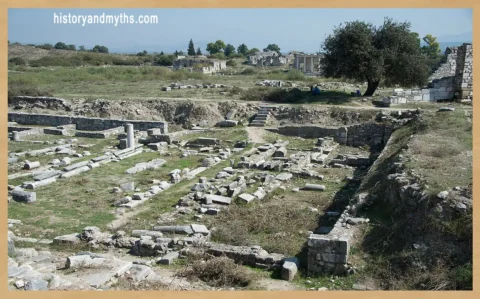
The agora was the central public space where daily life converged. It was not a single-purpose area, but a multifunctional environment where economic, social, and informal political activity took place simultaneously.
Its primary role was economic. Markets operated within the agora, allowing goods to be exchanged directly. This concentrated trade in a single location, making transactions more efficient and predictable. Producers, traders, and buyers interacted within the same space, reducing the distance between supply and demand.
At the same time, the agora functioned as a social hub. People gathered there not only to trade, but to meet, observe, and exchange information. This made it a place where news, ideas, and opinions circulated alongside goods.
Informal political activity also occurred in the agora. While formal decisions were made in designated buildings, discussion and influence often developed in this shared space. Visibility allowed individuals to engage with public life, even outside official settings.
The structure of the agora supported this integration. Open areas allowed movement and interaction, while surrounding buildings provided support functions—storage, administration, and specialized services. This created a system where multiple activities could operate without separation.
The key point is that the agora was not just a marketplace. It was the central node of the polis, where economic exchange, social interaction, and public life intersected in a single, continuous environment.
Temples and Religious Spaces
Temples in ancient Greece were not primarily spaces for collective worship; they were structures that defined the relationship between the community and its gods. Their main function was to house the deity and mark a sacred presence within the city.
Ritual activity took place around the temple, not inside it. Offerings, sacrifices, and gatherings were conducted in open areas, making religious practice visible and shared. This positioned temples as focal points for public ritual rather than enclosed spaces for congregation.
Their importance extended beyond religion. Temples represented stability and continuity within the polis. By dedicating resources to construction and maintenance, the community reinforced shared identity and collective commitment.
They also functioned as secure spaces. Valuable items—offerings, treasures, and sometimes resources—could be stored within temple complexes. This added an economic dimension, linking religious spaces to material wealth.
Location and scale reflected significance. Temples were often placed in prominent positions, making them visible across the city. This visibility reinforced their role as constant reference points within the urban environment.
The key point is that temples structured religious activity while also contributing to social and economic stability. They were not isolated sacred sites, but integrated elements of how the polis defined identity, value, and continuity.
Theaters and Public Gathering Spaces
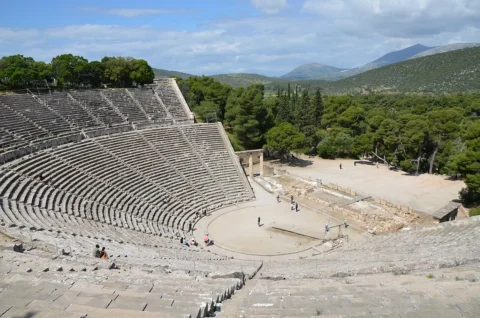
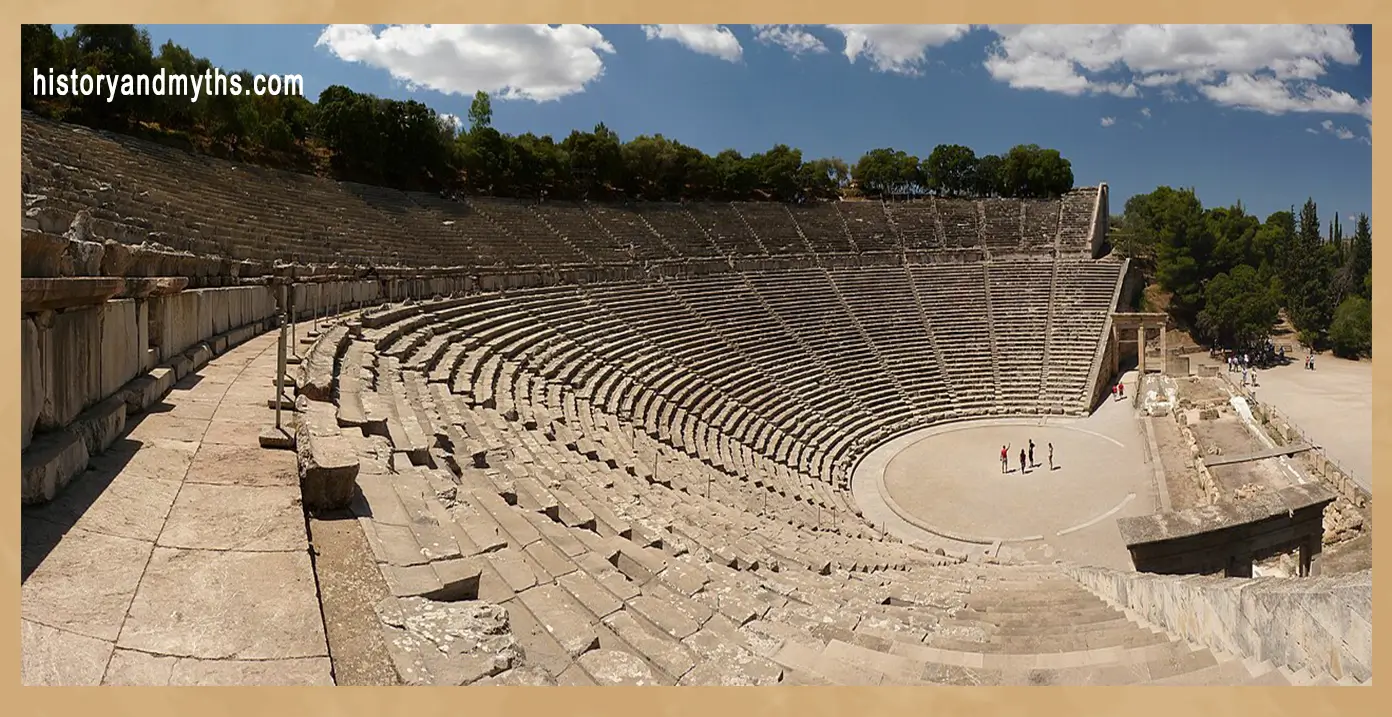
Theaters in ancient Greece were designed to organize large-scale public gatherings, not just to host performances. They created a structured environment where large numbers of people could assemble, observe, and engage in shared experiences.
Their most visible function was performance. Dramatic works—tragedies and comedies—were presented to audiences, but these were not purely for entertainment. They reflected social values, political ideas, and collective concerns, making the theater a space where the community could interpret itself.
The physical design supported this role. Tiered seating allowed visibility for large audiences, while the open layout ensured that events were accessible and public. This made participation possible at a scale that smaller spaces could not accommodate.
Theaters also reinforced civic identity. Attendance at performances was a shared activity that brought together different parts of the population in one place. This created a sense of collective experience, linking individuals to the broader community.
Beyond performances, these spaces demonstrated how the polis managed public presence. They showed that large groups could be organized, directed, and engaged within a defined structure, supporting both social and cultural cohesion.
The key point is that theaters functioned as organized gathering spaces. They combined performance with participation, making them an integral part of how public life was experienced in ancient Greece.
- Public buildings structured economic, political, and social life
- Each space was defined by function, not just design
- The agora acted as the central hub of daily activity
- Temples reinforced identity and continuity
- Theaters organized large-scale public gatherings
- Political buildings formalized governance processes
Administrative and Political Buildings
Administrative and political buildings were the spaces where formal decisions were made and authority was exercised. Unlike the agora, where discussion was open and informal, these structures were designed for controlled processes—deliberation, record-keeping, and governance.
The council house, or bouleuterion, was central to this system. It provided a defined setting where selected members could meet, debate, and prepare decisions. This separated structured political activity from the wider public environment, allowing governance to operate with order and continuity.
Other administrative spaces supported this function. Offices and archives handled records, resources, and communication, ensuring that decisions were documented and implemented. These buildings turned political activity into a repeatable process rather than a series of isolated events.
Access was limited compared to other public spaces. Participation depended on status and role, which created a boundary between those who influenced decisions directly and those who engaged indirectly through public life.
Location reinforced function. Political buildings were often placed near central areas, keeping them connected to the broader civic environment while maintaining a distinct space for formal activity.
The key point is that these buildings structured governance. They provided the framework through which authority was organized, decisions were processed, and political life operated within the polis.
How Public Buildings Organized Daily Life
Public buildings in ancient Greece structured daily life by assigning specific activities to defined spaces. Instead of mixing functions randomly, the polis operated through a spatial system where each type of activity had a place.
Movement followed this structure. Economic activity concentrated in the agora, political processes occurred in designated buildings, and religious rituals took place around temples. This created predictable patterns, where individuals moved between spaces depending on purpose.
This organization reduced complexity. By separating functions, the city made interactions more efficient. Trade happened where goods were available, decisions were made where authority was concentrated, and gatherings occurred where large groups could be managed.
Visibility reinforced this system. Activities took place in open or accessible environments, allowing people to observe and understand how processes worked. This made participation clearer and helped maintain consistency in daily routines.
The layout also shaped behavior. Being in a specific space implied a specific role—buyer, participant, observer, or decision-maker. This connection between place and function helped maintain order without requiring constant enforcement.
The key point is that public buildings did not just host activity—they organized it. They turned daily life into a structured sequence of interactions, making the polis operate as a coordinated system rather than a collection of independent actions.
Architecture as Power and Identity
Greek public buildings were not neutral structures; they communicated authority and identity through their design, scale, and placement. Architecture made power visible and gave the polis a recognizable form.
Scale was the first signal. Large, prominent buildings demonstrated the ability of the community to mobilize resources and labor. This was not only practical—it showed that the polis had the capacity to build, maintain, and organize at a collective level.
Design reinforced this message. Consistent architectural forms and proportions created a sense of order and stability. When buildings followed recognizable patterns, they conveyed continuity and control rather than improvisation.
Location amplified impact. Placing major structures in visible or elevated positions ensured that they were constantly present in daily experience. This made authority and identity part of the physical environment, not something abstract.
Symbolism added another layer. Religious buildings represented shared beliefs, while political structures reflected governance. Together, they expressed what the community valued and how it understood itself.
What matters is that architecture shaped perception. It influenced how people understood the polis by making its structure, priorities, and power visible in physical form.
The key point is that public buildings did more than serve functions—they expressed identity and reinforced authority through their presence.
The Limits of Greek Public Infrastructure
Greek public buildings organized civic life effectively, but they operated within clear structural limits. These limits were defined by scale, resources, and access.
The first constraint was capacity. Even well-designed spaces could only accommodate a portion of the population at any given time. Large gatherings were possible, but not continuous or universal, which limited how often full participation could occur.
Resources also set boundaries. Construction and maintenance required labor and materials, which were not unlimited. This restricted how many public buildings could be built and how large they could become.
Access was another limitation. Not all individuals participated equally in public life. Social status, role, and circumstance determined who could enter certain spaces and take part in specific activities. This meant that “public” did not always include everyone.
Geography influenced distribution. While central areas were well developed, other parts of the city had fewer structured spaces. This created uneven access to public functions depending on location.
There was also no centralized system coordinating infrastructure across different poleis. Each city developed its own buildings based on local needs, which limited standardization at a broader level.
The key point is that Greek public infrastructure was effective but not universal. It structured civic life within its limits, but it did not provide full access or unlimited capacity across the entire population.
- Greek public buildings organized shared civic activities
- The agora connected economic and social life
- Temples represented religious and cultural identity
- Theaters enabled large-scale public participation
- Political buildings structured decision-making and authority
- The system was effective but limited by scale and access
Frequently Asked Questions
What were public buildings in ancient Greece?
They were shared spaces used for economic, political, religious, and social activities.
What was the agora used for?
It was the central area for trade, social interaction, and informal public life.
Were temples only for worship?
No, they also symbolized identity and could store valuable resources.
What role did theaters play?
They hosted performances and organized large public gatherings.
Where were political decisions made?
In council buildings and other administrative spaces.
Did everyone have access to public buildings?
Access varied depending on status and role within the polis.
Why are Greek public buildings important today?
They show how civic life was organized and how space shaped social and political systems.
Sources & Rights
- Lawrence, A.W. Greek Architecture. Yale University Press.
- Hansen, Mogens Herman. Polis: An Introduction to the Ancient Greek City-State.
- Camp, John. The Athenian Agora. Thames & Hudson.
- Cartledge, Paul. Ancient Greece. Oxford University Press.
- Osborne, Robin. Classical Greece.
- Whitley, James. The Archaeology of Ancient Greece.
- Snodgrass, Anthony. Archaic Greece.
- Harris, Edward. The Ancient Greek Economy.
- Finley, M.I. The Ancient Economy.
- Bresson, Alain. The Making of the Ancient Greek Economy.
- Thucydides. History of the Peloponnesian War.
- Herodotus. Histories.
- Aristotle. Politics.
- Xenophon. Oeconomicus.
- Strabo. Geography.
- Diodorus Siculus. Library of History.
- Neer, Richard. Greek Art and Archaeology.
- Hurwit, Jeffrey. The Acropolis in the Age of Pericles.
- Wycherley, R.E. How the Greeks Built Cities.
- Stewart, Andrew. Classical Greece and the Birth of Western Art.
Written by H. Moses — All rights reserved © Mythology and History