How Trade Worked in the Ancient Greek Agora (Daily System)
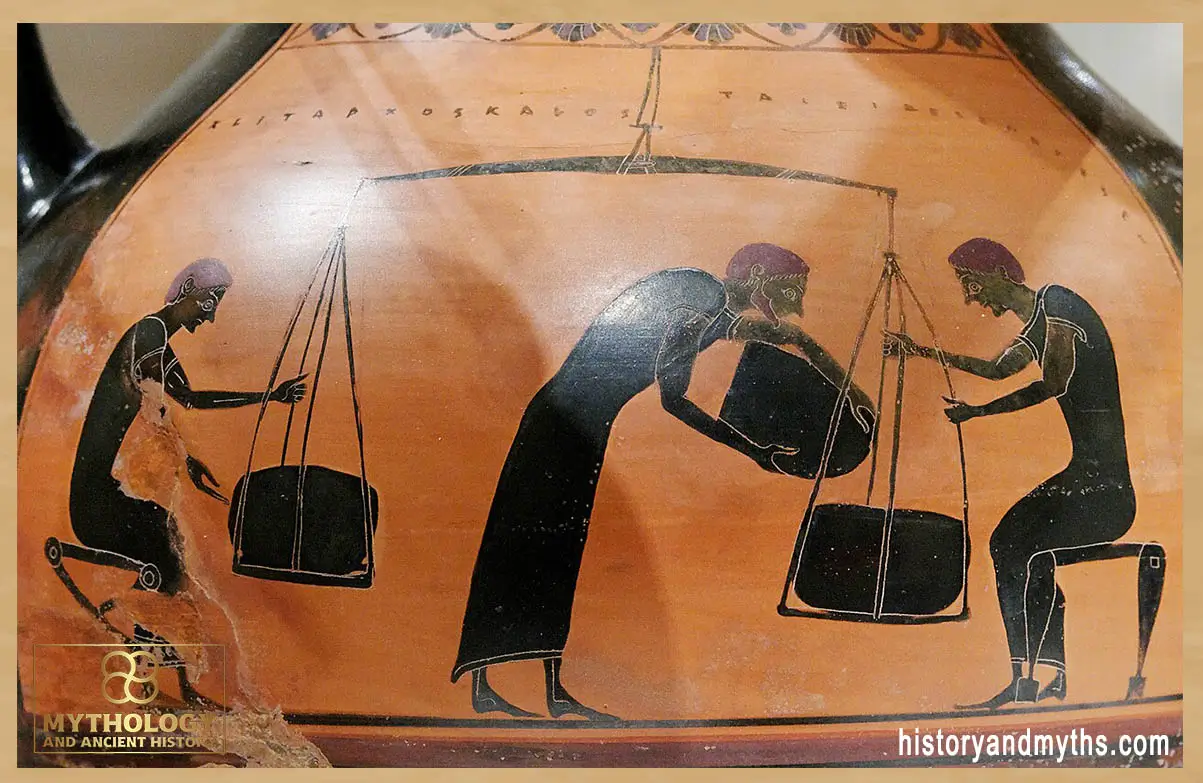
Ancient Greek trade in the agora worked as a structured daily system of exchange, not random buying and selling. Farmers, craftsmen, and merchants brought goods into the market early, displayed them in fixed areas, and negotiated prices directly with buyers. Shoppers compared quality, checked weights, and bargained face-to-face, while city officials monitored fairness, prices, and measures to prevent fraud. Goods flowed constantly from countryside farms, local workshops, and nearby ports into the agora, making it the central mechanism that connected production to consumption in everyday Greek life.
How the Agora Turned Daily Needs into Trade
The agora did not operate as a passive marketplace; it functioned as a conversion point where daily needs became structured transactions. Demand started the process. Households needed bread, oil, pottery, tools—basic, repeat purchases. Sellers responded by bringing limited quantities tied to what they could produce or transport that day. This constraint mattered. It forced constant interaction between supply and immediate demand, creating a fast-moving exchange cycle rather than long-term inventory selling.
Trade began early. Vendors arrived at first light, secured space, and arranged goods visibly. Position was not random—regular sellers often occupied familiar spots, allowing returning buyers to locate trusted sources quickly. This reduced search time and built micro-reputations inside the market. A buyer looking for oil, for example, did not scan the entire agora; he went directly to known sellers and compared within a small cluster.
Transactions were short but information-heavy. Buyers asked direct questions: origin, freshness, weight, durability. Sellers responded in real time, often adjusting claims based on competition nearby. There was no separation between marketing and selling—the negotiation itself revealed value. If a product failed to attract attention, the seller reacted immediately by lowering price, improving display, or emphasizing quality.
The key mechanism here is continuous price discovery under constraint. No fixed pricing system dominated daily trade. Instead, value emerged through repeated micro-negotiations across similar goods. Because buyers could compare side-by-side within minutes, sellers were forced into realistic pricing ranges. Overpricing meant no sales; underpricing reduced margins. The balance formed dynamically each day.
This system explains why the agora remained central to Greek economic life. It was not just where goods were exchanged—it was where value was constantly tested, adjusted, and confirmed through direct human interaction.
| Mechanism | How It Worked | Daily Impact |
|---|---|---|
| Supply Entry | Goods arrived daily from farms, workshops, and ports | Availability changed every morning |
| Seller Types | Producers, retailers, and traders operated side by side | Created competition and price variation |
| Buyer Behavior | Inspection, comparison, and quick decisions | Maintained quality standards |
| Price Formation | Negotiation based on quality, time, and alternatives | Flexible pricing throughout the day |
| Regulation | Officials enforced weights, quality, and order | Reduced fraud and stabilized trade |
Who Sold Goods in the Greek Agora?
The sellers in the agora were not a single group. Trade depended on three distinct types of participants, each operating under different constraints and strategies.
Primary producers—farmers and small-scale craftsmen—brought their own goods directly to market. A farmer selling olives or grain worked with limited daily supply and needed quick turnover. He priced to sell within hours, not days. Craftsmen—potters, metalworkers, textile producers—operated differently. Their goods had longer production cycles, so they focused on durability and differentiation rather than volume. Their pricing allowed more room for negotiation because quality varied more visibly.
Professional retailers acted as intermediaries. They did not produce goods; they bought in bulk from producers or arriving traders and resold in smaller quantities. Their advantage was consistency. While a farmer might appear only on certain days, a retailer maintained a regular presence. This reliability attracted repeat buyers and allowed tighter control over pricing because customers valued availability as much as cost.
Itinerant traders connected the agora to external supply. They brought goods from other regions—wine, metals, luxury items—and operated with higher margins due to transport risk and scarcity. Unlike local sellers, they relied less on repeat relationships and more on product uniqueness. Their presence introduced variation into the market, forcing local sellers to adjust when imported goods competed directly.
These roles created a layered selling environment. Producers pushed volume under time pressure, retailers stabilized supply and pricing, and traders injected new goods and price shifts. The interaction between them prevented any single pricing model from dominating, keeping the market responsive and competitive on a daily basis.
How Buyers Chose, Checked, and Compared Goods
Buying in the agora was a fast evaluation process, not a passive choice. The buyer’s goal was to reduce uncertainty within minutes using direct inspection and comparison.
The first filter was visual sorting. Buyers scanned multiple stalls offering the same category—grain, oil, pottery—and narrowed options by appearance alone: color, texture, finish, or visible defects. This step eliminated weak options quickly without discussion.
Next came physical checking. Food items were handled, smelled, or even tasted when possible. Dry goods like grain were checked for impurities or moisture. Pottery was tapped lightly to detect cracks. Tools were tested for weight and balance. These actions were standard, not exceptional—they formed the baseline of trust before any price discussion.
After inspection, buyers moved to side-by-side comparison. The agora’s layout made this efficient. Competing sellers stood within short distance, allowing immediate switching. A buyer could check three sellers in minutes and return to the strongest option. This mobility forced sellers to stay within competitive quality and price ranges.
The final step was decision under time pressure. Goods were limited and demand was active. Delaying too long risked losing the best option. Buyers balanced price, quality, and availability in real time, often choosing a “good enough” deal rather than searching for perfection.
This process explains how trust functioned without formal guarantees. Verification happened directly through the buyer’s actions, and comparison across nearby sellers kept both quality and pricing in check.
- Daily supply reset — no long-term stock buffering
- Direct buyer–seller interaction shaped prices
- Competition existed within walking distance
- Time pressure influenced negotiation outcomes
- Officials enforced fairness without controlling trade
© historyandmyths.com — Educational use
How Prices Were Set Through Bargaining
Prices in the agora were not posted in a fixed system. They emerged through short, repeated bargaining between buyer and seller, shaped by competition, supply, and urgency.
The seller usually opened with a higher price. This was not arbitrary—it created room to adjust based on the buyer’s reaction. The buyer responded with a lower offer, often referencing nearby alternatives or visible flaws in the product. Each side used immediate, observable facts: freshness, size, scarcity, or competing prices within a few steps.
Negotiation moved quickly. Most exchanges lasted seconds, not minutes. If the gap between offers was small, the deal closed. If not, the buyer walked away. This exit option was critical—it forced sellers to stay within a realistic range because buyers could switch stalls instantly.
Timing influenced outcomes. Early in the day, sellers held firmer prices, expecting more buyers. As time passed and unsold goods remained—especially perishables—prices softened. This created predictable patterns: stronger margins early, faster concessions later.
Market officials added a boundary. While bargaining was free, fraud was not. Standard weights and measures limited manipulation, so price differences reflected negotiation, not hidden cheating.
The result was a decentralized pricing system. No authority set daily prices; they formed continuously through hundreds of small negotiations, adjusting to supply, demand, and time within the same day.
How Goods Moved from Farms, Workshops, and Ports
The agora depended on steady, short-distance movement of goods rather than large, centralized storage. Supply entered the market through three main channels, each with its own rhythm.
Rural inflow came from nearby farms. Farmers transported produce at first light—often by foot, mule, or cart—to ensure freshness and secure early buyers. Perishable goods dominated this flow, which meant the supply was reset daily. What arrived that morning defined what could be sold that day.
Urban production fed the market from within the city. Workshops produced pottery, tools, textiles, and small manufactured items. These goods moved in smaller batches but with more consistency. Unlike farm produce, they were less time-sensitive, allowing sellers to manage inventory across multiple days.
Maritime supply connected the agora to external goods through nearby ports. Imported items—wine, metals, fine ceramics—entered the city in bulk, then filtered into the market through traders or retailers. This flow was irregular but impactful; when new shipments arrived, they shifted both availability and pricing.
There was no warehouse system smoothing supply. Movement was direct: source → seller → buyer within a short time window. This created a market where availability changed daily, forcing both sellers and buyers to act within the constraints of that day’s supply.
Why Market Officials Mattered in Everyday Trade
The agora did not run on trust alone. Officials enforced the rules that made rapid, face-to-face trade workable at scale.
Their primary control point was measurement. Standard weights and measures were checked on the spot. If a seller used altered scales or false containers, penalties followed immediately. This reduced hidden manipulation and kept bargaining focused on visible factors like quality and quantity.
They also monitored product integrity. Selling spoiled or diluted goods—especially staples like oil or wine—was treated as a violation, not a negotiation issue. Inspections were practical: officials sampled, observed, and responded quickly to complaints raised by buyers.
Price oversight appeared in sensitive goods. For items critical to daily life, authorities could intervene if pricing moved outside acceptable bounds during shortages. This did not eliminate bargaining, but it prevented extreme spikes that could destabilize supply.
Finally, officials enforced market order. They regulated where goods could be sold and who could sell them, limiting overcrowding and conflict between sellers. This spatial control kept comparison efficient and reduced friction during peak hours.
These actions created a controlled environment where buyers could rely on basic fairness without slowing down the transaction process. The system did not remove risk, but it narrowed it enough to keep trade moving continuously.
What the Agora Reveals About Greek Economic Life
The agora shows that the Greek economy functioned through constant small-scale exchange, not large, centralized control. Production, pricing, and distribution were all pushed into daily interaction rather than managed from above.
First, it reveals a decentralized system. No single authority set prices or controlled supply in normal conditions. Value formed through repeated transactions between individuals. This kept the market flexible but also dependent on continuous participation.
Second, it shows speed over storage. Goods moved quickly from source to buyer with minimal holding. This reduced the need for large inventories but increased sensitivity to daily changes in supply. A weak harvest or delayed shipment was felt immediately inside the market.
Third, it highlights information as a market force. Buyers and sellers operated with direct, visible data—quality, availability, nearby prices. Decisions were based on what could be checked instantly, not on long-term contracts or abstract pricing systems.
Finally, it reflects a socially embedded economy. Trade was not isolated from civic life. Reputation, repeated interaction, and public visibility shaped behavior as much as profit. A seller who failed consistently lost position in the market, while reliability translated into steady demand.
The agora, in practice, was not just a place of exchange. It was the mechanism that coordinated production, distribution, and value in everyday Greek life through continuous, direct interaction.
- The agora operated as a daily exchange system, not a static market
- Prices were formed through fast, repeated bargaining
- Buyers controlled quality through direct inspection
- Supply changed daily based on local and imported goods
- Officials ensured fairness without fixing prices
Frequently Asked Questions
How did trade work in the Greek agora?
Trade worked through direct buying, selling, and bargaining between individuals, with goods arriving daily from local and external sources.
Were prices fixed in the agora?
No. Prices were negotiated based on quality, competition, and timing within the day.
Who sold goods in the Greek agora?
Farmers, craftsmen, retailers, and traveling traders all participated in selling goods.
How did buyers check product quality?
Buyers inspected, handled, and compared goods directly before purchasing.
Did the government control trade in the agora?
Officials enforced fairness and standards but did not control daily pricing.
Where did goods in the agora come from?
Goods came from nearby farms, urban workshops, and imported shipments through ports.
Sources & Rights
- Bresson, Alain. The Making of the Ancient Greek Economy: Institutions, Markets, and Growth in the City-States. Princeton University Press, 2016.
- Davies, J.K. The Greek Economy. Cambridge University Press, 2007.
- Cartledge, Paul. Ancient Greece: A History in Eleven Cities. Oxford University Press, 2009.
- Harris, Edward M. Democracy and the Rule of Law in Classical Athens. Cambridge University Press, 2006.
- Ober, Josiah. The Rise and Fall of Classical Greece. Princeton University Press, 2015.
- Foxhall, Lin. Studying Gender in Classical Antiquity. Cambridge University Press, 2013.
- de Ste. Croix, G.E.M. The Class Struggle in the Ancient Greek World. Cornell University Press, 1981.
- Finley, M.I. The Ancient Economy. University of California Press, 1999 (updated edition).
- Morley, Neville. Trade in Classical Antiquity. Cambridge University Press, 2007.
- Vlassopoulos, Kostas. Unthinking the Greek Polis: Ancient Greek History Beyond Eurocentrism. Cambridge University Press, 2007.
- Osborne, Robin. Greece in the Making 1200–479 BC. Routledge, 2009.
- Shipton, Katherine. Money and the Elite in Classical Athens. Cambridge University Press, 2000.
- Amemiya, Toru. Economy and Economics of Ancient Greece. Routledge, 2007.
- Burford, Alison. Craftsmen in Greek and Roman Society. Cornell University Press, 1972.
- Garnsey, Peter. Famine and Food Supply in the Graeco-Roman World. Cambridge University Press, 1988.
- Hansen, Mogens Herman. The Athenian Democracy in the Age of Demosthenes. University of Oklahoma Press, 1991.
- Loomis, William T. Wages, Welfare Costs and Inflation in Classical Athens. University of Michigan Press, 1998.
- Isager, Signe, and Jens Erik Skydsgaard. Ancient Greek Agriculture. Routledge, 1992.
- Cohen, Edward E. Athenian Economy and Society: A Banking Perspective. Princeton University Press, 1992.
- Meiggs, Russell. The Athenian Empire. Oxford University Press, 1972.
- Aristotle. The Athenian Constitution.
- Xenophon. Oeconomicus.
- Demosthenes. Private Orations.
Written by H. Moses — All rights reserved © Mythology and History