Ancient Greek Olympics: History, Events, and Real System
The ancient Greek Olympics were not simply athletic games—they were a structured system that linked religion, politics, and identity across the Greek world. Held every four years at Olympia, the Games functioned as a pan-Greek institution where rival city-states competed under shared rules, common rituals, and a unified cultural framework centered on Zeus.
What made the Olympics powerful was not the competition itself, but the system behind it: a recurring event that temporarily reorganized the Greek world—standardizing time (Olympiads), creating controlled interaction between enemies, and turning athletic victory into political influence and social status. This article breaks that system down—how it worked, why it mattered, and how it shaped Greek civilization beyond the stadium.
The Panhellenic System: How the Olympics Unified Greece
The Olympic Games operated as a Panhellenic system, meaning they created a shared framework that connected otherwise independent and often hostile Greek city-states. There was no central government in ancient Greece—each polis acted autonomously—so the Olympics filled a structural gap: they provided a recurring, neutral platform where all Greeks could participate under the same rules.
This system was exclusive by design. Only Greeks were allowed to compete, which turned the Games into a mechanism for defining identity. Participation itself became a statement: you were not just representing your city, but confirming your place within the wider Greek world. In practical terms, the Olympics helped transform fragmented local identities into a broader concept of “Hellenic” identity.
A key component of this system was the Olympic truce, known as ekecheiria. Contrary to the common assumption, it was not a full political peace. Its primary function was to guarantee safe movement—athletes, officials, and spectators could travel to and from Olympia without being attacked.
This created something rare in Greek history: temporary mobility across hostile territories, enforced by religious obligation rather than political authority.
The Games also standardized time across Greece. The four-year cycle, or Olympiad, became a shared chronological system used to date events beyond local calendars. This matters structurally: when different states begin to measure time using the same reference point, they are operating inside a unified cultural framework.
Equally important, the Olympics created a controlled environment for interaction. Rival elites—athletes, politicians, envoys—gathered in one place under predictable conditions. Alliances could be announced, reputations built, and influence projected. The Games did not eliminate conflict; they reorganized it into regulated competition.
From a system perspective, the Olympics solved a core problem of Greek civilization: how to connect a decentralized world without centralizing it. They did not unify Greece politically—but they made it function as a coherent cultural system.
| System Layer | Function | Impact on Greek Civilization |
|---|---|---|
| Religious System | Worship of Zeus and ritual structure | Unified belief and sacred timing |
| Panhellenic System | Shared framework for all Greeks | Created common identity across city-states |
| Athletic System | Controlled competition and selection | Produced elite representatives |
| Political System | Projection of power and prestige | Replaced conflict with symbolic competition |
| Economic System | Periodic trade and resource flow | Created cyclical economic activity |
| Social System | Status creation and fame | Reinforced elite hierarchy |
The Athletic System: Rules, Training, and Selection
The Olympic Games were not open competitions—they operated under a controlled athletic system that determined who could participate, how they trained, and how competition was conducted.
Eligibility was strictly defined. Only free Greek males could compete, and participation required proof of Greek identity. Athletes also had to undergo a preparation period, including formal training and registration under officials. This was not symbolic—entry into the Games depended on meeting these conditions, which filtered competitors before they even reached Olympia.
Training itself was institutionalized. Athletes typically prepared in gymnasia within their city-states, but before the Games, they were required to train under supervision in Elis, near Olympia. This created a level of standardization—competitors were not arriving randomly; they were processed through a controlled pre-competition phase.
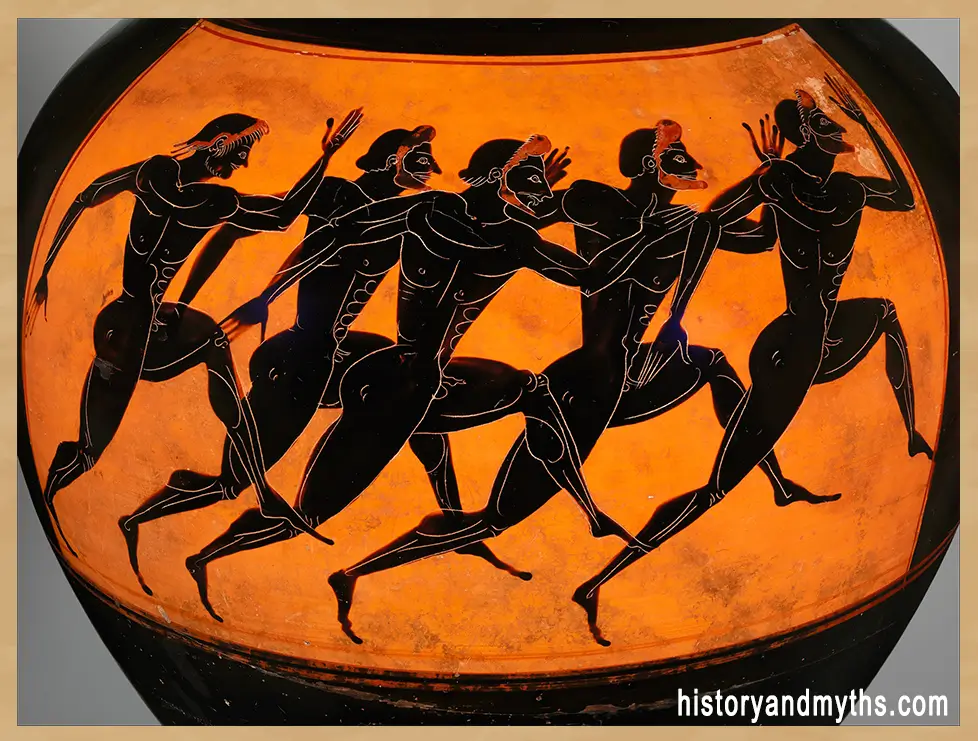
The structure of events was also system-based. Competitions followed fixed categories—running, wrestling, boxing, pankration, and pentathlon—each with defined rules and progression. There were no team sports or large-scale tournaments; the system focused on individual performance, where victory was absolute and public.
Another key element was professionalism. Although often described as “amateur,” Olympic athletes were not casual participants. Many trained full-time, supported by their city-states or patrons. Victory brought significant rewards—financial, political, and social—making competition highly strategic rather than purely recreational.
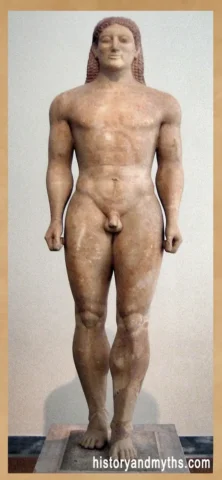
Even the presentation of the athlete was regulated. Competing nude was not incidental; it reflected ideals of physical perfection, discipline, and equality within the competitive space. All athletes entered under the same visible conditions—status outside the Games was temporarily stripped away, but only within the limits of the system.
From a system perspective, the Olympics created a controlled environment for elite competition. It was not about participation—it was about filtering, standardizing, and showcasing the best representatives of each city-state within a fixed and repeatable structure.
The Political System Behind the Games
The Olympics were not politically neutral. They operated as a structured platform where city-states projected power, influence, and legitimacy without direct warfare.
At the simplest level, every athlete represented his polis. A victory was not personal—it was political capital. Winning at Olympia elevated the status of the city itself, turning athletic success into a form of symbolic dominance. This is why city-states invested in athletes, rewarded victors heavily, and publicized their achievements.
Rulers and elites used the Games strategically. Tyrants and kings sponsored competitors, funded monuments, and commissioned statues to associate themselves with victory. The sanctuary became a display zone of political messaging—dedications, inscriptions, and offerings were not just religious acts, but signals of wealth and power.
The Games also functioned as a diplomatic environment. Because representatives from across Greece gathered in one place under predictable conditions, the Olympics created opportunities for negotiation, alliance signaling, and public announcements. This was not formal diplomacy in the modern sense, but it served a similar function: communication between rival powers without immediate conflict.
Another layer was internal politics. Victorious athletes often gained influence within their own cities. Their success could translate into political roles, public honor, or elite status. In some cases, athletic fame became a pathway into leadership or reinforced existing power structures.
Importantly, the Olympics did not remove political tension—they channeled it into controlled forms. Instead of direct confrontation, cities competed through athletes, visibility, and reputation. The Games became a stage where power was displayed rather than enforced.
From a system perspective, the Olympics acted as a soft power mechanism. They allowed Greek city-states to compete, communicate, and assert dominance within a shared framework—without requiring centralized control or constant warfare.
How the Olympic System Actually Worked
- Religious core defined purpose and timing
- Panhellenic structure connected all Greek city-states
- Strict athletic rules filtered elite competitors only
- Victories translated into political influence
- Economic activity peaked around the event cycle
- Winners became long-term symbols of status and identity
© historyandmyths.com — Educational use
The Economic System of Olympia
The Olympics operated as a recurring economic hub built around a predictable event cycle. Every four years, Olympia transformed from a religious sanctuary into a temporary marketplace attracting athletes, officials, merchants, and spectators from across the Greek world.
This concentration of movement created demand. Traders brought goods, craftsmen offered services, and cities invested resources to support their participants. The Games did not generate a permanent economy, but they created periodic economic intensity—short bursts of high activity tied to the Olympic cycle.
Athletes themselves were part of this system. Although the official prize was symbolic, victors received substantial rewards from their city-states—money, privileges, and public support. This created an indirect economic incentive structure: cities invested in potential winners because victory translated into prestige, which justified the cost.
Sanctuary space also functioned as an economic display. Offerings, statues, and monuments required funding, labor, and materials, turning religious dedication into visible expenditure. Wealth was not just possessed—it was demonstrated publicly within Olympia.
From a system perspective, the Olympics did not operate as a commercial market in the modern sense, but they created a cyclical economic network—driven by movement, visibility, and prestige rather than continuous trade.
The Social System: Status, Fame, and Elite Identity
The Olympics functioned as a system for producing and distributing social status. Victory did not just mean winning a competition—it created a public identity that extended beyond the Games.
Winners were elevated into elite figures. Their names were recorded, celebrated in poetry, and associated with their city’s reputation. This visibility transformed athletic success into long-term social capital—recognition that could influence status within their community and across the Greek world.
The system also reinforced hierarchy. Participation was already restricted to free Greek males, which meant the Games reflected and amplified existing social structures rather than challenging them. Within this framework, victory separated individuals even further, placing them above their peers as symbols of excellence and discipline.
Recognition was not temporary. Victors often received privileges from their city-states—financial rewards, public honors, and sometimes political influence. Their success became part of the city’s identity, and in return, the city reinforced their elevated position.
From a system perspective, the Olympics created a mechanism for elite formation. They identified individuals, amplified their visibility, and integrated them into a broader structure of prestige that extended beyond sport into social and political life.
Continue Reading
Why the System Collapsed
The Olympic system did not collapse suddenly—it lost its function gradually as the structure of the Greek world changed.
The first shift came with the expansion of Roman control. As Greece became part of the Roman sphere, the Games continued, but their original role as a pan-Greek system weakened. The political landscape was no longer decentralized in the same way, so the Olympics were no longer needed to connect independent city-states. They survived, but as tradition rather than necessity.
At the same time, the meaning of competition changed. Roman influence introduced different cultural priorities—spectacle over ritual, entertainment over structured identity. The Games remained active, but the underlying system that gave them significance began to erode.
The decisive break came with the rise of Christianity as the dominant religious framework. The Olympics were fundamentally tied to pagan worship, particularly the cult of Zeus. As imperial policy shifted against traditional religious practices, the foundation of the Games was no longer acceptable.
In 393 AD, Emperor Theodosius I officially banned pagan festivals, which included the Olympic Games. This did not just end a sporting event—it removed the religious core that sustained the entire system.
From a system perspective, the Olympics disappeared because the conditions that made them necessary no longer existed. Once political unity replaced fragmentation, and a new religious system replaced the old one, the Olympic framework lost its function—and without function, it could not survive.
Key Takeaways
- The Olympics were a system linking religion, politics, and identity—not just sports.
- They unified Greek city-states without central political control.
- Competition was structured to produce elite individuals, not mass participation.
- Victories carried political and social power beyond the Games.
- The system declined when its religious and political foundations disappeared.
Frequently Asked Questions
What was the main purpose of the ancient Olympics?
The Olympics were primarily a religious event dedicated to Zeus, structured to combine worship with competition.
Were the ancient Olympics peaceful events?
No. Wars continued, but safe passage was allowed for participants traveling to Olympia.
Who could participate in the Olympic Games?
Only free Greek males were allowed to compete, making the Games exclusive by design.
Did athletes get rewards in ancient Greece?
Yes. While the official prize was symbolic, winners received wealth, honors, and political influence from their city-states.
Why were the Olympics important to Greek identity?
They created a shared system that connected independent city-states under common rules and beliefs.
Why did the ancient Olympics end?
They ended after pagan religious practices were banned under Roman rule in the late 4th century AD.
Sources & Rights
- Golden, Mark. Sport and Society in Ancient Greece. Cambridge University Press.
- Miller, Stephen G. Ancient Greek Athletics. Yale University Press.
- Kyle, Donald G. Sport and Spectacle in the Ancient World. Wiley-Blackwell.
- Swaddling, Judith. The Ancient Olympic Games. University of Texas Press.
- Finley, M. I., and H. W. Pleket. The Olympic Games: The First Thousand Years. Dover Publications.
- Young, David C. A Brief History of the Olympic Games. Wiley-Blackwell.
- Scanlon, Thomas F. Eros and Greek Athletics. Oxford University Press.
- Pomeroy, Sarah B. Ancient Greece: A Political, Social, and Cultural History. Oxford University Press.
- Hornblower, Simon, and Antony Spawforth. The Oxford Classical Dictionary. Oxford University Press.
- Cartledge, Paul. Ancient Greece: A Very Short Introduction. Oxford University Press.
Written by H. Moses — All rights reserved © Mythology and History