Arsameia: The Ancient Tunnel & Royal Cult of a Greek-Iranian Kingdom
Arsameia on the Nymphaios was an ancient settlement and royal religious center in the kingdom of Commagene, in what is now southeastern Türkiye. During the first century BCE, King Antiochus I developed a sanctuary honoring his father, Mithridates I Kallinikos, where Greek inscriptions, monumental reliefs, and religious ceremonies expressed the dynasty’s Greek and Iranian heritage.
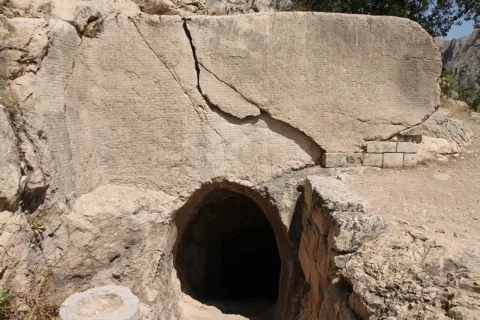
Among its most remarkable features is a 158.1-meter staircase tunnel carved into the rock beneath a monumental Greek inscription. Long associated with access to groundwater, the tunnel gained renewed scholarly attention in November 2026, when archaeologist Lennart Wouter Kruijer proposed that it may also have shaped the religious experience of pilgrims. Whether descending into it formed part of a ritual journey associated with the underworld, however, remains unproven.
What Was Arsameia in Ancient Commagene?
Arsameia on the Nymphaios stood near modern Eski Kâhta in Türkiye’s Adıyaman Province, overlooking the Nymphaios River, now known as the Kâhta Çayı. It was one of the principal settlements of Commagene, a kingdom that emerged from the declining Seleucid Empire in the second century BCE. While Samosata served as the capital, Arsameia became an important center of dynastic power and religious life.
According to the Great Cult Inscription commissioned by Antiochus I, the city was founded and fortified by his ancestor Arsames, generally associated with the third century BCE. Arsames also founded another settlement of the same name, Arsameia on the Euphrates, near modern Gerger.
Archaeological evidence suggests that substantial building activity at Arsameia preceded the reign of Antiochus. In a 2021 reassessment, Lennart Kruijer and Stefan Riedel examined mosaic pavements, architectural fragments, pottery, and two stamped Rhodian amphora handles dating from the second and early first centuries BCE. These finds support the possibility that some buildings originated during the reign of Mithridates I and were subsequently incorporated into his son’s architectural program.
Although excavations have revealed much of the royal sanctuary, the precise location and extent of the ancient city described in the inscription remain uncertain.
Mithridates I and the Origins of the Royal Cult
Arsameia’s royal sanctuary was closely associated with Mithridates I Kallinikos, who ruled Commagene before his son Antiochus I. Mithridates married Laodice, a daughter of the Seleucid king Antiochus VIII, strengthening the dynasty’s connections to the Greek-speaking royal houses of the eastern Mediterranean.
According to the Great Cult Inscription, Mithridates prepared Arsameia as his burial place. Antiochus later restored and embellished the site, transforming it into a hierothesion, a sanctuary combining royal commemoration with religious worship. Scholars disagree over how much of this program originated under Mithridates. The inscription credits him with earlier preparations, but the surviving monumental evidence belongs predominantly to his son’s reign.
By honoring his father and emphasizing both his claimed Persian ancestry and documented Seleucid family connections, Antiochus used dynastic worship to reinforce his royal authority.
The cult also extended beyond Arsameia. Smaller sanctuaries across Commagene allowed communities to participate in royal celebrations without traveling to the principal tomb-sanctuaries, making dynastic worship part of religious life throughout the kingdom.
What Does the Great Cult Inscription Reveal?
Carved into the rock above the entrance to Arsameia’s long staircase tunnel, the Great Cult Inscription contains five columns of Greek text commissioned by Antiochus I. It records the sanctuary’s history and establishes a religious law, or nomos, governing the worship of the royal family.
The inscription provides detailed evidence of how the cult operated. The law prescribed two monthly festivals commemorating the birthdays of Antiochus and his father, Mithridates I. Priests supervised the ceremonies, prepared offerings, and organized communal feasts. They were also instructed to welcome both local worshippers and visitors from outside Commagene.
The regulations required sacred tables to be supplied with appropriate foods and vessels filled with wine mixed with water. Drinking cups dedicated by the king were reserved for participants while they remained within the sanctuary.
The inscription also invokes divine protection and warns against violating the sanctuary’s regulations. Antiochus presented these rules as sacred obligations, giving his religious foundation an authority intended to endure beyond his lifetime.
The inscription establishes what Antiochus ordered his priests and subjects to do, although it cannot tell us how consistently those instructions were followed.
The Sacred Road and the Royal Tomb-Sanctuary
Visitors approaching Arsameia from the Nymphaios valley followed a winding road up the hillside, passing three principal cult stations before reaching the upper sanctuary. The route brought them past carved royal reliefs and places associated with offerings and dynastic commemoration.
The second station contained an imposing rock-cut hall with an arched ceiling rising approximately nine meters. A short staircase passage, about ten meters long, led toward an underground chamber traditionally identified as the possible burial place of Mithridates I Kallinikos. Another relief near the entrance depicted Antiochus I with his father. Although the sanctuary was explicitly dedicated to Mithridates, the archaeological evidence does not establish with certainty that his remains were deposited in this chamber.
Farther uphill, the third station combined a monumental royal relief, the Great Cult Inscription, and the entrance to the much longer staircase tunnel. At the summit stood the principal ceremonial complex, including banquet halls and colossal limestone statues representing the king and the gods. Whether every visitor followed an obligatory ritual sequence remains uncertain.
Antiochus I and Artagnes-Herakles: Gods and Kingship
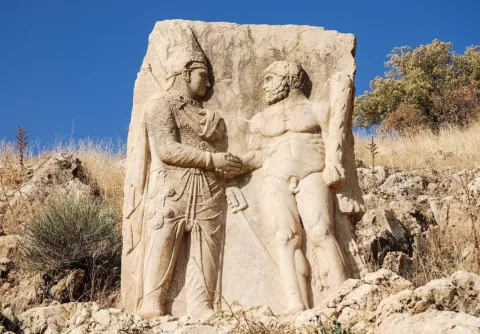
One of Arsameia’s best-preserved reliefs depicts Antiochus I shaking hands with Artagnes-Herakles, a deity combining the Iranian Verethragna with the Greek Herakles. Known as dexiosis, this gesture was central to the royal imagery developed under Antiochus.
The contrast between the figures is striking. Antiochus wears an elaborate tiara and Persian-style royal clothing, while Herakles appears almost naked, carrying his club and lion skin. Both stand at nearly equal height, presenting the king as someone who enjoyed a privileged relationship with the divine.
This combination extended beyond a single relief. Antiochus promoted a pantheon that included Zeus-Oromasdes, Apollo-Mithras-Helios-Hermes, and Artagnes-Herakles-Ares. Their names joined Greek and Iranian divine identities, while their representations drew on different artistic traditions.
What Was the Arsameia Tunnel Used For?
The staircase tunnel at Arsameia extends 158.1 meters into the rock, descending from a horseshoe-shaped entrance approximately two meters high and 1.5 meters wide. Its uneven steps lead past two circular shafts cut into the floor near the lower end, where the passage terminates without an exit.
One explanation is that the tunnel provided access to groundwater. Similar passages occur at fortified sites across Anatolia, where reliable water supplies were essential during sieges. At Karalar, near Ankara, a staircase tunnel ends in a shaft that fills with water during winter. The ancient geographer Strabo also described rock-cut water passages at Amaseia, reinforcing the practical importance of such structures.
An earlier military interpretation identified these tunnels as secret escape routes. However, the absence of an exit at Arsameia, as at many comparable Anatolian tunnels, makes that explanation difficult to sustain.
The tunnel’s construction date is equally uncertain. Its integration with the monumental inscription demonstrates its place within the late Hellenistic sanctuary, but does not establish when it was first excavated. It may have originated before Antiochus I developed the royal cult complex.
A practical function did not necessarily exclude religious associations. At Kurul Fortress, for example, archaeologists discovered a statue of Kybele near the entrance to another staircase tunnel.
Did the Arsameia Tunnel Lead Symbolically to the Underworld?
In his November 2026 study, archaeologist Lennart Wouter Kruijer examined how the tunnel’s physical features might have shaped the movements and perceptions of visitors to Arsameia’s royal sanctuary.
The interpretation draws partly on the tunnel’s position near the presumed tomb of Mithridates I and beneath the relief of Antiochus greeting Artagnes-Herakles. In Greek mythology, Herakles entered the underworld, making his presence above the passage potentially significant. Kruijer suggests that visitors familiar with these traditions might have associated the descent with death and the divine realm.
The experience itself could reinforce such associations. Daylight diminished, the temperature dropped, and the steep, irregular steps demanded careful movement. Kruijer describes the entrance as a kind of trap, not because it physically imprisoned visitors, but because its confined setting could capture their attention.
Groundwater provides another connection. Its levels fluctuated with the seasons, while the Great Cult Inscription described local water in sacred terms. Kruijer argues that supplying the sanctuary with water and contributing to its religious significance were not necessarily separate functions.
The evidence, however, does not establish an underworld ritual. No surviving inscription instructs pilgrims to descend the tunnel, and there is no direct testimony describing ceremonies inside it. The association with Herakles, the nearby tomb, and the sensory experience of descending offer a possible interpretation, not proof of a prescribed religious practice.
Was Arsameia Connected to Roman Mithraism?
Mithras had a place in the royal religion of Commagene, but this does not mean that Arsameia was a center of Roman Mithraism. The sanctuary’s inscriptions identify the god under the combined name Mithras-Helios-Apollo-Hermes, while a separate inscription on the back of a relief stele mentions a priest dedicated to his worship.
Early excavators, including Friedrich Karl Dörner, suggested that Arsameia’s rock-cut passage might have been an early form of the underground temples later used by Roman followers of Mithras. Known as mithraea, these sanctuaries were associated with initiation ceremonies and commonly featured an image of Mithras killing a bull, a scene known as tauroctony.
Neither a bull-slaying relief nor evidence of Mithraic initiation has been identified in Arsameia’s tunnel. A genuine Roman mithraeum was discovered at Doliche, elsewhere in ancient Commagene, but it belongs to a later religious tradition.
Scholars have proposed connections between the worship of Mithras under Antiochus I and the Roman mysteries that developed during the imperial period. The extent of that continuity remains disputed.
Arsameia and Mount Nemrut
Arsameia and Mount Nemrut were separate royal sanctuaries within the same religious program established by Antiochus I of Commagene. Arsameia honored his father, Mithridates I Kallinikos, while Mount Nemrut, approximately 2,150 meters above sea level, housed the monumental tomb-sanctuary Antiochus prepared for himself.
Their architecture differed considerably. Arsameia’s monuments occupied a hillside connected by a sacred road, with rock-cut chambers, reliefs, and a long staircase tunnel. At Nemrut, an enormous mound of crushed stone stood between ceremonial terraces lined with colossal statues, ancestral reliefs, and altars.
Both sites expressed the dynasty’s claimed Greek and Persian ancestry, but their monuments were not necessarily used in identical ways. At Nemrut, relief stelae formed part of ceremonial arrangements with altars placed before them. At Arsameia, comparable images stood along the approach to the main sanctuary, suggesting a different relationship between visitors, religious images, and ritual activity.
The Decline and Rediscovery of Arsameia
Arsameia’s royal sanctuary appears to have been abandoned during the first century CE, when a large agricultural structure replaced its principal religious complex.
Excavations southwest of Eski Kale uncovered a mosaic-decorated building, now tentatively identified as a Late Antique bathhouse associated with a rural settlement. Another excavation area revealed furnaces used for ironworking. These discoveries indicate that the landscape continued to support domestic and productive activities long after the royal cult declined.
The site’s modern identification began in 1951, when German archaeologist Friedrich Karl Dörner discovered the Greek inscription naming Arsameia. Between 1953 and 1956, Dörner and American archaeologist Theresa Goell excavated the sanctuary, revealing its principal monuments. Further investigations in 1963–1965 uncovered evidence of later occupation but failed to locate the ancient urban settlement described in the inscription.
Archaeological work resumed in 2024 under the Adıyaman Museum Directorate. Meanwhile, renewed study of Dörner’s excavation archives has helped researchers reassess the site’s buildings and later history.
Conclusion
Arsameia reveals how the kings of Commagene turned dynastic remembrance into an organized form of worship. Its Greek inscription preserves the rules governing that cult, while its monuments place royal authority within a landscape shaped by both Greek and Iranian traditions.
The tunnel leaves one question unresolved: whether a passage of uncertain original purpose also played a role in the sanctuary’s religious experience.
Academic Sources & Primary Texts
- Kruijer, Lennart Wouter (2026).
Descent into a Trap: Pilgrim Affordances of the Rock-Cut Staircase Tunnel at Arsameia on the Nymphaios.
Journal of Roman Archaeology.
The latest archaeological interpretation of the tunnel, its possible religious associations, and the limits of the evidence. - Dörner, Friedrich Karl, and Theresa Goell (1963).
Arsameia am Nymphaios: Die Ausgrabungen im Hierothesion des Mithradates Kallinikos von 1953–1956.
Istanbuler Forschungen.
The original excavation report documenting the sanctuary, monuments, inscriptions, and archaeological remains. - Waldmann, Helmut (1973).
Die kommagenischen Kultreformen unter König Mithradates I. Kallinikos und seinem Sohne Antiochos I.
Brill.
A scholarly study of the royal cult reforms and the Greek religious inscriptions. - Kruijer, Lennart, and Stefan Riedel (2021).
Transforming Objectscapes in Samosata: The Impact of the Palatial Complex.
In Common Dwelling Place of All the Gods.
Reassesses archaeological evidence for building activity at Arsameia before Antiochus I. - Brijder, Herman A. G. (2014).
Nemrud Dagi: Recent Archaeological Research and Preservation and Restoration Activities in the Tomb Sanctuary on Mount Nemrud.
De Gruyter.
Archaeological research on the sanctuaries, royal monuments, and religious program of Commagene. - Adrych, Philippa, et al. (2017).
Syncretisms: Apollo-Mithras in Commagene.
In Images of Mithra, Oxford University Press.
Examines Mithras in Commagene and the interaction of Greek and Iranian divine traditions. - Intagliata, Emanuele E. (2024).
The Mosaic Field at Eski Kahta, Adiyaman Province.
Jahrbuch für Antike und Christentum, 67, pp. 133–147.
Reassesses later archaeological remains using the Dörner excavation archive. - Encyclopaedia Iranica.
Antiochus of Commagene.
Academic reference on Antiochus I, his dynastic ancestry, royal ideology, and religious policy.
Copyright & Content Rights
© 2026 History & Myths. All rights reserved.
Original article by H. Moses. Historical interpretations are based on the archaeological evidence and academic research cited above. The article’s original text may not be reproduced without permission, except as permitted by applicable copyright law. Third-party images and source materials remain subject to their respective licenses and attribution requirements.