Owain and the Lady of the Fountain: A Welsh Arthurian Romance
Owain and the Lady of the Fountain is one of the three medieval Welsh Arthurian romances included in the Mabinogion. It tells the story of a knight of King Arthur’s court who wins the hand of a noblewoman after defeating the guardian of a mysterious fountain. When Owain breaks his promise to his wife, he loses his position and must earn back his honour.
The tale is closely related to Chrétien de Troyes’ Yvain, the Knight of the Lion, though the origins and relationship of the two romances remain subjects of scholarly debate.
Who Was Owain in Welsh Tradition?
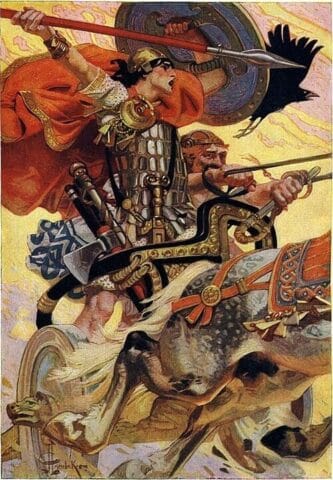
The literary Owain is associated with Owain mab Urien, a sixth-century warrior and son of Urien, ruler of Rheged, a Brittonic kingdom in northern Britain. Early Welsh poetry attributed to Taliesin celebrates his military achievements and mourns his death.
Medieval Arthurian tradition transformed this warrior into a knight of King Arthur’s court, known as Yvain in French literature. Although the character has historical roots, his adventures at the fountain are literary inventions rather than historical events.
The Fountain and the Black Knight
The adventure begins at Arthur’s court in Caerleon, where Cynon recounts his defeat by a mysterious knight. During his travels, he encountered a giant who commanded wild animals and directed him to a fountain beneath a tree. Following the giant’s instructions, Cynon poured water from a bowl onto a stone slab, unleashing a violent storm that stripped the tree of its leaves. When the sky cleared, birds gathered in its branches and began to sing. A knight dressed in black then appeared and defeated him.
Owain sets out to find the fountain and repeats the ritual, provoking an even more violent storm. He mortally wounds the Black Knight and pursues him into his castle, where a falling portcullis cuts his horse in two, leaving Owain trapped between the gates.
Luned and the Lady of the Fountain
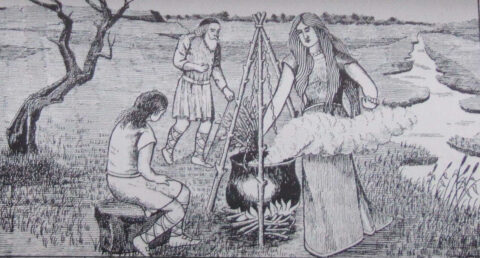
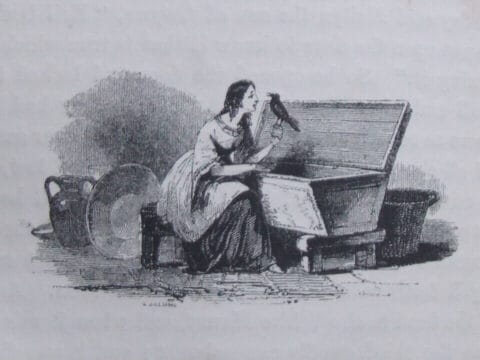
Luned, an attendant of the Lady of the Fountain, rescues Owain by giving him a ring that makes him invisible. From his hiding place, he witnesses the funeral of the knight he has mortally wounded and falls in love with his widow.
Luned pretends to travel to Arthur’s court in search of a new defender but secretly shelters Owain. When she introduces him to her mistress, the countess recognises him as the man who killed her husband. Luned argues that his victory demonstrates his ability to protect her lands.
The countess consults her subjects, who agree that she should marry a warrior from outside their territory. Following the marriage, the men of the earldom swear allegiance to Owain. For three years, he defends the fountain, ransoming defeated knights and sharing the proceeds among his barons and followers.
Owain’s Broken Promise and Exile
After three years, Arthur sets out to find Owain, guided by Cynon. At the fountain, Owain defeats several of Arthur’s knights before facing Gwalchmai, known as Gawain in French literature. Neither recognises the other during their three-day combat. When their identities become clear, each insists that the other deserves victory, and Arthur settles the dispute by taking both swords.
At Arthur’s request, the countess agrees to let Owain accompany the king for three months, although she is reluctant to part with him. Owain remains with his friends and relatives for three years. An unnamed maiden eventually appears at Arthur’s court, condemns him for breaking his promise, and removes his ring.
Ashamed, Owain retreats into the wilderness, where his physical condition gradually deteriorates. A widowed countess discovers him and sends an attendant to treat him with a healing ointment. After recovering, Owain defeats a neighbouring earl and forces him to restore two earldoms he had seized from her.
Owain and the Lion
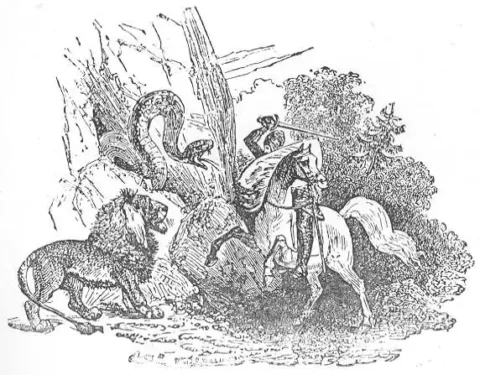
While travelling through a forest, Owain encounters a black lion under attack from a serpent. He kills the serpent, and the lion follows him, providing food, gathering firewood, and guarding him at night.
Owain later finds Luned imprisoned in a stone chamber. Two attendants of the countess have threatened to burn her alive unless Owain comes to defend her. Her imprisonment stems from her refusal to accept their accusations against him.
Before rescuing Luned, Owain confronts a giant who has captured an earl’s two sons and demands his daughter in exchange for their lives. The giant and, later, Luned’s accusers object to the lion’s participation in combat. On both occasions, Owain confines the animal to fight alone, but the lion breaks free when its master is in danger and kills his opponents.
By saving Luned, Owain repays the woman who once saved his life.
Owain’s Return and Final Adventures
After rescuing Luned, Owain is reunited with the Lady of the Fountain and takes her to Arthur’s court. In a subsequent adventure at the Castle of the Black Oppressor, he discovers twenty-four noblewomen whose husbands have been murdered and whose possessions have been stolen.
Owain defeats their captor but spares his life on condition that he transforms his castle into a place of refuge and hospitality. He then returns the women’s possessions and escorts them to Arthur’s court, where they are free to remain or depart.
The romance ends with Owain becoming the head of Arthur’s household before leaving with his army of three hundred ravens, a detail also associated with him in another Welsh tale, The Dream of Rhonabwy.
Owain and Yvain: How Do the Two Romances Differ?
The Welsh Owain shares much of its plot with Yvain, the Knight of the Lion, composed by Chrétien de Troyes in the late twelfth century. The Welsh version is written in prose, while Chrétien’s romance is composed in Old French verse.
The French poem names the Lady of the Fountain Laudine, while her Welsh counterpart remains unnamed. Yvain is allowed to leave his wife for a year, whereas Owain is granted three months. In Chrétien’s version, Gawain encourages Yvain to pursue further adventures and maintain his reputation as a knight.
The endings also differ. Chrétien concludes with the reconciliation between Yvain and Laudine, whereas the Welsh narrative continues beyond the couple’s reunion. Its reference to Owain’s ravens has no equivalent in the French poem.
One curious difference concerns the ring. In Chrétien’s poem, Laudine gives Yvain a ring before his departure. The Welsh narrative contains no corresponding episode, although a maiden later removes a ring from Owain’s hand. Such gaps have prompted scholars to consider whether the Welsh author abbreviated or reworked an earlier narrative.
- S. Loomis argued for Celtic sources behind Chrétien’s romance, while R. L. Thomson remained cautious about the precise relationship between the texts. Ceridwen Lloyd-Morgan considers the French poem the principal source of the surviving Welsh romance. This interpretation still allows for the possibility that Chrétien drew on earlier Brittonic traditions.
The Welsh romance’s treatment of political authority is another distinguishing feature. The countess’s consultation with her subjects and Owain’s distribution of wealth among his followers place his adventures within the obligations of medieval lordship as well as knighthood.
The Medieval Manuscripts of Owain
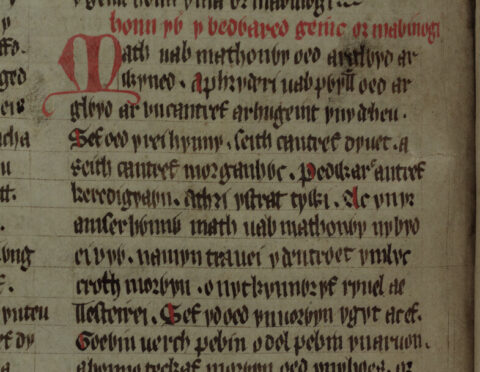
The earliest surviving manuscript evidence for Owain is found in the White Book of Rhydderch (Peniarth MS 4), compiled around 1350, which preserves fragments of the tale. A complete version survives in the Red Book of Hergest, produced between approximately 1382 and 1400. The romance itself is generally dated to the first half of the thirteenth century.Together with Peredur son of Efrawg and Geraint son of Erbin, Owain forms the group known as the Three Welsh Romances. These tales were later published alongside other medieval Welsh narratives in the collection now known as the Mabinogion.
Read Also:
Conclusion
In Owain and the Lady of the Fountain, Owain’s downfall comes not from defeat in battle but from his failure to keep a promise. His redemption rests on learning that the obligations of knighthood matter as much as prowess in combat.
Sources & Primary Texts:
- Charlotte Guest (trans.). The Mabinogion: The Lady of the Fountain.
- Sioned Davies (trans.). The Mabinogion. Oxford University Press, 2007.
- R. L. Thomson (ed.). Owein or Chwedyl Iarlles y Ffynawn. Dublin Institute for Advanced Studies, 1968.
- Chrétien de Troyes. Yvain: The Knight of the Lion. Translated by Burton Raffel. Yale University Press.
- Ceridwen Lloyd-Morgan. “Migrating Narratives: Peredur, Owain, and Geraint.” A Companion to Arthurian Literature. Wiley-Blackwell, 2009.
- University of Rochester, The Camelot Project. The Legend of Yvain.
- National Library of Wales. The White Book of Rhydderch.
- Bodleian Libraries, University of Oxford. The Red Book of Hergest, Jesus College MS 111.