Taliesin: The Legendary Welsh Bard and the Cauldron of Inspiration
Taliesin is one of the most celebrated bards in Welsh tradition, but the legend of his extraordinary birth begins with a boy named Gwion Bach. While tending a magical cauldron prepared by Ceridwen to give wisdom to her son, Gwion accidentally tastes three drops of its brew. He gains the knowledge intended for someone else and flees, changing into different creatures as Ceridwen pursues him. The chase ends with his rebirth as Taliesin, a poet gifted with remarkable wisdom.
Behind the legend stands a poet associated with sixth-century Britain, whose verses survive in later Welsh manuscripts. The story of Gwion Bach and Ceridwen, however, was preserved in much later texts and cannot be treated as the historical poet’s biography.
Who Was Taliesin? The Historical Bard and the Legend
Taliesin is generally regarded as a Brittonic court poet active in the late sixth century. His surviving reputation rests largely on praise poetry associated with Urien Rheged, a ruler in northern Britain, and his son Owain. Other poems attributed to him address Gwallawg of Elfed and Cynan Garwyn of Powys. The ninth-century Historia Brittonum also names Taliesin among the celebrated poets of early Britain.
No contemporary biography of Taliesin survives. The poems associated with him are preserved in the Book of Taliesin (Peniarth MS 2), a Welsh manuscript copied in the first half of the fourteenth century. Scholars identify a small group of poems that may preserve genuine sixth-century compositions, while others reflect later religious, prophetic, and legendary traditions.
Ceridwen and the Cauldron of Inspiration
In Hanes Taliesin, Ceridwen lives with her husband, Tegid Foel, beside Llyn Tegid (Bala Lake) in North Wales. Their daughter, Creirfyw, is renowned for her beauty, while Afagddu is described as exceptionally unattractive. The manuscripts differ over his identity: some identify him with Morfran, while others portray the two as brothers.
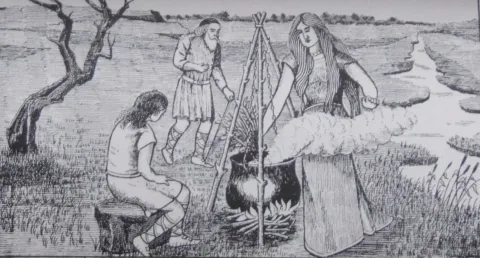
Ceridwen, a powerful enchantress rather than an established ancient Celtic goddess, hopes to compensate for Afagddu’s appearance by granting him extraordinary wisdom and awen, the gift of poetic inspiration. Following instructions from magical and astrological texts, she prepares a potion that must boil continuously for a year and a day, adding herbs at carefully chosen times.
She assigns the young Gwion Bach to stir the cauldron and a blind man named Morda to tend the fire while she gathers the necessary ingredients.
Gwion Bach and the Three Drops of Wisdom
Near the end of the year, while Ceridwen was gathering herbs, three drops of the boiling potion splashed onto Gwion Bach’s finger. The liquid burned him, and he instinctively put his finger into his mouth. He immediately gained knowledge of future events and realized that he would have to escape Ceridwen’s anger.
The cauldron then split apart, spilling the remaining potion, which was poisonous. According to the tale, the liquid flowed into a stream and poisoned the horses of Gwyddno Garanhir that drank from it.
In the version translated by Lady Charlotte Guest, Gwion receives the three drops by accident. The earlier surviving account recorded by Elis Gruffydd tells a different story: Gwion deliberately pushes Morfran aside to receive the gift intended for him.
The Shape-Shifting Chase
When Ceridwen discovered that the potion was lost, she struck Morda with a piece of wood, mistakenly blaming him. Realizing that Gwion Bach had taken the three drops, she pursued him. Gwion transformed into a hare, but Ceridwen became a greyhound and chased him towards a river.
Gwion plunged into the water as a fish, with Ceridwen following as an otter. He then took the form of a bird, but she pursued him through the sky as a hawk. As she closed in, Gwion dropped into a barn and changed into a grain of wheat, hiding among a heap of grain.
Ceridwen became a black hen, searched through the wheat, found Gwion, and swallowed him.
The Birth of Taliesin and His Rescue by Elphin
After swallowing Gwion Bach in the form of a grain of wheat, Ceridwen became pregnant. Nine months later, she gave birth to a beautiful boy. Although she had intended to kill him, she could not bring herself to do it. Instead, she placed the infant in a leather bag and cast him into the sea on April 29.
The following day, Elphin, the unfortunate son of Gwyddno Garanhir, went to inspect his father’s fishing weir on the coast between the River Dyfi and Aberystwyth. He had been granted the day’s catch in the hope of improving his fortunes, but the weir contained no fish. Instead, he found a leather bag caught on one of its posts.
When the bag was opened, the child’s beautiful forehead inspired the name Taliesin, usually translated as “Radiant Brow.” Elphin took the infant with him, and the boy astonished him by speaking in verse, promising that their meeting would bring better fortune. Elphin brought him home, where the child was raised with care.
Taliesin’s Wisdom and His Adventures at Court
When Taliesin was thirteen, Elphin attended a Christmas feast at the court of King Maelgwn Gwynedd in Deganwy. During the celebrations, he boasted that his wife was as virtuous as any woman in the kingdom and that his bard surpassed all the king’s poets. Offended, Maelgwn imprisoned him and set out to challenge both claims.
The king sent his son Rhun to disgrace Elphin’s wife, but Taliesin arranged for a servant to take her place. Rhun drugged the disguised servant and cut off her little finger, taking Elphin’s ring as supposed proof of his wife’s disgrace. Elphin recognized that the finger was not his wife’s, but Maelgwn sent him back to prison.
Taliesin then entered the royal court, where Maelgwn’s twenty-four bards found themselves unable to speak properly. The young poet recited verses proclaiming his knowledge of past ages, creation, and prophecy. When his singing brought a powerful wind against the castle, the frightened king ordered Elphin brought from prison. Taliesin sang again, and the chains fell from his patron’s feet.
The tale also describes a horse race against Maelgwn’s twenty-four horses. Taliesin gave Elphin’s rider twenty-four blackened holly twigs, instructing him to strike each rival horse as he overtook it. He also told the rider to mark the spot where his own horse stumbled. After Elphin’s horse won, they dug at the marked place and discovered a cauldron filled with gold, which Taliesin presented as repayment for rescuing and raising him.
The Meaning of the Cauldron and Awen
Ceridwen’s cauldron represents the source of awen, the Welsh term for poetic inspiration. In Hanes Taliesin, its three powerful drops grant Gwion Bach not only the gift of poetry but also knowledge of future events. His transformation into Taliesin presents inspiration as an extraordinary gift rather than a skill acquired through ordinary learning.
The connection between Ceridwen’s cauldron and poetry predates the surviving prose tale. In the late twelfth or early thirteenth century, the Welsh poet Llywarch ap Llywelyn, known as Prydydd y Moch, invoked God’s gift of awen through a comparison with Ceridwen’s cauldron. Other medieval Welsh poets also referred to her as a source of poetic inspiration.
These earlier references show that the cauldron was already an established image in Welsh bardic poetry. They do not, however, prove that the complete story of Gwion Bach’s transformation existed in its later recorded form.
Where Does the Legend of Taliesin Come From?
The story of Gwion Bach and Ceridwen survives in Hanes Taliesin (The Tale of Taliesin), a Welsh narrative combining prose and poetry. Its earliest surviving manuscript, copied by Elis Gruffydd in the first half of the sixteenth century, forms part of his Chronicle of the Six Ages of the World. Later manuscripts preserve different versions, with some recording the birth of Taliesin but omitting his adventures at Maelgwn’s court.
The legend has older roots. Medieval Welsh poetry refers to Ceridwen’s cauldron and presents Taliesin as a figure of extraordinary knowledge. The fourteenth-century Book of Taliesin, however, is a collection of poems, not a manuscript of the complete Gwion Bach story. These earlier references suggest that elements of the legend circulated long before the surviving prose narrative was written down.
The tale became familiar to English readers when Lady Charlotte Guest included it in The Mabinogion in 1849. Despite that association, Hanes Taliesin is not one of the Four Branches of the Mabinogi and is absent from the principal medieval manuscripts preserving those tales, the White Book of Rhydderch and the Red Book of Hergest.
Conclusion
Taliesin’s legend begins with a gift of wisdom intended for one person but received by another. From Gwion Bach’s escape to Taliesin’s triumph at Maelgwn’s court, the story portrays poetic inspiration as a power that even Ceridwen cannot fully control. Although the tale cannot serve as a biography of the historical bard, it preserves a distinctive Welsh vision of poetry, transformation, and the extraordinary knowledge attributed to Taliesin.
Sources & Primary Texts
This article draws on studies of medieval Welsh literature, manuscript evidence, and historical translations of Hanes Taliesin. The distinction between the sixth-century poet and the later legend is based on the surviving literary evidence.
Academic Studies
- Ford, Patrick K. (1975). “A Fragment of the Hanes Taliesin by Llywelyn Siôn.” Études Celtiques, 14(2), 451-460. Examines manuscript traditions and the transmission of the Taliesin narrative.
- Wood, Juliette (1981). “The Elphin Section of Hanes Taliesin.” Études Celtiques, 18, 229-244. Investigates the episodes involving Elphin, Maelgwn, and the surviving manuscript versions.
- Williams, Sir Ifor (1959). “Taliesin, a Bard Who Sang in the Second Half of the 6th Century.” Dictionary of Welsh Biography. National Library of Wales and the University of Wales Centre for Advanced Welsh and Celtic Studies.
- Hutton, Ronald (2023). “Finding Lost Gods in Wales.” Gresham College lecture. Discusses Ceridwen, medieval Welsh literary traditions, and the later identification of supernatural figures as ancient deities.
Manuscripts & Historical Evidence
- National Library of Wales, Book of Taliesin (Peniarth MS 2). A fourteenth-century manuscript containing poetry attributed to the historical and legendary Taliesin.
- National Library of Wales, Peniarth MS 2 Catalogue Record. Official archival description and manuscript identification.
Historical Translation
- Guest, Lady Charlotte. “Taliesin.” In The Mabinogion, 1877 edition. An English translation of the later Welsh tale, including Gwion Bach, Ceridwen’s cauldron, the transformations, and Taliesin’s adventures at Maelgwn’s court. The tale first appeared in Guest’s collection in 1849.
Copyright & Editorial Notice
© 2026 History & Myths. All rights reserved. Original writing, analysis, and editorial content are protected by copyright. Historical Welsh narratives, medieval texts, and cited scholarly works remain subject to their respective copyright or public-domain status. Images are credited separately where applicable.