The Elatias Sanctuary: Mountain Worship in Ancient Greece
The Elatias sanctuary on Mount Olympus in Euboea preserves evidence of religious activity dating back to the eighth century BCE. Situated at an elevation of 1,138 metres, the site was identified during an archaeological survey in 2025 and first excavated in June 2026.
Pottery and deposits of burnt animal bones suggest that worshippers visited the summit to perform rituals that may have included animal sacrifices and communal meals. The deposits span several centuries, although no temple or altar has yet been identified.
An inscription from nearby Eretria records a dedication to Artemis Olympia, making her a possible candidate for the deity worshipped at Elatias. The sanctuary’s dedication, however, remains uncertain.
Where Is the Elatias Sanctuary?
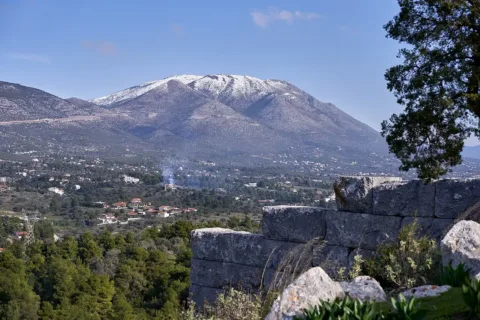
Elatias is one of the highest peaks of Mount Olympus in central Euboea, overlooking the plain between Eretria and Amarynthos. The mountain should not be confused with Mount Olympus in northern mainland Greece, traditionally regarded as the home of the Greek gods.
In antiquity, Eretria was a major city-state whose territory extended beyond its coastal urban centre into the surrounding countryside. Approximately 11 kilometres east of the city stood the sanctuary of Artemis Amarysia, the principal place of worship outside Eretria’s walls.
Elatias occupied a markedly different geographical setting. While the sanctuary at Amarynthos stood near the coastal plain, worshippers visiting Elatias had to ascend rugged mountainous terrain.
How Was the Mountain Sanctuary Discovered?
The possibility of a mountain sanctuary on Euboea’s Mount Olympus had been discussed by scholars since the nineteenth century. Wilhelm Vischer in 1857 and Friedrich Geyer in 1903 considered the mountain in connection with the cult of Artemis Olympia, known from an inscription found in Eretria. For more than a century, the proposed association lacked direct archaeological evidence from the mountain.
In 2025, the Eretria–Amarynthos Survey Project identified concentrations of ancient pottery near the summit of Elatias. The discovery prompted the first excavations, conducted from 5 to 9 June 2026.
In Sector 3, approximately 30 metres below the summit, pottery from different periods was mixed and showed signs of abrasion. These characteristics suggested that erosion had carried material downslope from higher ground, making it difficult to determine where the vessels had originally been used or deposited.
Trench 6, closer to the summit plateau, produced hundreds of pottery fragments and animal bones preserved within natural fissures in the bedrock. Excavations reached a depth of approximately two metres without revealing any constructed architectural features within the trench.
The concentration of pottery and burnt animal remains near the summit strengthened the interpretation of Elatias as a place of worship, even in the absence of identifiable religious architecture. The fissures provided a better-preserved archaeological context than the dispersed material recovered farther down the mountain.
How Long Was the Elatias Sanctuary in Use?
The 2026 excavations extended the known history of the sanctuary back to the Geometric period. Among the earliest finds is a jug with a trefoil mouth dating to the eighth century BCE, when Eretria was emerging as an important city-state and establishing its religious institutions.
Archaic and Classical pottery documents activity during subsequent centuries, while a decorated mould-made bowl dating to the second or first century BCE places visitors at the site during the late Hellenistic period. The excavators also identified material from the Roman Imperial period, extending the chronological range of the finds beyond the Hellenistic kingdoms.
The shapes of the vessels also offer clues to their possible uses. Jugs and bowls may have served for pouring liquids, drinking or communal dining, although their presence alone cannot establish a ritual function.
The earliest pottery establishes that activity at Elatias dates back at least to the eighth century BCE, not necessarily that the sanctuary was founded at that time. Similarly, material from successive historical periods indicates repeated use of the mountain but does not establish uninterrupted worship or the preservation of the same religious traditions throughout its history.
Animal Sacrifice and Ritual Feasting at Elatias
Most of the animal bones recovered from Trench 6 belonged to sheep and goats, although hare and bird remains were also present. Many showed signs of burning, and some were completely calcined, indicating exposure to high temperatures. Calcination alone, however, does not establish whether whole animals or selected body parts were burnt.
In a common form of Greek animal sacrifice known as thysia, portions of the victim were offered to the gods by burning them on an altar, while much of the meat was distributed among the participants. The divine portion often included thigh bones wrapped in fat, although the sacrum and tail vertebrae were also used.
Archaeological evidence from Eretria provides a particularly relevant comparison. According to research by Gunnel Ekroth, burnt thigh bones accounted for 87% of the animal bone assemblage from the city’s sacrificial area (Aire sacrificielle), with sheep and goats predominating. This concentration demonstrates how the deliberate selection of body parts can leave a recognisable archaeological pattern.
At Elatias, the excavators also noted an unusually high representation of certain skeletal elements. Further examination of their anatomical distribution, burning patterns and possible butchery marks may reveal whether the deposits contain portions selected for divine offerings or discarded after communal meals.
The presence of hare and bird bones raises additional questions about the role of wild animals at the sanctuary. Their remains could reflect food consumption or ritual offerings, but their precise function has yet to be established.
Was the Sanctuary Dedicated to Artemis or Zeus?
Two fragmentary inscriptions on pottery recovered at Elatias may preserve the opening letters of divine names or dedicatory formulas. The surviving traces have been tentatively read as alpha (Α) or delta (Δ). The former could refer to Artemis (Ἄρτεμις), while the latter might belong to the dedicatory formula Dii (Διί), meaning “to Zeus.” Neither reading is sufficiently complete to identify the recipient of the dedication.
Zeus’ association with mountain cults makes him a plausible candidate, while the Artemis hypothesis draws on more specific epigraphic evidence from Euboea.
An inscription discovered in Eretria, dating to the late fourth or third century BCE (IG XII, 9, 260), reads:
Χρυσαλλὶς Σημίου Ἀρτέμιδι Ὀλυμπίαι.
“Chrysallis, daughter of Semios, to Artemis Olympia.”
The epithet Olympia suggests a possible connection with Mount Olympus. Although the inscription confirms that Artemis was worshipped under this title in Eretria, it does not establish the location of her sanctuary. It also postdates the earliest pottery from Elatias by several centuries, leaving open the possibility that the dedication of the mountain sanctuary changed over time.
The nearby sanctuary of Artemis Amarysia at Amarynthos illustrates what a secure identification requires. In 2017, inscribed roof tiles and dedications naming Artemis provided direct evidence of the sanctuary’s identity. At Elatias, the connection with Artemis Olympia rests on geographical and epigraphic clues rather than a complete dedication recovered from the sanctuary itself.
Read Also
Elatias and the Sacred Landscape of Eretria
Religious life in ancient Eretria extended well beyond the city walls. The Eretria–Amarynthos Survey Project investigates the relationships between rural sanctuaries, settlements and communication routes, placing sites such as Elatias within the wider territory of the ancient city-state.
On the southern slope of Mount Olympus, a cave previously identified as a place of worship may have had a connection with the summit sanctuary. The excavators have proposed investigating whether a religious procession once linked the two sites.
There is a historical precedent for such processions in Eretrian territory. The sanctuary of Artemis Amarysia at Amarynthos was connected to Eretria through religious celebrations involving movement between the city and its principal extra-urban sanctuary.
Strabo (Geography, 10.1.10) records a law displayed at Amarynthos regulating an annual procession involving 3,000 infantrymen, 600 cavalrymen and 60 chariots. The scale of this procession illustrates how religious journeys could express the collective identity of a Greek city-state.
No comparable written or archaeological evidence has yet established a ceremonial route between the cave and Elatias. Investigating the ancient paths and dating the activity at both sites could help determine whether they functioned independently or formed part of a connected system of mountain worship.
Why Did Ancient Greeks Worship on Mountain Peaks?
Mountain summits were prominent features of the Greek landscape, often visible from several settlements and across extensive stretches of territory. Their religious significance was sometimes connected to natural phenomena, particularly rain and thunderstorms. Zeus, whose power over rainfall was vital to agricultural communities, was among the deities frequently worshipped at high-altitude sanctuaries.
At Hellanion Oros, the highest mountain on Aegina, ancient sources associate the summit with Zeus Hellanios and prayers for rain. Excavations have uncovered dark layers containing thousands of burnt animal bone fragments. Researchers suggest that the ashes and remains of sacrifices were discarded down the mountainside after ceremonies, explaining why ritual deposits may survive at some distance from the original altar. A similar depositional process could explain some of the material found downslope at Elatias, although this has yet to be demonstrated.
Evidence for mountain worship elsewhere in Euboea varies considerably. The cult on Mount Kenaion is known primarily through literary testimony, while the interpretation of religious activity on Mount Ochi and the slopes of the Karababa range remains a subject of archaeological investigation. Elatias provides direct material evidence that can be examined alongside these less securely documented sites.
Greek mountain sanctuaries did not necessarily require monumental temples. Altars, open spaces and natural rock formations could accommodate religious ceremonies. Although the limited excavations at Elatias cannot rule out the existence of religious buildings, the pottery and animal remains demonstrate why archaeological investigation of sacred places must extend beyond architectural evidence.
Conclusion
The discovery of Elatias extends the archaeological record of mountain worship in Euboea back to the Geometric period. Its significance goes beyond identifying the deity worshipped there: the sanctuary offers an opportunity to reconstruct religious practices in the mountainous territory of ancient Eretria, an aspect of Greek religious life that remains less well documented than worship in major urban sanctuaries.
Sources & Primary Texts
Archaeological Reports
- Chezeaux, C., Verdan, S., Allegro, T., Saggini, T., Simosi, A. G., and Fachard, S. (2026). Excavation on the Summit of Elatias, Mount Olympus in Euboea. Swiss School of Archaeology in Greece, Annual Report 2026, pp. 8–10.
- Swiss School of Archaeology in Greece (2025). Annual Report 2025.
- Swiss School of Archaeology in Greece. Eretria–Amarynthos Survey Project (2021–2025).
- Swiss School of Archaeology in Greece. The Sanctuary of Artemis Amarysia at Amarynthos.
- Swiss School of Archaeology in Greece (2023). Excavations at Hellanion Oros, Aegina.
Academic Studies
- Fachard, S., Simosi, A., and Chezeaux, C. (2026). The Eretria–Amarynthos Survey Project. Antike Kunst, 69, pp. 134–139.
- Ekroth, G. (2009). Thighs or Tails? The Osteological Evidence as a Source for Greek Ritual Norms. Kernos, Supplement 21, pp. 125–151.
- Belis, A. M. (2015). Fire on the Mountain: A Comprehensive Study of Greek Mountaintop Sanctuaries. Doctoral dissertation, Princeton University.
- Recent Research at the Sanctuary of Artemis Amarysia in Amarynthos (Euboea). Archaeological Reports, Cambridge University Press.
Primary Classical and Epigraphic Sources
- Inscriptiones Graecae, XII, 9, 260. Dedication to Artemis Olympia from Eretria. Packard Humanities Institute, Searchable Greek Inscriptions.
- Strabo. Geography, Book X, 1.10. Account of the Eretrian procession to Amarynthos.
Copyright Notice
© 2026 History & Myths. All rights reserved.
This article was independently researched, written, and edited for History & Myths. Its original text and analysis may not be reproduced, republished, or distributed without prior written permission, except as permitted by applicable copyright law.Archaeological findings, academic research, ancient inscriptions, and classical sources are credited to their respective authors and institutions. Third-party images remain subject to their individual copyright and licensing terms.