Brigantia: The Celtic Goddess of Roman Britain
Brigantia was a Celtic goddess worshipped in Roman Britain, particularly in the north, where the powerful Brigantes lived. Unlike deities whose stories survive in mythology, she is known mainly through stone inscriptions and a remarkable sculpture discovered at Birrens, in southern Scotland.
The Birrens sculpture shows Brigantia as a winged, helmeted goddess holding a spear and globe, with a shield beside her. Her appearance recalls the Roman goddesses Minerva and Victoria, while other inscriptions explicitly honor her as Victoria Brigantia. These finds show how a local Celtic deity was represented and worshipped within Roman Britain.
Much less is known about Brigantia’s earlier history. Her name is linguistically related to that of the Irish goddess Brigid, but whether they shared more than a common Celtic heritage remains uncertain.
Who Was Brigantia in Roman Britain?
Brigantia was a Celtic deity associated with the Brigantes, a powerful tribal grouping that occupied much of northern England. She is generally understood as a protective goddess of their people or territory, although the surviving inscriptions do not establish how widely she was worshipped among the Brigantes themselves.
Her worship is documented through Roman-period dedications that preserve the names of individual devotees. At Birrens, Amandus, an architectus associated with Roman military engineering, commissioned an image in her honor. At South Shields, Congennicus recorded the fulfillment of a religious vow, while an altar from Adel, near Leeds, bears an offering made by Cingetissa.
An inscription from Greetland, dated to 208 CE, provides a further clue about religious practice. Its dedicator, Titus Aurelius Aurelianus, identifies himself as magister sacrorum, or master of sacred rites. He dedicated the altar to Victoria Brigantia and the divine powers of the emperors on behalf of himself and his family. His title points to an identifiable religious role, although the inscription does not explain the duties involved or establish a formal priesthood devoted exclusively to Brigantia.
These dedications show that Brigantia attracted worshippers within different parts of Romano-British society. They also preserve evidence of personal vows and religious offices, while leaving the larger organization of her cult, its festivals, and its communal ceremonies largely unknown.
What Does the Name Brigantia Mean?
The name Brigantia is generally understood to mean “the High One” or “the Exalted One.” It derives from the Celtic stem brigant-, associated with height, prominence, and elevated status. The same element appears in Brigantes, the name of the northern British people, which may have meant “upland people” or referred to their high social standing.
The shared root raises a question about the relationship between the goddess and the tribe. Was Brigantia an established deity whose name became associated with the Brigantes, or did her identity as their protector develop from the tribal name?
Scholar Noémie Beck argues against assuming that Brigantia’s name was simply created from the name of the Brigantes. She points to related divine names and linguistic forms beyond northern Britain. Alan James, however, considers it more likely that the goddess’s name, at least in northern Britain, developed from the tribal name. He also suggests that Brigantia could have functioned as an honorific title expressing power or prestige, rather than a unique divine name.
The surviving inscriptions cannot settle this question. They show that Brigantia was worshipped under that name during the Roman period, but not when the name first acquired religious significance.
The Irish goddess Brigid belongs to the same linguistic family. Whether the two names also reflect a shared religious identity requires evidence beyond etymology.
What Does the Birrens Relief Reveal About Brigantia?
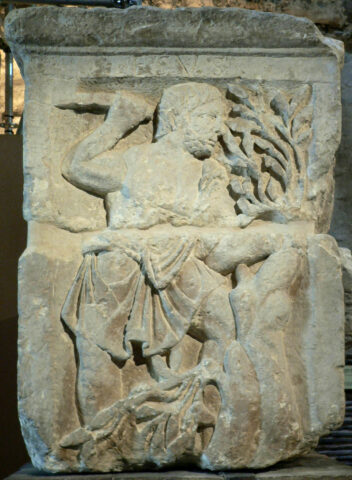
The most detailed surviving depiction of Brigantia was discovered in 1731 among the ruins of a building outside the Roman fort at Birrens (Blatobulgium), in southern Scotland. Carved from sandstone and measuring 91.4 centimetres in height, the relief is now housed in the National Museum of Scotland in Edinburgh.
The goddess stands inside a gabled niche, wearing a plumed helmet encircled by a turreted crown. She has wings and a Gorgon’s head on her chest, holds a spear in her right hand and a globe in her left, and has a shield beside her. A rounded, omphalos-shaped stone appears on the opposite side. The combination recalls Roman images of Minerva and Victoria. Early accounts also report traces of gilding when the sculpture was discovered.
The inscription identifies the figure as Brigantia and names its dedicator, Amandus, an architectus or military engineer. It records that he fulfilled an order, but the abbreviated Latin does not identify who gave it. The wording may refer to a divine command rather than an instruction from a military superior. Unlike images identified through artistic comparisons, this sculpture carries an inscription naming the goddess herself.
Its date has been the subject of an important correction. Earlier scholars identified Amandus with a military engineer recorded in Germany in 209 CE, suggesting that the sculpture belonged to the early third century. The revised Roman Inscriptions of Britain rejects that identification, noting the absence of evidence for occupation at Birrens after approximately 180 CE. The monument is now provisionally assigned to the Hadrianic or Antonine period, making the earlier connection with the Severan era unsupported.
Where Was Brigantia Worshipped?
The surviving inscriptions place Brigantia’s worship across northern Roman Britain, with a noticeable concentration in West Yorkshire. Altars have been found at Greetland near Halifax, Adel near Leeds, and Castleford. The Greetland dedication can be dated precisely to 208 CE, while the Castleford altar, discovered in the River Calder in 1890, has no secure date or known original setting.
Evidence also appears farther north, particularly around the Roman frontier. At South Shields, an altar was discovered just outside the fort, while another dedication comes from Corbridge. A separate inscription, recorded near Brampton in Cumbria during the early seventeenth century, was commissioned by an imperial official during Caracalla’s reign (212–217 CE). The stone is now lost, and its precise findspot remains uncertain. At Birrens, in present-day southern Scotland, the sculpted dedication provides evidence of Brigantia’s worship beyond Hadrian’s Wall.
These finds show that devotion to Brigantia extended across different parts of Roman Britain, from settlements in Yorkshire to military communities near the northern frontier. The presence of soldiers and imperial officials helps explain how her worship could travel beyond its presumed regional origins.
Archaeologists caution against using this distribution to reconstruct the boundaries of the Brigantes before the Roman conquest. The inscriptions document where particular individuals made offerings during Roman rule, not the full geographical extent of an earlier tribal cult. They also tell us little about worship conducted without permanent stone monuments.
Why Was Brigantia Associated with Minerva and Victoria?
In Roman Britain, local gods could be portrayed through the symbols of familiar Roman deities without losing their original names. This practice is commonly discussed under the term interpretatio Romana, although the relationship between indigenous and Roman gods was not always one of complete identification.
The sculpture from Birrens illustrates this process. Brigantia’s weapons and protective imagery recall Minerva, while her wings evoke Victoria, the Roman personification of victory. Scholars have compared the figure with Minerva Victrix, or victorious Minerva. Yet the inscription dedicates the sculpture to Brigantia alone. The resemblance tells us how she was represented, not that her worshippers necessarily regarded her as identical to Minerva.
The association with Victoria rests on more explicit evidence. An altar from Greetland, dated to 208 CE, invokes Dea Victoria Brigantia alongside the divine powers of the two emperors. At Castleford, another altar bears the same divine title and names Aurelius Senopianus as its dedicator. These inscriptions show worshippers addressing Brigantia through a title that directly connected her with victory.
The distinction is important when considering her religious functions. The Roman imagery does not establish that Brigantia governed wisdom, crafts, or every other sphere associated with Minerva. The dedications provide firmer evidence for her connection with victory, but do not tell us what kind of success her worshippers hoped to obtain.
Was Brigantia Also Caelestis or a Water Goddess?
Two inscriptions raise questions about Brigantia’s association with other divine figures, particularly Caelestis and the nymphs.
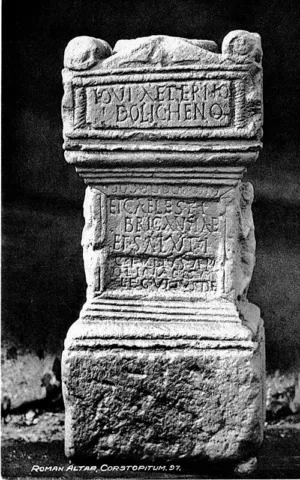
A third-century altar from Corbridge (RIB 1131) was dedicated by Gaius Julius Apolinaris, a centurion of the Sixth Legion, on the command of a god. Its inscription names Jupiter Dolichenus, Caelesti Brigantiae, and Salus. The conventional reading identifies Caelestis Brigantia as a single goddess, suggesting a connection with Juno Caelestis, the Romanized form of the North African goddess Tanit.
Scholar Noémie Beck offers another possibility. Because the Latin names appear in the same grammatical case, the inscription could list Caelestis and Brigantia as separate deities. Beck also notes evidence supporting their identification: Caelestis could be portrayed as an armed protector, sharing attributes with Minerva and Brigantia. Both readings are therefore possible.
The second inscription, RIB 2066, was dedicated by the imperial procurator Marcus Cocceius Nigrinus during Caracalla’s reign (212–217 CE). Its abbreviated wording is conventionally expanded as Deae Nymphae Brigantiae, addressing Brigantia as a goddess-nymph. An alternative reading, however, would make the dedication to a nymph associated with the Brigantes, rather than necessarily to Brigantia herself.
Since nymphs were associated with springs and water, the traditional reading has encouraged descriptions of Brigantia as a water goddess. Yet Beck notes that no known sanctuary or surviving depiction directly connects her with aquatic worship. Nor does the inscription’s prayer for the emperor’s welfare establish that healing was one of Brigantia’s functions.
The evidence supports possible associations with Caelestis and the nymphs, but not a securely documented independent cult of Brigantia centered on water or healing.
Was Brigantia the Same Goddess as Brigid?
Brigantia and the Irish goddess Brigid (Old Irish Brigit) have related Celtic names, suggesting a possible connection between their religious traditions. Yet the evidence for each comes from different periods and tells us different things about their worship.
Brigantia is documented through Roman inscriptions in Britain, particularly those identifying her with Victoria. Brigid appears in medieval Irish literature, including Cormac’s Glossary, which describes her as a goddess of poets and names two sisters, also called Brigit, associated with healing and smithcraft. None of these functions is explicitly attributed to Brigantia in her surviving inscriptions.
A more intriguing parallel concerns victory. Early Irish hymns praise St Brigit as búadach, meaning “victorious,” and invoke her with language celebrating victory. Scholars at University College Cork have drawn attention to the resemblance between these expressions and the Roman title Victoria Brigantia. The comparison raises the possibility of an older religious association, although the hymns concern a Christian saint and were composed centuries after the British inscriptions.
The names and victory imagery provide reasons to investigate a connection, but no surviving myth, ritual, or dedication securely identifies Brigantia and Brigid as the same goddess. Whether they developed from a shared Celtic tradition remains an open question.
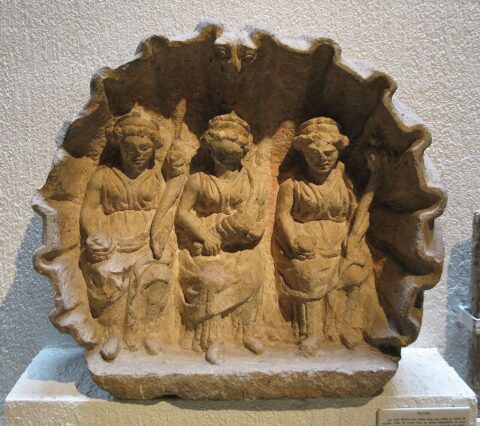
Matres and Matronae: Celtic Mother Goddesses in Roman Europe
Explore how inscriptions and sculptures reveal the worship of local mother goddesses across Roman Britain, Gaul, and the Rhineland.
What Can We Know About Brigantia Before Roman Rule?
Brigantia’s Celtic name suggests roots in indigenous British religion, but the surviving evidence for her worship belongs to the Roman period. The historian Tacitus describes the Brigantes and their queen Cartimandua in the first century CE, concentrating on their political struggles and relations with Rome. He says nothing about Brigantia or the religious practices of the tribe.
Archaeology offers some context without identifying the goddess directly. At Stanwick, in North Yorkshire, extensive earthworks and evidence of elite activity reveal an important centre of political and economic power among the Brigantes during the late Iron Age. However, no securely identified dedication connects the site with Brigantia. The same difficulty applies to ritual deposits elsewhere in northern Britain: without inscriptions or recognizable divine attributes, archaeologists cannot reliably determine which deities received these offerings.
Roman occupation changed how religious devotion was recorded. Stone altars bearing Latin dedications made local deities more visible in the archaeological record. Brigantia may therefore have possessed an older cult that left no identifiable written evidence. Alternatively, her role as a protector of the Brigantes may have acquired greater prominence as regional identities were reshaped under Roman administration.
The surviving material cannot distinguish securely between these possibilities. It documents Brigantia’s worship under Roman rule, but offers no reliable reconstruction of her earlier ceremonies, sanctuaries, or position within Iron Age religion.
Conclusion
Brigantia’s surviving monuments reveal a goddess worshipped by identifiable individuals across northern Roman Britain. Her association with Victoria is explicitly recorded in inscriptions, while the Birrens sculpture shows how Roman religious imagery could be used to represent a Celtic deity.
Other proposed connections, particularly with Caelestis, water nymphs, and the Irish Brigid, rest on less certain evidence. Her worship before the Roman conquest remains difficult to reconstruct. What the surviving monuments do preserve is a distinctive example of local religious devotion expressed through Roman inscriptions, imagery, and personal offerings.
Sources & Primary Texts
- Roman Inscriptions of Britain (RIB).
Primary inscriptions documenting Brigantia’s worship, including
RIB 2091 (Birrens),
RIB 627 (Greetland),
RIB 628 (Castleford),
RIB 630 (Adel),
RIB 1053 (South Shields),
RIB 1131 (Corbridge), and
RIB 2066 (Hadrian’s Wall region). - Beck, Noémie (2013).
“Celtic Divine Names Related to Gaulish and British Population Groups.”
In Théonymie celtique, cultes, interpretatio.
Austrian Academy of Sciences.
Read study. - Wolf, Ismael (2021).
“Brigantia from Birrens: Cultural Interactions in Frontier Zone of Roman Britain.”
Mare Nostrum, 12(1).
Read article. - James, Alan G. (2025 edition).
The Brittonic Language in the Old North,
Volume II: Dictionary, pp. 34–35.
Discussion of the linguistic relationship between Brigantia and the Brigantes.
Read PDF. - Goldberg (2009).
“Hybridisation and Identity,” Chapter 5.
University of Glasgow doctoral research on religious and regional identities in northern Britain.
Read thesis. - University College Cork (2022).
“Brigit: Saint or Goddess?”
Department of Early and Medieval Irish.
Discussion of Brigid, Brigantia, and early Irish references to victory.
Read analysis. - Tacitus.
Histories 3.45 and Annals 12.36–40.
Ancient accounts of Cartimandua and the Brigantes.
Read primary texts via the University of Warwick.
Copyright & Image Credits
© 2026 History & Myths (H. Moses). All rights reserved.
The original research synthesis, analysis, and written content
of this article are protected by copyright.
Ancient inscriptions, historical sources, and archaeological
evidence are discussed for educational and research purposes.
Images, where used, remain subject to their respective
creators’ rights and licenses, with attribution provided
alongside each image.