Púca (Pooka): The Shape-Shifting Spirit of Irish Folklore
The Púca (Pooka) is a shape-shifting creature in Irish folklore, best known for appearing as a horse and carrying travelers on frightening rides after dark. Yet not all encounters were threatening. Some stories describe a mischievous trickster, while others tell of a Púca secretly helping with household chores.
The creature could also appear as a goat or other animal. In parts of Ireland, it was associated with the end of the harvest, when people avoided eating berries believed to have been spoiled by the Púca.
What Is the Púca in Irish Folklore?
In Irish folklore, the Púca is commonly placed among the solitary fairies, supernatural beings encountered apart from the larger fairy hosts. W. B. Yeats included it in this category in Fairy and Folk Tales of the Irish Peasantry (1888), describing it as an animal spirit associated with lonely mountains and old ruins.
The Púca is not known as a deity in the early Irish mythological cycles, nor do surviving sources establish a connection to the Tuatha Dé Danann. Our clearest accounts come from nineteenth-century folklore collections and later oral records, rather than medieval narratives about the Irish gods.
The Meaning and Origins of the Name Púca
The Irish word púca (plural púcaí) appears in English folklore collections under several spellings, including Pooka, Phooka, and Phouka. It is linguistically related to English Puck, from Old English pūca, a term for a goblin or supernatural spirit. Welsh folklore also has a similarly named figure, the pwca.
The word’s origin remains disputed. In 1888, W. B. Yeats mentioned a proposed derivation from the Irish poc, meaning a male goat, without establishing it as fact. Researchers at Ireland’s Placenames Database consider púca a probable borrowing from Middle English following the Anglo-Norman arrival in Ireland. Linguist Erin Sebo, however, has investigated the possibility that the Old English word itself had an Irish origin.
What Does the Púca Look Like?
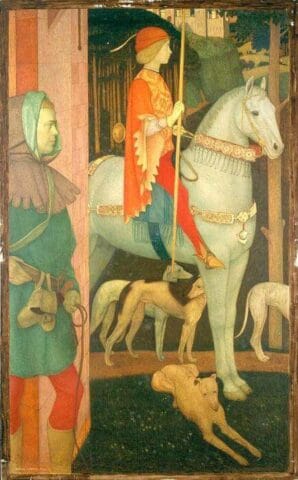
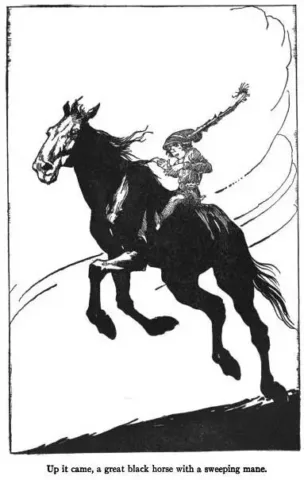
The Púca most commonly appears as a horse, often black, although Irish folklore also records white horses. Some accounts describe the creature as the horse itself, while others portray it riding one.
- B. Yeats listed five animal forms in Fairy and Folk Tales of the Irish Peasantry (1888): horse, donkey, bull, goat, and eagle. Other traditions mention a dog or a human-like figure. Yeats also cited a Leinster tale about a speaking horse that emerged from a hill and foretold future events, although he acknowledged that it might concern a water horse rather than the Púca.
The giant rabbit associated with the Pooka in Harvey is a modern literary interpretation, not an established form in the principal nineteenth-century Irish collections.
The Púca’s Wild Night Rides
In some Irish tales, a traveler who mounts an unfamiliar horse after dark discovers too late that it is the Púca. The creature races across fields, over hedges, and through rough countryside before throwing its passenger off. Other accounts describe the Púca slipping between someone’s legs and carrying them away without warning.
A story from Clounmellane, County Kerry, recorded in 1936, tells of a man repeatedly carried off and thrown into a patch of briars. He eventually confronts the creature wearing spurs, digging them into its sides until it allows him to dismount. When they meet again, the Púca agrees to carry him only if he removes the spurs. From then on, it leaves him alone.
Unlike the deadly each-uisge, the water horse of Irish and Scottish folklore, the Púca’s night rides often ended with the victim frightened or humiliated rather than killed.
Stories of the Púca in Irish Folklore
Two stories preserved in W. B. Yeats’s Fairy and Folk Tales of the Irish Peasantry (1888) offer contrasting accounts of encounters with the Púca.
The Kildare Pooka
In The Kildare Pooka, published by Patrick Kennedy in 1866, servants at a country house are troubled by strange noises from the kitchen after dark. One night, a young servant discovers a talking donkey washing dishes and sweeping the floor.
The creature explains that it was once a lazy servant, condemned after death to perform the work it had neglected. When the household gives it a warm coat to protect it from the cold, the Púca declares that its punishment is over. Having finally earned a reward for its work, it disappears, leaving the servants to resume their chores.
The Piper and the Púca
Douglas Hyde’s The Piper and the Púca, translated from Irish, tells of a poor piper from Dunmore, County Galway, who can play only one tune. One night, a horned Púca carries him to a feast at the Banshee’s house on Croagh Patrick, where hundreds of old women have gathered.
The piper plays for the guests and receives gold coins. A white gander, which he had previously stolen from a priest, also appears and gives him a new set of pipes. Back home, the gold turns into leaves, while the new pipes produce nothing but the cries of geese. Yet his old instrument now plays beautifully, and he becomes the finest piper in Galway.
Was the Púca Dangerous or Helpful?
The Púca could be frightening or generous, but its behavior did not follow a consistent moral code. Kindness sometimes earned its cooperation, although that cooperation could end unexpectedly.
In Lady Wilde’s Fairy Help, the Phouka (1887), a young man named Phadrig offers his coat to a Púca appearing as a bull. Later, an elderly Phouka directs smaller supernatural helpers who grind the family’s corn at night, bringing them considerable wealth. When Phadrig rewards him with fine clothes, the creature abandons the mill, declaring that gentlemen should not grind corn.
At Phadrig’s wedding, a mysterious golden cup appears, which he believes to be a gift from the Phouka.
The Púca, Samhain, and the End of the Harvest
The Púca was associated with Samhain, the traditional beginning of winter around October 31 and November 1. In parts of Ireland, people avoided eating blackberries after Halloween, believing the creature had spoiled them. In County Galway, such fruit was known as sméara cac púca, literally referring to berries fouled by the Púca.
The belief varied by region. A record from Killossery, County Dublin, describes the Púca riding a white horse and destroying blackberries on Halloween night. In Craanford, County Wexford, children were instead warned against eating them after Michaelmas on September 29. The local account explains that the berries had begun to decay, suggesting a practical reason for the warning.
These traditions linked the Púca to the end of the gathering season, but they provide no evidence that it was an ancient harvest deity or that the customs survived unchanged from pre-Christian Celtic religion.
Regional Traditions of the Púca in Ireland
In County Mayo, Tom Munnelly of Muingreevagh near Ballycastle described seeing a Púca resembling a week-old donkey foal. At Howth in County Dublin, a figure called Black Jack or Puck was said to inhabit Howth Castle, making strange noises to frighten people away. Some locals suspected the castle’s owners had invented the story to discourage trespassers.
A tradition recorded at Brosna in County Kerry associates a hollow called Cumairín a’ Phúca with a headless pig, although one informant described the creature as more like a goat. In County Cork, Carrigafooka, meaning the Púca’s Rock, near Macroom, became associated with supernatural mischief and tales of buried treasure.
The creature also left its mark on Irish place names. Poll an Phúca, meaning the Púca’s hole, pool, or cave, occurs in counties including Wicklow, Galway, and Clare. Gleann an Phúca, the Púca’s glen, appears elsewhere. However, Ireland’s Placenames Database cautions that some apparently similar names derive from surnames such as Puck or personal names such as Foulke, rather than the supernatural creature.
The Púca in Historical Folklore Collections and Modern Culture
Thomas Crofton Croker included Púca tales in Fairy Legends and Traditions of the South of Ireland (1825). Later accounts appeared in Patrick Kennedy’s Legendary Fictions of the Irish Celts (1866) and Lady Wilde’s Ancient Legends, Mystic Charms, and Superstitions of Ireland (1887). W. B. Yeats subsequently brought together stories from earlier collectors, including Kennedy and Douglas Hyde, in Fairy and Folk Tales of the Irish Peasantry (1888). These publications remain important sources, although their contents sometimes reflect editorial choices and translation.
The Irish Schools’ Collection (1937 to 1939) offers a different record. Pupils from approximately 5,000 primary schools gathered stories, customs, and local beliefs from relatives and neighbours. Many entries preserve the names and locations of informants, allowing researchers to trace regional traditions more precisely.
The Púca later reached a wider audience through Mary Chase’s play Harvey (1944), adapted into a film in 1950. Its portrayal belongs to modern fiction rather than a recorded Irish folktale.
Conclusion
The Púca cannot be reduced to the black horse of its best-known stories. Accounts of helpful spirits, nighttime mischief, and seasonal warnings reveal how much the figure varied across Ireland. Nineteenth-century folklore collections and later oral records preserve these differences, but they offer no reliable evidence of a single original myth from which all Púca traditions developed.
Sources & Primary Texts
This article draws on scholarly research, nineteenth-century folklore collections, and oral traditions preserved by Ireland’s National Folklore Collection.
Academic Studies
- Breatnach, Deasún (1993). “The Púca: A Multi-Functional Irish Supernatural Entity.” Folklore, 104 (1-2), 105-110.
- Sebo, Erin (2017). “Does OE Puca Have an Irish Origin?” Studia Neophilologica, 89 (2), 167-175.
Historical Folklore Collections
- Croker, Thomas Crofton (1825). Fairy Legends and Traditions of the South of Ireland. Includes traditions concerning the Phooka.
- Yeats, W. B., editor (1888). “The Pooka.” In Fairy and Folk Tales of the Irish Peasantry.
- Kennedy, Patrick (1866). “The Kildare Pooka.” Originally published in Legendary Fictions of the Irish Celts.
- Hyde, Douglas. “The Piper and the Puca.” Irish tale translated by Hyde and included in Yeats’s 1888 collection.
- Wilde, Lady (1887). Ancient Legends, Mystic Charms, and Superstitions of Ireland. See “Fairy Help, the Phouka.”
Folklore Archives & Linguistic Evidence
- National Folklore Collection, University College Dublin. The Schools’ Collection (1937-1939), documenting Irish local beliefs and oral traditions.
- “A Púca Story,” Clounmellane, County Kerry. The Schools’ Collection, recorded in 1936.
- Local Festival Customs, Killossery, County Dublin. Traditional beliefs concerning Halloween and blackberries.
- Festival Customs, Craanford, County Wexford. The Michaelmas tradition concerning blackberries.
- Placenames Database of Ireland (2026). “Púca in Placenames, a Researcher’s Nightmare (2).” Linguistic evidence concerning the name and its interpretation in Irish placenames.
Copyright & Editorial Notice
© 2026 History & Myths. All rights reserved. Original research, analysis, and editorial content are protected by copyright. Traditional folklore narratives and historical source materials remain subject to their respective rights and public-domain status. Images are credited separately where applicable.