What If the Sumerian City-States Had United Earlier?
Long before Sargon of Akkad conquered southern Mesopotamia, the Sumerian city-states competed for land, water, and political power. Cities such as Uruk, Ur, Lagash, and Umma fought repeated wars, yet cooperation was not entirely absent. An ancient inscription records a political relationship between Enmetena of Lagash and Lugal-kinishe-dudu of Uruk. What if that relationship had developed into a lasting union?
A united Sumer might have managed irrigation canals more effectively, strengthened trade, and organized a common army. But bringing rival cities together would not have guaranteed political stability. Their rulers still had competing interests, and disputes over power could have threatened the entire arrangement.
Could an earlier Sumerian union have prevented Sargon’s conquest, or would Akkad have risen regardless? The answer depends on whether the cities could have built a political system strong enough to survive beyond its founders.
Why Did the Sumerian City-States Remain Divided?
During the Early Dynastic period (c. 2900–2350 BCE), Sumer consisted of competing city-states that controlled farmland and settlements beyond their urban centers. Lagash, for example, included Girsu and Nigin, while Uruk, Ur, and Kish pursued their own political interests. Shared religious traditions, writing, and commercial ties did not produce a common government.
The conflict between Lagash and Umma illustrates how difficult cooperation could be. Both claimed rights over the Gu’edena, a fertile tract of land near their border. According to Enmetena’s inscription, Mesilim of Kish had established a boundary between them, but the dispute continued. Eannatum of Lagash later defeated Umma and commemorated his victory on the Stele of the Vultures. Fighting over the territory resumed under subsequent rulers, with agricultural land and irrigation rights remaining at stake.
Some rulers sought power beyond their own cities. Eannatum claimed victories over neighboring states and adopted the title King of Kish, asserting wider political authority. Yet military dominance did not necessarily create lasting unity. Defeated cities retained their local interests, and their submission could end when the balance of power shifted.
The Point of Divergence: An Alliance Between Lagash and Uruk
A royal inscription records that Enmetena of Lagash and Lugal-kinishe-dudu of Uruk established brotherhood during the Early Dynastic period. The Sumerian term nam-šeš suggests a formal political relationship, although its precise nature remains uncertain.
The inscription does not specify the agreement’s terms. Scholars have questioned whether the two rulers were equal partners or whether the arrangement reflected an imbalance of power. Nothing in the surviving evidence indicates that they established a unified state.
In our alternate scenario, the rulers take their agreement further. They establish a permanent council to resolve disputes, coordinate military assistance, and negotiate with neighboring cities. They also introduce provisions intended to preserve the alliance beyond their own reigns, creating the possibility of a broader political union.
The Alternate Scenario: A United Sumer Emerges
Note: The following section presents an alternate historical scenario based on real historical conditions, but the events described below are hypothetical.
The alliance’s first serious test comes at Umma. Its long conflict with Lagash over the Gu’edena had survived earlier boundary settlements and military defeats. Enmetena now offers a compromise: the recognized boundary remains in place, while access to water and maintenance responsibilities come under joint supervision. With Uruk guaranteeing the agreement, Umma’s ruler accepts rather than face another confrontation.
Lugal-kinishe-dudu already holds authority in Ur as well as Uruk, giving the alliance a wider political base. Other southern cities are offered membership without surrendering their local governments or religious institutions. In return, they must contribute to common defense and accept decisions on disputes between members.
At Nippur, participating rulers swear to uphold their commitments before Enlil. The ceremony gives their political agreement religious legitimacy, while shared military and economic interests encourage further cities to join.
Within a generation, much of southern Sumer operates under a common political authority. Local rulers retain control over their cities, but disputes affecting the wider union are no longer theirs to settle independently.
How Would a United Sumer Be Governed?
The union would preserve the institutions already governing each city. Local rulers, holding titles such as ensi or lugal, would continue administering their territories, while temples retained their religious and economic roles. Matters affecting several cities would fall under the authority of the joint council.
Meeting at Nippur, the council would settle disputes between members, manage shared obligations, and negotiate with foreign powers. Sumerian scribes could record agreements, contributions, and decisions using established administrative practices. Enforcing those decisions would be harder, particularly when a powerful city opposed the council’s ruling.
Choosing the council’s leader would present a serious political challenge. If one dynasty attempted to make the position hereditary, other cities might resist. Allowing the council to select its own leader could limit that risk, although disputed appointments might still divide its members. Without an accepted procedure for transferring authority, the council itself could become an arena for rivalry between cities.
Could Unification Transform Irrigation and Trade?
Agriculture in southern Mesopotamia depended on irrigation canals that required regular clearing and repair. Disputes over access to irrigated land, as seen in the conflict between Lagash and Umma, could become sources of political tension.
In a united Sumer, member cities could coordinate canal maintenance, contribute workers to shared projects, and establish rules for allocating water during shortages. Officials and scribes already had experience organizing irrigation work. The change would be extending that cooperation across political boundaries.
Trade could benefit as well. Rivers and canals provided routes for transporting grain and other goods between settlements. Reduced warfare and better maintenance of waterways might make these journeys more reliable. Southern Mesopotamia also depended on imports of timber, metals, and stone, making access to external trade networks particularly important.
Flooding, shifting river channels, and disagreements over labor contributions would still threaten these arrangements. Maintaining shared infrastructure would require resources even when individual cities saw little immediate benefit.
Would a United Sumer Have a Stronger Army?
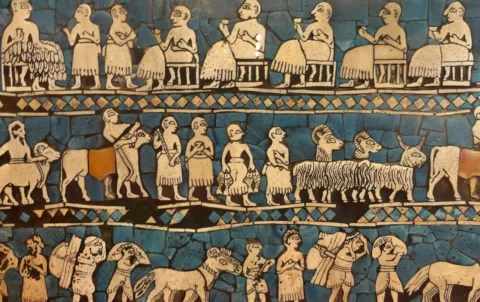
The Stele of the Vultures, commissioned by Eannatum of Lagash, depicts infantry advancing in close formation with spears and large shields. Sumerian rulers already possessed organized military forces. A political union could increase their effectiveness by bringing troops from several cities under a single command.
Each member city could supply soldiers, weapons, and provisions for joint campaigns. The council would appoint a commander and coordinate deployments, allowing the union to concentrate its forces against external threats rather than fight separate wars. Such arrangements might also reduce the need for individual cities to maintain constant military pressure on their neighbors.
The difficulties would emerge during prolonged campaigns. Many soldiers were drawn from populations needed for agricultural work, and local rulers might resist sending troops far from home. Commanders could disagree over strategy, while disputes over captured territory or wealth might weaken cooperation. A joint army could defend the union effectively yet struggle to remain united during an ambitious campaign of conquest.
Could Sargon Still Have Founded the Akkadian Empire?
Sargon did not conquer a completely fragmented Sumer. Before his rise, Lugalzagesi of Umma had established control over much of southern Mesopotamia and ruled as king of Uruk. Sargon defeated and captured him, then extended his conquests across the region, including Ur and Umma.
An earlier Sumerian union might have presented a different challenge. If the alliance founded by Enmetena and Lugal-kinishe-dudu had survived for generations, its institutions could have coordinated resistance across several cities. Defeating one ruler would not necessarily dismantle a political system supported by others.
Sargon might still have built a powerful kingdom in northern Mesopotamia. He could have challenged the southern union militarily, negotiated with its leaders, or supported cities dissatisfied with their obligations. A dispute over succession might have offered him an opportunity to intervene.
The Akkadian Empire could therefore have emerged under different circumstances, perhaps without controlling all of Sumer. The decisive question was not whether the southern cities possessed a powerful ruler, as Lugalzagesi already demonstrated, but whether their political institutions could withstand the defeat of one.
Read Also: Explore Sumerian History
How Might Sumerian Culture and Politics Have Changed?
A lasting union might have changed how rulers presented their authority. Early Sumerian royal inscriptions commemorated temple construction, religious dedications, and military victories. Rulers participating in the union could also record agreements between cities and projects undertaken jointly, giving shared political institutions a more visible place in public life.
Local religious traditions would remain important. Uruk’s worship of Inanna and Ur’s devotion to Nanna would continue, while Nippur’s association with Enlil could strengthen its role in legitimizing the union’s leadership. Religious ceremonies might also provide occasions for rulers to renew their political commitments without diminishing the authority of local cults.
Administration could undergo more noticeable changes. Officials working across several cities would need consistent records of contributions, labor obligations, and council decisions. This might encourage shared scribal conventions and wider use of Sumerian in official documents. Akkadian, however, was already spoken in Mesopotamia before Sargon’s conquests. A southern political union would not prevent continued contact between the two languages.
Why Might the Union Have Failed?
A poor harvest could put the union’s agreements to the test. If one city could no longer supply its promised grain or workers for a shared project, the council would have to decide whether to reduce its obligations or demand full compliance. Either choice could provoke resentment among other members, particularly those already struggling to meet their own contributions.
Political rivalries posed another danger. A wealthy or militarily successful city might seek greater control over the council, prompting smaller members to resist its authority. Disputes could lead cities to withhold troops, ignore collective decisions, or seek support from outside powers. An ambitious neighboring ruler could exploit these divisions without confronting the entire union in battle.
Conclusion
The recorded relationship between Enmetena of Lagash and Lugal-kinishe-dudu of Uruk offers a historical starting point, not evidence that Sumer was on the verge of unification. Unlike the territorial dominance later achieved by Lugalzagesi, the proposed union would rest on institutions shared by competing cities.
That distinction could have changed Sumer’s fate. If those institutions survived changes of leadership, Sargon might have faced a more difficult conquest. If they failed, the union could have fractured before Akkad became a serious threat.
Sources & Primary Texts
This article draws on Sumerian royal inscriptions, archaeological evidence, and modern scholarship on Early Dynastic Mesopotamia. The historical sources establish the political conditions underlying the scenario, not the hypothetical events themselves.
Primary Texts and Archaeological Evidence
- Enmetena’s Royal Inscription (RIME 1.9.5.3).
The inscription recording the brotherhood established between Enmetena of Lagash and Lugal-kinishe-dudu of Uruk.
Cuneiform Digital Library Initiative. - Lugal-kinishe-dudu’s Royal Inscription (ETCSRI Q001368).
Evidence for the ruler’s authority in both Uruk and Ur.
Electronic Text Corpus of Sumerian Royal Inscriptions. - Sargon’s Royal Inscription (RIME 2.01.01.01).
A royal account of Sargon’s victory over Lugalzagesi and campaigns in southern Mesopotamia.
Electronic Text Corpus of Sumerian Royal Inscriptions. - The Stele of the Vultures, Eannatum of Lagash.
An Early Dynastic monument documenting warfare between Lagash and Umma, including depictions of organized infantry.
Musée du Louvre, Collections.
Academic Studies
- Cooper, Jerrold S. (1983).
Reconstructing History from Ancient Inscriptions: The Lagash-Umma Border Conflict.
Sources and Monographs on the Ancient Near East, 2/1. A detailed examination of the boundary dispute and its royal inscriptions.
Academic publication (PDF). - Ragavan, Deena (2010).
“Cuneiform Texts and Fragments in the Harvard Art Museum / Arthur M. Sackler Museum.”
Cuneiform Digital Library Journal, 2010:1. Includes an edition and translation of Enmetena’s foundation inscription.
Read the study. - Sallaberger, Walther, and Ingo Schrakamp (2015).
“Philological Data for a Historical Chronology of Mesopotamia in the 3rd Millennium.”
ARCANE III: History & Philology. Examines the chronology of Early Dynastic rulers, Lugalzagesi’s kingdom, and the rise of Sargon.
Academic volume (PDF). - Schrakamp, Ingo (2018).
“Irrigation in 3rd Millennium Southern Mesopotamia: Cuneiform Evidence from the Early Dynastic IIIb City-State of Lagash (2475–2315 BC).”
In Water Management in Ancient Civilizations, pp. 117–195. Examines irrigation infrastructure, administration, and labor organization.
Freie Universität Berlin. - McMahon, Augusta, et al. (2023).
“Dense Urbanism and Economic Multi-centrism at Third-Millennium BC Lagash.”
Antiquity 97(393), 596–615. Archaeological research on Lagash’s urban organization, economy, and environmental setting.
Cambridge University Press.
Copyright & Editorial Notice
© 2026 History & Myths. All rights reserved. Written by H. Moses. This article is original editorial content combining documented historical research with a clearly identified alternate-history scenario.
The hypothetical events and outcomes presented here are speculative and should not be treated as established historical facts. Historical sources, archaeological materials, and third-party images remain subject to their respective attribution and licensing requirements. Unauthorized reproduction of the article’s original content is prohibited, except as permitted by applicable law.