Baby Naming in Ancient Egypt: Rituals, Meaning, and Protection
Naming in ancient Egypt was more than choosing a word for a child. A name established identity, belonging, and protection, and it could signal devotion to a deity, family tradition, or hoped-for qualities. While evidence for one fixed “naming ceremony” is limited, naming clearly functioned as a meaningful social transition.
This article explains how Egyptians selected names, what “the name” meant in everyday belief, how status and religion shaped naming, when names could change, and what surviving evidence suggests about naming as a life-transition ritual rather than a simple household decision.
What a Name Meant in Ancient Egypt (Identity, Memory, Protection)
In ancient Egypt, a name was not treated as a decorative label. It was part of how a person became socially “real”: recognized by family, legible to the community, and anchored in memory. That is why naming mattered even in ordinary households. The moment a child received a name, the child stopped being only a biological newborn and became a known individual with a place in relationships, duties, and future expectations.
This is also why names carried protective weight. A name could express loyalty to a god, signal trust in divine guardianship, or embed the child inside a family’s spiritual world. It could also work as a shield in a more practical sense: a socially recognized child is harder to erase, abandon, or ignore. Naming therefore functioned as a first act of integration, linking identity to both human recognition and religious meaning without needing a single formal “ceremony” to make it real.
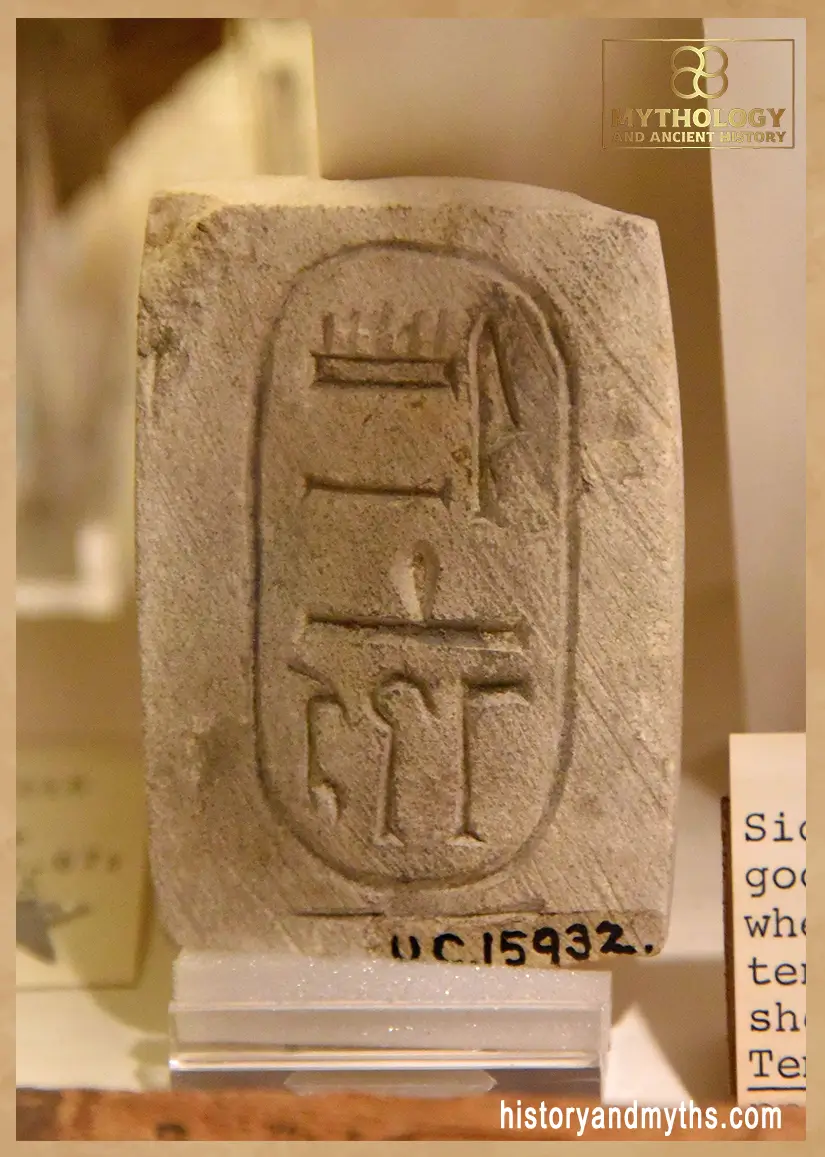
Image: Foundation tablet bearing the cartouche of Amenhotep II’s birth name and epithet (18th Dynasty, Petrie Museum, UCL) — cropped detail — Photo: Osama Shukir Muhammed Amin — Source: Wikimedia Commons (CC BY-SA 4.0)
| Naming Element | How It Worked in Daily Life | Why It Mattered | What It Signaled |
|---|---|---|---|
| Identity | A child becomes socially recognizable through repeated use of a name | Naming creates a stable personhood in community life | Belonging and legitimacy |
| Religion | Names can invoke gods or express devotion and trust | Divine association strengthens social meaning and protection | Sacred alignment |
| Family continuity | Names repeat ancestors, relatives, and household identities | Transmits memory even when wealth is limited | Lineage and social continuity |
| Protection | A name can function as a protective signal and invocation | Early childhood risk makes protection urgent | Safety and survival |
| Social transition | Naming moves the newborn into community recognition | Acts like a life-transition ritual even without one fixed script | Public personhood |
Did Ancient Egyptians Have a “Naming Ceremony”?
The surviving evidence does not support one universal, standardized naming ceremony practiced the same way in every period and household. What it does support is something more historically realistic: naming was a serious moment, often surrounded by customs, timing choices, and protective actions that varied by region, class, and family tradition. In practice, naming acted like a ceremony because it marked the child’s social entry into the world, even if it happened quietly inside the home rather than through an official public ritual.
That distinction matters for accuracy. Many societies have important life-transition moments that are not “formal ceremonies” with a fixed script. Ancient Egypt fits that pattern. The child’s name mattered enough to be remembered, recorded, and sometimes displayed, which implies that the act of naming was treated as consequential. The ceremony, in the strict sense, may not always be visible to us, but the transition is visible: a named child becomes part of the community’s social and religious order.
How Families Chose Names (Religion, Kinship, and Daily Hopes)
Most Egyptian names were not chosen randomly or purely for sound. They were selected to locate a child inside a web of meaning that was immediately understandable to the family and often to the wider community. Religion shaped this strongly. Theophoric names, built around the name of a god, could express gratitude, dependence, or devotion, and they framed the child’s life as protected or guided by a divine power from the beginning.
Kinship mattered just as much. Families could reflect lineage by repeating a relative’s name, echoing a household tradition, or preserving a respected identity across generations. In that sense, naming worked like inheritance: it transmitted social continuity even when material wealth was limited. For non-elite families, this continuity could be one of the most durable forms of legacy available.
Daily hopes also shaped naming. Many names express desired qualities rather than family history: health, strength, joy, stability, or divine favor. These names functioned as short statements about what the family wanted life to become. Instead of treating the name as a prediction, it is better to treat it as a public intention—an early shaping of identity through language that both family and community could recognize.
Protective Naming: When a Name Worked Like an Amulet
Ancient Egyptian life was full of risks, especially in early childhood. Naming could therefore carry a protective purpose beyond identity. A name might invoke a god not only as a statement of devotion, but as a practical appeal for protection, strength, and survival. In a world where illness, accident, and uncertainty were everyday realities, naming could be one of the first protective actions a family took for a new child.
This is also why naming could overlap with fear and avoidance. Some protective strategies in traditional societies involve reducing attention, deflecting envy, or masking vulnerability. Ancient Egypt’s sources do not give us a single rulebook for this, but the broader logic fits the environment: the name was a social and spiritual signal, and signals could be shaped to guard the child as much as to celebrate them. Even without a visible public rite, the protective function turns naming into a real life-transition act—part language, part defense, and part belonging.
- Guardianship and Minors in Ancient Egypt: Protecting Children by Law
- Mehet-Weret: The Egyptian Cow Goddess Who Births the Sun
- Childhood Discipline in Ancient Egypt | How Society Shaped Obedience
- Meskhenet — Egypt’s Goddess of Birth, Destiny, and the Ka
- Motherhood and Childhood in Ancient Egypt: Pregnancy, Birth, Care
- Childhood in Ancient Egypt: How Children Lived, Learned, and Worked
Who Announced the Name—and When It Became “Official”
In most households, the name would have been decided and used within the family before it ever appeared in a formal context. That first stage mattered because everyday speech is where identity becomes real. A child becomes recognizable through repeated use of a name, not through a document. But over time, what made a name “official” was administrative visibility: when the child’s identity entered spaces where records, duties, or social transactions mattered.
For ordinary people, that official visibility could arrive later, through work, taxation, service obligations, or household accounting. For elites, it could arrive earlier, because their children existed inside networks that produced writing as part of daily life. The main point is that the transition from private naming to official naming was not necessarily a single moment. It was a gradual shift from family recognition to social recognition, and then to institutional recognition—three layers that could overlap or arrive at different times depending on status.
Could Egyptians Change Their Names Later in Life?
Name changes were possible in ancient Egypt, but they were not a casual modern-style rebranding. A name was tied to identity, memory, and reputation, so changing it carried weight. The most common reason would have been a change in social role: advancement in status, new religious devotion, or a shift in how a person wanted to be publicly defined. In other cases, a name could change because a person became associated with a new household, patron, or institutional environment, where a different identity was more useful or more acceptable.
There is also a practical point. In a literate administrative culture, what mattered was not only what people called you at home, but what name survived in records. That meant a person could effectively “become” the name that appeared in official contexts, especially if work or status depended on it. So the answer is not simply yes or no. Egyptians could change names, but the change usually reflected a real shift in life circumstances, not a decorative preference.
Naming as a Life Transition: From Newborn to Social Person
The most accurate way to understand naming in ancient Egypt is to treat it as a threshold event rather than a single ceremony. A newborn was physically present, but naming turned that presence into a socially recognized person. It created a stable reference point for family bonds, responsibilities, protection, and memory. Even if the naming happened quietly, it still marked a clear transition: the child was no longer only “the baby,” but someone whose identity could be spoken, remembered, and defended.
This is why naming belongs in the same category as other life transitions Egyptians took seriously, even when the actions were domestic rather than institutional. It was a moment where private life and public meaning touched. The name carried the family’s hopes, their religious world, and their place in society, and it followed the person through every later stage—work, marriage, reputation, and death. In that sense, naming was not a decorative tradition. It was one of the earliest ways an Egyptian life became anchored in the human and sacred order.
- Naming created personhood in society, not just a label inside the household.
- There is limited evidence for one fixed naming ceremony, but naming still functioned as a major transition.
- Religion shaped many names, linking children to gods, devotion, and protective meaning.
- Family tradition made naming a tool of continuity and social memory.
- Names could change later, usually reflecting real shifts in role, status, or public identity.
FAQ
Did ancient Egyptians have naming ceremonies?
There is limited evidence for one universal ceremony, but naming clearly functioned as a meaningful life transition within family and community life.
Why were names important in ancient Egypt?
A name created identity, belonging, and memory, and it often carried protective and religious meaning from the start of life.
Were Egyptian children named after gods?
Many names invoked deities or expressed devotion, linking a child’s identity to sacred protection and family belief.
Could a person change their name later?
Yes, but usually for serious reasons like changes in status, role, or religious identity rather than casual preference.
Who chose a child’s name?
Most names were decided within the household, but the name became socially “official” as it entered wider community and administrative use.
Did naming act as protection for newborns?
In a high-risk world for early childhood, naming could function as a protective signal, invoking strength and divine support.
Were naming practices the same for everyone?
No. Practices likely differed by region, social class, and household tradition, even if the social meaning of naming was widely shared.
Sources & Rights
- Allen, James P. Middle Egyptian: An Introduction to the Language and Culture of Hieroglyphs. 3rd ed. Cambridge: Cambridge University Press, 2014.
- Assmann, Jan. Death and Salvation in Ancient Egypt. Ithaca, NY: Cornell University Press, 2005.
- Baines, John. “Egyptian Myth and Discourse: Myth, Gods, and the Early Written and Iconographic Record.” Journal of Near Eastern Studies 50, no. 2 (1991): 81–105.
- Fischer, Henry G. Ancient Egyptian Calligraphy: A Beginner’s Guide to Writing Hieroglyphs. New York: Metropolitan Museum of Art, 1988.
- Hornung, Erik. Idea into Image: Essays on Ancient Egyptian Thought. New York: Timken Publishers, 1992.
- Quirke, Stephen. Ancient Egyptian Religion. London: British Museum Press, 1992.
- Redford, Donald B. The Oxford Encyclopedia of Ancient Egypt. Oxford: Oxford University Press, 2001.
- Wilkinson, Richard H. The Complete Gods and Goddesses of Ancient Egypt. London: Thames & Hudson, 2003.
- Wente, Edward F. Letters from Ancient Egypt. Atlanta: Scholars Press, 1990.
- Teeter, Emily. Religion and Ritual in Ancient Egypt. Cambridge: Cambridge University Press, 2011.