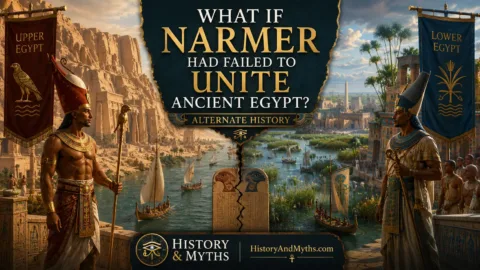
What If Narmer Had Failed to Unite Ancient Egypt? Alternate History
Ancient Egypt is often linked to the unification of Upper and Lower Egypt under Narmer around 3100 BCE. But that unification was probably the final stage of a longer political process, not the work of one ruler alone.
What if Narmer had failed to make that unity permanent?
Upper Egypt could remain a powerful southern kingdom, while Lower Egypt kept its own rulers and political centers. That would delay the rise of a single pharaoh ruling the “Two Lands” and could slow the development of the centralized state that later shaped the Old Kingdom.
Memphis might not become the same political center, royal ideology could evolve differently, and the age of the pyramids might begin later.
But Egypt would probably not remain divided forever.
The real question is how much Ancient Egypt would change if unification came later, under another ruler, and under different political conditions.
The Historical Turning Point
By the late Predynastic Period, political power in the Nile Valley was becoming concentrated in a smaller number of competing centers. Upper Egyptian rulers based around places such as Abydos and Hierakonpolis were expanding their influence northward, while the Delta remained politically important and more difficult to control.
Narmer appears at the end of this process. His famous palette shows him wearing both the White Crown of Upper Egypt and the Red Crown of Lower Egypt, which later tradition associated with the rule of the Two Lands.
The key point is that unification was probably not a single battle followed by instant national unity.
Our alternate history changes the moment when southern authority becomes permanent.
Narmer succeeds in Upper Egypt but fails to secure lasting control over the Delta. Lower Egypt remains politically separate, and the unified kingdom that later becomes dynastic Egypt does not fully emerge during his reign.
The Scenario Used in This Article
This is a hypothetical scenario, not a claim about what actually happened.
Narmer remains king of Upper Egypt but fails to establish durable control over Lower Egypt. The Delta keeps its own rulers and political centers, while the south remains dominated by the Upper Egyptian monarchy.
Egypt does not collapse, and neither region is isolated from the other. Trade, warfare, migration, and competition along the Nile continue.
The key change is political unity.
For several generations, there is no single ruler securely governing both lands, no stable kingdom stretching from the Delta into Upper Egypt, and no fully developed ideology of one pharaoh ruling the Two Lands.
The central question is therefore:
If Narmer failed to unite Ancient Egypt permanently, would another ruler eventually succeed, and how much would the delay change Egyptian civilization?
Was Narmer Really the Man Who United Egypt?
Probably not by himself.
Narmer is traditionally associated with the unification of Upper and Lower Egypt, especially because the Narmer Palette shows him wearing the crowns of both regions. But the political process had begun earlier, as powerful Upper Egyptian centers expanded their influence northward during the late Predynastic Period.
That means Narmer may have completed or formalized a process already underway rather than creating a unified state from nothing.
This matters for the alternate scenario.
If Narmer failed, the forces pushing Egypt toward political consolidation would still exist. Trade along the Nile, competition between regional rulers, and the advantages of controlling both the valley and the Delta would continue.
So his failure would probably delay unification rather than eliminate it completely.
Would Upper and Lower Egypt Become Rival Kingdoms?
Very likely, at least for a time.
Upper Egypt would probably remain dominated by the southern royal centers that had already become powerful before Narmer, while the Delta could preserve several competing rulers or gradually consolidate around its own northern kingdom.
The Nile would connect the two regions economically, but it would also make control of trade, taxation, and transport a constant source of tension.
That rivalry could produce repeated border conflicts, shifting alliances, and attempts by one side to dominate the other.
The two regions would not become completely separate civilizations. They already shared many cultural traditions, religious ideas, and economic connections.
The more realistic outcome is political division inside a broadly connected Egyptian world, with both north and south competing to become the state that eventually controls the whole Nile Valley.
Could Another Pharaoh Unite Egypt Later?
Probably yes.
Narmer’s failure would not remove the advantages of controlling the entire Nile Valley. A ruler who held both Upper Egypt and the Delta would gain access to more farmland, trade routes, labor, taxes, and military resources than either region could command alone.
That incentive would keep unification on the political agenda.
A later king from Upper Egypt might renew the northern campaign, or a powerful Delta ruler could attempt the opposite and expand southward. The eventual unifier might therefore come from a different dynasty and build the state under different political traditions.
The important change is timing.
If unification were delayed by several generations, regional rulers would have more time to strengthen their own institutions and identities. A later unified Egypt could emerge from negotiation, conquest, or dynastic alliance rather than from the process associated with Narmer.
Would Memphis Still Become the Center of Egypt?
Not necessarily.
Memphis became important because of its strategic position near the point where the Nile Valley opens into the Delta. For a ruler controlling both Upper and Lower Egypt, that location made it an ideal administrative and military center.
If Egypt remained divided, that advantage would be reduced.
Upper Egypt might continue to rely more heavily on southern centers such as Abydos or Hierakonpolis, while Lower Egypt developed its own northern political capital. Memphis could still grow as a trading or frontier city, but it might not become the central seat of a unified kingdom.
Its real rise would probably depend on reunification.
If a later ruler eventually brought both regions together, Memphis could still emerge as the logical center of government, but later and under a different dynasty.
How Would Egyptian Kingship Develop Without the Two Lands?
Egyptian kingship would probably become more regional before becoming fully national.
The later pharaoh was not just king of a territory. He was presented as ruler of Upper and Lower Egypt, the political and sacred unifier of the Two Lands. If that unity did not exist, northern and southern rulers would build legitimacy around their own regions instead.
Upper Egyptian kings might emphasize traditions linked to southern royal centers, while Delta rulers developed separate symbols, court rituals, and claims to authority.
Over time, both sides could still borrow from one another.
If reunification came later, the eventual ruler would need to do more than conquer territory. He would have to combine two established royal traditions into a single ideology.
That could make the symbolism of Egyptian kingship more complex and make unification itself an even more powerful part of royal identity.
Would Hieroglyphic Writing and Central Government Develop Differently?
Yes, but neither would disappear.
Early writing was already developing before Narmer, so Egypt would not suddenly lose hieroglyphs because political unification failed. What would change is how quickly writing became tied to a large centralized state.
A divided Egypt would need smaller administrative systems for taxation, storage, trade, and royal recordkeeping. Upper and Lower Egypt might even develop different bureaucratic habits before later rulers brought them together.
That could slow the standardization of titles, accounting practices, royal inscriptions, and state administration across the whole Nile Valley.
The effect would be gradual rather than dramatic.
Writing would continue to evolve, but the powerful bureaucracy associated with dynastic Egypt might emerge later, shaped by competition between regional governments rather than by one early unified monarchy.
What Happens to the First Dynasty?
It would probably not exist in the form historians recognize today.
The First Dynasty is built around rulers who governed an increasingly unified Egyptian state after Narmer. If Lower Egypt remained outside firm southern control, the succession that followed him would take place in a much smaller political world.
Hor-Aha and later rulers might still appear, but their authority could be limited mainly to Upper Egypt. At the same time, northern dynasties or rival royal houses could develop independently in the Delta.
That would make early Egyptian chronology far less straightforward.
Instead of one First Dynasty ruling a united kingdom, historians might later identify separate northern and southern dynastic traditions that eventually collided, merged, or were absorbed by a later unifier.
The dynastic age would still begin, but not with the same political structure or sequence of kings.
Would Lower Egypt Become More Connected to the Levant?
Probably yes.
The Nile Delta was already positioned closer to trade routes linking Egypt with the eastern Mediterranean and southern Levant. If Lower Egypt remained politically independent, its rulers would have stronger reasons to develop those connections on their own rather than through a unified Egyptian state.
That could mean more direct exchange in timber, oils, metals, pottery, and luxury goods, along with stronger diplomatic ties to communities in Canaan.
The effect would not make Lower Egypt culturally non-Egyptian. Its language, religion, and local traditions would still belong to the wider Egyptian world.
But sustained independence could give the Delta a more outward-looking political identity, while Upper Egypt remained focused more heavily on the Nile Valley and the south.
Would Upper Egypt Turn More Toward Nubia?
Very likely.
Upper Egypt was geographically closer to Nubia and already depended on southern routes for gold, stone, livestock, and other valuable resources. If the Delta remained politically separate, southern rulers would have even stronger reasons to secure those connections.
That could lead to earlier military pressure on Nubian communities, tighter control of river routes, and more direct exchange between Upper Egypt and the regions to its south.
The relationship would not be purely hostile. Trade and cultural contact would remain important, even when competition increased.
Over time, an independent Upper Egyptian kingdom might define its power more through control of the Nile corridor toward Nubia, while Lower Egypt looked more toward the Mediterranean and Levant.
That regional split could shape two different strategic priorities long before Egypt was eventually reunited.
Would the Old Kingdom Still Emerge?
Probably, but later and in a different form.
The Old Kingdom depended on a strong monarchy able to control land, taxation, labor, and resources across a large part of Egypt. If political unification were delayed, those institutions would take longer to reach the scale needed for such a centralized state.
A later unifier could still create a powerful kingdom, especially once northern and southern administrative systems were combined. But the dynasties, capitals, and pace of state expansion might differ sharply from the historical path.
The result might still resemble an Old Kingdom in broad terms: centralized kingship, major temple institutions, large royal building projects, and expanding control over resources.
What changes is the timetable.
Instead of emerging soon after early dynastic unification, Egypt’s first great centralized age could begin generations later under a completely different royal house.
Explore more alternate turning points in ancient Egyptian history:
Would the Pyramids Still Be Built?
Probably, but not on the same timetable.
The great pyramids required more than architectural knowledge. They depended on a centralized monarchy capable of organizing labor, collecting resources, controlling transport, and sustaining enormous royal projects over many years.
If Egypt remained divided for several generations, neither northern nor southern rulers might have access to the same scale of resources.
That could delay the transition from smaller royal tombs to monumental pyramid complexes.
Once Egypt was eventually unified, however, large royal monuments would still serve an obvious political purpose: displaying the power of the king and the unity of the state.
So pyramids might still emerge, but later, under different rulers, and perhaps in different forms.
The most likely change is not their disappearance, but a slower and less predictable path toward the Pyramid Age.
Could a Divided Egypt Be More Vulnerable to Foreign Powers?
Yes, especially if the division lasted for many generations.
A single Egyptian kingdom could concentrate troops, taxes, and resources across the Nile Valley. Two rival states would have to divide those advantages while also watching each other.
Lower Egypt could face greater pressure from the Levant and eastern Mediterranean, while Upper Egypt remained exposed to competition along the Nubian frontier. Foreign powers might exploit the rivalry by supporting one Egyptian ruler against another rather than attempting direct conquest.
That does not mean Egypt would be easily invaded.
The Nile Valley still offered strong geographic defenses, and both northern and southern kingdoms could become formidable states in their own right.
The greater risk would be political interference. A divided Egypt would give neighboring powers more opportunities to influence succession disputes, alliances, and regional conflicts before reunification occurred.
Would Egypt Eventually Reunify Anyway?
Most likely, yes.
The Nile encouraged political concentration because whoever controlled more of the river also controlled more farmland, transport, taxation, and trade. That gave every ambitious ruler a strong reason to push beyond regional borders.
If Narmer failed, unification might simply become a later contest between stronger northern and southern states.
The eventual outcome could come through conquest, dynastic marriage, or gradual absorption rather than one decisive campaign. What matters is that the pressure toward a single state would remain.
Permanent division is therefore less plausible than delayed unification.
The biggest change would be who achieved it, when it happened, and what kind of institutions the new kingdom inherited from the rival states that existed before it.
Did Ancient Egyptians Practice Human Sacrifice? New Evidence
What Would Probably Not Change
Egyptian civilization would continue to develop even without immediate political unity.
Agriculture along the Nile, regional trade, religious traditions, early writing, and competition between royal centers were already established before Narmer. Upper and Lower Egypt would still depend on the river and remain closely connected economically and culturally.
What would change most is the scale and timing of state power.
A divided Egypt would delay the rise of one centralized monarchy, but it would not erase the forces that had already been shaping Egyptian society for centuries.
Most Likely
The most likely outcome is a delayed unification rather than a permanently divided Egypt.
Upper and Lower Egypt would probably remain separate for several generations, developing stronger regional courts, administrative systems, and political identities. Competition along the Nile would continue until one side gained enough military and economic advantage to dominate the other.
A later unifier could still create a powerful Egyptian state, but it would inherit a different political landscape from the one associated with Narmer.
The main consequence would therefore be timing.
Dynastic unity, centralized government, Memphis, and the later Old Kingdom could all emerge later and under a different royal house.
Plausible but Uncertain
A longer period of division could produce two more distinct political traditions before reunification.
Lower Egypt might build stronger ties with the Levant, while Upper Egypt deepened its focus on Nubia and the southern Nile. Separate royal courts could also develop different administrative practices, religious emphases, and claims to legitimacy.
It is possible that these differences would make later unification harder and more violent.
Another possibility is the opposite: one region becomes clearly dominant and absorbs the other with relatively little resistance.
Both outcomes are plausible, but neither can be predicted with confidence because they depend on how long the division lasts and which regional rulers become powerful enough to challenge the balance.
Highly Unlikely
Narmer’s failure would be very unlikely to prevent Egyptian civilization from developing altogether.
Upper and Lower Egypt would not suddenly become isolated cultures, and writing, agriculture, trade, religion, and royal government would continue on both sides of the political divide.
It is also unlikely that Egypt would remain permanently split for thousands of years. Control of the Nile offered too many economic and strategic advantages for ambitious rulers to ignore.
The least plausible outcome is a complete disappearance of dynastic Egypt.
Narmer could fail to unify the country, but the broader forces pushing Egypt toward larger states would remain.
Final Verdict: Narmer’s Failure Might Delay Egypt More Than Prevent It
If Narmer failed to unite Ancient Egypt, the most likely result would be delay, not the disappearance of Egyptian civilization.
Upper and Lower Egypt could remain separate for several generations, allowing rival courts, regional identities, and different political priorities to develop more strongly. Memphis, centralized kingship, the First Dynasty, and even the Old Kingdom could emerge later and under different rulers.
But the Nile would still reward whoever controlled more territory, trade, farmland, and resources.
That makes eventual reunification highly likely.
Narmer’s failure could therefore change who built the Egyptian state and when it appeared, while leaving the deeper forces behind Egyptian unification largely intact.
Frequently Asked Questions
Did Narmer really unite Upper and Lower Egypt?
Narmer is traditionally associated with the unification of Egypt, but modern scholarship generally treats unification as a longer process that began before his reign. He may have completed or consolidated political control rather than creating a unified state in a single event.
What would happen if Narmer failed to unite Egypt?
Upper and Lower Egypt could remain politically separate for several generations, with rival rulers competing for control of the Nile. State institutions, royal ideology, and dynastic history would likely develop more slowly and along different regional paths.
Would Egypt remain divided forever?
Probably not. Control of the Nile offered major economic and strategic advantages, so ambitious rulers would still have strong reasons to unite the two regions. A later king could eventually achieve what Narmer failed to do.
Would the First Dynasty still exist?
Not in the same form. Narmer’s successors might rule only Upper Egypt, while separate royal houses developed in the Delta. Historians could later recognize parallel northern and southern dynasties before eventual reunification.
Would the pyramids still be built?
Most likely, but later. Monumental pyramid building depended on a powerful centralized monarchy able to mobilize labor and resources on a large scale. Delayed unification could postpone the rise of that kind of state.
Would Ancient Egypt still become a major civilization?
Very likely. Agriculture, trade, religion, early writing, and royal government were already developing before Narmer. His failure would change the political timetable, but it would not erase the foundations of Egyptian civilization.
Sources & Further Reading
This alternate-history analysis is based on archaeological evidence and modern scholarship on Narmer, the political unification of Egypt, state formation in the Nile Valley and Delta, and the development of Early Dynastic and Old Kingdom institutions.
Narmer and Early Dynastic Egypt
- UCL Digital Egypt, Narmer.
Provides archaeological attestations of Narmer, including the Narmer Palette, Abydos material, and evidence bearing his name from sites in southern Palestine. It also explains the uncertainty surrounding his position at the beginning of the First Dynasty and his possible identification with the later figure Menes.
UCL Digital Egypt
- UCL Digital Egypt, Kings of Archaic Egypt.
Provides the reconstructed royal sequence from Dynasty 0 through the First and Second Dynasties, useful for placing Narmer, Hor-Aha, and their successors within the uncertain chronology of early dynastic kingship.
UCL Digital Egypt
State Formation and the Unification of Egypt
- B. G. Trigger, B. J. Kemp, D. O’Connor and A. B. Lloyd, “The Rise of Egyptian Civilization.”
A major academic treatment of Egypt’s formative period. The chapter emphasizes that political unification was part of a longer continuum of social and cultural development already well advanced during the late Predynastic Period, rather than an isolated event at the beginning of Dynasty 1.
Cambridge University Press
- “The Emergence of the Egyptian State,” The Cambridge World Prehistory.
Examines the archaeological evidence for early Egyptian state formation and the changing interpretation of the Narmer Palette. It is especially important for understanding why Narmer should not automatically be treated as the sole creator of Egyptian political unity.
Cambridge University Press
- Frédéric Guyot, “The Nile Delta before the Pharaohs.”
A recent study of Lower Egypt before political unification. It highlights the Delta as a distinct cultural and economic region with its own development and connections to neighboring areas, helping support the article’s analysis of what an independent Lower Egypt might have looked like.
Cambridge University Press
Early Egypt, Writing, Trade, and the Old Kingdom
- The Metropolitan Museum of Art, The Art of Ancient Egypt: Historical Outline.
Summarizes the transition from Predynastic to Early Dynastic Egypt and describes political unity as the gradual result of cultural expansion and conflict rather than a single conquest. It also places the beginnings of hieroglyphic writing, Memphis, trade with Canaan, and contact with Nubia within this formative period.
The Metropolitan Museum of Art
- The Metropolitan Museum of Art, “Egypt in the Old Kingdom.”
Provides context for the highly centralized monarchy, royal ideology, administration, and pyramid complexes of the Old Kingdom. This material helps establish the historical baseline for considering how delayed unification might have changed the timing of centralized government and monumental building.
The Metropolitan Museum of Art
Evidence for Egypt’s political unification around the beginning of the First Dynasty is incomplete and remains open to interpretation. Narmer is strongly associated with this period, but modern scholarship generally treats state formation as a gradual process that began before his reign. The alternate outcomes explored in this article are reasoned historical possibilities based on that evidence, not claims about events that actually occurred.
Copyright & Use
Written by H. Moses
This article is original content published by History & Myths. Its alternate-history analysis, structure, and written interpretation may not be reproduced, republished, or redistributed in full without permission.
Short quotations may be used for reference or discussion when accompanied by clear attribution and a link to the original article on
HistoryAndMyths.com